SUBSCRIBE TO OUR FREE NEWSLETTER
Daily news & progressive opinion—funded by the people, not the corporations—delivered straight to your inbox.
5
#000000
#FFFFFF
To donate by check, phone, or other method, see our More Ways to Give page.
Daily news & progressive opinion—funded by the people, not the corporations—delivered straight to your inbox.
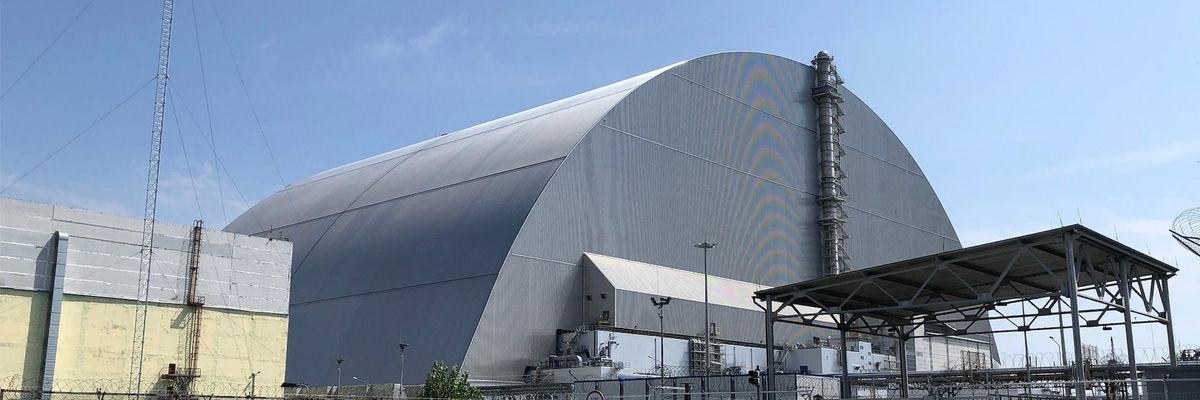
The New Safe Confinement arch over what was once Reactor Four at the Chernobyl nuclear power plant in Ukraine is the world's largest mobile steel structure. (Photo: Clay Gilliland/Flickr/cc)
Scientists monitoring the Chernobyl nuclear power plant in northern Ukraine are detecting increased fission reactions inside an inaccessible chamber built around the radioactive ruins of a reactor that suffered a catastrophic meltdown in 1986--and they aren't sure why.
"There are many uncertainties, but we can't rule out the possibility of [an] accident."
--Maxim Saveliev, ISPNPP
New Scientist reported this week that since 2016, researchers have detected a 40% surge in neutron emissions from a sealed room containing large amounts of corium, a highly radioactive and hardened lava-like material containing much of the uranium fuel from Reactor Four of the Vladimir Ilyich Lenin Nuclear Power Plant, the site of history's worst nuclear disaster.
Scientists say the increased emissions are indicative of a growing nuclear fission reaction, but they don't know whether the surge will burn itself out, as has previously occurred in other parts of the former plant, or if further intervention might be necessary.
"There are many uncertainties, but we can't rule out the possibility of [an] accident," Maxim Saveliev of Ukraine's Institute for Safety Problems of Nuclear Power Plants (ISPNPP) told Science earlier this month.
Saveliev said that neutron levels are rising slowly enough that scientists should have a few years left to determine how to best address a threat that Neil Hyatt, a nuclear chemist at the University of Sheffield in Britain, desribed as "like the embers in a barbecue pit."
Hyatt told Science that the threat cannot be ignored because the rainwater that collected inside the damaged reactor due to flaws in the sarcophagus hastily built to entomb it in the months immediately after the disaster is now receding following the construction of the New Safe Confinement (NSC). This massive steel arch, completed in 2019, is the world's largest mobile steel structure. It covers the damaged reactor and is designed to prevent further radioactive leaks.
However, water slows neutrons, and as NSC does its job and water levels inside the structure continue to fall, scientists fear that the fission reaction will accelerate "exponentially," according to Hyatt, causing "an uncontrolled release of nuclear energy."
Hyatt told New Scientist that the situation is "cause for concern but not alarm," adding that additional acceleration in neutron production could require further intervention.
ISPNPP says it believes the risk of a catastrophic containment failure in the near future is low, and that it is working on ways to diagnose and address the cause of the surging fissile emissions. One possible solution involves deploying a robot that can drill holes in the hardened radioactive material and then insert boron cylinders to absorb neutrons like control rods do in a normally functioning nuclear reactor.
The April 26, 1986 explosion at Reactor Four--the result of a flawed reactor design and inadequately trained personnel--caused widespread ecological devastation, considerable loss of life, and sand rendered a 1,000-square mile area around the town of Pripyat in what was then the Soviet Union unihabitable for all but a handful of human beings who returned to their homes despite the risk.
The massive containment and cleanup effort following the meltdown cost tens of billions of dollars and won't be completed until the latter half of this century.
This country and this world are at a monumental crossroads. US voters have an opportunity to beat back the forces of fascism and confront the billionaires who are rigging the economy, our media system, and our democracy, making it increasingly impossible for ordinary people to get by. We’re not just talking about the election. We’re talking about what must be done once these fascist elements are vanquished from power. We need a bolder set of solutions than what either major party has so far been willing to offer and a working-class movement ready to fight like hell for it. Trump didn't emerge from nowhere. The conditions that fueled MAGA authoritarianism were created by decades of radical neoliberal economic policies and a corrupt political system dominated by corporate interests. They slashed taxes on the super-rich, promising that the benefits would trickle down. They said giveaways to the corporate titans would make life more affordable for the rest of us. It was all bullshit. And when a bitter, betrayed populace searches for someone to blame, right-wing demagogues have little trouble finding scapegoats. People know when they're being lied to, but you won't hear any of this from the corporate media. Only independent journalism—powered and funded by people who believe in building a better world—can deliver truly trustworthy daily news. If you share our vision, please contribute whatever you can to sustain our work. |
Scientists monitoring the Chernobyl nuclear power plant in northern Ukraine are detecting increased fission reactions inside an inaccessible chamber built around the radioactive ruins of a reactor that suffered a catastrophic meltdown in 1986--and they aren't sure why.
"There are many uncertainties, but we can't rule out the possibility of [an] accident."
--Maxim Saveliev, ISPNPP
New Scientist reported this week that since 2016, researchers have detected a 40% surge in neutron emissions from a sealed room containing large amounts of corium, a highly radioactive and hardened lava-like material containing much of the uranium fuel from Reactor Four of the Vladimir Ilyich Lenin Nuclear Power Plant, the site of history's worst nuclear disaster.
Scientists say the increased emissions are indicative of a growing nuclear fission reaction, but they don't know whether the surge will burn itself out, as has previously occurred in other parts of the former plant, or if further intervention might be necessary.
"There are many uncertainties, but we can't rule out the possibility of [an] accident," Maxim Saveliev of Ukraine's Institute for Safety Problems of Nuclear Power Plants (ISPNPP) told Science earlier this month.
Saveliev said that neutron levels are rising slowly enough that scientists should have a few years left to determine how to best address a threat that Neil Hyatt, a nuclear chemist at the University of Sheffield in Britain, desribed as "like the embers in a barbecue pit."
Hyatt told Science that the threat cannot be ignored because the rainwater that collected inside the damaged reactor due to flaws in the sarcophagus hastily built to entomb it in the months immediately after the disaster is now receding following the construction of the New Safe Confinement (NSC). This massive steel arch, completed in 2019, is the world's largest mobile steel structure. It covers the damaged reactor and is designed to prevent further radioactive leaks.
However, water slows neutrons, and as NSC does its job and water levels inside the structure continue to fall, scientists fear that the fission reaction will accelerate "exponentially," according to Hyatt, causing "an uncontrolled release of nuclear energy."
Hyatt told New Scientist that the situation is "cause for concern but not alarm," adding that additional acceleration in neutron production could require further intervention.
ISPNPP says it believes the risk of a catastrophic containment failure in the near future is low, and that it is working on ways to diagnose and address the cause of the surging fissile emissions. One possible solution involves deploying a robot that can drill holes in the hardened radioactive material and then insert boron cylinders to absorb neutrons like control rods do in a normally functioning nuclear reactor.
The April 26, 1986 explosion at Reactor Four--the result of a flawed reactor design and inadequately trained personnel--caused widespread ecological devastation, considerable loss of life, and sand rendered a 1,000-square mile area around the town of Pripyat in what was then the Soviet Union unihabitable for all but a handful of human beings who returned to their homes despite the risk.
The massive containment and cleanup effort following the meltdown cost tens of billions of dollars and won't be completed until the latter half of this century.