SUBSCRIBE TO OUR FREE NEWSLETTER
Daily news & progressive opinion—funded by the people, not the corporations—delivered straight to your inbox.
5
#000000
#FFFFFF
To donate by check, phone, or other method, see our More Ways to Give page.
Daily news & progressive opinion—funded by the people, not the corporations—delivered straight to your inbox.
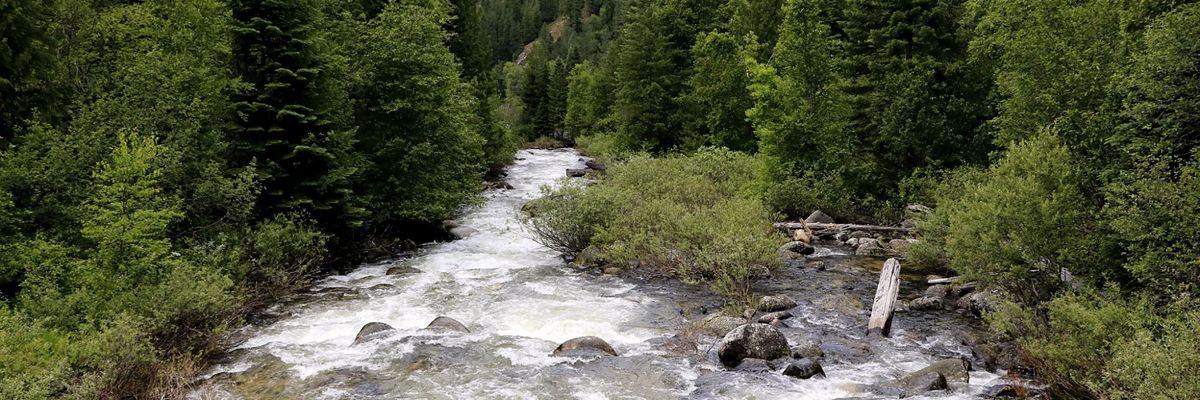
Pristine Boulder Creek flows from the Selway Bitterroot Wilderness toward the Lochsa River in the Clearwater National Forest of northern Idaho. (Photo: Don & Melinda Crawford/Education Images/Universal Images Group via Getty Images)
Climate and conservation advocacy groups joined business, Indigenous, and local political leaders on Thursday in welcoming a new federal report that details the Biden administration's vision for conserving at least 30% of U.S. lands and waters by 2030.
"We need to translate this vision into new and enduring conservation actions on the ground across our country."
--Randi Spivak, Center for Biological Diversity
"It's a big deal that the Biden administration recognizes we're in the midst of a wildlife extinction crisis and a climate emergency. This report is an important rallying cry," said Randi Spivak, public lands director at the Center for Biological Diversity. "There's no time to waste. We need to translate this vision into new and enduring conservation actions on the ground across our country."
In a statement about the administration's report on what supporters call the 30x30 goal, Natural Resources Defense Council president and chief counsel Mitch Bernard emphasized that "this is a critical opportunity for Americans to come together to build a new, more inclusive model of conservation to save nature, and ultimately ourselves."
That message was echoed by Defenders of Wildlife president and CEO Jamie Rappaport Clark, who directed the U.S. Fish and Wildlife Service from 1997 to 2001.
" Science tells us that we need to change course to save species--and ourselves--and that achieving the 30x30 goal is a key part of the solution," she said, citing estimates that about a million species are at risk due to escalating threats. "The recommendations from the administration recognize that we must engage all interested constituencies to create enduring solutions for climate and biodiversity."
Wendy Wendlandt, president of Environment America, said that "from Florida's manatees to my own California desert tortoises, habitat loss threatens iconic species and the ecosystems they depend on. And from orcas off the Washington coast to right whales in the Atlantic, our marine species are at risk. That's why Americans from coast to coast support conservation, and why we're looking forward to working with the administration to do what it takes to preserve our most amazing and important landscapes for centuries to come."
Interior Secretary Deb Haaland, Agriculture Secretary Tom Vilsack, Commerce Secretary Gina Raimondo, and Council on Environmental Quality Chair Brenda Mallory developed the report--entitled Conserving and Restoring America the Beautiful (pdf)--and submitted it to the National Climate Task Force.
In his January Executive Order on Tackling the Climate Crisis at Home and Abroad, President Joe Biden had directed the four officials and heads of other relevant agencies to work with state, local, tribal, and territorial governments, landowners, fishers, and other stakeholders to achieve the 30x30 goal.
"The ambition of this goal reflects the urgency of the challenges we face: the need to do more to safeguard the drinking water, clean air, food supplies, and wildlife upon which we all depend; the need to fight climate change with the natural solutions that our forests, agricultural lands, and the ocean provide," the quartet write in the report.
Their "central recommendation" is the pursuit of a nationwide, decadelong, locally led, and voluntary conservation push guided by eight core principles.
Specifically, the report calls for pursuing "a collaborative and inclusive approach," which includes supporting locally designed efforts and respecting tribal rights, to conserve land and waters "for the benefit of all people."
The report also calls for using science as a guide, building on existing tools and strategies, prioritizing job creation and healthy communities, and respecting voluntary stewardship efforts of landowners and fishers.
The six early priorities the report identifies, based on feedback from the Biden administration's first 100 days, are:
"Indigenous people of this continent have successfully managed complex societies and resource dependent economies for 10,000 years," said Natasha Hayden, an elected tribal representative and owner of a small fishing business in Alaska. "When our communities and businesses are provided a genuine role in policymaking, we can expect to see meaningful results that mirror this legacy for the good of all communities."
"The administration's new process is a major step in the right direction for my tribe, my business, and the perpetual health of the resources we have always depended on," Hayden added.
David Levine, president and co-founder of the American Sustainable Business Council, similarly welcomed the report as "an important step forward in protecting our environment, addressing the climate crisis, and helping communities and sustainable businesses thrive."
In a statement from the Mountain Pact, which mobilizes local elected officials in over 80 Western U.S. communities, Pitkin County, Colorado Commissioner Francie Jacober said: "I feel like I've been holding my breath for something like this since the 1970s. I'm so happy with what the Biden administration is doing. "
"Across the country, nature is in a state of collapse. We're facing a mass extinction of plants and animals which impacts how clean our air is, how pure our water is, and how plentiful our food supplies are," Jacober added. "Every 30 seconds, a football field worth of America's natural areas disappears to roads, houses, pipelines, and other development. That's why President Biden's plan is so critical."
Greenpeace USA senior oceans campaigner Arlo Hemphill also applauded the administration for its "climate-focused, justice-centered plan that honors Indigenous peoples and elevates science," saying that "this visionary report is a critical step that will help slow the loss of nature and ensure that the outdoor world is a more accessible place for all living in the United States."
However, Hemphill also called for going further, adding that "despite the virtues of this report as a historic effort for conservation at home, the U.S. still lacks leadership in advancing these principles on the international stage," and "a truly holistic 30x30 policy would include support for a strong new Global Ocean Treaty that would enable us to extend the work we are doing at home to protect wildlife and fisheries through a network of ocean sanctuaries across international waters."
Various federal lawmakers also expressed support for the administration's 30x30 goal, including Reps. Steny Hoyer (D-Md.), the House majority leader; Chellie Pingree (D-Maine), chair of the House Appropriations Committee; Kathy Castor (D-Fla.), chair of the House Select Committee on the Climate Crisis; and Bruce Westerman (R-Ark.), ranking member of the House Natural Resources Committee.
Meanwhile, other GOP lawmakers are waging what HuffPost reporter Chris D'Angelo called "a dumb disinformation campaign against Biden's climate agenda."
Dear Common Dreams reader, It’s been nearly 30 years since I co-founded Common Dreams with my late wife, Lina Newhouser. We had the radical notion that journalism should serve the public good, not corporate profits. It was clear to us from the outset what it would take to build such a project. No paid advertisements. No corporate sponsors. No millionaire publisher telling us what to think or do. Many people said we wouldn't last a year, but we proved those doubters wrong. Together with a tremendous team of journalists and dedicated staff, we built an independent media outlet free from the constraints of profits and corporate control. Our mission has always been simple: To inform. To inspire. To ignite change for the common good. Building Common Dreams was not easy. Our survival was never guaranteed. When you take on the most powerful forces—Wall Street greed, fossil fuel industry destruction, Big Tech lobbyists, and uber-rich oligarchs who have spent billions upon billions rigging the economy and democracy in their favor—the only bulwark you have is supporters who believe in your work. But here’s the urgent message from me today. It's never been this bad out there. And it's never been this hard to keep us going. At the very moment Common Dreams is most needed, the threats we face are intensifying. We need your support now more than ever. We don't accept corporate advertising and never will. We don't have a paywall because we don't think people should be blocked from critical news based on their ability to pay. Everything we do is funded by the donations of readers like you. When everyone does the little they can afford, we are strong. But if that support retreats or dries up, so do we. Will you donate now to make sure Common Dreams not only survives but thrives? —Craig Brown, Co-founder |
Climate and conservation advocacy groups joined business, Indigenous, and local political leaders on Thursday in welcoming a new federal report that details the Biden administration's vision for conserving at least 30% of U.S. lands and waters by 2030.
"We need to translate this vision into new and enduring conservation actions on the ground across our country."
--Randi Spivak, Center for Biological Diversity
"It's a big deal that the Biden administration recognizes we're in the midst of a wildlife extinction crisis and a climate emergency. This report is an important rallying cry," said Randi Spivak, public lands director at the Center for Biological Diversity. "There's no time to waste. We need to translate this vision into new and enduring conservation actions on the ground across our country."
In a statement about the administration's report on what supporters call the 30x30 goal, Natural Resources Defense Council president and chief counsel Mitch Bernard emphasized that "this is a critical opportunity for Americans to come together to build a new, more inclusive model of conservation to save nature, and ultimately ourselves."
That message was echoed by Defenders of Wildlife president and CEO Jamie Rappaport Clark, who directed the U.S. Fish and Wildlife Service from 1997 to 2001.
" Science tells us that we need to change course to save species--and ourselves--and that achieving the 30x30 goal is a key part of the solution," she said, citing estimates that about a million species are at risk due to escalating threats. "The recommendations from the administration recognize that we must engage all interested constituencies to create enduring solutions for climate and biodiversity."
Wendy Wendlandt, president of Environment America, said that "from Florida's manatees to my own California desert tortoises, habitat loss threatens iconic species and the ecosystems they depend on. And from orcas off the Washington coast to right whales in the Atlantic, our marine species are at risk. That's why Americans from coast to coast support conservation, and why we're looking forward to working with the administration to do what it takes to preserve our most amazing and important landscapes for centuries to come."
Interior Secretary Deb Haaland, Agriculture Secretary Tom Vilsack, Commerce Secretary Gina Raimondo, and Council on Environmental Quality Chair Brenda Mallory developed the report--entitled Conserving and Restoring America the Beautiful (pdf)--and submitted it to the National Climate Task Force.
In his January Executive Order on Tackling the Climate Crisis at Home and Abroad, President Joe Biden had directed the four officials and heads of other relevant agencies to work with state, local, tribal, and territorial governments, landowners, fishers, and other stakeholders to achieve the 30x30 goal.
"The ambition of this goal reflects the urgency of the challenges we face: the need to do more to safeguard the drinking water, clean air, food supplies, and wildlife upon which we all depend; the need to fight climate change with the natural solutions that our forests, agricultural lands, and the ocean provide," the quartet write in the report.
Their "central recommendation" is the pursuit of a nationwide, decadelong, locally led, and voluntary conservation push guided by eight core principles.
Specifically, the report calls for pursuing "a collaborative and inclusive approach," which includes supporting locally designed efforts and respecting tribal rights, to conserve land and waters "for the benefit of all people."
The report also calls for using science as a guide, building on existing tools and strategies, prioritizing job creation and healthy communities, and respecting voluntary stewardship efforts of landowners and fishers.
The six early priorities the report identifies, based on feedback from the Biden administration's first 100 days, are:
"Indigenous people of this continent have successfully managed complex societies and resource dependent economies for 10,000 years," said Natasha Hayden, an elected tribal representative and owner of a small fishing business in Alaska. "When our communities and businesses are provided a genuine role in policymaking, we can expect to see meaningful results that mirror this legacy for the good of all communities."
"The administration's new process is a major step in the right direction for my tribe, my business, and the perpetual health of the resources we have always depended on," Hayden added.
David Levine, president and co-founder of the American Sustainable Business Council, similarly welcomed the report as "an important step forward in protecting our environment, addressing the climate crisis, and helping communities and sustainable businesses thrive."
In a statement from the Mountain Pact, which mobilizes local elected officials in over 80 Western U.S. communities, Pitkin County, Colorado Commissioner Francie Jacober said: "I feel like I've been holding my breath for something like this since the 1970s. I'm so happy with what the Biden administration is doing. "
"Across the country, nature is in a state of collapse. We're facing a mass extinction of plants and animals which impacts how clean our air is, how pure our water is, and how plentiful our food supplies are," Jacober added. "Every 30 seconds, a football field worth of America's natural areas disappears to roads, houses, pipelines, and other development. That's why President Biden's plan is so critical."
Greenpeace USA senior oceans campaigner Arlo Hemphill also applauded the administration for its "climate-focused, justice-centered plan that honors Indigenous peoples and elevates science," saying that "this visionary report is a critical step that will help slow the loss of nature and ensure that the outdoor world is a more accessible place for all living in the United States."
However, Hemphill also called for going further, adding that "despite the virtues of this report as a historic effort for conservation at home, the U.S. still lacks leadership in advancing these principles on the international stage," and "a truly holistic 30x30 policy would include support for a strong new Global Ocean Treaty that would enable us to extend the work we are doing at home to protect wildlife and fisheries through a network of ocean sanctuaries across international waters."
Various federal lawmakers also expressed support for the administration's 30x30 goal, including Reps. Steny Hoyer (D-Md.), the House majority leader; Chellie Pingree (D-Maine), chair of the House Appropriations Committee; Kathy Castor (D-Fla.), chair of the House Select Committee on the Climate Crisis; and Bruce Westerman (R-Ark.), ranking member of the House Natural Resources Committee.
Meanwhile, other GOP lawmakers are waging what HuffPost reporter Chris D'Angelo called "a dumb disinformation campaign against Biden's climate agenda."
Climate and conservation advocacy groups joined business, Indigenous, and local political leaders on Thursday in welcoming a new federal report that details the Biden administration's vision for conserving at least 30% of U.S. lands and waters by 2030.
"We need to translate this vision into new and enduring conservation actions on the ground across our country."
--Randi Spivak, Center for Biological Diversity
"It's a big deal that the Biden administration recognizes we're in the midst of a wildlife extinction crisis and a climate emergency. This report is an important rallying cry," said Randi Spivak, public lands director at the Center for Biological Diversity. "There's no time to waste. We need to translate this vision into new and enduring conservation actions on the ground across our country."
In a statement about the administration's report on what supporters call the 30x30 goal, Natural Resources Defense Council president and chief counsel Mitch Bernard emphasized that "this is a critical opportunity for Americans to come together to build a new, more inclusive model of conservation to save nature, and ultimately ourselves."
That message was echoed by Defenders of Wildlife president and CEO Jamie Rappaport Clark, who directed the U.S. Fish and Wildlife Service from 1997 to 2001.
" Science tells us that we need to change course to save species--and ourselves--and that achieving the 30x30 goal is a key part of the solution," she said, citing estimates that about a million species are at risk due to escalating threats. "The recommendations from the administration recognize that we must engage all interested constituencies to create enduring solutions for climate and biodiversity."
Wendy Wendlandt, president of Environment America, said that "from Florida's manatees to my own California desert tortoises, habitat loss threatens iconic species and the ecosystems they depend on. And from orcas off the Washington coast to right whales in the Atlantic, our marine species are at risk. That's why Americans from coast to coast support conservation, and why we're looking forward to working with the administration to do what it takes to preserve our most amazing and important landscapes for centuries to come."
Interior Secretary Deb Haaland, Agriculture Secretary Tom Vilsack, Commerce Secretary Gina Raimondo, and Council on Environmental Quality Chair Brenda Mallory developed the report--entitled Conserving and Restoring America the Beautiful (pdf)--and submitted it to the National Climate Task Force.
In his January Executive Order on Tackling the Climate Crisis at Home and Abroad, President Joe Biden had directed the four officials and heads of other relevant agencies to work with state, local, tribal, and territorial governments, landowners, fishers, and other stakeholders to achieve the 30x30 goal.
"The ambition of this goal reflects the urgency of the challenges we face: the need to do more to safeguard the drinking water, clean air, food supplies, and wildlife upon which we all depend; the need to fight climate change with the natural solutions that our forests, agricultural lands, and the ocean provide," the quartet write in the report.
Their "central recommendation" is the pursuit of a nationwide, decadelong, locally led, and voluntary conservation push guided by eight core principles.
Specifically, the report calls for pursuing "a collaborative and inclusive approach," which includes supporting locally designed efforts and respecting tribal rights, to conserve land and waters "for the benefit of all people."
The report also calls for using science as a guide, building on existing tools and strategies, prioritizing job creation and healthy communities, and respecting voluntary stewardship efforts of landowners and fishers.
The six early priorities the report identifies, based on feedback from the Biden administration's first 100 days, are:
"Indigenous people of this continent have successfully managed complex societies and resource dependent economies for 10,000 years," said Natasha Hayden, an elected tribal representative and owner of a small fishing business in Alaska. "When our communities and businesses are provided a genuine role in policymaking, we can expect to see meaningful results that mirror this legacy for the good of all communities."
"The administration's new process is a major step in the right direction for my tribe, my business, and the perpetual health of the resources we have always depended on," Hayden added.
David Levine, president and co-founder of the American Sustainable Business Council, similarly welcomed the report as "an important step forward in protecting our environment, addressing the climate crisis, and helping communities and sustainable businesses thrive."
In a statement from the Mountain Pact, which mobilizes local elected officials in over 80 Western U.S. communities, Pitkin County, Colorado Commissioner Francie Jacober said: "I feel like I've been holding my breath for something like this since the 1970s. I'm so happy with what the Biden administration is doing. "
"Across the country, nature is in a state of collapse. We're facing a mass extinction of plants and animals which impacts how clean our air is, how pure our water is, and how plentiful our food supplies are," Jacober added. "Every 30 seconds, a football field worth of America's natural areas disappears to roads, houses, pipelines, and other development. That's why President Biden's plan is so critical."
Greenpeace USA senior oceans campaigner Arlo Hemphill also applauded the administration for its "climate-focused, justice-centered plan that honors Indigenous peoples and elevates science," saying that "this visionary report is a critical step that will help slow the loss of nature and ensure that the outdoor world is a more accessible place for all living in the United States."
However, Hemphill also called for going further, adding that "despite the virtues of this report as a historic effort for conservation at home, the U.S. still lacks leadership in advancing these principles on the international stage," and "a truly holistic 30x30 policy would include support for a strong new Global Ocean Treaty that would enable us to extend the work we are doing at home to protect wildlife and fisheries through a network of ocean sanctuaries across international waters."
Various federal lawmakers also expressed support for the administration's 30x30 goal, including Reps. Steny Hoyer (D-Md.), the House majority leader; Chellie Pingree (D-Maine), chair of the House Appropriations Committee; Kathy Castor (D-Fla.), chair of the House Select Committee on the Climate Crisis; and Bruce Westerman (R-Ark.), ranking member of the House Natural Resources Committee.
Meanwhile, other GOP lawmakers are waging what HuffPost reporter Chris D'Angelo called "a dumb disinformation campaign against Biden's climate agenda."