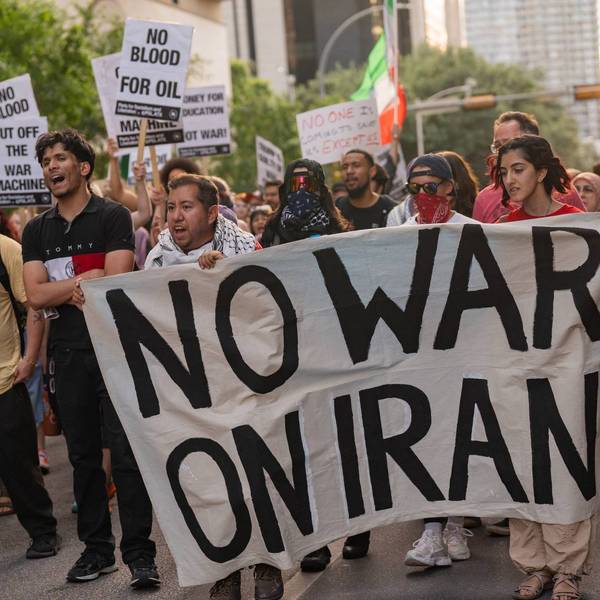


Peace activists gathered outside the Internal Revenue Service offices in Manhattan on April 15, 2021 to protest against spending federal tax dollars on the Pentagon and U.S. wars. (Photo: Erik McGregor/LightRocket via Getty Images)
Global Military Spending Grew to Nearly $2 Trillion in 2020 Despite Pandemic
At $778 billion, U.S. military expenditure—4.4% higher in 2020 than in 2019—accounted for 39% of the world total.
Despite the coronavirus pandemic, worldwide military spending rose to nearly $2 trillion in 2020, according to an analysis published Monday by the Stockholm International Peace Research Institute.
Global military expenditure in 2020--estimated to have reached $1.98 trillion--was 2.6% higher than in 2019 and 9.3% higher than in 2011, according to SIPRI's new report (pdf). A 2020 bump in military budgets was observed inAfrica (5.1%), Europe (4.0%), the Americas (3.9%), and Asia and Oceania (2.5%). The Middle East was the only regional exception, where there was a 6.5% decrease in military spending in the 11 countries for which data is available.
SIPRI researcher Diego Lopes da Silva told AFP that last year's growth in world military expenditure, which coincided with a 4.4% decline in global gross domestic product, was unexpected.
"Because of the pandemic, one would think military spending would decrease," he said. "But it's possible to conclude with some certainty that Covid-19 did not have a significant impact on global military spending, in 2020 at least."
Given that military spending continued to escalate during an economic downturn, SIPRI found that the "global military burden," or military expenditure as a share of GDP, grew from 2.2% to 2.4%--the largest annual increase since the 2009 financial crisis.
A substantial percentage of global military spending in 2020 was driven by a handful of countries. According to SIPRI's analysis of the data, 62% of the world's military expenditure was attributable to just five countries--the United States, China, India, Russia, and the United Kingdom.
When the military budgets of Saudi Arabia, Germany, France, Japan, and South Korea are added to the tally, these 10 countries accounted for $1.48 trillion, or 75%, of the world's total military expenditure last year.
With a military budget of $778 billion in 2020, the U.S. alone was responsible for 39% of the world's total military expenditure last year.
Although other top spenders all increased their military budgets last year--China (1.9%), India (2.1%), Russia (2.5%), and the U.K. (2.9%)--the U.S. continued to lead the surge in militarism, spending 4.4% more in 2020 than in 2019.
Alexandra Marksteiner, a researcher at SIPRI, said in a statement that three consecutive years of increased U.S. military spending "reflects growing concerns over perceived threats from strategic competitors such as China and Russia, as well as the Trump administration's drive to bolster what it saw as a depleted U.S. military."
The U.S. spends more on its military than the next 10 countries combined, according to the Institute for Policy Studies' National Priorities Project. In addition, military spending accounts for more than half of the federal discretionary budget, even as U.S. voters support reallocating a portion of the Pentagon budget to healthcare, education, housing, and renewable energy.
SIPRI noted in its report that while "military spending rose globally, some countries explicitly reallocated part of their planned military spending to pandemic response, such as Chile and South Korea," which is precisely what U.S. campaigners have been urging President Joe Biden and Congress to do.
Despite growing demands made by progressive lawmakers and activists to redirect funds from the Pentagon to impoverished communities nationwide to promote human and environmental flourishing, Biden earlier this month requested an even bigger military budget than the one approved last year.
While the White House has been provided with specific proposals for how to slash the Pentagon budget and actually improve national security, Lopes da Silva said the Biden administration "has not given any indications that it will reduce military spending."
As Carley Towne, co-director of the anti-war group CodePink and coordinator of the Defund the Pentagon campaign, stressed last month, "Cutting the Pentagon budget and reinvesting in the needs of our communities is not only morally necessary, it's also urgent if we're going to address the biggest threat that faces our planet: climate change."
"The Pentagon is the world's single largest consumer of oil and one of the world's top greenhouse gas emitters," Towne added. "If we're going to take the future of our planet seriously, we need to cut the Pentagon budget now."
We are at a crossroads
This country and this world are at a monumental crossroads. In a few short weeks, US voters will have an opportunity to beat back the forces of fascism and confront the billionaires who are rigging the economy, our media system, and our democracy, making it increasingly impossible for ordinary people to get by. We’re not just talking about the election. We’re talking about what must be done once these fascist elements are vanquished from power. We need a bolder set of solutions than what either major party has so far been willing to offer and a working-class movement ready to fight like hell for it. Trump didn't emerge from nowhere. The conditions that fueled MAGA authoritarianism were created by decades of radical neoliberal economic policies and a corrupt political system dominated by corporate interests. They slashed taxes on the super-rich, promising that the benefits would trickle down. They said giveaways to the corporate titans would make life more affordable for the rest of us. It was all bullshit. And when a bitter, betrayed populace searches for someone to blame, right-wing demagogues have little trouble finding scapegoats. People know when they're being lied to, but you won't hear any of this from the corporate media. Only independent journalism—powered and funded by people who believe in building a better world—can deliver truly trustworthy daily news. Our Fall Campaign is underway, and we need your help. To power our newsroom through the rest of the year, we need to raise $125,000 by midnight on October 31. So if you share our vision, please contribute whatever you can to sustain our work. |
Despite the coronavirus pandemic, worldwide military spending rose to nearly $2 trillion in 2020, according to an analysis published Monday by the Stockholm International Peace Research Institute.
Global military expenditure in 2020--estimated to have reached $1.98 trillion--was 2.6% higher than in 2019 and 9.3% higher than in 2011, according to SIPRI's new report (pdf). A 2020 bump in military budgets was observed inAfrica (5.1%), Europe (4.0%), the Americas (3.9%), and Asia and Oceania (2.5%). The Middle East was the only regional exception, where there was a 6.5% decrease in military spending in the 11 countries for which data is available.
SIPRI researcher Diego Lopes da Silva told AFP that last year's growth in world military expenditure, which coincided with a 4.4% decline in global gross domestic product, was unexpected.
"Because of the pandemic, one would think military spending would decrease," he said. "But it's possible to conclude with some certainty that Covid-19 did not have a significant impact on global military spending, in 2020 at least."
Given that military spending continued to escalate during an economic downturn, SIPRI found that the "global military burden," or military expenditure as a share of GDP, grew from 2.2% to 2.4%--the largest annual increase since the 2009 financial crisis.
A substantial percentage of global military spending in 2020 was driven by a handful of countries. According to SIPRI's analysis of the data, 62% of the world's military expenditure was attributable to just five countries--the United States, China, India, Russia, and the United Kingdom.
When the military budgets of Saudi Arabia, Germany, France, Japan, and South Korea are added to the tally, these 10 countries accounted for $1.48 trillion, or 75%, of the world's total military expenditure last year.
With a military budget of $778 billion in 2020, the U.S. alone was responsible for 39% of the world's total military expenditure last year.
Although other top spenders all increased their military budgets last year--China (1.9%), India (2.1%), Russia (2.5%), and the U.K. (2.9%)--the U.S. continued to lead the surge in militarism, spending 4.4% more in 2020 than in 2019.
Alexandra Marksteiner, a researcher at SIPRI, said in a statement that three consecutive years of increased U.S. military spending "reflects growing concerns over perceived threats from strategic competitors such as China and Russia, as well as the Trump administration's drive to bolster what it saw as a depleted U.S. military."
The U.S. spends more on its military than the next 10 countries combined, according to the Institute for Policy Studies' National Priorities Project. In addition, military spending accounts for more than half of the federal discretionary budget, even as U.S. voters support reallocating a portion of the Pentagon budget to healthcare, education, housing, and renewable energy.
SIPRI noted in its report that while "military spending rose globally, some countries explicitly reallocated part of their planned military spending to pandemic response, such as Chile and South Korea," which is precisely what U.S. campaigners have been urging President Joe Biden and Congress to do.
Despite growing demands made by progressive lawmakers and activists to redirect funds from the Pentagon to impoverished communities nationwide to promote human and environmental flourishing, Biden earlier this month requested an even bigger military budget than the one approved last year.
While the White House has been provided with specific proposals for how to slash the Pentagon budget and actually improve national security, Lopes da Silva said the Biden administration "has not given any indications that it will reduce military spending."
As Carley Towne, co-director of the anti-war group CodePink and coordinator of the Defund the Pentagon campaign, stressed last month, "Cutting the Pentagon budget and reinvesting in the needs of our communities is not only morally necessary, it's also urgent if we're going to address the biggest threat that faces our planet: climate change."
"The Pentagon is the world's single largest consumer of oil and one of the world's top greenhouse gas emitters," Towne added. "If we're going to take the future of our planet seriously, we need to cut the Pentagon budget now."
Despite the coronavirus pandemic, worldwide military spending rose to nearly $2 trillion in 2020, according to an analysis published Monday by the Stockholm International Peace Research Institute.
Global military expenditure in 2020--estimated to have reached $1.98 trillion--was 2.6% higher than in 2019 and 9.3% higher than in 2011, according to SIPRI's new report (pdf). A 2020 bump in military budgets was observed inAfrica (5.1%), Europe (4.0%), the Americas (3.9%), and Asia and Oceania (2.5%). The Middle East was the only regional exception, where there was a 6.5% decrease in military spending in the 11 countries for which data is available.
SIPRI researcher Diego Lopes da Silva told AFP that last year's growth in world military expenditure, which coincided with a 4.4% decline in global gross domestic product, was unexpected.
"Because of the pandemic, one would think military spending would decrease," he said. "But it's possible to conclude with some certainty that Covid-19 did not have a significant impact on global military spending, in 2020 at least."
Given that military spending continued to escalate during an economic downturn, SIPRI found that the "global military burden," or military expenditure as a share of GDP, grew from 2.2% to 2.4%--the largest annual increase since the 2009 financial crisis.
A substantial percentage of global military spending in 2020 was driven by a handful of countries. According to SIPRI's analysis of the data, 62% of the world's military expenditure was attributable to just five countries--the United States, China, India, Russia, and the United Kingdom.
When the military budgets of Saudi Arabia, Germany, France, Japan, and South Korea are added to the tally, these 10 countries accounted for $1.48 trillion, or 75%, of the world's total military expenditure last year.
With a military budget of $778 billion in 2020, the U.S. alone was responsible for 39% of the world's total military expenditure last year.
Although other top spenders all increased their military budgets last year--China (1.9%), India (2.1%), Russia (2.5%), and the U.K. (2.9%)--the U.S. continued to lead the surge in militarism, spending 4.4% more in 2020 than in 2019.
Alexandra Marksteiner, a researcher at SIPRI, said in a statement that three consecutive years of increased U.S. military spending "reflects growing concerns over perceived threats from strategic competitors such as China and Russia, as well as the Trump administration's drive to bolster what it saw as a depleted U.S. military."
The U.S. spends more on its military than the next 10 countries combined, according to the Institute for Policy Studies' National Priorities Project. In addition, military spending accounts for more than half of the federal discretionary budget, even as U.S. voters support reallocating a portion of the Pentagon budget to healthcare, education, housing, and renewable energy.
SIPRI noted in its report that while "military spending rose globally, some countries explicitly reallocated part of their planned military spending to pandemic response, such as Chile and South Korea," which is precisely what U.S. campaigners have been urging President Joe Biden and Congress to do.
Despite growing demands made by progressive lawmakers and activists to redirect funds from the Pentagon to impoverished communities nationwide to promote human and environmental flourishing, Biden earlier this month requested an even bigger military budget than the one approved last year.
While the White House has been provided with specific proposals for how to slash the Pentagon budget and actually improve national security, Lopes da Silva said the Biden administration "has not given any indications that it will reduce military spending."
As Carley Towne, co-director of the anti-war group CodePink and coordinator of the Defund the Pentagon campaign, stressed last month, "Cutting the Pentagon budget and reinvesting in the needs of our communities is not only morally necessary, it's also urgent if we're going to address the biggest threat that faces our planet: climate change."
"The Pentagon is the world's single largest consumer of oil and one of the world's top greenhouse gas emitters," Towne added. "If we're going to take the future of our planet seriously, we need to cut the Pentagon budget now."