SUBSCRIBE TO OUR FREE NEWSLETTER
Daily news & progressive opinion—funded by the people, not the corporations—delivered straight to your inbox.
5
#000000
#FFFFFF
To donate by check, phone, or other method, see our More Ways to Give page.
Daily news & progressive opinion—funded by the people, not the corporations—delivered straight to your inbox.
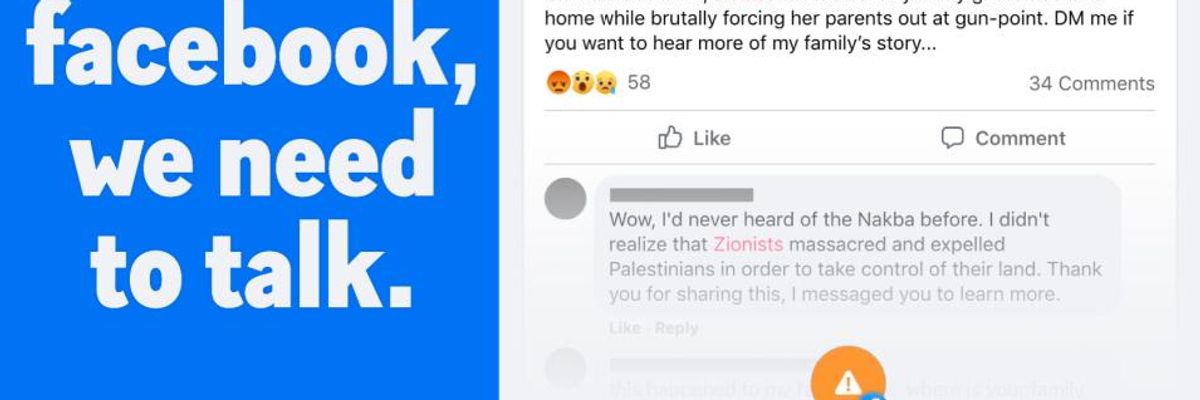
"Facebook must stop harming and silencing Palestinians living under apartheid and start cracking down on white supremacist groups--like the Proud Boys--that have used their platform as a recruitment site," said Lau Barrios of MPower Change. (Photo: Jewish Voice for Peace via Twitter)
Human rights activists from around the world launched a campaign this week to prevent Facebook from amending its hate speech policy to penalize use of the word "Zionist," a move the technology giant is reportedly considering but that critics say would shield Israel from accountability for violating the rights of Palestinians.
The "Facebook, We Need to Talk" campaign "began in response to an inquiry by Facebook to assess if critical conversations that use the term 'Zionist' fall within the rubric of hate speech as per Facebook's Community Standards," Jewish Voice for Peace (JVP) explained in a statement released Wednesday.
The campaign's petition urging Facebook not to crack down on use of the word "Zionist" garnered more than 14,500 signatures in its first 24 hours and surpassed 15,500 supporters on Wednesday afternoon. According to JVP, Facebook could make a decision as soon as the end of February.
JVP described Zionism as "a political ideology and movement that emerged in the 19th century and led to the founding of the state of Israel on Palestinian land," adding that "it has been deeply contested since its conception, including within the Jewish community."
In an open letter to Mark Zuckerberg and Sheryl Sandberg, Facebook's CEO and COO, respectively, two dozen organizations wrote that disallowing use of the word "Zionist," and therefore critiques of the Israeli government--recently described by prominent Israeli human rights group B'tselem as an apartheid regime--on the social media platform would "shut down conversations about accountability for policies and actions that harm Palestinians."
"We are deeply concerned about Facebook's proposed revision of its hate speech policy to consider 'Zionist' as a proxy for 'Jew' or 'Jewish,'" wrote the coalition, which includes American Muslims for Palestine, the BDS National Committee, and the Center for Constitutional Rights, among others.
"The proposed policy would too easily mischaracterize conversations about Zionists--and by extension, Zionism--as inherently anti-Semitic, would harm Facebook users, and would undermine efforts to dismantle real antisemitism and all forms of racism, extremism, and oppression," the letter continues.
The groups added that "this is the wrong solution to a real and important problem: those who fuel antisemitism online will continue doing so, with or without the word 'Zionist.' In fact, many anti-Semites, especially among white supremacists and evangelical Christian Zionists, explicitly support Zionism and Israel, while engaging in speech and actions that dehumanize, insult, and isolate Jewish people."
Stressing that criticism of Zionist ideology and policies is not anti-Semitic, opponents of Facebook's proposed hate speech policy revision say that banning use of the word "Zionist" would fail to tackle the problem of anti-Jewish discrimination while also suppressing legitimate criticisms of the Israeli government's oppression of Palestinians.
"This move by Facebook would represent them actively siding against Palestinians and those fighting in solidarity alongside them for Palestinian liberation," said Lau Barrios, campaign manager at MPower Change, a grassroots movement of U.S. Muslims working to build social justice. "It would also set a dangerous precedent around Big Tech's ability to further target our movements and harm marginalized communities."
"Facebook must stop harming and silencing Palestinians living under apartheid," Barrios added, "and start cracking down on white supremacist groups--like the Proud Boys--that have used their platform as a recruitment site."
The coalition added in its letter that "this move will prohibit Palestinians from sharing their daily experiences and histories with the world, be it a photo of the keys to their grandparent's house lost when attacked by Zionist militias in 1948, or a livestream of Zionist settlers attacking their olive trees in 2021."
Neve Gordon, Professor of International Law at Queen Mary University of London, explained last year that "right-wing Zionist organizations have recently begun pressuring Facebook to include criticism of Israel as part of its own definition of hate speech."
Writing in Al-Jazeera last September, Gordon noted the following:
In July, Orit Farkash-Hacohen, Israel's Minister of Strategic Affairs, published an op-ed in Newsweek urging social media companies to root out the anti-Semitic "virus" by fully adopting the International Holocaust Remembrance Alliance (IHRA) working definition of antisemitism.
A few weeks later, on August 7, 120 organizations representing the "who's who" of Zionist right-wing groups sent a letter to Facebook's Board of Directors, calling upon them to fully adopt the IHRA definition as the "cornerstone of Facebook's hate speech policy regarding antisemitism."
This definition, which has been endorsed or adopted in some official capacity by more than 30 countries, includes 11 examples of anti-Semitism, several of which involve criticism of Israel. This is just the latest concrete manifestation of how any critique of the Israeli government and its politics now assumes the taint of antisemitism.
"There is, to be sure, some irony here," Gordon continued. "Historically, the fight against antisemitism has sought to advance the equal rights and emancipation of Jews. Yet, in the IHRA definition those who speak out against the subjugation of Palestinians are called anti-Semites."
Gordon added that "if Facebook does eventually bow down and include the full IHRA definition in its algorithms, free speech on Israel/Palestine, which is already under immense pressure, will receive a lethal blow."
In its letter, the coalition noted that if Facebook penalizes use of the word "Zionist" under its hate speech policy, not only would pro-Palestinian perspectives be silenced, but Jewish social media users would be prevented from even "discussing their relationships to Zionist political ideology."
"We cannot dismantle antisemitism if we are blocked from voicing our opinions and sharing our experiences with each other," the groups concluded. "We can discuss, debate, and even disagree, as long as we share the belief that all of us deserve safety, freedom, and dignity. We ask Facebook to not erect barriers impeding users from connecting with each other as we engage in this work."
Dear Common Dreams reader, It’s been nearly 30 years since I co-founded Common Dreams with my late wife, Lina Newhouser. We had the radical notion that journalism should serve the public good, not corporate profits. It was clear to us from the outset what it would take to build such a project. No paid advertisements. No corporate sponsors. No millionaire publisher telling us what to think or do. Many people said we wouldn't last a year, but we proved those doubters wrong. Together with a tremendous team of journalists and dedicated staff, we built an independent media outlet free from the constraints of profits and corporate control. Our mission has always been simple: To inform. To inspire. To ignite change for the common good. Building Common Dreams was not easy. Our survival was never guaranteed. When you take on the most powerful forces—Wall Street greed, fossil fuel industry destruction, Big Tech lobbyists, and uber-rich oligarchs who have spent billions upon billions rigging the economy and democracy in their favor—the only bulwark you have is supporters who believe in your work. But here’s the urgent message from me today. It's never been this bad out there. And it's never been this hard to keep us going. At the very moment Common Dreams is most needed, the threats we face are intensifying. We need your support now more than ever. We don't accept corporate advertising and never will. We don't have a paywall because we don't think people should be blocked from critical news based on their ability to pay. Everything we do is funded by the donations of readers like you. When everyone does the little they can afford, we are strong. But if that support retreats or dries up, so do we. Will you donate now to make sure Common Dreams not only survives but thrives? —Craig Brown, Co-founder |
Human rights activists from around the world launched a campaign this week to prevent Facebook from amending its hate speech policy to penalize use of the word "Zionist," a move the technology giant is reportedly considering but that critics say would shield Israel from accountability for violating the rights of Palestinians.
The "Facebook, We Need to Talk" campaign "began in response to an inquiry by Facebook to assess if critical conversations that use the term 'Zionist' fall within the rubric of hate speech as per Facebook's Community Standards," Jewish Voice for Peace (JVP) explained in a statement released Wednesday.
The campaign's petition urging Facebook not to crack down on use of the word "Zionist" garnered more than 14,500 signatures in its first 24 hours and surpassed 15,500 supporters on Wednesday afternoon. According to JVP, Facebook could make a decision as soon as the end of February.
JVP described Zionism as "a political ideology and movement that emerged in the 19th century and led to the founding of the state of Israel on Palestinian land," adding that "it has been deeply contested since its conception, including within the Jewish community."
In an open letter to Mark Zuckerberg and Sheryl Sandberg, Facebook's CEO and COO, respectively, two dozen organizations wrote that disallowing use of the word "Zionist," and therefore critiques of the Israeli government--recently described by prominent Israeli human rights group B'tselem as an apartheid regime--on the social media platform would "shut down conversations about accountability for policies and actions that harm Palestinians."
"We are deeply concerned about Facebook's proposed revision of its hate speech policy to consider 'Zionist' as a proxy for 'Jew' or 'Jewish,'" wrote the coalition, which includes American Muslims for Palestine, the BDS National Committee, and the Center for Constitutional Rights, among others.
"The proposed policy would too easily mischaracterize conversations about Zionists--and by extension, Zionism--as inherently anti-Semitic, would harm Facebook users, and would undermine efforts to dismantle real antisemitism and all forms of racism, extremism, and oppression," the letter continues.
The groups added that "this is the wrong solution to a real and important problem: those who fuel antisemitism online will continue doing so, with or without the word 'Zionist.' In fact, many anti-Semites, especially among white supremacists and evangelical Christian Zionists, explicitly support Zionism and Israel, while engaging in speech and actions that dehumanize, insult, and isolate Jewish people."
Stressing that criticism of Zionist ideology and policies is not anti-Semitic, opponents of Facebook's proposed hate speech policy revision say that banning use of the word "Zionist" would fail to tackle the problem of anti-Jewish discrimination while also suppressing legitimate criticisms of the Israeli government's oppression of Palestinians.
"This move by Facebook would represent them actively siding against Palestinians and those fighting in solidarity alongside them for Palestinian liberation," said Lau Barrios, campaign manager at MPower Change, a grassroots movement of U.S. Muslims working to build social justice. "It would also set a dangerous precedent around Big Tech's ability to further target our movements and harm marginalized communities."
"Facebook must stop harming and silencing Palestinians living under apartheid," Barrios added, "and start cracking down on white supremacist groups--like the Proud Boys--that have used their platform as a recruitment site."
The coalition added in its letter that "this move will prohibit Palestinians from sharing their daily experiences and histories with the world, be it a photo of the keys to their grandparent's house lost when attacked by Zionist militias in 1948, or a livestream of Zionist settlers attacking their olive trees in 2021."
Neve Gordon, Professor of International Law at Queen Mary University of London, explained last year that "right-wing Zionist organizations have recently begun pressuring Facebook to include criticism of Israel as part of its own definition of hate speech."
Writing in Al-Jazeera last September, Gordon noted the following:
In July, Orit Farkash-Hacohen, Israel's Minister of Strategic Affairs, published an op-ed in Newsweek urging social media companies to root out the anti-Semitic "virus" by fully adopting the International Holocaust Remembrance Alliance (IHRA) working definition of antisemitism.
A few weeks later, on August 7, 120 organizations representing the "who's who" of Zionist right-wing groups sent a letter to Facebook's Board of Directors, calling upon them to fully adopt the IHRA definition as the "cornerstone of Facebook's hate speech policy regarding antisemitism."
This definition, which has been endorsed or adopted in some official capacity by more than 30 countries, includes 11 examples of anti-Semitism, several of which involve criticism of Israel. This is just the latest concrete manifestation of how any critique of the Israeli government and its politics now assumes the taint of antisemitism.
"There is, to be sure, some irony here," Gordon continued. "Historically, the fight against antisemitism has sought to advance the equal rights and emancipation of Jews. Yet, in the IHRA definition those who speak out against the subjugation of Palestinians are called anti-Semites."
Gordon added that "if Facebook does eventually bow down and include the full IHRA definition in its algorithms, free speech on Israel/Palestine, which is already under immense pressure, will receive a lethal blow."
In its letter, the coalition noted that if Facebook penalizes use of the word "Zionist" under its hate speech policy, not only would pro-Palestinian perspectives be silenced, but Jewish social media users would be prevented from even "discussing their relationships to Zionist political ideology."
"We cannot dismantle antisemitism if we are blocked from voicing our opinions and sharing our experiences with each other," the groups concluded. "We can discuss, debate, and even disagree, as long as we share the belief that all of us deserve safety, freedom, and dignity. We ask Facebook to not erect barriers impeding users from connecting with each other as we engage in this work."
Human rights activists from around the world launched a campaign this week to prevent Facebook from amending its hate speech policy to penalize use of the word "Zionist," a move the technology giant is reportedly considering but that critics say would shield Israel from accountability for violating the rights of Palestinians.
The "Facebook, We Need to Talk" campaign "began in response to an inquiry by Facebook to assess if critical conversations that use the term 'Zionist' fall within the rubric of hate speech as per Facebook's Community Standards," Jewish Voice for Peace (JVP) explained in a statement released Wednesday.
The campaign's petition urging Facebook not to crack down on use of the word "Zionist" garnered more than 14,500 signatures in its first 24 hours and surpassed 15,500 supporters on Wednesday afternoon. According to JVP, Facebook could make a decision as soon as the end of February.
JVP described Zionism as "a political ideology and movement that emerged in the 19th century and led to the founding of the state of Israel on Palestinian land," adding that "it has been deeply contested since its conception, including within the Jewish community."
In an open letter to Mark Zuckerberg and Sheryl Sandberg, Facebook's CEO and COO, respectively, two dozen organizations wrote that disallowing use of the word "Zionist," and therefore critiques of the Israeli government--recently described by prominent Israeli human rights group B'tselem as an apartheid regime--on the social media platform would "shut down conversations about accountability for policies and actions that harm Palestinians."
"We are deeply concerned about Facebook's proposed revision of its hate speech policy to consider 'Zionist' as a proxy for 'Jew' or 'Jewish,'" wrote the coalition, which includes American Muslims for Palestine, the BDS National Committee, and the Center for Constitutional Rights, among others.
"The proposed policy would too easily mischaracterize conversations about Zionists--and by extension, Zionism--as inherently anti-Semitic, would harm Facebook users, and would undermine efforts to dismantle real antisemitism and all forms of racism, extremism, and oppression," the letter continues.
The groups added that "this is the wrong solution to a real and important problem: those who fuel antisemitism online will continue doing so, with or without the word 'Zionist.' In fact, many anti-Semites, especially among white supremacists and evangelical Christian Zionists, explicitly support Zionism and Israel, while engaging in speech and actions that dehumanize, insult, and isolate Jewish people."
Stressing that criticism of Zionist ideology and policies is not anti-Semitic, opponents of Facebook's proposed hate speech policy revision say that banning use of the word "Zionist" would fail to tackle the problem of anti-Jewish discrimination while also suppressing legitimate criticisms of the Israeli government's oppression of Palestinians.
"This move by Facebook would represent them actively siding against Palestinians and those fighting in solidarity alongside them for Palestinian liberation," said Lau Barrios, campaign manager at MPower Change, a grassroots movement of U.S. Muslims working to build social justice. "It would also set a dangerous precedent around Big Tech's ability to further target our movements and harm marginalized communities."
"Facebook must stop harming and silencing Palestinians living under apartheid," Barrios added, "and start cracking down on white supremacist groups--like the Proud Boys--that have used their platform as a recruitment site."
The coalition added in its letter that "this move will prohibit Palestinians from sharing their daily experiences and histories with the world, be it a photo of the keys to their grandparent's house lost when attacked by Zionist militias in 1948, or a livestream of Zionist settlers attacking their olive trees in 2021."
Neve Gordon, Professor of International Law at Queen Mary University of London, explained last year that "right-wing Zionist organizations have recently begun pressuring Facebook to include criticism of Israel as part of its own definition of hate speech."
Writing in Al-Jazeera last September, Gordon noted the following:
In July, Orit Farkash-Hacohen, Israel's Minister of Strategic Affairs, published an op-ed in Newsweek urging social media companies to root out the anti-Semitic "virus" by fully adopting the International Holocaust Remembrance Alliance (IHRA) working definition of antisemitism.
A few weeks later, on August 7, 120 organizations representing the "who's who" of Zionist right-wing groups sent a letter to Facebook's Board of Directors, calling upon them to fully adopt the IHRA definition as the "cornerstone of Facebook's hate speech policy regarding antisemitism."
This definition, which has been endorsed or adopted in some official capacity by more than 30 countries, includes 11 examples of anti-Semitism, several of which involve criticism of Israel. This is just the latest concrete manifestation of how any critique of the Israeli government and its politics now assumes the taint of antisemitism.
"There is, to be sure, some irony here," Gordon continued. "Historically, the fight against antisemitism has sought to advance the equal rights and emancipation of Jews. Yet, in the IHRA definition those who speak out against the subjugation of Palestinians are called anti-Semites."
Gordon added that "if Facebook does eventually bow down and include the full IHRA definition in its algorithms, free speech on Israel/Palestine, which is already under immense pressure, will receive a lethal blow."
In its letter, the coalition noted that if Facebook penalizes use of the word "Zionist" under its hate speech policy, not only would pro-Palestinian perspectives be silenced, but Jewish social media users would be prevented from even "discussing their relationships to Zionist political ideology."
"We cannot dismantle antisemitism if we are blocked from voicing our opinions and sharing our experiences with each other," the groups concluded. "We can discuss, debate, and even disagree, as long as we share the belief that all of us deserve safety, freedom, and dignity. We ask Facebook to not erect barriers impeding users from connecting with each other as we engage in this work."