SUBSCRIBE TO OUR FREE NEWSLETTER
Daily news & progressive opinion—funded by the people, not the corporations—delivered straight to your inbox.
5
#000000
#FFFFFF
To donate by check, phone, or other method, see our More Ways to Give page.
Daily news & progressive opinion—funded by the people, not the corporations—delivered straight to your inbox.
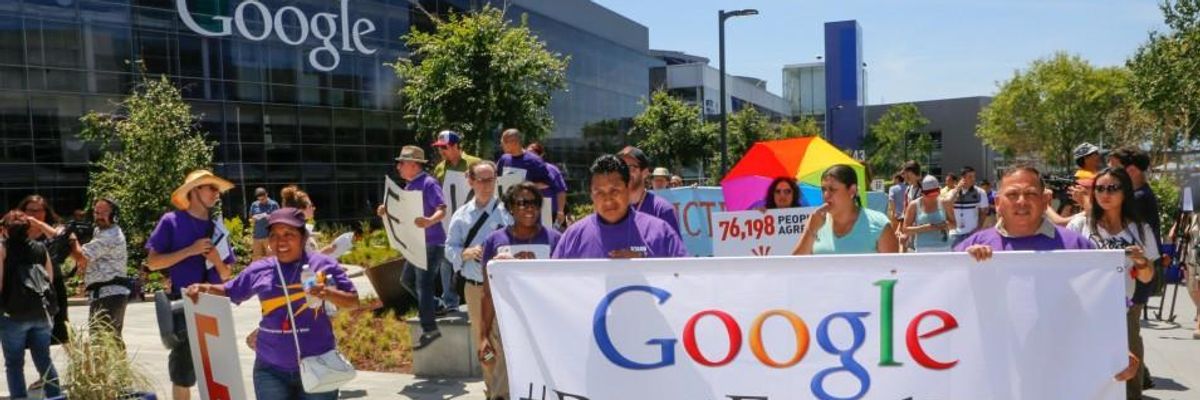
Activists held a rally during Google's annual shareholders meeting in Mountain View, California on May 14, 2014. (Photo: John Green/MediaNews Group/Bay Area News via Getty Images)
Decrying numerous policies and practices they say violate Google's "don't be evil" founding principle, more than 200 of the Silicon Valley tech giant's workers on Monday announced they are forming a union, a move that was applauded by progressive lawmakers and labor advocates nationwide.
The Alphabet Workers Union (AWU)--named after Google's parent corporation--says it "strives to protect Alphabet workers, our global society, and our world," and to "promote solidarity, democracy, and social and economic justice." It will operate as part of the Communications Workers of America and will be open to all 120,000 of the company's employees.
"We deserve a workplace that respects us, where we can work for a fair wage without fear of abuse or discrimination. We deserve meaningful control over the projects we work on and the direction of this company."
--Parul Koul and Chewy Shaw, AWU
"For far too long, thousands of us at Google and other subsidiaries of Alphabet... have had our workplace concerns dismissed by executives," Parul Koul and Chewy Shaw, respectively AWU's chair and vice chair, wrote in a New York Times op-ed on Monday.
"Our bosses have collaborated with repressive governments around the world," Koul and Shaw said. "They have developed artificial intelligence technology for use by the Department of Defense and profited from ads by a hate group. They have failed to make the changes necessary to meaningfully address our retention issues with people of color."
"Most recently, Timnit Gebru, a leading artificial intelligence researcher and one of the few Black women in her field, said she was fired over her work to fight bias," Koul and Shaw continued. "Her offense? Conducting research that was critical of large-scale AI models and being critical of existing diversity and inclusion efforts. In response, thousands of our colleagues organized, demanding an explanation."
"Both of us have heard from colleagues--some new, some with over a decade at the company--who have decided that working at Alphabet is no longer a choice they can make in good conscience," added Koul and Shaw.
They then listed some of the successful employee activism that has borne results in recent years, including ending participation in the Project Maven AI warfare project with the Pentagon; terminating the Dragonfly censored search engine in China; winning a $15 per hour minimum wage for some subcontracted workers; and an end to forced arbitration of sexual harassment and other claims.
Koul and Shaw stressed that Alphabet "has a responsibility to prioritize the public good. It has a responsibility to its thousands of workers and billions of users to make the world a better place."
"As Alphabet workers, we can help build that world," they wrote.
Unionization is the exception to the rule in Silicon Valley. And unlike traditional labor unions, AWU is a so-called minority union--it represents only a small percentage of the company's 260,000-strong global workforce--that will not negotiate contracts.
"Our goals go beyond the workplace questions of, 'Are people getting paid enough?' Our issues are going much broader," Shaw, an engineer in the San Francisco Bay Area, told the Times in a report about the new union. "It is a time where a union is an answer to these problems."
Veena Dubal, a law professor at the University of California Hastings College of the Law in San Francisco, called AWU a "powerful experiment."
"If it grows--which Google will do everything they can to prevent--it could have huge impacts not just for the workers, but for the broader issues that we are all thinking about in terms of tech power in society," Dubal told the Times.
Progressive lawmakers and labor advocates hailed Monday's announcement.
"The time is long overdue for the workers who built Big Tech to have a voice in their workplace," said Rep. Mark Pocan (D-Wis.), co-chair of the House Labor Caucus.
"The future of tech is stronger with the power of a union," tweeted AFL-CIO secretary-treasurer Liz Shuler. "We stand in solidarity with Alphabet workers who are courageously organizing for a better future at Google!"
Yasemin Zahra, chair of Labor Against Racism and War, asserted that by unionizing, "Google workers are not just standing up to management but also Lockheed-Martin and ICE [U.S. Immigration and Customs Enforcement] ties in the company. Silicon Valley giants are military-intel contractors. Incredible!"
Dear Common Dreams reader, It’s been nearly 30 years since I co-founded Common Dreams with my late wife, Lina Newhouser. We had the radical notion that journalism should serve the public good, not corporate profits. It was clear to us from the outset what it would take to build such a project. No paid advertisements. No corporate sponsors. No millionaire publisher telling us what to think or do. Many people said we wouldn't last a year, but we proved those doubters wrong. Together with a tremendous team of journalists and dedicated staff, we built an independent media outlet free from the constraints of profits and corporate control. Our mission has always been simple: To inform. To inspire. To ignite change for the common good. Building Common Dreams was not easy. Our survival was never guaranteed. When you take on the most powerful forces—Wall Street greed, fossil fuel industry destruction, Big Tech lobbyists, and uber-rich oligarchs who have spent billions upon billions rigging the economy and democracy in their favor—the only bulwark you have is supporters who believe in your work. But here’s the urgent message from me today. It's never been this bad out there. And it's never been this hard to keep us going. At the very moment Common Dreams is most needed, the threats we face are intensifying. We need your support now more than ever. We don't accept corporate advertising and never will. We don't have a paywall because we don't think people should be blocked from critical news based on their ability to pay. Everything we do is funded by the donations of readers like you. When everyone does the little they can afford, we are strong. But if that support retreats or dries up, so do we. Will you donate now to make sure Common Dreams not only survives but thrives? —Craig Brown, Co-founder |
Decrying numerous policies and practices they say violate Google's "don't be evil" founding principle, more than 200 of the Silicon Valley tech giant's workers on Monday announced they are forming a union, a move that was applauded by progressive lawmakers and labor advocates nationwide.
The Alphabet Workers Union (AWU)--named after Google's parent corporation--says it "strives to protect Alphabet workers, our global society, and our world," and to "promote solidarity, democracy, and social and economic justice." It will operate as part of the Communications Workers of America and will be open to all 120,000 of the company's employees.
"We deserve a workplace that respects us, where we can work for a fair wage without fear of abuse or discrimination. We deserve meaningful control over the projects we work on and the direction of this company."
--Parul Koul and Chewy Shaw, AWU
"For far too long, thousands of us at Google and other subsidiaries of Alphabet... have had our workplace concerns dismissed by executives," Parul Koul and Chewy Shaw, respectively AWU's chair and vice chair, wrote in a New York Times op-ed on Monday.
"Our bosses have collaborated with repressive governments around the world," Koul and Shaw said. "They have developed artificial intelligence technology for use by the Department of Defense and profited from ads by a hate group. They have failed to make the changes necessary to meaningfully address our retention issues with people of color."
"Most recently, Timnit Gebru, a leading artificial intelligence researcher and one of the few Black women in her field, said she was fired over her work to fight bias," Koul and Shaw continued. "Her offense? Conducting research that was critical of large-scale AI models and being critical of existing diversity and inclusion efforts. In response, thousands of our colleagues organized, demanding an explanation."
"Both of us have heard from colleagues--some new, some with over a decade at the company--who have decided that working at Alphabet is no longer a choice they can make in good conscience," added Koul and Shaw.
They then listed some of the successful employee activism that has borne results in recent years, including ending participation in the Project Maven AI warfare project with the Pentagon; terminating the Dragonfly censored search engine in China; winning a $15 per hour minimum wage for some subcontracted workers; and an end to forced arbitration of sexual harassment and other claims.
Koul and Shaw stressed that Alphabet "has a responsibility to prioritize the public good. It has a responsibility to its thousands of workers and billions of users to make the world a better place."
"As Alphabet workers, we can help build that world," they wrote.
Unionization is the exception to the rule in Silicon Valley. And unlike traditional labor unions, AWU is a so-called minority union--it represents only a small percentage of the company's 260,000-strong global workforce--that will not negotiate contracts.
"Our goals go beyond the workplace questions of, 'Are people getting paid enough?' Our issues are going much broader," Shaw, an engineer in the San Francisco Bay Area, told the Times in a report about the new union. "It is a time where a union is an answer to these problems."
Veena Dubal, a law professor at the University of California Hastings College of the Law in San Francisco, called AWU a "powerful experiment."
"If it grows--which Google will do everything they can to prevent--it could have huge impacts not just for the workers, but for the broader issues that we are all thinking about in terms of tech power in society," Dubal told the Times.
Progressive lawmakers and labor advocates hailed Monday's announcement.
"The time is long overdue for the workers who built Big Tech to have a voice in their workplace," said Rep. Mark Pocan (D-Wis.), co-chair of the House Labor Caucus.
"The future of tech is stronger with the power of a union," tweeted AFL-CIO secretary-treasurer Liz Shuler. "We stand in solidarity with Alphabet workers who are courageously organizing for a better future at Google!"
Yasemin Zahra, chair of Labor Against Racism and War, asserted that by unionizing, "Google workers are not just standing up to management but also Lockheed-Martin and ICE [U.S. Immigration and Customs Enforcement] ties in the company. Silicon Valley giants are military-intel contractors. Incredible!"
Decrying numerous policies and practices they say violate Google's "don't be evil" founding principle, more than 200 of the Silicon Valley tech giant's workers on Monday announced they are forming a union, a move that was applauded by progressive lawmakers and labor advocates nationwide.
The Alphabet Workers Union (AWU)--named after Google's parent corporation--says it "strives to protect Alphabet workers, our global society, and our world," and to "promote solidarity, democracy, and social and economic justice." It will operate as part of the Communications Workers of America and will be open to all 120,000 of the company's employees.
"We deserve a workplace that respects us, where we can work for a fair wage without fear of abuse or discrimination. We deserve meaningful control over the projects we work on and the direction of this company."
--Parul Koul and Chewy Shaw, AWU
"For far too long, thousands of us at Google and other subsidiaries of Alphabet... have had our workplace concerns dismissed by executives," Parul Koul and Chewy Shaw, respectively AWU's chair and vice chair, wrote in a New York Times op-ed on Monday.
"Our bosses have collaborated with repressive governments around the world," Koul and Shaw said. "They have developed artificial intelligence technology for use by the Department of Defense and profited from ads by a hate group. They have failed to make the changes necessary to meaningfully address our retention issues with people of color."
"Most recently, Timnit Gebru, a leading artificial intelligence researcher and one of the few Black women in her field, said she was fired over her work to fight bias," Koul and Shaw continued. "Her offense? Conducting research that was critical of large-scale AI models and being critical of existing diversity and inclusion efforts. In response, thousands of our colleagues organized, demanding an explanation."
"Both of us have heard from colleagues--some new, some with over a decade at the company--who have decided that working at Alphabet is no longer a choice they can make in good conscience," added Koul and Shaw.
They then listed some of the successful employee activism that has borne results in recent years, including ending participation in the Project Maven AI warfare project with the Pentagon; terminating the Dragonfly censored search engine in China; winning a $15 per hour minimum wage for some subcontracted workers; and an end to forced arbitration of sexual harassment and other claims.
Koul and Shaw stressed that Alphabet "has a responsibility to prioritize the public good. It has a responsibility to its thousands of workers and billions of users to make the world a better place."
"As Alphabet workers, we can help build that world," they wrote.
Unionization is the exception to the rule in Silicon Valley. And unlike traditional labor unions, AWU is a so-called minority union--it represents only a small percentage of the company's 260,000-strong global workforce--that will not negotiate contracts.
"Our goals go beyond the workplace questions of, 'Are people getting paid enough?' Our issues are going much broader," Shaw, an engineer in the San Francisco Bay Area, told the Times in a report about the new union. "It is a time where a union is an answer to these problems."
Veena Dubal, a law professor at the University of California Hastings College of the Law in San Francisco, called AWU a "powerful experiment."
"If it grows--which Google will do everything they can to prevent--it could have huge impacts not just for the workers, but for the broader issues that we are all thinking about in terms of tech power in society," Dubal told the Times.
Progressive lawmakers and labor advocates hailed Monday's announcement.
"The time is long overdue for the workers who built Big Tech to have a voice in their workplace," said Rep. Mark Pocan (D-Wis.), co-chair of the House Labor Caucus.
"The future of tech is stronger with the power of a union," tweeted AFL-CIO secretary-treasurer Liz Shuler. "We stand in solidarity with Alphabet workers who are courageously organizing for a better future at Google!"
Yasemin Zahra, chair of Labor Against Racism and War, asserted that by unionizing, "Google workers are not just standing up to management but also Lockheed-Martin and ICE [U.S. Immigration and Customs Enforcement] ties in the company. Silicon Valley giants are military-intel contractors. Incredible!"