SUBSCRIBE TO OUR FREE NEWSLETTER
Daily news & progressive opinion—funded by the people, not the corporations—delivered straight to your inbox.
5
#000000
#FFFFFF
To donate by check, phone, or other method, see our More Ways to Give page.


Daily news & progressive opinion—funded by the people, not the corporations—delivered straight to your inbox.

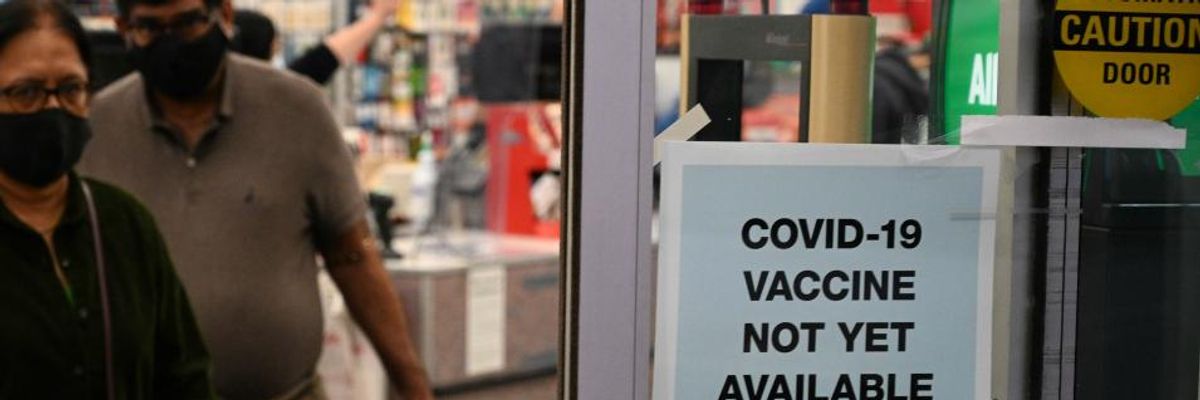
A sign on the entrance to a pharmacy reads "Covid-19 Vaccine Not Yet Available", November 23, 2020 in Burbank, California. (Photo: Robyn Beck/AFP via Getty Images)
With President Donald Trump expected to sign an executive order Tuesday purportedly aiming to prioritize coronavirus vaccine access for Americans over the people of other nations, consumer advocates denounced the president's move as a "false choice" that would do nothing to tackle the corporate monopolies responsible for inadequate global doses.
"Instead of pitting people against each other, the president should be advocating global access to Covid-19 vaccines," Peter Maybarduk, director of Public Citizen's Access to Medicines program, said in a statement late Monday. "The U.S. government can expand the supply of vaccines everywhere by scaling-up manufacturing, sharing technology with the World Health Organization, and teaching the world to make safe and effective vaccines."
"The U.S. government can expand the supply of vaccines everywhere by scaling-up manufacturing, sharing technology with the World Health Organization, and teaching the world to make safe and effective vaccines."
--Peter Maybarduk, Public Citizen
"That would help shorten the pandemic, save lives, and restore jobs," Maybarduk added. "All that's missing is effective U.S. global leadership."
The president is expected to sign his new order during a self-congratulatory vaccine summit at the White House later Tuesday, hours after a New York Times report revealed that the Trump administration passed on an opportunity to add to its 100 million-dose supply of Pfizer and BioNTech's coronavirus vaccine.
In an analysis released Tuesday morning, the Food and Drug Administration said the companies' vaccine is safe and effective. The United Kingdom began administering the Pfizer-BioNTech vaccine on Tuesday.
While many Americans understandably reacted with outrage to the Times report, analysts have noted that the current scarcity in vaccine supply is an entirely preventable consequence of pharmaceutical giants' monopoly control over products developed with the help of public funds--control that can be revoked by governments.
But the U.S., Canada, the U.K., and other powerful nations are actively blocking an effort at the World Trade Organization (WTO) to do just that.
In a Times op-ed on Monday, public health activist Achal Prabhala and economists Arjun Jayadev and Dean Baker noted that "the proposal, put forward by India and South Africa in October, calls on the WTO to exempt member countries from enforcing some patents, trade secrets, or pharmaceutical monopolies under the organization's agreement on trade-related intellectual property rights, known as TRIPs."
"By our count, nearly 100 countries favor the proposal, and yet because almost all decisions at the WTO are made by consensus, a small number of countries can thwart the will of the majority, even a super majority," wrote Prabhala, Jayadev, and Baker.
"Mounting pressure from poor countries at the WTO should give the governments of rich countries leverage to negotiate with their pharmaceutical companies for cheaper drugs and vaccines worldwide," the trio added. "Leaning on those companies is the right thing to do in the face of a global pandemic; it is also the best way for the governments of rich countries to take care of their own populations, which in some cases experience more severe drug shortages than do people in far less affluent places."
In a video released Tuesday by advocacy organization Global Justice Now, political leaders from around the world demanded that WTO member nations support the India-South Africa proposal to temporarily suspend intellectual property rights preventing mass distribution of a coronavirus vaccine.
"The Covid-19 vaccines shouldn't be made into another money-making scheme," says Sen. Risa Hontiveros of the Phillipines. "In a global pandemic of unprecedented proportions, it is inhumane and unjust to let stringent IP regulations stand in the way of a vaccine that can save lives."
Watch:
Despite the massive potential benefits to the United States and the rest of the world, there is no indication that Trump intends to abandon its so-called "America First" approach--even after Pfizer reportedly informed the administration that the company won't be able to provide the U.S. with additional doses of the vaccine until late June or July because other nations have bought much of its supply.
In a statement on Tuesday, the international medical humanitarian organization Doctors Without Borders/Medecins Sans Frontieres (MSF) said recent vaccine breakthroughs only serve to highlight the need for "a global approach" that ensures all people of the world--not just a select few--benefit.
"Right now, we're in a situation where the lion's share of the limited number of first doses have already been bought by a handful of countries like the U.S. and U.K., as well as the E.U., leaving very little for other countries in the short term," said Dr. Sidney Wong, executive co-director of MSF's Access Campaign. "What we really want to see is a rapid expansion of the overall global supply so there are more vaccines to go around and doses can be allocated according to WHO's public health criteria, not a country's ability to pay more than others."
It is unclear whether Trump's coming executive order would do anything to address the U.S. supply issue. As the Washington Post reported, the order "would prioritize vaccinating Americans before providing doses to other countries," but a specific enforcement mechanism has not been specified.
Asked about the president's executive action in an appearance Tuesday on ABC's "Good Morning America," Moncef Slaoui, the top scientist of the White House's Operation Warp Speed Initiative, said he doesn't "know exactly what this order is about."
"Frankly, I don't know, and frankly, I'm staying out of this. I can't comment. I literally don't know," said Slaoui. "Our work is, you know, rolling. We have plans. We feel that we can deliver the vaccines as needed. So I don't know exactly what this order is about."
With the Trump administration refusing to use its authority to ensure sufficient production and availability of the coronavirus vaccine as cases, hospitalizations, and deaths surge nationwide, incoming President-elect Joe Biden is facing calls to remedy his predecessor's failure.
"We urge the Biden-Harris Administration to end drug corporations' monopoly control to overcharge us for prescription drugs, which has led to the cost of medicines in the U.S. being the highest in the world, and has created false scarcity in the market for vaccines and other necessary Covid treatments," Margarida Jorge, campaign director for advocacy coalition Lower Drug Prices Now, said in a statement Monday.

Dear Common Dreams reader, It’s been nearly 30 years since I co-founded Common Dreams with my late wife, Lina Newhouser. We had the radical notion that journalism should serve the public good, not corporate profits. It was clear to us from the outset what it would take to build such a project. No paid advertisements. No corporate sponsors. No millionaire publisher telling us what to think or do. Many people said we wouldn't last a year, but we proved those doubters wrong. Together with a tremendous team of journalists and dedicated staff, we built an independent media outlet free from the constraints of profits and corporate control. Our mission has always been simple: To inform. To inspire. To ignite change for the common good. Building Common Dreams was not easy. Our survival was never guaranteed. When you take on the most powerful forces—Wall Street greed, fossil fuel industry destruction, Big Tech lobbyists, and uber-rich oligarchs who have spent billions upon billions rigging the economy and democracy in their favor—the only bulwark you have is supporters who believe in your work. But here’s the urgent message from me today. It's never been this bad out there. And it's never been this hard to keep us going. At the very moment Common Dreams is most needed, the threats we face are intensifying. We need your support now more than ever. We don't accept corporate advertising and never will. We don't have a paywall because we don't think people should be blocked from critical news based on their ability to pay. Everything we do is funded by the donations of readers like you. When everyone does the little they can afford, we are strong. But if that support retreats or dries up, so do we. Will you donate now to make sure Common Dreams not only survives but thrives? —Craig Brown, Co-founder |
With President Donald Trump expected to sign an executive order Tuesday purportedly aiming to prioritize coronavirus vaccine access for Americans over the people of other nations, consumer advocates denounced the president's move as a "false choice" that would do nothing to tackle the corporate monopolies responsible for inadequate global doses.
"Instead of pitting people against each other, the president should be advocating global access to Covid-19 vaccines," Peter Maybarduk, director of Public Citizen's Access to Medicines program, said in a statement late Monday. "The U.S. government can expand the supply of vaccines everywhere by scaling-up manufacturing, sharing technology with the World Health Organization, and teaching the world to make safe and effective vaccines."
"The U.S. government can expand the supply of vaccines everywhere by scaling-up manufacturing, sharing technology with the World Health Organization, and teaching the world to make safe and effective vaccines."
--Peter Maybarduk, Public Citizen
"That would help shorten the pandemic, save lives, and restore jobs," Maybarduk added. "All that's missing is effective U.S. global leadership."
The president is expected to sign his new order during a self-congratulatory vaccine summit at the White House later Tuesday, hours after a New York Times report revealed that the Trump administration passed on an opportunity to add to its 100 million-dose supply of Pfizer and BioNTech's coronavirus vaccine.
In an analysis released Tuesday morning, the Food and Drug Administration said the companies' vaccine is safe and effective. The United Kingdom began administering the Pfizer-BioNTech vaccine on Tuesday.
While many Americans understandably reacted with outrage to the Times report, analysts have noted that the current scarcity in vaccine supply is an entirely preventable consequence of pharmaceutical giants' monopoly control over products developed with the help of public funds--control that can be revoked by governments.
But the U.S., Canada, the U.K., and other powerful nations are actively blocking an effort at the World Trade Organization (WTO) to do just that.
In a Times op-ed on Monday, public health activist Achal Prabhala and economists Arjun Jayadev and Dean Baker noted that "the proposal, put forward by India and South Africa in October, calls on the WTO to exempt member countries from enforcing some patents, trade secrets, or pharmaceutical monopolies under the organization's agreement on trade-related intellectual property rights, known as TRIPs."
"By our count, nearly 100 countries favor the proposal, and yet because almost all decisions at the WTO are made by consensus, a small number of countries can thwart the will of the majority, even a super majority," wrote Prabhala, Jayadev, and Baker.
"Mounting pressure from poor countries at the WTO should give the governments of rich countries leverage to negotiate with their pharmaceutical companies for cheaper drugs and vaccines worldwide," the trio added. "Leaning on those companies is the right thing to do in the face of a global pandemic; it is also the best way for the governments of rich countries to take care of their own populations, which in some cases experience more severe drug shortages than do people in far less affluent places."
In a video released Tuesday by advocacy organization Global Justice Now, political leaders from around the world demanded that WTO member nations support the India-South Africa proposal to temporarily suspend intellectual property rights preventing mass distribution of a coronavirus vaccine.
"The Covid-19 vaccines shouldn't be made into another money-making scheme," says Sen. Risa Hontiveros of the Phillipines. "In a global pandemic of unprecedented proportions, it is inhumane and unjust to let stringent IP regulations stand in the way of a vaccine that can save lives."
Watch:
Despite the massive potential benefits to the United States and the rest of the world, there is no indication that Trump intends to abandon its so-called "America First" approach--even after Pfizer reportedly informed the administration that the company won't be able to provide the U.S. with additional doses of the vaccine until late June or July because other nations have bought much of its supply.
In a statement on Tuesday, the international medical humanitarian organization Doctors Without Borders/Medecins Sans Frontieres (MSF) said recent vaccine breakthroughs only serve to highlight the need for "a global approach" that ensures all people of the world--not just a select few--benefit.
"Right now, we're in a situation where the lion's share of the limited number of first doses have already been bought by a handful of countries like the U.S. and U.K., as well as the E.U., leaving very little for other countries in the short term," said Dr. Sidney Wong, executive co-director of MSF's Access Campaign. "What we really want to see is a rapid expansion of the overall global supply so there are more vaccines to go around and doses can be allocated according to WHO's public health criteria, not a country's ability to pay more than others."
It is unclear whether Trump's coming executive order would do anything to address the U.S. supply issue. As the Washington Post reported, the order "would prioritize vaccinating Americans before providing doses to other countries," but a specific enforcement mechanism has not been specified.
Asked about the president's executive action in an appearance Tuesday on ABC's "Good Morning America," Moncef Slaoui, the top scientist of the White House's Operation Warp Speed Initiative, said he doesn't "know exactly what this order is about."
"Frankly, I don't know, and frankly, I'm staying out of this. I can't comment. I literally don't know," said Slaoui. "Our work is, you know, rolling. We have plans. We feel that we can deliver the vaccines as needed. So I don't know exactly what this order is about."
With the Trump administration refusing to use its authority to ensure sufficient production and availability of the coronavirus vaccine as cases, hospitalizations, and deaths surge nationwide, incoming President-elect Joe Biden is facing calls to remedy his predecessor's failure.
"We urge the Biden-Harris Administration to end drug corporations' monopoly control to overcharge us for prescription drugs, which has led to the cost of medicines in the U.S. being the highest in the world, and has created false scarcity in the market for vaccines and other necessary Covid treatments," Margarida Jorge, campaign director for advocacy coalition Lower Drug Prices Now, said in a statement Monday.
With President Donald Trump expected to sign an executive order Tuesday purportedly aiming to prioritize coronavirus vaccine access for Americans over the people of other nations, consumer advocates denounced the president's move as a "false choice" that would do nothing to tackle the corporate monopolies responsible for inadequate global doses.
"Instead of pitting people against each other, the president should be advocating global access to Covid-19 vaccines," Peter Maybarduk, director of Public Citizen's Access to Medicines program, said in a statement late Monday. "The U.S. government can expand the supply of vaccines everywhere by scaling-up manufacturing, sharing technology with the World Health Organization, and teaching the world to make safe and effective vaccines."
"The U.S. government can expand the supply of vaccines everywhere by scaling-up manufacturing, sharing technology with the World Health Organization, and teaching the world to make safe and effective vaccines."
--Peter Maybarduk, Public Citizen
"That would help shorten the pandemic, save lives, and restore jobs," Maybarduk added. "All that's missing is effective U.S. global leadership."
The president is expected to sign his new order during a self-congratulatory vaccine summit at the White House later Tuesday, hours after a New York Times report revealed that the Trump administration passed on an opportunity to add to its 100 million-dose supply of Pfizer and BioNTech's coronavirus vaccine.
In an analysis released Tuesday morning, the Food and Drug Administration said the companies' vaccine is safe and effective. The United Kingdom began administering the Pfizer-BioNTech vaccine on Tuesday.
While many Americans understandably reacted with outrage to the Times report, analysts have noted that the current scarcity in vaccine supply is an entirely preventable consequence of pharmaceutical giants' monopoly control over products developed with the help of public funds--control that can be revoked by governments.
But the U.S., Canada, the U.K., and other powerful nations are actively blocking an effort at the World Trade Organization (WTO) to do just that.
In a Times op-ed on Monday, public health activist Achal Prabhala and economists Arjun Jayadev and Dean Baker noted that "the proposal, put forward by India and South Africa in October, calls on the WTO to exempt member countries from enforcing some patents, trade secrets, or pharmaceutical monopolies under the organization's agreement on trade-related intellectual property rights, known as TRIPs."
"By our count, nearly 100 countries favor the proposal, and yet because almost all decisions at the WTO are made by consensus, a small number of countries can thwart the will of the majority, even a super majority," wrote Prabhala, Jayadev, and Baker.
"Mounting pressure from poor countries at the WTO should give the governments of rich countries leverage to negotiate with their pharmaceutical companies for cheaper drugs and vaccines worldwide," the trio added. "Leaning on those companies is the right thing to do in the face of a global pandemic; it is also the best way for the governments of rich countries to take care of their own populations, which in some cases experience more severe drug shortages than do people in far less affluent places."
In a video released Tuesday by advocacy organization Global Justice Now, political leaders from around the world demanded that WTO member nations support the India-South Africa proposal to temporarily suspend intellectual property rights preventing mass distribution of a coronavirus vaccine.
"The Covid-19 vaccines shouldn't be made into another money-making scheme," says Sen. Risa Hontiveros of the Phillipines. "In a global pandemic of unprecedented proportions, it is inhumane and unjust to let stringent IP regulations stand in the way of a vaccine that can save lives."
Watch:
Despite the massive potential benefits to the United States and the rest of the world, there is no indication that Trump intends to abandon its so-called "America First" approach--even after Pfizer reportedly informed the administration that the company won't be able to provide the U.S. with additional doses of the vaccine until late June or July because other nations have bought much of its supply.
In a statement on Tuesday, the international medical humanitarian organization Doctors Without Borders/Medecins Sans Frontieres (MSF) said recent vaccine breakthroughs only serve to highlight the need for "a global approach" that ensures all people of the world--not just a select few--benefit.
"Right now, we're in a situation where the lion's share of the limited number of first doses have already been bought by a handful of countries like the U.S. and U.K., as well as the E.U., leaving very little for other countries in the short term," said Dr. Sidney Wong, executive co-director of MSF's Access Campaign. "What we really want to see is a rapid expansion of the overall global supply so there are more vaccines to go around and doses can be allocated according to WHO's public health criteria, not a country's ability to pay more than others."
It is unclear whether Trump's coming executive order would do anything to address the U.S. supply issue. As the Washington Post reported, the order "would prioritize vaccinating Americans before providing doses to other countries," but a specific enforcement mechanism has not been specified.
Asked about the president's executive action in an appearance Tuesday on ABC's "Good Morning America," Moncef Slaoui, the top scientist of the White House's Operation Warp Speed Initiative, said he doesn't "know exactly what this order is about."
"Frankly, I don't know, and frankly, I'm staying out of this. I can't comment. I literally don't know," said Slaoui. "Our work is, you know, rolling. We have plans. We feel that we can deliver the vaccines as needed. So I don't know exactly what this order is about."
With the Trump administration refusing to use its authority to ensure sufficient production and availability of the coronavirus vaccine as cases, hospitalizations, and deaths surge nationwide, incoming President-elect Joe Biden is facing calls to remedy his predecessor's failure.
"We urge the Biden-Harris Administration to end drug corporations' monopoly control to overcharge us for prescription drugs, which has led to the cost of medicines in the U.S. being the highest in the world, and has created false scarcity in the market for vaccines and other necessary Covid treatments," Margarida Jorge, campaign director for advocacy coalition Lower Drug Prices Now, said in a statement Monday.