SUBSCRIBE TO OUR FREE NEWSLETTER
Daily news & progressive opinion—funded by the people, not the corporations—delivered straight to your inbox.
5
#000000
#FFFFFF
To donate by check, phone, or other method, see our More Ways to Give page.
Daily news & progressive opinion—funded by the people, not the corporations—delivered straight to your inbox.
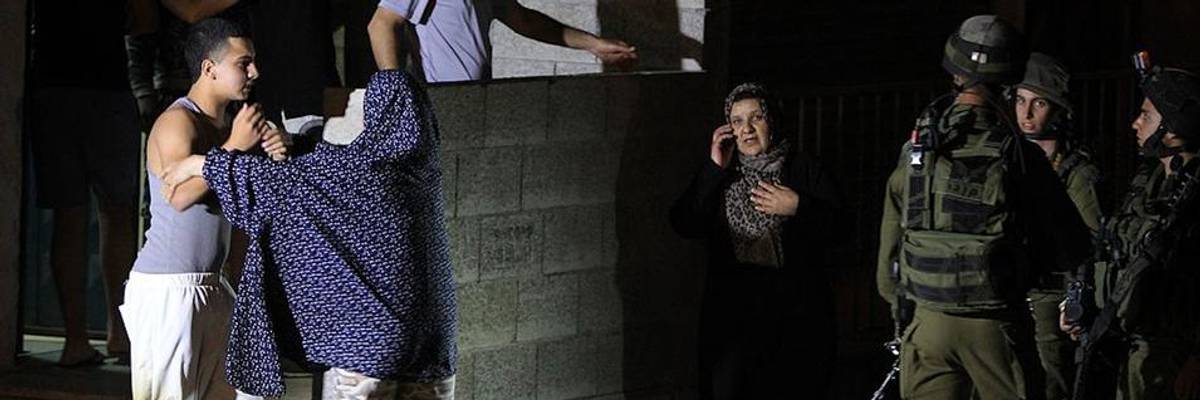
IDF troops carry out a night raid on a Palestinian home in the Jalazon refugee camp in the illegally occupied West Bank on June 16, 2014. (Photo: Abbas Momani/AFP via Getty Images)
Terrorized civilians are a universal, immutable fact of military occupation, as a report about Israeli night raids on Palestinian homes published last week affirms.
"The process involves the dehumanization of a whole society. [The] point is to break their human spirit."
--Dr. Jumana Milhem, Physicians for Human Rights Israel
The report--entitled A Life Exposed: Military Invasions of Palestinian Homes in the West Bank (pdf)--and put forth by the groups Breaking the Silence, Yesh Din, and Physicians for Human Rights Israel, contains harrowing first-hand testimonies of Palestinian families subjected to frequentIsrael Defense Forces night raids. In addition, the report included the voices of dozens of the IDF soldiers who executed such operations and the doctors who treat the men, women, and children traumatized by them.
"Almost every night, armed Israeli soldiers raid homes, wake women, men, and children, and carry out different actions inside the homes of Palestinian residents," the report explains. "According to U.N. figures, these invasions occur more than 200 times each month. Beyond the harm suffered by individuals and families as a result of the intrusion into their homes, this practice effectively serves as a means to oppress and intimidate the Palestinian population and increase control over it."
The report identifies and explores four types of home invasions perpetrated by Israeli forces in the illegally occupied West Bank: searches for money, weapons, or other items; arrest raids; "mapping" homes to learn layouts and the identities of residents; and seizing homes for military use.
"The invasion usually begins with shouting and banging on the door, followed by an aggressive, violent entry of armed and sometimes masked soldiers into the home," the report states. "In about a quarter of the documented cases, soldiers did not wait for the door to be opened by a member of the household, but forced it open by damaging or destroying it."
"Once inside the house, in most cases, soldiers order all members of the household, including children, to gather in one room where they remain under guard, helpless and unable to move freely," the report continues. "In some cases, the soldiers themselves wake up members of the household, including children."
According to the report, Israeli forces claim broad authority to conduct raids as they choose and dispose with the formality with obtaining judicial warrants before invading Palestinian homes. "Soldiers' conduct during the invasions is predicated on aggression, show of force, and intimidation," the report states, adding that the raids serve as a "means to oppress and intimidate the Palestinian population and increase control over it."
Lufti Ahmad, a man from Silwad, recounted how the Israeli invaders "completely destroyed our sense--one that everyone has--that our home is the most peaceful, safest place. What they did was a kind of terrorism."
One woman told how IDF soldiers forced their way into her Einabus home at 1:30 am.
"I started screaming, saying, 'Would you agree to someone coming in on your mother, your sister?'" she recalled. "The male soldiers left the room to let me get dressed. I was so scared I couldn't find my clothes."
Enduring trauma is an inevitable outcome of such actions, which unfold and are experienced quite like burglaries--but with the "burglars" belonging to one of the world's most powerful armies. Post-traumatic stress disorder (PTSD) and other mental health problems are widely reported by adult and child victims of the raids.
Dr. Jumana Milhem, a psychologist who works with Physicians for Human Rights Israel, told the Observer that "what comes to my mind is that the process involves the dehumanization of a whole society... [the] point is to break their human spirit."
The Israeli soldiers who perpetrate the raids are also sometimes traumatized by what they are forced to do in pursuit of an elusive "security" that is undermined by the very actions they take. Adding to the confusion is the fact that IDF troops say there is often no good reason at all for the invasions.
"There's rarely an operational motivation for it. Often, the motivation is practice."
--IDF soldier
"There's rarely an operational motivation for it," one IDF veteran said of the raids. "Often, the motivation is practice, meaning we got a breaching tool for the first time; no one knows how to use it, so it is decided that we break into a house now."
Another soldier recounted his first night raid. "We go into a house, gather everyone who is home, which is mostly a ton of children and women, in the living room.... It's my first arrest, and I just point the weapon at them, at a mother and children, I'm aiming my weapon at them, and children are crying hysterically in there."
One female soldier told the Observer that she volunteered to go on a raid because it seemed exciting:
I thought it was cool. I was 19 years old and playing war. I wanted to be part of it, to see how it was from the inside. In the end it was a turning point for me. When I got inside, the commander said, 'you have to search the women.' The family was really scared. I have this strong image of this other soldier who I really liked. He had a small machine gun. He's holding it in front of this cute three-year-old. He has a face mask on and he pulls off the mask and smiles at the boy. And I'm thinking this is so fucked up. It was like, it doesn't matter how nice this soldier is. I had this strong idea that held my world together. Because I am nice, I'll do it differently. But what matters is you're in a home at three in the morning. We can't be there without destroying their lives and creating the terror that later comes back to us.
Often the Israelis leave empty-handed. Other times, they arrest one or more person in a home--sometimes children--and remove them in handcuffs and blindfolds.
Some Palestinians have been subjected to so many IDF raids that they lose track of the number. Fadel Tamimi, the 59-year-old imam at a mosque in Nebi Salih who says his home has likely been raided more than 20 times, told the Observer that "the reason they do this is to scare everyone, to show who is in charge."
"On one occasion, I remember I had gone to the mosque for the first early morning prayers," Tamimi recalled. "When I came back the soldiers were in my house. They had put all of my family in the kitchen. When I went into my bedroom I found three soldiers resting on the bed."
"The consequences are psychological," he added. "You feel your privacy is being invaded. It's horrible for a conservative family and a traditional society. The aim is to control and humiliate."
Dear Common Dreams reader, It’s been nearly 30 years since I co-founded Common Dreams with my late wife, Lina Newhouser. We had the radical notion that journalism should serve the public good, not corporate profits. It was clear to us from the outset what it would take to build such a project. No paid advertisements. No corporate sponsors. No millionaire publisher telling us what to think or do. Many people said we wouldn't last a year, but we proved those doubters wrong. Together with a tremendous team of journalists and dedicated staff, we built an independent media outlet free from the constraints of profits and corporate control. Our mission has always been simple: To inform. To inspire. To ignite change for the common good. Building Common Dreams was not easy. Our survival was never guaranteed. When you take on the most powerful forces—Wall Street greed, fossil fuel industry destruction, Big Tech lobbyists, and uber-rich oligarchs who have spent billions upon billions rigging the economy and democracy in their favor—the only bulwark you have is supporters who believe in your work. But here’s the urgent message from me today. It's never been this bad out there. And it's never been this hard to keep us going. At the very moment Common Dreams is most needed, the threats we face are intensifying. We need your support now more than ever. We don't accept corporate advertising and never will. We don't have a paywall because we don't think people should be blocked from critical news based on their ability to pay. Everything we do is funded by the donations of readers like you. When everyone does the little they can afford, we are strong. But if that support retreats or dries up, so do we. Will you donate now to make sure Common Dreams not only survives but thrives? —Craig Brown, Co-founder |
Terrorized civilians are a universal, immutable fact of military occupation, as a report about Israeli night raids on Palestinian homes published last week affirms.
"The process involves the dehumanization of a whole society. [The] point is to break their human spirit."
--Dr. Jumana Milhem, Physicians for Human Rights Israel
The report--entitled A Life Exposed: Military Invasions of Palestinian Homes in the West Bank (pdf)--and put forth by the groups Breaking the Silence, Yesh Din, and Physicians for Human Rights Israel, contains harrowing first-hand testimonies of Palestinian families subjected to frequentIsrael Defense Forces night raids. In addition, the report included the voices of dozens of the IDF soldiers who executed such operations and the doctors who treat the men, women, and children traumatized by them.
"Almost every night, armed Israeli soldiers raid homes, wake women, men, and children, and carry out different actions inside the homes of Palestinian residents," the report explains. "According to U.N. figures, these invasions occur more than 200 times each month. Beyond the harm suffered by individuals and families as a result of the intrusion into their homes, this practice effectively serves as a means to oppress and intimidate the Palestinian population and increase control over it."
The report identifies and explores four types of home invasions perpetrated by Israeli forces in the illegally occupied West Bank: searches for money, weapons, or other items; arrest raids; "mapping" homes to learn layouts and the identities of residents; and seizing homes for military use.
"The invasion usually begins with shouting and banging on the door, followed by an aggressive, violent entry of armed and sometimes masked soldiers into the home," the report states. "In about a quarter of the documented cases, soldiers did not wait for the door to be opened by a member of the household, but forced it open by damaging or destroying it."
"Once inside the house, in most cases, soldiers order all members of the household, including children, to gather in one room where they remain under guard, helpless and unable to move freely," the report continues. "In some cases, the soldiers themselves wake up members of the household, including children."
According to the report, Israeli forces claim broad authority to conduct raids as they choose and dispose with the formality with obtaining judicial warrants before invading Palestinian homes. "Soldiers' conduct during the invasions is predicated on aggression, show of force, and intimidation," the report states, adding that the raids serve as a "means to oppress and intimidate the Palestinian population and increase control over it."
Lufti Ahmad, a man from Silwad, recounted how the Israeli invaders "completely destroyed our sense--one that everyone has--that our home is the most peaceful, safest place. What they did was a kind of terrorism."
One woman told how IDF soldiers forced their way into her Einabus home at 1:30 am.
"I started screaming, saying, 'Would you agree to someone coming in on your mother, your sister?'" she recalled. "The male soldiers left the room to let me get dressed. I was so scared I couldn't find my clothes."
Enduring trauma is an inevitable outcome of such actions, which unfold and are experienced quite like burglaries--but with the "burglars" belonging to one of the world's most powerful armies. Post-traumatic stress disorder (PTSD) and other mental health problems are widely reported by adult and child victims of the raids.
Dr. Jumana Milhem, a psychologist who works with Physicians for Human Rights Israel, told the Observer that "what comes to my mind is that the process involves the dehumanization of a whole society... [the] point is to break their human spirit."
The Israeli soldiers who perpetrate the raids are also sometimes traumatized by what they are forced to do in pursuit of an elusive "security" that is undermined by the very actions they take. Adding to the confusion is the fact that IDF troops say there is often no good reason at all for the invasions.
"There's rarely an operational motivation for it. Often, the motivation is practice."
--IDF soldier
"There's rarely an operational motivation for it," one IDF veteran said of the raids. "Often, the motivation is practice, meaning we got a breaching tool for the first time; no one knows how to use it, so it is decided that we break into a house now."
Another soldier recounted his first night raid. "We go into a house, gather everyone who is home, which is mostly a ton of children and women, in the living room.... It's my first arrest, and I just point the weapon at them, at a mother and children, I'm aiming my weapon at them, and children are crying hysterically in there."
One female soldier told the Observer that she volunteered to go on a raid because it seemed exciting:
I thought it was cool. I was 19 years old and playing war. I wanted to be part of it, to see how it was from the inside. In the end it was a turning point for me. When I got inside, the commander said, 'you have to search the women.' The family was really scared. I have this strong image of this other soldier who I really liked. He had a small machine gun. He's holding it in front of this cute three-year-old. He has a face mask on and he pulls off the mask and smiles at the boy. And I'm thinking this is so fucked up. It was like, it doesn't matter how nice this soldier is. I had this strong idea that held my world together. Because I am nice, I'll do it differently. But what matters is you're in a home at three in the morning. We can't be there without destroying their lives and creating the terror that later comes back to us.
Often the Israelis leave empty-handed. Other times, they arrest one or more person in a home--sometimes children--and remove them in handcuffs and blindfolds.
Some Palestinians have been subjected to so many IDF raids that they lose track of the number. Fadel Tamimi, the 59-year-old imam at a mosque in Nebi Salih who says his home has likely been raided more than 20 times, told the Observer that "the reason they do this is to scare everyone, to show who is in charge."
"On one occasion, I remember I had gone to the mosque for the first early morning prayers," Tamimi recalled. "When I came back the soldiers were in my house. They had put all of my family in the kitchen. When I went into my bedroom I found three soldiers resting on the bed."
"The consequences are psychological," he added. "You feel your privacy is being invaded. It's horrible for a conservative family and a traditional society. The aim is to control and humiliate."
Terrorized civilians are a universal, immutable fact of military occupation, as a report about Israeli night raids on Palestinian homes published last week affirms.
"The process involves the dehumanization of a whole society. [The] point is to break their human spirit."
--Dr. Jumana Milhem, Physicians for Human Rights Israel
The report--entitled A Life Exposed: Military Invasions of Palestinian Homes in the West Bank (pdf)--and put forth by the groups Breaking the Silence, Yesh Din, and Physicians for Human Rights Israel, contains harrowing first-hand testimonies of Palestinian families subjected to frequentIsrael Defense Forces night raids. In addition, the report included the voices of dozens of the IDF soldiers who executed such operations and the doctors who treat the men, women, and children traumatized by them.
"Almost every night, armed Israeli soldiers raid homes, wake women, men, and children, and carry out different actions inside the homes of Palestinian residents," the report explains. "According to U.N. figures, these invasions occur more than 200 times each month. Beyond the harm suffered by individuals and families as a result of the intrusion into their homes, this practice effectively serves as a means to oppress and intimidate the Palestinian population and increase control over it."
The report identifies and explores four types of home invasions perpetrated by Israeli forces in the illegally occupied West Bank: searches for money, weapons, or other items; arrest raids; "mapping" homes to learn layouts and the identities of residents; and seizing homes for military use.
"The invasion usually begins with shouting and banging on the door, followed by an aggressive, violent entry of armed and sometimes masked soldiers into the home," the report states. "In about a quarter of the documented cases, soldiers did not wait for the door to be opened by a member of the household, but forced it open by damaging or destroying it."
"Once inside the house, in most cases, soldiers order all members of the household, including children, to gather in one room where they remain under guard, helpless and unable to move freely," the report continues. "In some cases, the soldiers themselves wake up members of the household, including children."
According to the report, Israeli forces claim broad authority to conduct raids as they choose and dispose with the formality with obtaining judicial warrants before invading Palestinian homes. "Soldiers' conduct during the invasions is predicated on aggression, show of force, and intimidation," the report states, adding that the raids serve as a "means to oppress and intimidate the Palestinian population and increase control over it."
Lufti Ahmad, a man from Silwad, recounted how the Israeli invaders "completely destroyed our sense--one that everyone has--that our home is the most peaceful, safest place. What they did was a kind of terrorism."
One woman told how IDF soldiers forced their way into her Einabus home at 1:30 am.
"I started screaming, saying, 'Would you agree to someone coming in on your mother, your sister?'" she recalled. "The male soldiers left the room to let me get dressed. I was so scared I couldn't find my clothes."
Enduring trauma is an inevitable outcome of such actions, which unfold and are experienced quite like burglaries--but with the "burglars" belonging to one of the world's most powerful armies. Post-traumatic stress disorder (PTSD) and other mental health problems are widely reported by adult and child victims of the raids.
Dr. Jumana Milhem, a psychologist who works with Physicians for Human Rights Israel, told the Observer that "what comes to my mind is that the process involves the dehumanization of a whole society... [the] point is to break their human spirit."
The Israeli soldiers who perpetrate the raids are also sometimes traumatized by what they are forced to do in pursuit of an elusive "security" that is undermined by the very actions they take. Adding to the confusion is the fact that IDF troops say there is often no good reason at all for the invasions.
"There's rarely an operational motivation for it. Often, the motivation is practice."
--IDF soldier
"There's rarely an operational motivation for it," one IDF veteran said of the raids. "Often, the motivation is practice, meaning we got a breaching tool for the first time; no one knows how to use it, so it is decided that we break into a house now."
Another soldier recounted his first night raid. "We go into a house, gather everyone who is home, which is mostly a ton of children and women, in the living room.... It's my first arrest, and I just point the weapon at them, at a mother and children, I'm aiming my weapon at them, and children are crying hysterically in there."
One female soldier told the Observer that she volunteered to go on a raid because it seemed exciting:
I thought it was cool. I was 19 years old and playing war. I wanted to be part of it, to see how it was from the inside. In the end it was a turning point for me. When I got inside, the commander said, 'you have to search the women.' The family was really scared. I have this strong image of this other soldier who I really liked. He had a small machine gun. He's holding it in front of this cute three-year-old. He has a face mask on and he pulls off the mask and smiles at the boy. And I'm thinking this is so fucked up. It was like, it doesn't matter how nice this soldier is. I had this strong idea that held my world together. Because I am nice, I'll do it differently. But what matters is you're in a home at three in the morning. We can't be there without destroying their lives and creating the terror that later comes back to us.
Often the Israelis leave empty-handed. Other times, they arrest one or more person in a home--sometimes children--and remove them in handcuffs and blindfolds.
Some Palestinians have been subjected to so many IDF raids that they lose track of the number. Fadel Tamimi, the 59-year-old imam at a mosque in Nebi Salih who says his home has likely been raided more than 20 times, told the Observer that "the reason they do this is to scare everyone, to show who is in charge."
"On one occasion, I remember I had gone to the mosque for the first early morning prayers," Tamimi recalled. "When I came back the soldiers were in my house. They had put all of my family in the kitchen. When I went into my bedroom I found three soldiers resting on the bed."
"The consequences are psychological," he added. "You feel your privacy is being invaded. It's horrible for a conservative family and a traditional society. The aim is to control and humiliate."