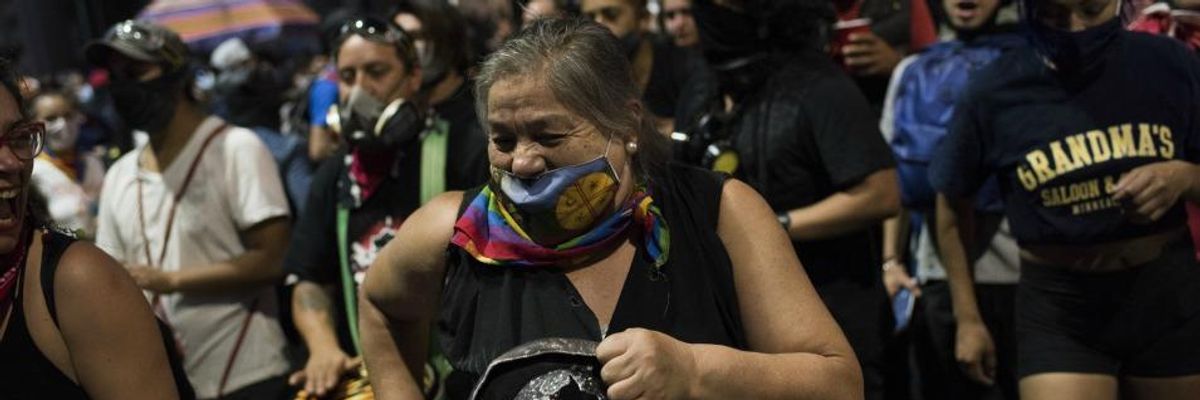
Citizens in favor of rewriting the Chilean constitution celebrate while awaiting the official results of the referendum at Plaza Italia Square in Santiago, Chile on October 25, 2020. (Photo: Alejandro Olivares/Anadolu Agency via Getty Images)
'Let This Echo Around the World': Nearly 50 Years After US-Backed Coup, Chile Votes to Rewrite Pinochet Era Constitution
"This historic day belongs to those who have struggled for decades, to those who have given their lives, to the tortured, to the mutilated, and especially to those who remain imprisoned."
Nearly 50 years after a U.S.-backed coup toppled Chile's democratically-elected socialist president Salvador Allende and paved the way for military dictator General Augusto Pinochet to impose a right-wing constitution that still exists three decades after his regime ended, Chileans on Sunday voted in a 4-to-1 landslide to approve the creation of a new constitution.
" Chile is reborn," political theorist Melany Cruz said on social media.
"The people of Chile have shed the shackles of Pinochetismo--and opened a new chapter in their history."
--Progressive International
Cruz explained earlier on Sunday in Tribune that the waves of privatization and other free-market policies implemented in the 1970's and 80's under anti-democratic circumstances at the behest of economists from the University of Chicago led to vast inequalities and rendered egalitarian reform exceedingly difficult, even in the post-dictatorship period that began in 1990.
There have been numerous attempts over the past 30 years to rein in market fundamentalism in Chile, but because neoliberalism was so deeply embedded into the country's constitution during the dictatorship era, Cruz wrote, the reign of Pinochet's politics outlived the military dictator.
Cruz called the historic referendum a "chance to bury Pinochet's legacy... and rebuild the country on a truly democratic basis."
The Chilean people responded en masse, seizing the opportunity to deliver a resounding blow to Pinochet's constitution. The vote signaled the culmination of a decades-long revolt against the era of neoliberalism that was unleashed in the wake of the U.S.-supported bombing of the capitol building in Santiago on September 11, 1973.
Celebrations erupted Sunday night as results of the plebiscite rolled in. The final vote tally showed that of the more than 7.5 million Chilean citizens who cast ballots, the vast majority--nearly 80%--were in favor of rewriting the country's right-wing constitution.
A video shared by AFP captures the jubilant mood of the massive pro-reform crowd that gathered in downtown Santiago:
"We've been living under an illegitimate constitution created by a military regime, that's only allowed progress to those who have money," Catalina Miranda told The Guardian on Sunday night. "There's been very few times that Chilean people have shared a collective victory like today."
Following Chile's democratic triumph, progressive voices around the world on social media expressed solidarity and congratulations, noting that this outcome is the product of generations of struggle and sacrifice.
"Another historic victory for the people of Latin America," wrote journalist Ben Norton, linking Chileans' demand for a democratic constitution to last week's defeat of authoritarianism, neoliberalism, and U.S. imperialism in neighboring Bolivia.
Chile "is finally liberating itself," Norton added, "from some of the institutional leftovers of the CIA-installed, U.S.-backed Pinochet dictatorship."
Progressive International followed suit, saying that "the people of Chile have shed the shackles of Pinochetismo--and opened a new chapter in their history."
"Let this echo around the world," wrote Canadian author and activist Naomi Klein, whose bestselling book 'The Shock Doctrine' used the Pinochet era as a benchmark example of what she termed disaster capitalism. "May this joyful day be the beginning of the end of the global reign of the Chicago Boys," which "started in Chile in 1973, in blood and fire."
May this joyful day be the beginning of the end of the global reign of the #ChicagoBoys. It started in Chile in 1973, in blood and fire. Let this echo around the world. https://t.co/sk4dWO0N7I
-- Naomi Klein (@NaomiAKlein) October 26, 2020
In response to the decisive rejection of the neoliberal constitution adopted during Pinochet's dictatorship, journalist Carla Astudillo stated that it is impossible to overstate "how historic this moment is!"
Astudillo and Norton both noted how Sunday's referendum was made possible by the nationwide protests against austerity that erupted last October following a transit fare hike. As Pablo Abufom wrote at the time, however, the social uprising in Chile is "not about 30 pesos, it's about 30 years."
As Norton documented in February in The Grayzone, Chilean president Sebastian Pinera--himself a billionaire whose University of Chicago-trained brother served as one of Pinochet's economists during the military dictatorship--responded viciously to the political unrest, "shooting anti-austerity protesters, blinding and maiming [them] by the thousands."
Despite the government's violent repression of demonstrations, Chilean citizens' persistent and militant resistance forced Pinera last November to schedule a plebiscite for April, which was postponed until October due to the Covid-19 pandemic.
As political scientist Lucia Dammert told the New York Times on Sunday, rewriting the country's constitution "wasn't on anyone's agenda" before last year's protests. "The fact we are now discussing a new constitution is a victory of the social movement."
Greg Grandin, the prize-winning historian of Latin America, pointed to the even longer roots of Sunday's victory, which he called "the fruit of decades of heroic protest" that was achieved "at the cost of untold lives."
"This historic day belongs to those who have struggled for decades, to those who have given their lives, to the tortured, to the mutilated, and especially to those who remain imprisoned," wrote Daniel Jadue, a left-wing architect and mayor of the community of Recoleta in the Santiago metropolitan region.
Sunday's call for a new constitution, Jadue added, "is the opportunity to transform Chile into a better country."
The political theorist Cruz noted that "what is ahead won't be easy and free of conflict."
"But it will be ours," she added. "We are writing our history."
We are at a crossroads
This country and this world are at a monumental crossroads. In a few short weeks, US voters will have an opportunity to beat back the forces of fascism and confront the billionaires who are rigging the economy, our media system, and our democracy, making it increasingly impossible for ordinary people to get by. We’re not just talking about the election. We’re talking about what must be done once these fascist elements are vanquished from power. We need a bolder set of solutions than what either major party has so far been willing to offer and a working-class movement ready to fight like hell for it. Trump didn't emerge from nowhere. The conditions that fueled MAGA authoritarianism were created by decades of radical neoliberal economic policies and a corrupt political system dominated by corporate interests. They slashed taxes on the super-rich, promising that the benefits would trickle down. They said giveaways to the corporate titans would make life more affordable for the rest of us. It was all bullshit. And when a bitter, betrayed populace searches for someone to blame, right-wing demagogues have little trouble finding scapegoats. People know when they're being lied to, but you won't hear any of this from the corporate media. Only independent journalism—powered and funded by people who believe in building a better world—can deliver truly trustworthy daily news. Our Fall Campaign is underway, and we need your help. To power our newsroom through the rest of the year, we need to raise $125,000 by midnight on October 31. So if you share our vision, please contribute whatever you can to sustain our work. |
Nearly 50 years after a U.S.-backed coup toppled Chile's democratically-elected socialist president Salvador Allende and paved the way for military dictator General Augusto Pinochet to impose a right-wing constitution that still exists three decades after his regime ended, Chileans on Sunday voted in a 4-to-1 landslide to approve the creation of a new constitution.
" Chile is reborn," political theorist Melany Cruz said on social media.
"The people of Chile have shed the shackles of Pinochetismo--and opened a new chapter in their history."
--Progressive International
Cruz explained earlier on Sunday in Tribune that the waves of privatization and other free-market policies implemented in the 1970's and 80's under anti-democratic circumstances at the behest of economists from the University of Chicago led to vast inequalities and rendered egalitarian reform exceedingly difficult, even in the post-dictatorship period that began in 1990.
There have been numerous attempts over the past 30 years to rein in market fundamentalism in Chile, but because neoliberalism was so deeply embedded into the country's constitution during the dictatorship era, Cruz wrote, the reign of Pinochet's politics outlived the military dictator.
Cruz called the historic referendum a "chance to bury Pinochet's legacy... and rebuild the country on a truly democratic basis."
The Chilean people responded en masse, seizing the opportunity to deliver a resounding blow to Pinochet's constitution. The vote signaled the culmination of a decades-long revolt against the era of neoliberalism that was unleashed in the wake of the U.S.-supported bombing of the capitol building in Santiago on September 11, 1973.
Celebrations erupted Sunday night as results of the plebiscite rolled in. The final vote tally showed that of the more than 7.5 million Chilean citizens who cast ballots, the vast majority--nearly 80%--were in favor of rewriting the country's right-wing constitution.
A video shared by AFP captures the jubilant mood of the massive pro-reform crowd that gathered in downtown Santiago:
"We've been living under an illegitimate constitution created by a military regime, that's only allowed progress to those who have money," Catalina Miranda told The Guardian on Sunday night. "There's been very few times that Chilean people have shared a collective victory like today."
Following Chile's democratic triumph, progressive voices around the world on social media expressed solidarity and congratulations, noting that this outcome is the product of generations of struggle and sacrifice.
"Another historic victory for the people of Latin America," wrote journalist Ben Norton, linking Chileans' demand for a democratic constitution to last week's defeat of authoritarianism, neoliberalism, and U.S. imperialism in neighboring Bolivia.
Chile "is finally liberating itself," Norton added, "from some of the institutional leftovers of the CIA-installed, U.S.-backed Pinochet dictatorship."
Progressive International followed suit, saying that "the people of Chile have shed the shackles of Pinochetismo--and opened a new chapter in their history."
"Let this echo around the world," wrote Canadian author and activist Naomi Klein, whose bestselling book 'The Shock Doctrine' used the Pinochet era as a benchmark example of what she termed disaster capitalism. "May this joyful day be the beginning of the end of the global reign of the Chicago Boys," which "started in Chile in 1973, in blood and fire."
May this joyful day be the beginning of the end of the global reign of the #ChicagoBoys. It started in Chile in 1973, in blood and fire. Let this echo around the world. https://t.co/sk4dWO0N7I
-- Naomi Klein (@NaomiAKlein) October 26, 2020
In response to the decisive rejection of the neoliberal constitution adopted during Pinochet's dictatorship, journalist Carla Astudillo stated that it is impossible to overstate "how historic this moment is!"
Astudillo and Norton both noted how Sunday's referendum was made possible by the nationwide protests against austerity that erupted last October following a transit fare hike. As Pablo Abufom wrote at the time, however, the social uprising in Chile is "not about 30 pesos, it's about 30 years."
As Norton documented in February in The Grayzone, Chilean president Sebastian Pinera--himself a billionaire whose University of Chicago-trained brother served as one of Pinochet's economists during the military dictatorship--responded viciously to the political unrest, "shooting anti-austerity protesters, blinding and maiming [them] by the thousands."
Despite the government's violent repression of demonstrations, Chilean citizens' persistent and militant resistance forced Pinera last November to schedule a plebiscite for April, which was postponed until October due to the Covid-19 pandemic.
As political scientist Lucia Dammert told the New York Times on Sunday, rewriting the country's constitution "wasn't on anyone's agenda" before last year's protests. "The fact we are now discussing a new constitution is a victory of the social movement."
Greg Grandin, the prize-winning historian of Latin America, pointed to the even longer roots of Sunday's victory, which he called "the fruit of decades of heroic protest" that was achieved "at the cost of untold lives."
"This historic day belongs to those who have struggled for decades, to those who have given their lives, to the tortured, to the mutilated, and especially to those who remain imprisoned," wrote Daniel Jadue, a left-wing architect and mayor of the community of Recoleta in the Santiago metropolitan region.
Sunday's call for a new constitution, Jadue added, "is the opportunity to transform Chile into a better country."
The political theorist Cruz noted that "what is ahead won't be easy and free of conflict."
"But it will be ours," she added. "We are writing our history."
Nearly 50 years after a U.S.-backed coup toppled Chile's democratically-elected socialist president Salvador Allende and paved the way for military dictator General Augusto Pinochet to impose a right-wing constitution that still exists three decades after his regime ended, Chileans on Sunday voted in a 4-to-1 landslide to approve the creation of a new constitution.
" Chile is reborn," political theorist Melany Cruz said on social media.
"The people of Chile have shed the shackles of Pinochetismo--and opened a new chapter in their history."
--Progressive International
Cruz explained earlier on Sunday in Tribune that the waves of privatization and other free-market policies implemented in the 1970's and 80's under anti-democratic circumstances at the behest of economists from the University of Chicago led to vast inequalities and rendered egalitarian reform exceedingly difficult, even in the post-dictatorship period that began in 1990.
There have been numerous attempts over the past 30 years to rein in market fundamentalism in Chile, but because neoliberalism was so deeply embedded into the country's constitution during the dictatorship era, Cruz wrote, the reign of Pinochet's politics outlived the military dictator.
Cruz called the historic referendum a "chance to bury Pinochet's legacy... and rebuild the country on a truly democratic basis."
The Chilean people responded en masse, seizing the opportunity to deliver a resounding blow to Pinochet's constitution. The vote signaled the culmination of a decades-long revolt against the era of neoliberalism that was unleashed in the wake of the U.S.-supported bombing of the capitol building in Santiago on September 11, 1973.
Celebrations erupted Sunday night as results of the plebiscite rolled in. The final vote tally showed that of the more than 7.5 million Chilean citizens who cast ballots, the vast majority--nearly 80%--were in favor of rewriting the country's right-wing constitution.
A video shared by AFP captures the jubilant mood of the massive pro-reform crowd that gathered in downtown Santiago:
"We've been living under an illegitimate constitution created by a military regime, that's only allowed progress to those who have money," Catalina Miranda told The Guardian on Sunday night. "There's been very few times that Chilean people have shared a collective victory like today."
Following Chile's democratic triumph, progressive voices around the world on social media expressed solidarity and congratulations, noting that this outcome is the product of generations of struggle and sacrifice.
"Another historic victory for the people of Latin America," wrote journalist Ben Norton, linking Chileans' demand for a democratic constitution to last week's defeat of authoritarianism, neoliberalism, and U.S. imperialism in neighboring Bolivia.
Chile "is finally liberating itself," Norton added, "from some of the institutional leftovers of the CIA-installed, U.S.-backed Pinochet dictatorship."
Progressive International followed suit, saying that "the people of Chile have shed the shackles of Pinochetismo--and opened a new chapter in their history."
"Let this echo around the world," wrote Canadian author and activist Naomi Klein, whose bestselling book 'The Shock Doctrine' used the Pinochet era as a benchmark example of what she termed disaster capitalism. "May this joyful day be the beginning of the end of the global reign of the Chicago Boys," which "started in Chile in 1973, in blood and fire."
May this joyful day be the beginning of the end of the global reign of the #ChicagoBoys. It started in Chile in 1973, in blood and fire. Let this echo around the world. https://t.co/sk4dWO0N7I
-- Naomi Klein (@NaomiAKlein) October 26, 2020
In response to the decisive rejection of the neoliberal constitution adopted during Pinochet's dictatorship, journalist Carla Astudillo stated that it is impossible to overstate "how historic this moment is!"
Astudillo and Norton both noted how Sunday's referendum was made possible by the nationwide protests against austerity that erupted last October following a transit fare hike. As Pablo Abufom wrote at the time, however, the social uprising in Chile is "not about 30 pesos, it's about 30 years."
As Norton documented in February in The Grayzone, Chilean president Sebastian Pinera--himself a billionaire whose University of Chicago-trained brother served as one of Pinochet's economists during the military dictatorship--responded viciously to the political unrest, "shooting anti-austerity protesters, blinding and maiming [them] by the thousands."
Despite the government's violent repression of demonstrations, Chilean citizens' persistent and militant resistance forced Pinera last November to schedule a plebiscite for April, which was postponed until October due to the Covid-19 pandemic.
As political scientist Lucia Dammert told the New York Times on Sunday, rewriting the country's constitution "wasn't on anyone's agenda" before last year's protests. "The fact we are now discussing a new constitution is a victory of the social movement."
Greg Grandin, the prize-winning historian of Latin America, pointed to the even longer roots of Sunday's victory, which he called "the fruit of decades of heroic protest" that was achieved "at the cost of untold lives."
"This historic day belongs to those who have struggled for decades, to those who have given their lives, to the tortured, to the mutilated, and especially to those who remain imprisoned," wrote Daniel Jadue, a left-wing architect and mayor of the community of Recoleta in the Santiago metropolitan region.
Sunday's call for a new constitution, Jadue added, "is the opportunity to transform Chile into a better country."
The political theorist Cruz noted that "what is ahead won't be easy and free of conflict."
"But it will be ours," she added. "We are writing our history."