SUBSCRIBE TO OUR FREE NEWSLETTER
Daily news & progressive opinion—funded by the people, not the corporations—delivered straight to your inbox.
5
#000000
#FFFFFF
To donate by check, phone, or other method, see our More Ways to Give page.
Daily news & progressive opinion—funded by the people, not the corporations—delivered straight to your inbox.
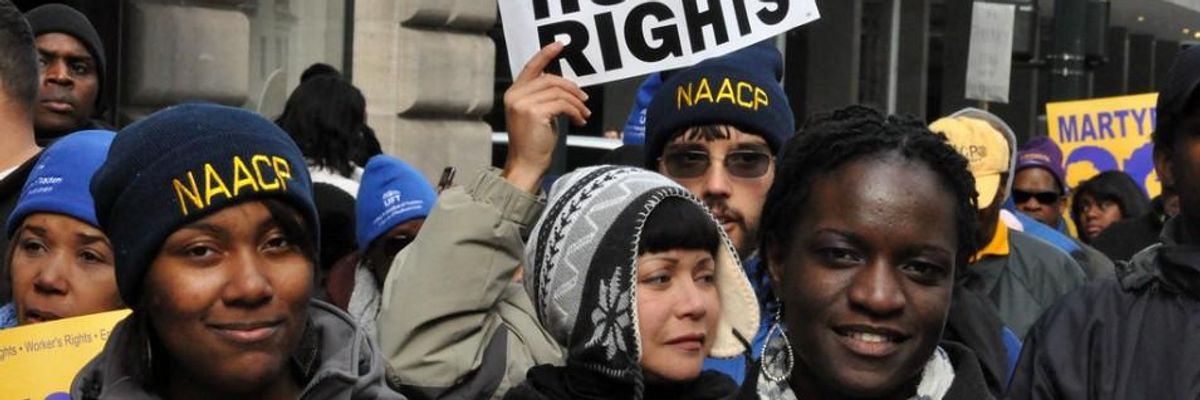
Voting rights advocates march in Manhattan, New York. (Photo: Michael Fleshman/Flickr/cc)
Despite reforms in many states aimed at restoring ex-felons' voting rights, an estimated 5.2 million Americans will remain disenfranchised and unable to vote in the 2020 elections, according to a study released Wednesday by The Sentencing Project.
"Laws that exclude people from voting have destabilized communities and families in America for decades by denying them a voice in determining their futures."
-- Amy Fettig, The Sentencing Project
According to the new report released by The Sentencing Project--titled "Locked Out 2020" (pdf)--one out of every 44 U.S. adults is disenfranchised due to current or previous felony convictions. The rate of disenfranchisement is highest in Southern states, the analysis found, where ballot restrictions enacted during the Jim Crow era in order to prevent Black men from voting and holding office remain in effect.
Key findings from the study include:
The study found significant variations in disenfranchisement rates due to disparate state laws. In three states--Alabama, Mississippi, and Tennessee--more than 8% of the adult population, or one of every 13 people, has had their right to vote taken away.
Black disenfranchisement rates also vary considerably. In seven states--Alabama, Florida, Kentucky, Mississippi, Tennessee, Virginia, and Wyoming--more than one in seven Black Americans is barred from the ballot box, twice the national average.
Only two states, Maine and Vermont, allow currently incarcerated felons to vote. Sen. Bernie Sanders (I-Vt.) said last year that people behind bars "paying their price to society" should not be "denied their inherent American right to participate in our democracy."
Sanders was widely rebuked, including by many U.S. liberals, for his assertion. However, other democracies around the world--including Canada, Croatia, the Czech Republic, Denmark, Finland, Ireland, Latvia, Lithuania, Macedonia, Serbia, Slovenia, Spain, South Africa, Sweden, Switzerland, and Ukraine--allow convicted felons to vote, even while they are incarcerated.
The study noted a trend toward restoring former felons' voting rights--over the past 25 years, half of the states have reformed their laws to expand ballot access to include people with felony convictions. However, setbacks in some states have reversed some of these gains.
In Florida, for example, nearly 900,000 people who have completed their sentences remain unable to vote despite the passage of a 2018 referendum that restored their voting rights. The following year, Republicans undermined this historic reform by passing a law--later upheld by the U.S. Supreme Court--requiring former felons to pay all their outstanding court fees in order to regain the right to vote.
"The bedrock of any democracy is the right to vote," said Amy Fettig, executive director of The Sentencing Project, in a statement introducing the study. "Laws that exclude people from voting have destabilized communities and families in America for decades by denying them a voice in determining their futures. Voting is a vital responsibility of citizenship that must be encouraged and defended."
Dear Common Dreams reader, It’s been nearly 30 years since I co-founded Common Dreams with my late wife, Lina Newhouser. We had the radical notion that journalism should serve the public good, not corporate profits. It was clear to us from the outset what it would take to build such a project. No paid advertisements. No corporate sponsors. No millionaire publisher telling us what to think or do. Many people said we wouldn't last a year, but we proved those doubters wrong. Together with a tremendous team of journalists and dedicated staff, we built an independent media outlet free from the constraints of profits and corporate control. Our mission has always been simple: To inform. To inspire. To ignite change for the common good. Building Common Dreams was not easy. Our survival was never guaranteed. When you take on the most powerful forces—Wall Street greed, fossil fuel industry destruction, Big Tech lobbyists, and uber-rich oligarchs who have spent billions upon billions rigging the economy and democracy in their favor—the only bulwark you have is supporters who believe in your work. But here’s the urgent message from me today. It's never been this bad out there. And it's never been this hard to keep us going. At the very moment Common Dreams is most needed, the threats we face are intensifying. We need your support now more than ever. We don't accept corporate advertising and never will. We don't have a paywall because we don't think people should be blocked from critical news based on their ability to pay. Everything we do is funded by the donations of readers like you. When everyone does the little they can afford, we are strong. But if that support retreats or dries up, so do we. Will you donate now to make sure Common Dreams not only survives but thrives? —Craig Brown, Co-founder |
Despite reforms in many states aimed at restoring ex-felons' voting rights, an estimated 5.2 million Americans will remain disenfranchised and unable to vote in the 2020 elections, according to a study released Wednesday by The Sentencing Project.
"Laws that exclude people from voting have destabilized communities and families in America for decades by denying them a voice in determining their futures."
-- Amy Fettig, The Sentencing Project
According to the new report released by The Sentencing Project--titled "Locked Out 2020" (pdf)--one out of every 44 U.S. adults is disenfranchised due to current or previous felony convictions. The rate of disenfranchisement is highest in Southern states, the analysis found, where ballot restrictions enacted during the Jim Crow era in order to prevent Black men from voting and holding office remain in effect.
Key findings from the study include:
The study found significant variations in disenfranchisement rates due to disparate state laws. In three states--Alabama, Mississippi, and Tennessee--more than 8% of the adult population, or one of every 13 people, has had their right to vote taken away.
Black disenfranchisement rates also vary considerably. In seven states--Alabama, Florida, Kentucky, Mississippi, Tennessee, Virginia, and Wyoming--more than one in seven Black Americans is barred from the ballot box, twice the national average.
Only two states, Maine and Vermont, allow currently incarcerated felons to vote. Sen. Bernie Sanders (I-Vt.) said last year that people behind bars "paying their price to society" should not be "denied their inherent American right to participate in our democracy."
Sanders was widely rebuked, including by many U.S. liberals, for his assertion. However, other democracies around the world--including Canada, Croatia, the Czech Republic, Denmark, Finland, Ireland, Latvia, Lithuania, Macedonia, Serbia, Slovenia, Spain, South Africa, Sweden, Switzerland, and Ukraine--allow convicted felons to vote, even while they are incarcerated.
The study noted a trend toward restoring former felons' voting rights--over the past 25 years, half of the states have reformed their laws to expand ballot access to include people with felony convictions. However, setbacks in some states have reversed some of these gains.
In Florida, for example, nearly 900,000 people who have completed their sentences remain unable to vote despite the passage of a 2018 referendum that restored their voting rights. The following year, Republicans undermined this historic reform by passing a law--later upheld by the U.S. Supreme Court--requiring former felons to pay all their outstanding court fees in order to regain the right to vote.
"The bedrock of any democracy is the right to vote," said Amy Fettig, executive director of The Sentencing Project, in a statement introducing the study. "Laws that exclude people from voting have destabilized communities and families in America for decades by denying them a voice in determining their futures. Voting is a vital responsibility of citizenship that must be encouraged and defended."
Despite reforms in many states aimed at restoring ex-felons' voting rights, an estimated 5.2 million Americans will remain disenfranchised and unable to vote in the 2020 elections, according to a study released Wednesday by The Sentencing Project.
"Laws that exclude people from voting have destabilized communities and families in America for decades by denying them a voice in determining their futures."
-- Amy Fettig, The Sentencing Project
According to the new report released by The Sentencing Project--titled "Locked Out 2020" (pdf)--one out of every 44 U.S. adults is disenfranchised due to current or previous felony convictions. The rate of disenfranchisement is highest in Southern states, the analysis found, where ballot restrictions enacted during the Jim Crow era in order to prevent Black men from voting and holding office remain in effect.
Key findings from the study include:
The study found significant variations in disenfranchisement rates due to disparate state laws. In three states--Alabama, Mississippi, and Tennessee--more than 8% of the adult population, or one of every 13 people, has had their right to vote taken away.
Black disenfranchisement rates also vary considerably. In seven states--Alabama, Florida, Kentucky, Mississippi, Tennessee, Virginia, and Wyoming--more than one in seven Black Americans is barred from the ballot box, twice the national average.
Only two states, Maine and Vermont, allow currently incarcerated felons to vote. Sen. Bernie Sanders (I-Vt.) said last year that people behind bars "paying their price to society" should not be "denied their inherent American right to participate in our democracy."
Sanders was widely rebuked, including by many U.S. liberals, for his assertion. However, other democracies around the world--including Canada, Croatia, the Czech Republic, Denmark, Finland, Ireland, Latvia, Lithuania, Macedonia, Serbia, Slovenia, Spain, South Africa, Sweden, Switzerland, and Ukraine--allow convicted felons to vote, even while they are incarcerated.
The study noted a trend toward restoring former felons' voting rights--over the past 25 years, half of the states have reformed their laws to expand ballot access to include people with felony convictions. However, setbacks in some states have reversed some of these gains.
In Florida, for example, nearly 900,000 people who have completed their sentences remain unable to vote despite the passage of a 2018 referendum that restored their voting rights. The following year, Republicans undermined this historic reform by passing a law--later upheld by the U.S. Supreme Court--requiring former felons to pay all their outstanding court fees in order to regain the right to vote.
"The bedrock of any democracy is the right to vote," said Amy Fettig, executive director of The Sentencing Project, in a statement introducing the study. "Laws that exclude people from voting have destabilized communities and families in America for decades by denying them a voice in determining their futures. Voting is a vital responsibility of citizenship that must be encouraged and defended."