SUBSCRIBE TO OUR FREE NEWSLETTER
Daily news & progressive opinion—funded by the people, not the corporations—delivered straight to your inbox.
5
#000000
#FFFFFF
To donate by check, phone, or other method, see our More Ways to Give page.
Daily news & progressive opinion—funded by the people, not the corporations—delivered straight to your inbox.
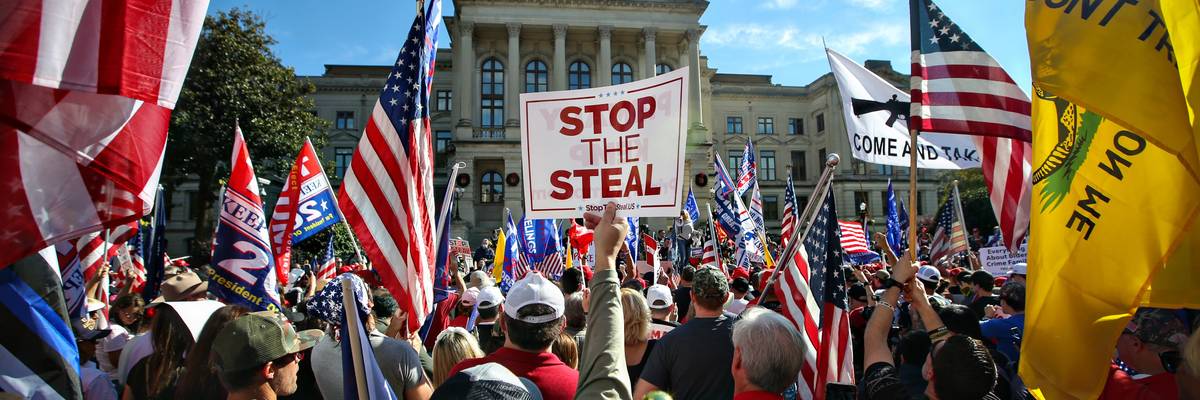
Hundreds of Trump supporters and gather near the Capitol Building for the Stop the Steal Rally in Atlanta, GA on November 21, 2020.
The threat of election-denying candidates is particularly acute in Arizona, where they are running for governor, secretary of state, and attorney general.
As President Donald Trump continues to push Republicans to aggressively gerrymander ahead of the 2026 midterm elections, a new analysis has found more than 50 candidates running for key offices who have in the past engaged in efforts to nullify election results.
As reported by NPR on Monday, election watchdog States United Action has released a report showing that election-denying candidates are running for offices in 23 states where, if victorious, they would have a direct role in certifying future elections.
States United classifies election deniers as candidates who meet one of five criteria: Falsely claiming that Trump won the 2020 election, spreading conspiracy theories about the election results, refusing to certify the 2020 election, supporting litigation to overturn election results, and refusing to concede a race after being defeated.
In total, States United found at least 53 such candidates running for positions this year, including secretaries of state and governorships, that would put them in position to try to block or impede the certification of elections.
The threat is particularly acute in Arizona, where election deniers are running for governor, secretary of state, and attorney general.
This prospective Arizona election denial ticket is headlined by MAGA hardliner Andy Biggs, who voted against certification of the 2020 election results as a US congressman and who is running to unseat incumbent Democratic Gov. Katie Hobbs.
States United CEO Joanna Lydgate told NPR that her organization is tracking election deniers running for office to "provide voters with the most accurate information possible" and "understand exactly what these candidates stand for and whether they fundamentally believe in free and fair elections in this country."
As election deniers are trying to win key offices throughout the US, the Trump administration is working to get more directly involved in purging voter rolls ahead of the midterms.
According to a Monday report from CNN, "Republicans and the Trump administration are now testing the scope of the federal law that imposes that ban on 'systematic' removal programs within three months of an election, as President Donald Trump pushes for more aggressive reviews of voter rolls for non-citizens and other ineligible voters."
What this means is that states could in theory purge voter rolls just weeks ahead of elections, giving people removed from the rolls almost no time to file challenges.
Wren Orey, director of the Bipartisan Policy Center’s Elections Project, told CNN that purging voter rolls less than three months before an election means there's a high risk that "voters won’t have adequate time or notice to be able to provide the documents that they’ll need ahead of the election."
"Maybe their birth certificate doesn’t meet the requirements," Orey explained. "Maybe they don’t have one handy, maybe they don’t have a passport. That could take months to get."
Brent Ferguson, the senior director of strategic litigation at Campaign Legal Center, told CNN that he was particularly disturbed by the Trump White House's involvement in this effort to manage voter rolls.
"It sets up a situation where the federal government itself is the actor trying to purge voters from the rolls in the days before the election," Ferguson said, "which is clearly illegal."
Dear Common Dreams reader, It’s been nearly 30 years since I co-founded Common Dreams with my late wife, Lina Newhouser. We had the radical notion that journalism should serve the public good, not corporate profits. It was clear to us from the outset what it would take to build such a project. No paid advertisements. No corporate sponsors. No millionaire publisher telling us what to think or do. Many people said we wouldn't last a year, but we proved those doubters wrong. Together with a tremendous team of journalists and dedicated staff, we built an independent media outlet free from the constraints of profits and corporate control. Our mission has always been simple: To inform. To inspire. To ignite change for the common good. Building Common Dreams was not easy. Our survival was never guaranteed. When you take on the most powerful forces—Wall Street greed, fossil fuel industry destruction, Big Tech lobbyists, and uber-rich oligarchs who have spent billions upon billions rigging the economy and democracy in their favor—the only bulwark you have is supporters who believe in your work. But here’s the urgent message from me today. It's never been this bad out there. And it's never been this hard to keep us going. At the very moment Common Dreams is most needed, the threats we face are intensifying. We need your support now more than ever. We don't accept corporate advertising and never will. We don't have a paywall because we don't think people should be blocked from critical news based on their ability to pay. Everything we do is funded by the donations of readers like you. When everyone does the little they can afford, we are strong. But if that support retreats or dries up, so do we. Will you donate now to make sure Common Dreams not only survives but thrives? —Craig Brown, Co-founder |
As President Donald Trump continues to push Republicans to aggressively gerrymander ahead of the 2026 midterm elections, a new analysis has found more than 50 candidates running for key offices who have in the past engaged in efforts to nullify election results.
As reported by NPR on Monday, election watchdog States United Action has released a report showing that election-denying candidates are running for offices in 23 states where, if victorious, they would have a direct role in certifying future elections.
States United classifies election deniers as candidates who meet one of five criteria: Falsely claiming that Trump won the 2020 election, spreading conspiracy theories about the election results, refusing to certify the 2020 election, supporting litigation to overturn election results, and refusing to concede a race after being defeated.
In total, States United found at least 53 such candidates running for positions this year, including secretaries of state and governorships, that would put them in position to try to block or impede the certification of elections.
The threat is particularly acute in Arizona, where election deniers are running for governor, secretary of state, and attorney general.
This prospective Arizona election denial ticket is headlined by MAGA hardliner Andy Biggs, who voted against certification of the 2020 election results as a US congressman and who is running to unseat incumbent Democratic Gov. Katie Hobbs.
States United CEO Joanna Lydgate told NPR that her organization is tracking election deniers running for office to "provide voters with the most accurate information possible" and "understand exactly what these candidates stand for and whether they fundamentally believe in free and fair elections in this country."
As election deniers are trying to win key offices throughout the US, the Trump administration is working to get more directly involved in purging voter rolls ahead of the midterms.
According to a Monday report from CNN, "Republicans and the Trump administration are now testing the scope of the federal law that imposes that ban on 'systematic' removal programs within three months of an election, as President Donald Trump pushes for more aggressive reviews of voter rolls for non-citizens and other ineligible voters."
What this means is that states could in theory purge voter rolls just weeks ahead of elections, giving people removed from the rolls almost no time to file challenges.
Wren Orey, director of the Bipartisan Policy Center’s Elections Project, told CNN that purging voter rolls less than three months before an election means there's a high risk that "voters won’t have adequate time or notice to be able to provide the documents that they’ll need ahead of the election."
"Maybe their birth certificate doesn’t meet the requirements," Orey explained. "Maybe they don’t have one handy, maybe they don’t have a passport. That could take months to get."
Brent Ferguson, the senior director of strategic litigation at Campaign Legal Center, told CNN that he was particularly disturbed by the Trump White House's involvement in this effort to manage voter rolls.
"It sets up a situation where the federal government itself is the actor trying to purge voters from the rolls in the days before the election," Ferguson said, "which is clearly illegal."
As President Donald Trump continues to push Republicans to aggressively gerrymander ahead of the 2026 midterm elections, a new analysis has found more than 50 candidates running for key offices who have in the past engaged in efforts to nullify election results.
As reported by NPR on Monday, election watchdog States United Action has released a report showing that election-denying candidates are running for offices in 23 states where, if victorious, they would have a direct role in certifying future elections.
States United classifies election deniers as candidates who meet one of five criteria: Falsely claiming that Trump won the 2020 election, spreading conspiracy theories about the election results, refusing to certify the 2020 election, supporting litigation to overturn election results, and refusing to concede a race after being defeated.
In total, States United found at least 53 such candidates running for positions this year, including secretaries of state and governorships, that would put them in position to try to block or impede the certification of elections.
The threat is particularly acute in Arizona, where election deniers are running for governor, secretary of state, and attorney general.
This prospective Arizona election denial ticket is headlined by MAGA hardliner Andy Biggs, who voted against certification of the 2020 election results as a US congressman and who is running to unseat incumbent Democratic Gov. Katie Hobbs.
States United CEO Joanna Lydgate told NPR that her organization is tracking election deniers running for office to "provide voters with the most accurate information possible" and "understand exactly what these candidates stand for and whether they fundamentally believe in free and fair elections in this country."
As election deniers are trying to win key offices throughout the US, the Trump administration is working to get more directly involved in purging voter rolls ahead of the midterms.
According to a Monday report from CNN, "Republicans and the Trump administration are now testing the scope of the federal law that imposes that ban on 'systematic' removal programs within three months of an election, as President Donald Trump pushes for more aggressive reviews of voter rolls for non-citizens and other ineligible voters."
What this means is that states could in theory purge voter rolls just weeks ahead of elections, giving people removed from the rolls almost no time to file challenges.
Wren Orey, director of the Bipartisan Policy Center’s Elections Project, told CNN that purging voter rolls less than three months before an election means there's a high risk that "voters won’t have adequate time or notice to be able to provide the documents that they’ll need ahead of the election."
"Maybe their birth certificate doesn’t meet the requirements," Orey explained. "Maybe they don’t have one handy, maybe they don’t have a passport. That could take months to get."
Brent Ferguson, the senior director of strategic litigation at Campaign Legal Center, told CNN that he was particularly disturbed by the Trump White House's involvement in this effort to manage voter rolls.
"It sets up a situation where the federal government itself is the actor trying to purge voters from the rolls in the days before the election," Ferguson said, "which is clearly illegal."