SUBSCRIBE TO OUR FREE NEWSLETTER
Daily news & progressive opinion—funded by the people, not the corporations—delivered straight to your inbox.
5
#000000
#FFFFFF
To donate by check, phone, or other method, see our More Ways to Give page.
Daily news & progressive opinion—funded by the people, not the corporations—delivered straight to your inbox.
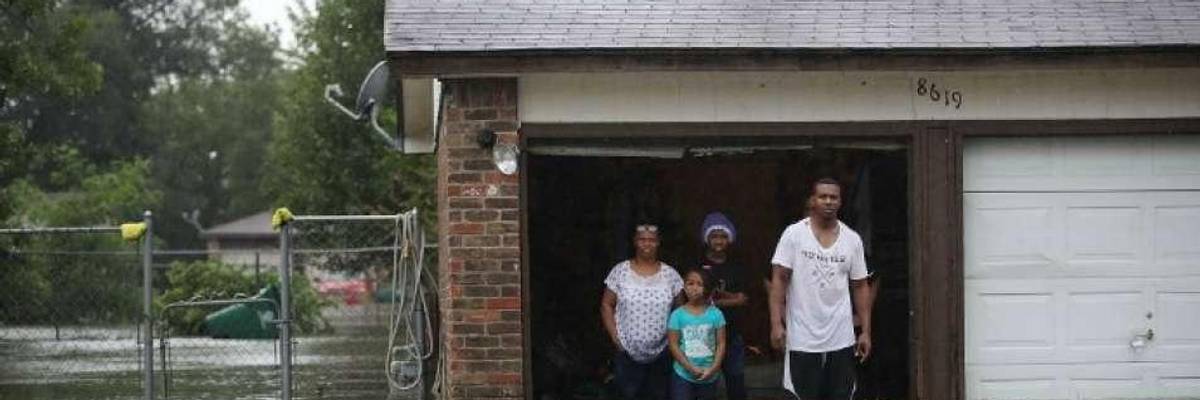
People wait to be rescued from their flooded homes after the area was inundated with flooding from Hurricane Harvey on Aug. 28, 2017 in Houston, Texas. (Photo: Joe Raedle/Getty Images)
New research first reported on Friday by The New York Times suggests banks are shifting mortgages made riskier by the climate emergency over to financial institutions backed by U.S. taxpayers--findings that "echo the subprime lending crisis of 2008, when unexpected drops in home values cascaded through the economy and triggered recession."
Readers described the Times report as "huge" as well as "fascinating and provocative." It elicited immediate critiques and concerns regarding banks' actions and the sweeping potential consequences for American taxpayers and the global economy.
The research is set to be published Monday as a National Bureau of Economic Research (NBER) working paper entitled Mortgage Finance in the Face of Rising Climate Risk (pdf).
"It is less likely that borrowers will continue to make mortgage payments if their homes are literally underwater."
--Sean Becketti, economist
Co-authors Amine Ouazad of HEC Montreal and Matthew Kahn of Johns Hopkins University analyzed how lenders have handled mortgages in U.S. regions hit by destructive hurricanes between 2004 and 2012.
"They found that, after those hurricanes, lenders increased by almost 10 percent the share of those mortgages that they sold to Fannie Mae and Freddie Mac, government-sponsored enterprises whose debts are backed by taxpayers," the Times reported.
According to the newspaper:
Selling mortgages to Fannie and Freddie allows banks to avoid the financial risk that homeowners will default on the mortgages. Hurricanes increase that risk: Mr. Ouazad and Mr. Kahn found that the odds of an eventual foreclosure rise by 3.6 percentage points for a mortgage originated in the first year after a hurricane, and by 4.9 percentage points for a mortgage originated in the third year.
The regulations governing Fannie and Freddie do not let them factor the added risk from natural disasters into their pricing, which means banks and other lenders can offload mortgages in vulnerable areas without financial penalty. That increases the incentive for banks to make the loans and then move them off their books, the authors said.
Fannie Mae and Freddie Mac are private companies created by the government to support mortgage and housing markets. After suffering massive losses during the 2008 financial crisis, the federal government essentially began to back their debts. The Trump administration has proposed shifting their role to the private sector, though no legislation appears imminent.
As unsustainable humanity activity continues to drive up global temperatures, which scientists say is making extreme weather worse, a growing number of homeowners impacted by natural disasters could default on their mortgages--which, according to the new paper, banks are selling to Fannie and Freddie. The researchers warn the impacts could be felt across the country.
"We're talking about a loss that's going to be borne by United States taxpayers," Ouazad told the Times. Noting that up to $100 billion in new mortgages are issued for coastal homes annually, he added, "we're not talking about a small number."
Ouazad said he hopes the research spurs a national discussion about lending policies for regions increasingly at risk in a warming world. "Do we still want to have 30-year fixed mortgages in areas at risk of flooding?" he asked. "I'm not sure about that."
The paper and its researchers declined to name any specific banks, but the Times reached out to some of the nation's largest lenders. Representatives for JP Morgan Chase and Wells Fargo "denied engaging in the practice described in the paper," the Times reported. "Quicken Loans and Bank of America did not respond to questions."
The Mortgage Bankers Association--which represents lenders--as well as Fannie Mae and Freddie Mac declined the Times' requests for comment. The Federal Housing Finance Agency, which regulates Fannie and Freddie, did not respond.
However, the Times noted, economists at Fannie and Freddie have previously expressed concerns about climate-related risks such as rising seas. For example, Freddie Mac's then-chief economist Sean Becketti warned in 2016 that "the economic losses and social disruption may happen gradually, but they are likely to be greater in total than those experienced in the housing crisis and Great Recession."
"In the housing crisis, a significant share of borrowers continued to make their mortgage payments even though the values of their homes were less than the balances of their mortgages," Becketti explained. "It is less likely that borrowers will continue to make mortgage payments if their homes are literally underwater. As a result, lenders, servicers, and mortgage insurers are likely to suffer large losses."
According to the new research, big banks may avoid some anticipated losses by selling off risky mortgages. Sierra Club campaigner Ben Cushing pointed out on Twitter Friday that those same big banks have helped fuel the climate crisis by pouring billions of dollars per year into coal, natural gas, and oil companies.
Highlighting a paragraph from the Times report that outlined how lenders can offload mortgages to Fannie and Freddie without penalty, Cushing concluded, "This is insane."
Dear Common Dreams reader, It’s been nearly 30 years since I co-founded Common Dreams with my late wife, Lina Newhouser. We had the radical notion that journalism should serve the public good, not corporate profits. It was clear to us from the outset what it would take to build such a project. No paid advertisements. No corporate sponsors. No millionaire publisher telling us what to think or do. Many people said we wouldn't last a year, but we proved those doubters wrong. Together with a tremendous team of journalists and dedicated staff, we built an independent media outlet free from the constraints of profits and corporate control. Our mission has always been simple: To inform. To inspire. To ignite change for the common good. Building Common Dreams was not easy. Our survival was never guaranteed. When you take on the most powerful forces—Wall Street greed, fossil fuel industry destruction, Big Tech lobbyists, and uber-rich oligarchs who have spent billions upon billions rigging the economy and democracy in their favor—the only bulwark you have is supporters who believe in your work. But here’s the urgent message from me today. It's never been this bad out there. And it's never been this hard to keep us going. At the very moment Common Dreams is most needed, the threats we face are intensifying. We need your support now more than ever. We don't accept corporate advertising and never will. We don't have a paywall because we don't think people should be blocked from critical news based on their ability to pay. Everything we do is funded by the donations of readers like you. When everyone does the little they can afford, we are strong. But if that support retreats or dries up, so do we. Will you donate now to make sure Common Dreams not only survives but thrives? —Craig Brown, Co-founder |
New research first reported on Friday by The New York Times suggests banks are shifting mortgages made riskier by the climate emergency over to financial institutions backed by U.S. taxpayers--findings that "echo the subprime lending crisis of 2008, when unexpected drops in home values cascaded through the economy and triggered recession."
Readers described the Times report as "huge" as well as "fascinating and provocative." It elicited immediate critiques and concerns regarding banks' actions and the sweeping potential consequences for American taxpayers and the global economy.
The research is set to be published Monday as a National Bureau of Economic Research (NBER) working paper entitled Mortgage Finance in the Face of Rising Climate Risk (pdf).
"It is less likely that borrowers will continue to make mortgage payments if their homes are literally underwater."
--Sean Becketti, economist
Co-authors Amine Ouazad of HEC Montreal and Matthew Kahn of Johns Hopkins University analyzed how lenders have handled mortgages in U.S. regions hit by destructive hurricanes between 2004 and 2012.
"They found that, after those hurricanes, lenders increased by almost 10 percent the share of those mortgages that they sold to Fannie Mae and Freddie Mac, government-sponsored enterprises whose debts are backed by taxpayers," the Times reported.
According to the newspaper:
Selling mortgages to Fannie and Freddie allows banks to avoid the financial risk that homeowners will default on the mortgages. Hurricanes increase that risk: Mr. Ouazad and Mr. Kahn found that the odds of an eventual foreclosure rise by 3.6 percentage points for a mortgage originated in the first year after a hurricane, and by 4.9 percentage points for a mortgage originated in the third year.
The regulations governing Fannie and Freddie do not let them factor the added risk from natural disasters into their pricing, which means banks and other lenders can offload mortgages in vulnerable areas without financial penalty. That increases the incentive for banks to make the loans and then move them off their books, the authors said.
Fannie Mae and Freddie Mac are private companies created by the government to support mortgage and housing markets. After suffering massive losses during the 2008 financial crisis, the federal government essentially began to back their debts. The Trump administration has proposed shifting their role to the private sector, though no legislation appears imminent.
As unsustainable humanity activity continues to drive up global temperatures, which scientists say is making extreme weather worse, a growing number of homeowners impacted by natural disasters could default on their mortgages--which, according to the new paper, banks are selling to Fannie and Freddie. The researchers warn the impacts could be felt across the country.
"We're talking about a loss that's going to be borne by United States taxpayers," Ouazad told the Times. Noting that up to $100 billion in new mortgages are issued for coastal homes annually, he added, "we're not talking about a small number."
Ouazad said he hopes the research spurs a national discussion about lending policies for regions increasingly at risk in a warming world. "Do we still want to have 30-year fixed mortgages in areas at risk of flooding?" he asked. "I'm not sure about that."
The paper and its researchers declined to name any specific banks, but the Times reached out to some of the nation's largest lenders. Representatives for JP Morgan Chase and Wells Fargo "denied engaging in the practice described in the paper," the Times reported. "Quicken Loans and Bank of America did not respond to questions."
The Mortgage Bankers Association--which represents lenders--as well as Fannie Mae and Freddie Mac declined the Times' requests for comment. The Federal Housing Finance Agency, which regulates Fannie and Freddie, did not respond.
However, the Times noted, economists at Fannie and Freddie have previously expressed concerns about climate-related risks such as rising seas. For example, Freddie Mac's then-chief economist Sean Becketti warned in 2016 that "the economic losses and social disruption may happen gradually, but they are likely to be greater in total than those experienced in the housing crisis and Great Recession."
"In the housing crisis, a significant share of borrowers continued to make their mortgage payments even though the values of their homes were less than the balances of their mortgages," Becketti explained. "It is less likely that borrowers will continue to make mortgage payments if their homes are literally underwater. As a result, lenders, servicers, and mortgage insurers are likely to suffer large losses."
According to the new research, big banks may avoid some anticipated losses by selling off risky mortgages. Sierra Club campaigner Ben Cushing pointed out on Twitter Friday that those same big banks have helped fuel the climate crisis by pouring billions of dollars per year into coal, natural gas, and oil companies.
Highlighting a paragraph from the Times report that outlined how lenders can offload mortgages to Fannie and Freddie without penalty, Cushing concluded, "This is insane."
New research first reported on Friday by The New York Times suggests banks are shifting mortgages made riskier by the climate emergency over to financial institutions backed by U.S. taxpayers--findings that "echo the subprime lending crisis of 2008, when unexpected drops in home values cascaded through the economy and triggered recession."
Readers described the Times report as "huge" as well as "fascinating and provocative." It elicited immediate critiques and concerns regarding banks' actions and the sweeping potential consequences for American taxpayers and the global economy.
The research is set to be published Monday as a National Bureau of Economic Research (NBER) working paper entitled Mortgage Finance in the Face of Rising Climate Risk (pdf).
"It is less likely that borrowers will continue to make mortgage payments if their homes are literally underwater."
--Sean Becketti, economist
Co-authors Amine Ouazad of HEC Montreal and Matthew Kahn of Johns Hopkins University analyzed how lenders have handled mortgages in U.S. regions hit by destructive hurricanes between 2004 and 2012.
"They found that, after those hurricanes, lenders increased by almost 10 percent the share of those mortgages that they sold to Fannie Mae and Freddie Mac, government-sponsored enterprises whose debts are backed by taxpayers," the Times reported.
According to the newspaper:
Selling mortgages to Fannie and Freddie allows banks to avoid the financial risk that homeowners will default on the mortgages. Hurricanes increase that risk: Mr. Ouazad and Mr. Kahn found that the odds of an eventual foreclosure rise by 3.6 percentage points for a mortgage originated in the first year after a hurricane, and by 4.9 percentage points for a mortgage originated in the third year.
The regulations governing Fannie and Freddie do not let them factor the added risk from natural disasters into their pricing, which means banks and other lenders can offload mortgages in vulnerable areas without financial penalty. That increases the incentive for banks to make the loans and then move them off their books, the authors said.
Fannie Mae and Freddie Mac are private companies created by the government to support mortgage and housing markets. After suffering massive losses during the 2008 financial crisis, the federal government essentially began to back their debts. The Trump administration has proposed shifting their role to the private sector, though no legislation appears imminent.
As unsustainable humanity activity continues to drive up global temperatures, which scientists say is making extreme weather worse, a growing number of homeowners impacted by natural disasters could default on their mortgages--which, according to the new paper, banks are selling to Fannie and Freddie. The researchers warn the impacts could be felt across the country.
"We're talking about a loss that's going to be borne by United States taxpayers," Ouazad told the Times. Noting that up to $100 billion in new mortgages are issued for coastal homes annually, he added, "we're not talking about a small number."
Ouazad said he hopes the research spurs a national discussion about lending policies for regions increasingly at risk in a warming world. "Do we still want to have 30-year fixed mortgages in areas at risk of flooding?" he asked. "I'm not sure about that."
The paper and its researchers declined to name any specific banks, but the Times reached out to some of the nation's largest lenders. Representatives for JP Morgan Chase and Wells Fargo "denied engaging in the practice described in the paper," the Times reported. "Quicken Loans and Bank of America did not respond to questions."
The Mortgage Bankers Association--which represents lenders--as well as Fannie Mae and Freddie Mac declined the Times' requests for comment. The Federal Housing Finance Agency, which regulates Fannie and Freddie, did not respond.
However, the Times noted, economists at Fannie and Freddie have previously expressed concerns about climate-related risks such as rising seas. For example, Freddie Mac's then-chief economist Sean Becketti warned in 2016 that "the economic losses and social disruption may happen gradually, but they are likely to be greater in total than those experienced in the housing crisis and Great Recession."
"In the housing crisis, a significant share of borrowers continued to make their mortgage payments even though the values of their homes were less than the balances of their mortgages," Becketti explained. "It is less likely that borrowers will continue to make mortgage payments if their homes are literally underwater. As a result, lenders, servicers, and mortgage insurers are likely to suffer large losses."
According to the new research, big banks may avoid some anticipated losses by selling off risky mortgages. Sierra Club campaigner Ben Cushing pointed out on Twitter Friday that those same big banks have helped fuel the climate crisis by pouring billions of dollars per year into coal, natural gas, and oil companies.
Highlighting a paragraph from the Times report that outlined how lenders can offload mortgages to Fannie and Freddie without penalty, Cushing concluded, "This is insane."