SUBSCRIBE TO OUR FREE NEWSLETTER
Daily news & progressive opinion—funded by the people, not the corporations—delivered straight to your inbox.
5
#000000
#FFFFFF
To donate by check, phone, or other method, see our More Ways to Give page.
Daily news & progressive opinion—funded by the people, not the corporations—delivered straight to your inbox.
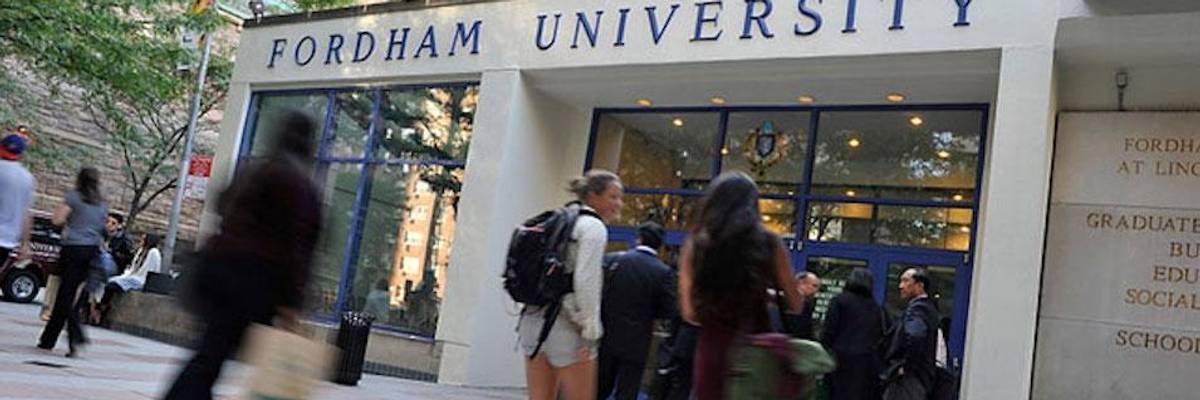
Fordham University cannot stop students from forming a pro-Palestinian group, the New York State Supreme Court ruled Tuesday. (Photo: Palestine Legal)
The New York State Supreme Court ruled in favor of pro-Palestine advocates from Fordham University on Tuesday, clearing the way for a chapter of the group Students for Justice in Palestine to operate at the school despite years of administrative resistance.
"The win reflects the recent trend in pro-Palestine sentiment in mainstream politics which has only been made possible through the uncompromising efforts of Palestine solidarity activists and anti-imperialists in the movement," victorious petitioner Sapphira Lurie told Common Dreams.
The ruling came after over two years of litigation stemming from a decision by Fordham in December 2016 to deny SJP club status at the school. Fordham administrators claimed that concerns over controversies and unspecified bad behavior led to the denial. In response, four students sued the school over their right to establish the chapter.
Justice Nancy Bannon, in her ruling (pdf), called Fordham Dean of Student Life Keith Eldredge's rejection of the student group "arbitrary and capricious" and said that "it must be concluded that his disapproval of SJP was made in large part because the subject of SJP's criticism is the State of Israel, rather than some other nation, in spite of the fact that SJP advocates only legal, nonviolent tactics aimed at changing Israel's policies."
"Fordham's decision to deny recognition to Students for Justice in Palestine was so utterly arbitrary and irrational that it can only be understood in the context of the nationwide effort to silence those voices seeking justice for Palestinians," said counsel Alan Levine, who represented the petitioners alongside the Center for Constitutional Rights and Palestine Legal. "In succumbing to those forces, Fordham abandoned its obligation to foster critical points of view on matters of public concern."
In a statement, petitioner Ahmad Awad, a 2017 Fordham graduate, said the victory was for the struggle as a whole, both on and off Fordham campus.
"Although over 1,000 days have passed since we initiated the process for club status, I did not give up on my fight for human rights and free speech," said Awad. "I continued to advocate for justice in Palestine, and now because of Justice Bannon's order, no Fordham student will be restricted or prohibited from advocating for justice in Palestine."
Plaintiff Lurie, who also graduated from Fordham in 2017, tied the lawsuit to other activism on the Jesuit campus.
"We are not just some student activists who came together on one issue," said Lurie, "we are serious about the liberation of all people and many of us were part of other student struggles to support workers at Fordham and to advocate for sexual health on campus."
SJP at Fordham co-founder Gunar Olsen, who was not a plaintiff in the case, told Common Dreams that Tuesday's ruling was a rare moment of good news in the fight for Palestinian rights.
"When backlash against the Palestine solidarity movement is so widespread--owing largely to the successes of the BDS movement--this ruling is a port in a storm," said Olsen. "It affirms our often-violated right to criticize the holiest of American empire's client states and advocate for the basic rights of a dispossessed people."
Watch the students reflect on their victory:
Dear Common Dreams reader, It’s been nearly 30 years since I co-founded Common Dreams with my late wife, Lina Newhouser. We had the radical notion that journalism should serve the public good, not corporate profits. It was clear to us from the outset what it would take to build such a project. No paid advertisements. No corporate sponsors. No millionaire publisher telling us what to think or do. Many people said we wouldn't last a year, but we proved those doubters wrong. Together with a tremendous team of journalists and dedicated staff, we built an independent media outlet free from the constraints of profits and corporate control. Our mission has always been simple: To inform. To inspire. To ignite change for the common good. Building Common Dreams was not easy. Our survival was never guaranteed. When you take on the most powerful forces—Wall Street greed, fossil fuel industry destruction, Big Tech lobbyists, and uber-rich oligarchs who have spent billions upon billions rigging the economy and democracy in their favor—the only bulwark you have is supporters who believe in your work. But here’s the urgent message from me today. It's never been this bad out there. And it's never been this hard to keep us going. At the very moment Common Dreams is most needed, the threats we face are intensifying. We need your support now more than ever. We don't accept corporate advertising and never will. We don't have a paywall because we don't think people should be blocked from critical news based on their ability to pay. Everything we do is funded by the donations of readers like you. When everyone does the little they can afford, we are strong. But if that support retreats or dries up, so do we. Will you donate now to make sure Common Dreams not only survives but thrives? —Craig Brown, Co-founder |
The New York State Supreme Court ruled in favor of pro-Palestine advocates from Fordham University on Tuesday, clearing the way for a chapter of the group Students for Justice in Palestine to operate at the school despite years of administrative resistance.
"The win reflects the recent trend in pro-Palestine sentiment in mainstream politics which has only been made possible through the uncompromising efforts of Palestine solidarity activists and anti-imperialists in the movement," victorious petitioner Sapphira Lurie told Common Dreams.
The ruling came after over two years of litigation stemming from a decision by Fordham in December 2016 to deny SJP club status at the school. Fordham administrators claimed that concerns over controversies and unspecified bad behavior led to the denial. In response, four students sued the school over their right to establish the chapter.
Justice Nancy Bannon, in her ruling (pdf), called Fordham Dean of Student Life Keith Eldredge's rejection of the student group "arbitrary and capricious" and said that "it must be concluded that his disapproval of SJP was made in large part because the subject of SJP's criticism is the State of Israel, rather than some other nation, in spite of the fact that SJP advocates only legal, nonviolent tactics aimed at changing Israel's policies."
"Fordham's decision to deny recognition to Students for Justice in Palestine was so utterly arbitrary and irrational that it can only be understood in the context of the nationwide effort to silence those voices seeking justice for Palestinians," said counsel Alan Levine, who represented the petitioners alongside the Center for Constitutional Rights and Palestine Legal. "In succumbing to those forces, Fordham abandoned its obligation to foster critical points of view on matters of public concern."
In a statement, petitioner Ahmad Awad, a 2017 Fordham graduate, said the victory was for the struggle as a whole, both on and off Fordham campus.
"Although over 1,000 days have passed since we initiated the process for club status, I did not give up on my fight for human rights and free speech," said Awad. "I continued to advocate for justice in Palestine, and now because of Justice Bannon's order, no Fordham student will be restricted or prohibited from advocating for justice in Palestine."
Plaintiff Lurie, who also graduated from Fordham in 2017, tied the lawsuit to other activism on the Jesuit campus.
"We are not just some student activists who came together on one issue," said Lurie, "we are serious about the liberation of all people and many of us were part of other student struggles to support workers at Fordham and to advocate for sexual health on campus."
SJP at Fordham co-founder Gunar Olsen, who was not a plaintiff in the case, told Common Dreams that Tuesday's ruling was a rare moment of good news in the fight for Palestinian rights.
"When backlash against the Palestine solidarity movement is so widespread--owing largely to the successes of the BDS movement--this ruling is a port in a storm," said Olsen. "It affirms our often-violated right to criticize the holiest of American empire's client states and advocate for the basic rights of a dispossessed people."
Watch the students reflect on their victory:
The New York State Supreme Court ruled in favor of pro-Palestine advocates from Fordham University on Tuesday, clearing the way for a chapter of the group Students for Justice in Palestine to operate at the school despite years of administrative resistance.
"The win reflects the recent trend in pro-Palestine sentiment in mainstream politics which has only been made possible through the uncompromising efforts of Palestine solidarity activists and anti-imperialists in the movement," victorious petitioner Sapphira Lurie told Common Dreams.
The ruling came after over two years of litigation stemming from a decision by Fordham in December 2016 to deny SJP club status at the school. Fordham administrators claimed that concerns over controversies and unspecified bad behavior led to the denial. In response, four students sued the school over their right to establish the chapter.
Justice Nancy Bannon, in her ruling (pdf), called Fordham Dean of Student Life Keith Eldredge's rejection of the student group "arbitrary and capricious" and said that "it must be concluded that his disapproval of SJP was made in large part because the subject of SJP's criticism is the State of Israel, rather than some other nation, in spite of the fact that SJP advocates only legal, nonviolent tactics aimed at changing Israel's policies."
"Fordham's decision to deny recognition to Students for Justice in Palestine was so utterly arbitrary and irrational that it can only be understood in the context of the nationwide effort to silence those voices seeking justice for Palestinians," said counsel Alan Levine, who represented the petitioners alongside the Center for Constitutional Rights and Palestine Legal. "In succumbing to those forces, Fordham abandoned its obligation to foster critical points of view on matters of public concern."
In a statement, petitioner Ahmad Awad, a 2017 Fordham graduate, said the victory was for the struggle as a whole, both on and off Fordham campus.
"Although over 1,000 days have passed since we initiated the process for club status, I did not give up on my fight for human rights and free speech," said Awad. "I continued to advocate for justice in Palestine, and now because of Justice Bannon's order, no Fordham student will be restricted or prohibited from advocating for justice in Palestine."
Plaintiff Lurie, who also graduated from Fordham in 2017, tied the lawsuit to other activism on the Jesuit campus.
"We are not just some student activists who came together on one issue," said Lurie, "we are serious about the liberation of all people and many of us were part of other student struggles to support workers at Fordham and to advocate for sexual health on campus."
SJP at Fordham co-founder Gunar Olsen, who was not a plaintiff in the case, told Common Dreams that Tuesday's ruling was a rare moment of good news in the fight for Palestinian rights.
"When backlash against the Palestine solidarity movement is so widespread--owing largely to the successes of the BDS movement--this ruling is a port in a storm," said Olsen. "It affirms our often-violated right to criticize the holiest of American empire's client states and advocate for the basic rights of a dispossessed people."
Watch the students reflect on their victory: