
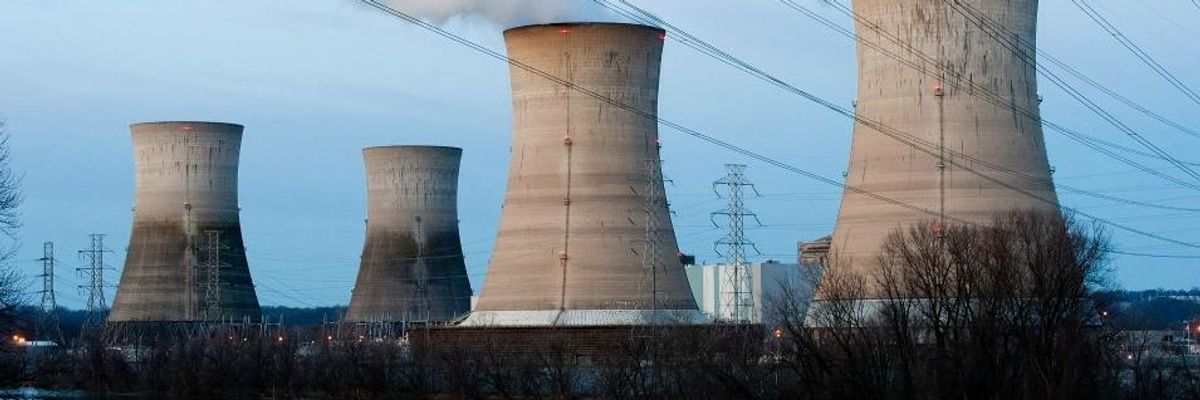
The Nuclear Regulatory Commission is considering rolling back some safety standards for nuclear power plants. (Photo: Jeff Fusco/Getty Images)
'An Insanely Bad Move': Experts Sound Alarm as Trump's Nuclear Safety Agency Weighs Rollback of Plant Inspections
The Nuclear Regulatory Commission, said one member of Congress, "needs to do more—not less—to ensure nuclear reactor safety."
After months of experts raising alarm over the nuclear power industry pressuring U.S. regulators to roll back safety policies, staffers at the federal agency that monitors reactors sparked concerns Tuesday with official recommendations that include scaling back required inspections to save money.
The Nuclear Regulatory Commission (NRC) has spent months reviewing its enforcement policies--and, as part of that process, sought input from industry groups, as Common Dreams detailed in March. In response, the industry representatives requested shifting to more "self-assessments," limiting public disclosures for "lower-level" problems at plants, and easing the "burden of radiation-protection and emergency-preparedness inspections."
According to The Associated Press, which first reported on NRC staffers' suggestions:
The recommendations, made public Tuesday, include reducing the time and scope of some annual inspections at the nation's 90-plus nuclear power plants. Some other inspections would be cut from every two years to every three years.
Some of the staff's recommendations would require a vote by the commission, which has a majority of members appointed or reappointed by President Donald Trump, who has urged agencies to reduce regulatory requirements for industries.
The NRC document that outlines the recommendations reportedly acknowledges that staffers disagree about the inspection reductions but claims that cutting back "improves efficiency while still helping to ensure reasonable assurance of adequate protection to the public."
Union of Concerned Scientists nuclear power expert Edwin Lyman, however, charged that the suggestion to decrease federal oversight of nuclear power plants "completely ignores the cause-and-effect relationship between inspections and good performances."
Democratic NRC member Jeff Baran also criticized the staff recommendations. He argued that the agency "shouldn't perform fewer inspections or weaken its safety oversight to save money" and called for a public debate before any changes are made to existing policy.
"It affects every power reactor in the country," he said. "We should absolutely hear from a broad range of stakeholders before making any far-reaching changes to NRC's safety oversight program."
Before the recommendations were released Tuesday, Democrats from the House Appropriations as well as Energy and Commerce committees expressed concerns about potential rollbacks of safety standards in a letter (pdf) to NRC Chairwoman Kristine Svinicki Monday.
The lawmakers wrote:
To ensure nuclear power provides safe, reliable, emissions-free energy, it is imperative for the NRC to uphold strong regulatory standards. That is why we are disturbed by the consideration of these far-reaching changes to the NRC's regulatory regime without first actively conducting robust public outreach and engagement. It would be a mistake to attempt to make nuclear power more cost competitive by weakening NRC's vital safety oversight. Cutting corners on such critical safety measures may eventually lead to a disaster that could be detrimental to the future of the domestic nuclear industry.
The AP's report on agency staffers' official recommendations provoked further alarm from lawmakers and the public. Some people on Twitter decried the inspection proposal as "an insanely bad move" and "beyond nuts," and referenced the 1986 Chernobyl disaster, which is considered the world's worst ever nuclear power plant accident.
Democratic Pennsylvania state Rep. Peter Schweyer tweeted that he would "happily" share his HBO password with the NRC "so they can catch up on" the network's recently released series about Chernobyl.
U.S. Rep. Harley Rouda (D-Calif.) wrote in a tweet that considering how many millions of Americans live in close proximity to nuclear power plants, the agency "needs to do more--not less--to ensure nuclear reactor safety."
We are at a crossroads
This country and this world are at a monumental crossroads. In a few short weeks, US voters will have an opportunity to beat back the forces of fascism and confront the billionaires who are rigging the economy, our media system, and our democracy, making it increasingly impossible for ordinary people to get by. We’re not just talking about the election. We’re talking about what must be done once these fascist elements are vanquished from power. We need a bolder set of solutions than what either major party has so far been willing to offer and a working-class movement ready to fight like hell for it. Trump didn't emerge from nowhere. The conditions that fueled MAGA authoritarianism were created by decades of radical neoliberal economic policies and a corrupt political system dominated by corporate interests. They slashed taxes on the super-rich, promising that the benefits would trickle down. They said giveaways to the corporate titans would make life more affordable for the rest of us. It was all bullshit. And when a bitter, betrayed populace searches for someone to blame, right-wing demagogues have little trouble finding scapegoats. People know when they're being lied to, but you won't hear any of this from the corporate media. Only independent journalism—powered and funded by people who believe in building a better world—can deliver truly trustworthy daily news. Our Fall Campaign is underway, and we need your help. To power our newsroom through the rest of the year, we need to raise $125,000 by midnight on October 31. So if you share our vision, please contribute whatever you can to sustain our work. |
After months of experts raising alarm over the nuclear power industry pressuring U.S. regulators to roll back safety policies, staffers at the federal agency that monitors reactors sparked concerns Tuesday with official recommendations that include scaling back required inspections to save money.
The Nuclear Regulatory Commission (NRC) has spent months reviewing its enforcement policies--and, as part of that process, sought input from industry groups, as Common Dreams detailed in March. In response, the industry representatives requested shifting to more "self-assessments," limiting public disclosures for "lower-level" problems at plants, and easing the "burden of radiation-protection and emergency-preparedness inspections."
According to The Associated Press, which first reported on NRC staffers' suggestions:
The recommendations, made public Tuesday, include reducing the time and scope of some annual inspections at the nation's 90-plus nuclear power plants. Some other inspections would be cut from every two years to every three years.
Some of the staff's recommendations would require a vote by the commission, which has a majority of members appointed or reappointed by President Donald Trump, who has urged agencies to reduce regulatory requirements for industries.
The NRC document that outlines the recommendations reportedly acknowledges that staffers disagree about the inspection reductions but claims that cutting back "improves efficiency while still helping to ensure reasonable assurance of adequate protection to the public."
Union of Concerned Scientists nuclear power expert Edwin Lyman, however, charged that the suggestion to decrease federal oversight of nuclear power plants "completely ignores the cause-and-effect relationship between inspections and good performances."
Democratic NRC member Jeff Baran also criticized the staff recommendations. He argued that the agency "shouldn't perform fewer inspections or weaken its safety oversight to save money" and called for a public debate before any changes are made to existing policy.
"It affects every power reactor in the country," he said. "We should absolutely hear from a broad range of stakeholders before making any far-reaching changes to NRC's safety oversight program."
Before the recommendations were released Tuesday, Democrats from the House Appropriations as well as Energy and Commerce committees expressed concerns about potential rollbacks of safety standards in a letter (pdf) to NRC Chairwoman Kristine Svinicki Monday.
The lawmakers wrote:
To ensure nuclear power provides safe, reliable, emissions-free energy, it is imperative for the NRC to uphold strong regulatory standards. That is why we are disturbed by the consideration of these far-reaching changes to the NRC's regulatory regime without first actively conducting robust public outreach and engagement. It would be a mistake to attempt to make nuclear power more cost competitive by weakening NRC's vital safety oversight. Cutting corners on such critical safety measures may eventually lead to a disaster that could be detrimental to the future of the domestic nuclear industry.
The AP's report on agency staffers' official recommendations provoked further alarm from lawmakers and the public. Some people on Twitter decried the inspection proposal as "an insanely bad move" and "beyond nuts," and referenced the 1986 Chernobyl disaster, which is considered the world's worst ever nuclear power plant accident.
Democratic Pennsylvania state Rep. Peter Schweyer tweeted that he would "happily" share his HBO password with the NRC "so they can catch up on" the network's recently released series about Chernobyl.
U.S. Rep. Harley Rouda (D-Calif.) wrote in a tweet that considering how many millions of Americans live in close proximity to nuclear power plants, the agency "needs to do more--not less--to ensure nuclear reactor safety."