SUBSCRIBE TO OUR FREE NEWSLETTER
Daily news & progressive opinion—funded by the people, not the corporations—delivered straight to your inbox.
5
#000000
#FFFFFF
To donate by check, phone, or other method, see our More Ways to Give page.
Daily news & progressive opinion—funded by the people, not the corporations—delivered straight to your inbox.
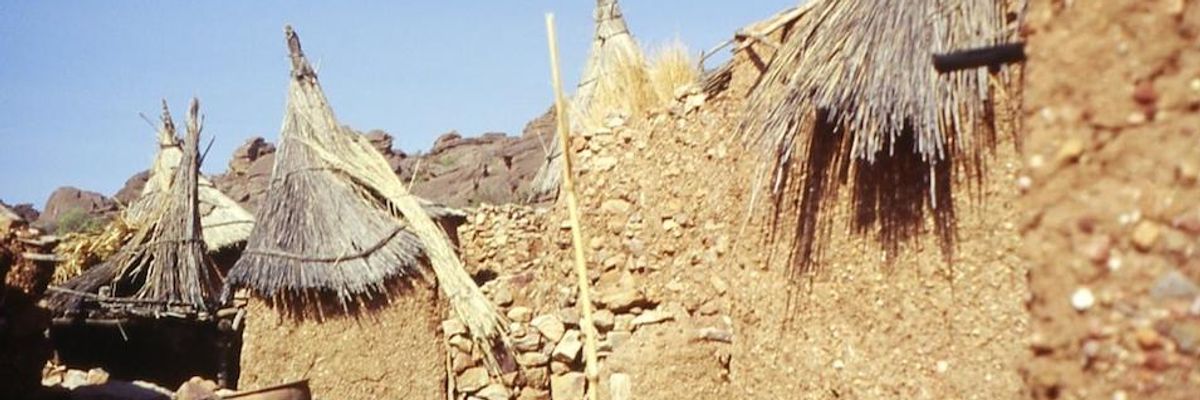
A Dogon village in Mali. (Photo: Jeanne Menjoulet, Flickr)
At least 95 people were killed Monday morning in the West African nation of Mali, the latest escalation of continued violence in the country in the last six years.
Central Mali villagers belonging to the Dogon ethnic group were the victims of the nighttime raid. The Mali government blamed "suspected terrorists" for the incursion, the BBC reported.
"About 50 heavily armed men arrived on motorbikes and pickups," a survivor who called himself Amadou Togo told the AFP agency. "They first surrounded the village and then attacked--anyone who tried to escape was killed."
"No-one was spared--women, children, elderly people," he added.
The first evidence coming from the village indicates the conflict was part of a longstanding ethnic grudge between the Dogon and the nomadic Fulani, as NPR's Ofeibea Quist-Arcton reported Monday.
"Local officials blame Fulani-Peulh herdsmen for the attack," said Quist-Arcton, "and say it's difficult to identify badly burned bodies and that many in the village of 300 are yet to be accounted for."
In a statement, Amnesty International's West and Central African director Marie-Evelyne Petrus Barry said that the killings were only "the latest episode of a spiral of violence which hit the country" and showed "a total and utter contempt for human life."
"The growing unrest and subsequent violence reported in the center of the country are characterized by killings, enforced disappearances, and burning of villages, on an appalling scale," said Barry. "The authorities should immediately investigate these unlawful killings and bring those responsible to justice."
Mali has been riven with conflict since 2013, when Islamist militants who had captured much of the country's desert north began incursions into the country's central and southern regions. They were pushed back to the Sahara in 2013 but eventually, per the BBC, "the uprising--which had spread to the centre of Mali by 2015--decreased government control and increased the availability of weapons," making conflicts more likely to be met with violence than negotiation.
This country and this world are at a monumental crossroads. US voters have an opportunity to beat back the forces of fascism and confront the billionaires who are rigging the economy, our media system, and our democracy, making it increasingly impossible for ordinary people to get by. We’re not just talking about the election. We’re talking about what must be done once these fascist elements are vanquished from power. We need a bolder set of solutions than what either major party has so far been willing to offer and a working-class movement ready to fight like hell for it. Trump didn't emerge from nowhere. The conditions that fueled MAGA authoritarianism were created by decades of radical neoliberal economic policies and a corrupt political system dominated by corporate interests. They slashed taxes on the super-rich, promising that the benefits would trickle down. They said giveaways to the corporate titans would make life more affordable for the rest of us. It was all bullshit. And when a bitter, betrayed populace searches for someone to blame, right-wing demagogues have little trouble finding scapegoats. People know when they're being lied to, but you won't hear any of this from the corporate media. Only independent journalism—powered and funded by people who believe in building a better world—can deliver truly trustworthy daily news. If you share our vision, please contribute whatever you can to sustain our work. |
At least 95 people were killed Monday morning in the West African nation of Mali, the latest escalation of continued violence in the country in the last six years.
Central Mali villagers belonging to the Dogon ethnic group were the victims of the nighttime raid. The Mali government blamed "suspected terrorists" for the incursion, the BBC reported.
"About 50 heavily armed men arrived on motorbikes and pickups," a survivor who called himself Amadou Togo told the AFP agency. "They first surrounded the village and then attacked--anyone who tried to escape was killed."
"No-one was spared--women, children, elderly people," he added.
The first evidence coming from the village indicates the conflict was part of a longstanding ethnic grudge between the Dogon and the nomadic Fulani, as NPR's Ofeibea Quist-Arcton reported Monday.
"Local officials blame Fulani-Peulh herdsmen for the attack," said Quist-Arcton, "and say it's difficult to identify badly burned bodies and that many in the village of 300 are yet to be accounted for."
In a statement, Amnesty International's West and Central African director Marie-Evelyne Petrus Barry said that the killings were only "the latest episode of a spiral of violence which hit the country" and showed "a total and utter contempt for human life."
"The growing unrest and subsequent violence reported in the center of the country are characterized by killings, enforced disappearances, and burning of villages, on an appalling scale," said Barry. "The authorities should immediately investigate these unlawful killings and bring those responsible to justice."
Mali has been riven with conflict since 2013, when Islamist militants who had captured much of the country's desert north began incursions into the country's central and southern regions. They were pushed back to the Sahara in 2013 but eventually, per the BBC, "the uprising--which had spread to the centre of Mali by 2015--decreased government control and increased the availability of weapons," making conflicts more likely to be met with violence than negotiation.