SUBSCRIBE TO OUR FREE NEWSLETTER
Daily news & progressive opinion—funded by the people, not the corporations—delivered straight to your inbox.
5
#000000
#FFFFFF
To donate by check, phone, or other method, see our More Ways to Give page.
Daily news & progressive opinion—funded by the people, not the corporations—delivered straight to your inbox.
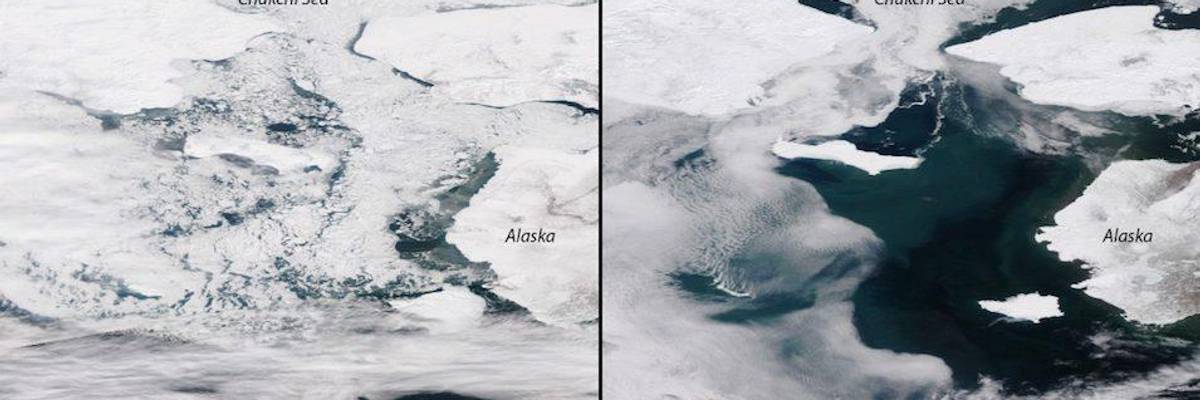
In March 2019, the Bering Sea had less ice than in April 2014. (Photo: U.S. National Oceanic and Atmospheric Administration)
Alaska's on thin ice.
That's according to reporting in Hakai Magazine by environmentalist Tim Lydon, who looked at the effects of a warmer-than-average late winter in the northernmost state in the U.S.
"March temperatures averaged 11 degC above normal," said Lydon. "The deviation was most extreme in the Arctic where, on March 30, thermometers rose almost 22 degC above normal--to 3 degC . That still sounds cold, but it was comparatively hot."
The warmth is having a major impact on Alaskans, said climate specialist Rick Thoman, who works with the Alaska Center for Climate Assessment and Policy.
"It's hard to characterize that anomaly," said Thoman, "it's just pretty darn remarkable for that part of the world."
In March, climate scientist Zach Labe shared a map on Twitter showing the warming.
That heat thinned out the ice in Alaska, leading to deaths and a loss of infrastructure--the latter because, as Lydon put it, "in Alaska, ice is infrastructure."
For example, the Kuskokwim River, which runs over 1,100 kilometers across southwestern Alaska, freezes so solid that it becomes a marked ice road connecting dozens of communities spread over 300 kilometers. In sparsely populated interior Alaska, frozen rivers are indispensable for transporting goods, visiting family, and delivering kids to school basketball games.
Along Alaska's west coast, the frozen waters of the Bering Sea also act as infrastructure. Each winter, frigid air transforms much of the Bering between Russia and Alaska into sea ice. As it fastens to shore, the ice provides platforms for fishing and hunting, and safe routes between communities. It also prevents wave action and storm surges from eroding the shores of coastal villages.
Losing that critical component of life in the Arctic could be devastating. Already, said Lydon, thinning ice is claiming lives of Alaskans who are quite naturally expecting normal conditions. In the 2019 winter, at least eight people died when snowmobiles or four-wheelers they were using for transportation crashed through thin ice. And a lack of icepack is adding to lower than normal fish and crab counts as routes provided by the ice have disappeared.
"Continued warmth like this has cascading effects," biological oceanographer Rob Campbell told Lydon. "We may not understand the consequences for species like salmon for years to come."
This country and this world are at a monumental crossroads. US voters have an opportunity to beat back the forces of fascism and confront the billionaires who are rigging the economy, our media system, and our democracy, making it increasingly impossible for ordinary people to get by. We’re not just talking about the election. We’re talking about what must be done once these fascist elements are vanquished from power. We need a bolder set of solutions than what either major party has so far been willing to offer and a working-class movement ready to fight like hell for it. Trump didn't emerge from nowhere. The conditions that fueled MAGA authoritarianism were created by decades of radical neoliberal economic policies and a corrupt political system dominated by corporate interests. They slashed taxes on the super-rich, promising that the benefits would trickle down. They said giveaways to the corporate titans would make life more affordable for the rest of us. It was all bullshit. And when a bitter, betrayed populace searches for someone to blame, right-wing demagogues have little trouble finding scapegoats. People know when they're being lied to, but you won't hear any of this from the corporate media. Only independent journalism—powered and funded by people who believe in building a better world—can deliver truly trustworthy daily news. If you share our vision, please contribute whatever you can to sustain our work. |
Alaska's on thin ice.
That's according to reporting in Hakai Magazine by environmentalist Tim Lydon, who looked at the effects of a warmer-than-average late winter in the northernmost state in the U.S.
"March temperatures averaged 11 degC above normal," said Lydon. "The deviation was most extreme in the Arctic where, on March 30, thermometers rose almost 22 degC above normal--to 3 degC . That still sounds cold, but it was comparatively hot."
The warmth is having a major impact on Alaskans, said climate specialist Rick Thoman, who works with the Alaska Center for Climate Assessment and Policy.
"It's hard to characterize that anomaly," said Thoman, "it's just pretty darn remarkable for that part of the world."
In March, climate scientist Zach Labe shared a map on Twitter showing the warming.
That heat thinned out the ice in Alaska, leading to deaths and a loss of infrastructure--the latter because, as Lydon put it, "in Alaska, ice is infrastructure."
For example, the Kuskokwim River, which runs over 1,100 kilometers across southwestern Alaska, freezes so solid that it becomes a marked ice road connecting dozens of communities spread over 300 kilometers. In sparsely populated interior Alaska, frozen rivers are indispensable for transporting goods, visiting family, and delivering kids to school basketball games.
Along Alaska's west coast, the frozen waters of the Bering Sea also act as infrastructure. Each winter, frigid air transforms much of the Bering between Russia and Alaska into sea ice. As it fastens to shore, the ice provides platforms for fishing and hunting, and safe routes between communities. It also prevents wave action and storm surges from eroding the shores of coastal villages.
Losing that critical component of life in the Arctic could be devastating. Already, said Lydon, thinning ice is claiming lives of Alaskans who are quite naturally expecting normal conditions. In the 2019 winter, at least eight people died when snowmobiles or four-wheelers they were using for transportation crashed through thin ice. And a lack of icepack is adding to lower than normal fish and crab counts as routes provided by the ice have disappeared.
"Continued warmth like this has cascading effects," biological oceanographer Rob Campbell told Lydon. "We may not understand the consequences for species like salmon for years to come."