
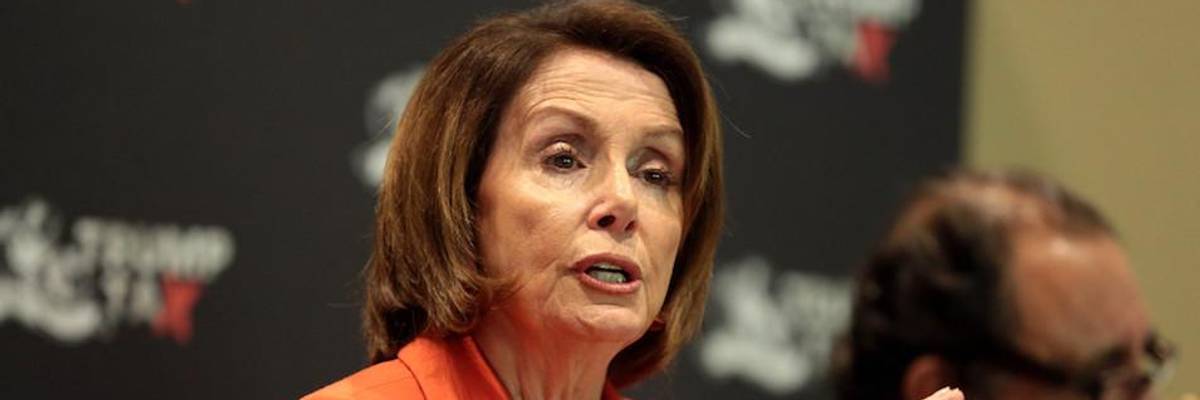
Nancy Pelosi speaking with the public in Phoenix, Arizona, February 8, 2018. (Photo: Gage Skidmore, Flickr)
'Hocus-Pocus Process': Pelosi Drug Pricing Bill Criticized for Going Too Easy on Big Pharma
"They need to do more."
Divisions in the Democratic House caucus over healthcare continued to deepen this week when the party's leader, Speaker Nancy Pelosi, informed members that drug pricing legislation will be designed to go easy on big pharma.
The new proposal, which Pelosi worked out with President Donald Trump, appears aimed at incremental change to the drug pricing system rather than the kind of relief health activists have been clamoring for over the past year.
"It creates this hocus-pocus process that isn't going to lower prescription drug prices," John Hassell, the national director of advocacy for advocacy group the AIDS Healthcare Foundation, told HuffPost. "It's going to nickel and dime it on the sides."
A Thursday evening in-depth HuffPost report on the bill lays out the legislation's scope--such as it is. The plan calls for allowing the secretary of health and human services to negotiate with drug companies for lower drug prices. Should the companies and secretary fail to reach an agreement, the Government Accountability Office is empowered to take over and set a price that aligns with how much the drugs go for overseas.
Per HuffPost:
The Department of Health and Human Services would be required to negotiate on at least 25 drugs each year, and companies that refused to participate would be slapped with a tax equal to 50 percent of their prior year's sales of the drug. Prices on all drugs covered under Medicare Parts B and D could not be increased going forward, and any company that still did so would have 100% of the price hike taxed away.
The HuffPost report comes more than two weeks after a Mother Jones piece that featured progressives wondering why there was even a debate over whether to "throw down" on drug prices.
"We're at the point where a deal is getting made on drug pricing, and this bill is the one that is progressive, bold, and has a huge amount of support," an aide to a member of the Congressional Progressive Caucus (CPC) told Mother Jones. "This is the moment to throw down."
The plan may be dead on arrival anyway--reporting from The Hill Friday claims that the current feud between the president and the speaker may be fatal to the proposal. In a statement, Pelosi spokesman Henry Connelly said that the speaker would continue fighting for drug pricing changes.
" House Democrats are determined to advance bold, tough legislation to lower prescription drug prices, and we are moving forward no matter what this White House does," said Connelly.
In April, journalist David Dayen reported in The Intercept that Pelosi's views on drug pricing were being influenced by her advisor Wendell Primus, a pharmaceutical industry advocate, emphasizing the outsized influence of powerful drug interests on the Speaker.
According to Dayen, Pelosi told her caucus briefly about the plan on Wednesday as part of a meeting that was called to focus on issues around impeaching the president and administration misbehavior.
"I was told she unveiled this at a caucus meeting, on the SAME DAY that Trump stormed out of the White House on her, by reading it off a piece of paper and taking no questions," Dayen said in an email.
Critics of the Pelosi plan HuffPost spoke to called the proposal insufficient and said it doesn't cover enough drugs. And, as HuffPost pointed out, there's no way to ensure that the government will act on behalf of consumers.
"There is also nothing as yet to prevent HHS from simply negotiating bad deals that do not meaningfully lower drug prices," said HuffPost.
Members of the House Congressional Progressive Caucus (CPC), which pushed for more comprehensive drug pricing reforms, were largely silent on the bill.
But activists like Public Citizen's Access to Medicines' Steven Knievel, were not. A drug pricing program that only takes care of 25 drugs a year, Knievel said, is unacceptable.
"They need to do more," said Knievel. "Our demand is to do all drugs."
We are at a crossroads
This country and this world are at a monumental crossroads. In a few short weeks, US voters will have an opportunity to beat back the forces of fascism and confront the billionaires who are rigging the economy, our media system, and our democracy, making it increasingly impossible for ordinary people to get by. We’re not just talking about the election. We’re talking about what must be done once these fascist elements are vanquished from power. We need a bolder set of solutions than what either major party has so far been willing to offer and a working-class movement ready to fight like hell for it. Trump didn't emerge from nowhere. The conditions that fueled MAGA authoritarianism were created by decades of radical neoliberal economic policies and a corrupt political system dominated by corporate interests. They slashed taxes on the super-rich, promising that the benefits would trickle down. They said giveaways to the corporate titans would make life more affordable for the rest of us. It was all bullshit. And when a bitter, betrayed populace searches for someone to blame, right-wing demagogues have little trouble finding scapegoats. People know when they're being lied to, but you won't hear any of this from the corporate media. Only independent journalism—powered and funded by people who believe in building a better world—can deliver truly trustworthy daily news. Our Fall Campaign is underway, and we need your help. To power our newsroom through the rest of the year, we need to raise $125,000 by midnight on October 31. So if you share our vision, please contribute whatever you can to sustain our work. |
Divisions in the Democratic House caucus over healthcare continued to deepen this week when the party's leader, Speaker Nancy Pelosi, informed members that drug pricing legislation will be designed to go easy on big pharma.
The new proposal, which Pelosi worked out with President Donald Trump, appears aimed at incremental change to the drug pricing system rather than the kind of relief health activists have been clamoring for over the past year.
"It creates this hocus-pocus process that isn't going to lower prescription drug prices," John Hassell, the national director of advocacy for advocacy group the AIDS Healthcare Foundation, told HuffPost. "It's going to nickel and dime it on the sides."
A Thursday evening in-depth HuffPost report on the bill lays out the legislation's scope--such as it is. The plan calls for allowing the secretary of health and human services to negotiate with drug companies for lower drug prices. Should the companies and secretary fail to reach an agreement, the Government Accountability Office is empowered to take over and set a price that aligns with how much the drugs go for overseas.
Per HuffPost:
The Department of Health and Human Services would be required to negotiate on at least 25 drugs each year, and companies that refused to participate would be slapped with a tax equal to 50 percent of their prior year's sales of the drug. Prices on all drugs covered under Medicare Parts B and D could not be increased going forward, and any company that still did so would have 100% of the price hike taxed away.
The HuffPost report comes more than two weeks after a Mother Jones piece that featured progressives wondering why there was even a debate over whether to "throw down" on drug prices.
"We're at the point where a deal is getting made on drug pricing, and this bill is the one that is progressive, bold, and has a huge amount of support," an aide to a member of the Congressional Progressive Caucus (CPC) told Mother Jones. "This is the moment to throw down."
The plan may be dead on arrival anyway--reporting from The Hill Friday claims that the current feud between the president and the speaker may be fatal to the proposal. In a statement, Pelosi spokesman Henry Connelly said that the speaker would continue fighting for drug pricing changes.
" House Democrats are determined to advance bold, tough legislation to lower prescription drug prices, and we are moving forward no matter what this White House does," said Connelly.
In April, journalist David Dayen reported in The Intercept that Pelosi's views on drug pricing were being influenced by her advisor Wendell Primus, a pharmaceutical industry advocate, emphasizing the outsized influence of powerful drug interests on the Speaker.
According to Dayen, Pelosi told her caucus briefly about the plan on Wednesday as part of a meeting that was called to focus on issues around impeaching the president and administration misbehavior.
"I was told she unveiled this at a caucus meeting, on the SAME DAY that Trump stormed out of the White House on her, by reading it off a piece of paper and taking no questions," Dayen said in an email.
Critics of the Pelosi plan HuffPost spoke to called the proposal insufficient and said it doesn't cover enough drugs. And, as HuffPost pointed out, there's no way to ensure that the government will act on behalf of consumers.
"There is also nothing as yet to prevent HHS from simply negotiating bad deals that do not meaningfully lower drug prices," said HuffPost.
Members of the House Congressional Progressive Caucus (CPC), which pushed for more comprehensive drug pricing reforms, were largely silent on the bill.
But activists like Public Citizen's Access to Medicines' Steven Knievel, were not. A drug pricing program that only takes care of 25 drugs a year, Knievel said, is unacceptable.
"They need to do more," said Knievel. "Our demand is to do all drugs."