

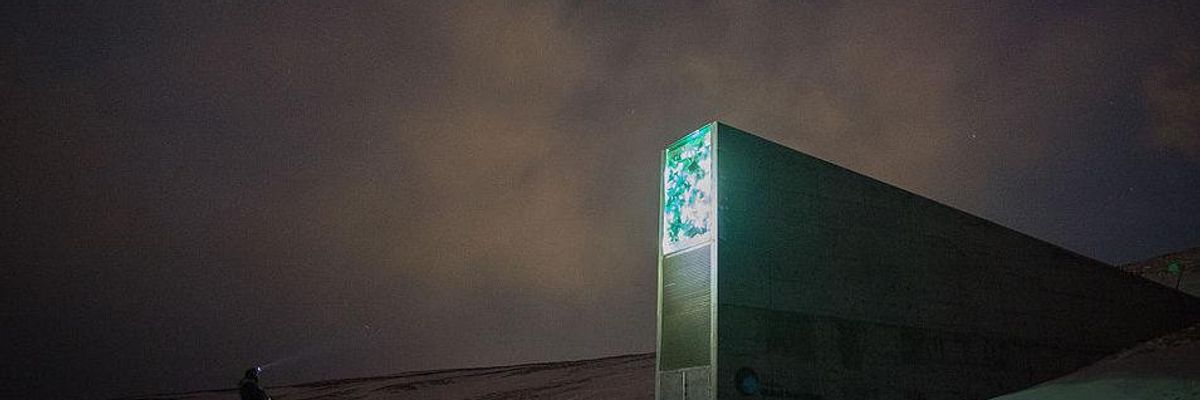
Dusk at the Svalbard Global Seed Vault.
'We Can't Trust the Permafrost Anymore': Doomsday Vault at Risk in Norway
"Not good."
Just over a decade after it first opened, the world's "doomsday vault" of seeds is imperiled by climate change as the polar region where it's located warms faster than any other area on the planet.
The Svalbard Global Seed Vault, which opened in late February 2008, was built by the organization Crop Trust and the Norwegian government on the island of Svalbard next to the northernmost town in the world with more than 1,000 residents, Longyearbyen.
"Svalbard is the ultimate failsafe for biodiversity of crops," said Crop Trust executive director Marie Haga.
Northern temperatures and environment on the island were a major reason for the construction. According to in-depth reporting from CNN, the project planners hoped that the permafrost around the construction of the underground vault would, in time, refreeze. But the planet has other plans.
Longyearbyen and, by extension, the vault, is warming more rapidly than the rest of the planet. That's because the polar regions of Earth--the coldest areas on the planet--are less able to reflect sunlight away from the polar seas due to disappearing ice and snow cover.
It's an ironic turn of events for the creators of the vault, who chose the location for the vault "because the area is not prone to volcanoes or earthquakes, while the Norwegian political system is also extremely stable,'" said CNN.
Because of the warming, the permafrost around the underground vault's tunnel entrance has not refrozen. That led to leaking water in the tunnel in October 2016, which then froze into ice.
In response, CNN reported, "Statsbygg [the Norwegian state agency in charge of real estate] undertook 100 million Norwegian krone ($11.7 million) of reconstruction work, more than double the original cost of the structure."
But the warming now may become unsustainable for the structure. It's already forcing changes to Longyearbyen's population of 2,144 as the people in the town find themselves scrambling to avoid avalanches and deal with a changing climate that's more often dumping rain rather than snow.
"We can't trust the permafrost anymore," said Statsbygg communications manager Hege Njaa Aschim.
British advocacy group Global Citizen was more to the point.
"Not good," the group tweeted.
We are at a crossroads
This country and this world are at a monumental crossroads. In a few short weeks, US voters will have an opportunity to beat back the forces of fascism and confront the billionaires who are rigging the economy, our media system, and our democracy, making it increasingly impossible for ordinary people to get by. We’re not just talking about the election. We’re talking about what must be done once these fascist elements are vanquished from power. We need a bolder set of solutions than what either major party has so far been willing to offer and a working-class movement ready to fight like hell for it. Trump didn't emerge from nowhere. The conditions that fueled MAGA authoritarianism were created by decades of radical neoliberal economic policies and a corrupt political system dominated by corporate interests. They slashed taxes on the super-rich, promising that the benefits would trickle down. They said giveaways to the corporate titans would make life more affordable for the rest of us. It was all bullshit. And when a bitter, betrayed populace searches for someone to blame, right-wing demagogues have little trouble finding scapegoats. People know when they're being lied to, but you won't hear any of this from the corporate media. Only independent journalism—powered and funded by people who believe in building a better world—can deliver truly trustworthy daily news. Our Fall Campaign is underway, and we need your help. To power our newsroom through the rest of the year, we need to raise $125,000 by midnight on October 31. So if you share our vision, please contribute whatever you can to sustain our work. |
Just over a decade after it first opened, the world's "doomsday vault" of seeds is imperiled by climate change as the polar region where it's located warms faster than any other area on the planet.
The Svalbard Global Seed Vault, which opened in late February 2008, was built by the organization Crop Trust and the Norwegian government on the island of Svalbard next to the northernmost town in the world with more than 1,000 residents, Longyearbyen.
"Svalbard is the ultimate failsafe for biodiversity of crops," said Crop Trust executive director Marie Haga.
Northern temperatures and environment on the island were a major reason for the construction. According to in-depth reporting from CNN, the project planners hoped that the permafrost around the construction of the underground vault would, in time, refreeze. But the planet has other plans.
Longyearbyen and, by extension, the vault, is warming more rapidly than the rest of the planet. That's because the polar regions of Earth--the coldest areas on the planet--are less able to reflect sunlight away from the polar seas due to disappearing ice and snow cover.
It's an ironic turn of events for the creators of the vault, who chose the location for the vault "because the area is not prone to volcanoes or earthquakes, while the Norwegian political system is also extremely stable,'" said CNN.
Because of the warming, the permafrost around the underground vault's tunnel entrance has not refrozen. That led to leaking water in the tunnel in October 2016, which then froze into ice.
In response, CNN reported, "Statsbygg [the Norwegian state agency in charge of real estate] undertook 100 million Norwegian krone ($11.7 million) of reconstruction work, more than double the original cost of the structure."
But the warming now may become unsustainable for the structure. It's already forcing changes to Longyearbyen's population of 2,144 as the people in the town find themselves scrambling to avoid avalanches and deal with a changing climate that's more often dumping rain rather than snow.
"We can't trust the permafrost anymore," said Statsbygg communications manager Hege Njaa Aschim.
British advocacy group Global Citizen was more to the point.
"Not good," the group tweeted.