SUBSCRIBE TO OUR FREE NEWSLETTER
Daily news & progressive opinion—funded by the people, not the corporations—delivered straight to your inbox.
5
#000000
#FFFFFF
To donate by check, phone, or other method, see our More Ways to Give page.
Daily news & progressive opinion—funded by the people, not the corporations—delivered straight to your inbox.
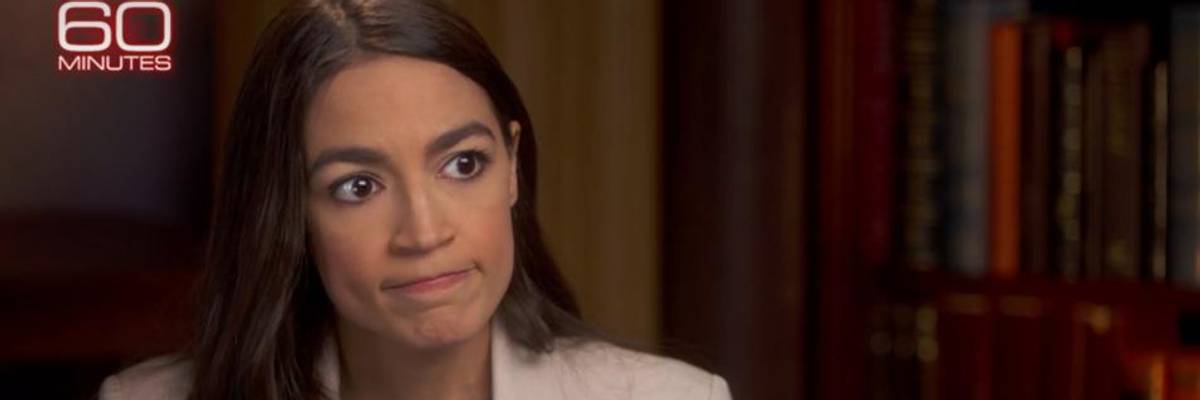
A "60 Minutes" interview with newly sworn-in Rep. Alexandria Ocasio-Cortez (D-N.Y.) is scheduled to air on CBS at 7pm ET on Sunday. (Photo: CBS News/screenshot)
In the second video featuring Rep. Alexandria Ocasio-Cortez (D-N.Y.) to make headlines in less than 24 hours, the first-term congresswoman called for major systemic changes to address the climate crisis and suggested taxing ultra wealthy Americans around 70 percent to help pay for it--declaring, "if that's what radical means, call me a radical."
The preview of Anderson Cooper's forthcoming interview with Ocasio-Cortez, which is set to air at 7pm ET Sunday on CBS's "60 Minutes," quickly caught the attention of both advocates and critics of implementing a progressive taxation scheme that, as she put, could force the rich "to start paying their fair share in taxes."
Watch:
According to CBS News, in the interview Ocasio-Cortez charges that hiking taxes on the very rich could help pay for the Green New Deal--an increasingly popular proposal among the American public and Democrats in Congress that would pair efforts to curb anthropogenic global warming with policies to create a more just economy.
A foundational goal of the Green New Deal championed by Ocasio-Cortez is fully eliminating fossil fuels and carbon emissions within the next 12 years, in line with recent demands from international climate scientists. "It's going to require a lot of rapid change that we don't even conceive as possible right now," she told Cooper, but "what is the problem with trying to push our technological capacities to the furthest extent possible?"
As Ocasio-Cortez pointed out:
You know, you look at our tax rates back in the '60s and when you have a progressive tax rate system, your tax rate, you know, let's say, from zero to $75,000 may be ten percent or 15 percent, et cetera. But once you get to, like, the tippy tops, on your 10 millionth dollar, sometimes you see tax rates as high as 60 or 70 percent. That doesn't mean all $10 million are taxed at an extremely high rate, but it means that as you climb up this ladder you should be contributing more.
After Cooper suggested that such a plan is considered "radical" in the context of the current U.S. political system, she responded: "I think that it only has ever been radicals that have changed this country. Abraham Lincoln made the radical decision to sign the Emancipation Proclamation. Franklin Delano Roosevelt made the radical decision to embark on establishing programs like Social Security. That is radical."
Expanding on her remarks in a tweet that included the video on Friday morning, she added: "Sometimes we take for granted exactly how radical ideas like Social Security, the VA, and public schooling really are: that we will care for our elders, provide healthcare, and educate *all* children in America free of cost at the point of service."
In a Twitter thread, Michael Linden, a Roosevelt Institute fellow who also serves as managing director of policy and research at the Hub Project, welcomed Ocasio-Cortez's tax suggestions, breaking down why she is "on very solid ground here," as "there is a lot of evidence that from an economic and fiscal perspective, we'd be way better off with top rates approaching 70 [percent]."
"The basic question we should ask: Will the investment financed by the higher tax rates generate more good than the lower rate would?" Linden posed. His conclusion? Yes, raising taxes on the rich would have a net positive impact. As he put it, "There will be many on the right and in the media who will mock @AOC for calling for tax rates at 60 or 70, but they're the ones who are economically illiterate. They're basing their view on an outdated and ideological understanding of taxation, not on the best research."
Responding to Politico's reporting on the video, John Iadarola of The Young Turks offered an alternative headline on Twitter, acknowledging that Ocasio-Cortez's proposal is the "same top tax rate U.S. had for literally decades during a time of unprecedented, historic growth."
Others responded to Cooper's apparent surprise at the congresswoman's so-called radical suggestions by noting that he is the son of fashion designer and heiress Gloria Vanderbilt, a descendant of railroad tycoon Cornelius Vanderbilt. While Cooper has said, "I don't believe in inheriting money," Town & Country reported in 2017 that independent of his family fortune, he makes "$11 million a year and is worth about $100 million."
As for the other video that provoked recent headlines--which shows Ocasio-Cortez dancing on a rooftop as a Boston University student, borrowing moves from the famous '80s film The Breakfast Club--the congresswoman responded early Friday afternoon to the failed right-wing effort to embarrass her:
This post has been updated with comment from John Iadarola, Kate Aronoff, and Adam Johnson.
Dear Common Dreams reader, It’s been nearly 30 years since I co-founded Common Dreams with my late wife, Lina Newhouser. We had the radical notion that journalism should serve the public good, not corporate profits. It was clear to us from the outset what it would take to build such a project. No paid advertisements. No corporate sponsors. No millionaire publisher telling us what to think or do. Many people said we wouldn't last a year, but we proved those doubters wrong. Together with a tremendous team of journalists and dedicated staff, we built an independent media outlet free from the constraints of profits and corporate control. Our mission has always been simple: To inform. To inspire. To ignite change for the common good. Building Common Dreams was not easy. Our survival was never guaranteed. When you take on the most powerful forces—Wall Street greed, fossil fuel industry destruction, Big Tech lobbyists, and uber-rich oligarchs who have spent billions upon billions rigging the economy and democracy in their favor—the only bulwark you have is supporters who believe in your work. But here’s the urgent message from me today. It's never been this bad out there. And it's never been this hard to keep us going. At the very moment Common Dreams is most needed, the threats we face are intensifying. We need your support now more than ever. We don't accept corporate advertising and never will. We don't have a paywall because we don't think people should be blocked from critical news based on their ability to pay. Everything we do is funded by the donations of readers like you. When everyone does the little they can afford, we are strong. But if that support retreats or dries up, so do we. Will you donate now to make sure Common Dreams not only survives but thrives? —Craig Brown, Co-founder |
In the second video featuring Rep. Alexandria Ocasio-Cortez (D-N.Y.) to make headlines in less than 24 hours, the first-term congresswoman called for major systemic changes to address the climate crisis and suggested taxing ultra wealthy Americans around 70 percent to help pay for it--declaring, "if that's what radical means, call me a radical."
The preview of Anderson Cooper's forthcoming interview with Ocasio-Cortez, which is set to air at 7pm ET Sunday on CBS's "60 Minutes," quickly caught the attention of both advocates and critics of implementing a progressive taxation scheme that, as she put, could force the rich "to start paying their fair share in taxes."
Watch:
According to CBS News, in the interview Ocasio-Cortez charges that hiking taxes on the very rich could help pay for the Green New Deal--an increasingly popular proposal among the American public and Democrats in Congress that would pair efforts to curb anthropogenic global warming with policies to create a more just economy.
A foundational goal of the Green New Deal championed by Ocasio-Cortez is fully eliminating fossil fuels and carbon emissions within the next 12 years, in line with recent demands from international climate scientists. "It's going to require a lot of rapid change that we don't even conceive as possible right now," she told Cooper, but "what is the problem with trying to push our technological capacities to the furthest extent possible?"
As Ocasio-Cortez pointed out:
You know, you look at our tax rates back in the '60s and when you have a progressive tax rate system, your tax rate, you know, let's say, from zero to $75,000 may be ten percent or 15 percent, et cetera. But once you get to, like, the tippy tops, on your 10 millionth dollar, sometimes you see tax rates as high as 60 or 70 percent. That doesn't mean all $10 million are taxed at an extremely high rate, but it means that as you climb up this ladder you should be contributing more.
After Cooper suggested that such a plan is considered "radical" in the context of the current U.S. political system, she responded: "I think that it only has ever been radicals that have changed this country. Abraham Lincoln made the radical decision to sign the Emancipation Proclamation. Franklin Delano Roosevelt made the radical decision to embark on establishing programs like Social Security. That is radical."
Expanding on her remarks in a tweet that included the video on Friday morning, she added: "Sometimes we take for granted exactly how radical ideas like Social Security, the VA, and public schooling really are: that we will care for our elders, provide healthcare, and educate *all* children in America free of cost at the point of service."
In a Twitter thread, Michael Linden, a Roosevelt Institute fellow who also serves as managing director of policy and research at the Hub Project, welcomed Ocasio-Cortez's tax suggestions, breaking down why she is "on very solid ground here," as "there is a lot of evidence that from an economic and fiscal perspective, we'd be way better off with top rates approaching 70 [percent]."
"The basic question we should ask: Will the investment financed by the higher tax rates generate more good than the lower rate would?" Linden posed. His conclusion? Yes, raising taxes on the rich would have a net positive impact. As he put it, "There will be many on the right and in the media who will mock @AOC for calling for tax rates at 60 or 70, but they're the ones who are economically illiterate. They're basing their view on an outdated and ideological understanding of taxation, not on the best research."
Responding to Politico's reporting on the video, John Iadarola of The Young Turks offered an alternative headline on Twitter, acknowledging that Ocasio-Cortez's proposal is the "same top tax rate U.S. had for literally decades during a time of unprecedented, historic growth."
Others responded to Cooper's apparent surprise at the congresswoman's so-called radical suggestions by noting that he is the son of fashion designer and heiress Gloria Vanderbilt, a descendant of railroad tycoon Cornelius Vanderbilt. While Cooper has said, "I don't believe in inheriting money," Town & Country reported in 2017 that independent of his family fortune, he makes "$11 million a year and is worth about $100 million."
As for the other video that provoked recent headlines--which shows Ocasio-Cortez dancing on a rooftop as a Boston University student, borrowing moves from the famous '80s film The Breakfast Club--the congresswoman responded early Friday afternoon to the failed right-wing effort to embarrass her:
This post has been updated with comment from John Iadarola, Kate Aronoff, and Adam Johnson.
In the second video featuring Rep. Alexandria Ocasio-Cortez (D-N.Y.) to make headlines in less than 24 hours, the first-term congresswoman called for major systemic changes to address the climate crisis and suggested taxing ultra wealthy Americans around 70 percent to help pay for it--declaring, "if that's what radical means, call me a radical."
The preview of Anderson Cooper's forthcoming interview with Ocasio-Cortez, which is set to air at 7pm ET Sunday on CBS's "60 Minutes," quickly caught the attention of both advocates and critics of implementing a progressive taxation scheme that, as she put, could force the rich "to start paying their fair share in taxes."
Watch:
According to CBS News, in the interview Ocasio-Cortez charges that hiking taxes on the very rich could help pay for the Green New Deal--an increasingly popular proposal among the American public and Democrats in Congress that would pair efforts to curb anthropogenic global warming with policies to create a more just economy.
A foundational goal of the Green New Deal championed by Ocasio-Cortez is fully eliminating fossil fuels and carbon emissions within the next 12 years, in line with recent demands from international climate scientists. "It's going to require a lot of rapid change that we don't even conceive as possible right now," she told Cooper, but "what is the problem with trying to push our technological capacities to the furthest extent possible?"
As Ocasio-Cortez pointed out:
You know, you look at our tax rates back in the '60s and when you have a progressive tax rate system, your tax rate, you know, let's say, from zero to $75,000 may be ten percent or 15 percent, et cetera. But once you get to, like, the tippy tops, on your 10 millionth dollar, sometimes you see tax rates as high as 60 or 70 percent. That doesn't mean all $10 million are taxed at an extremely high rate, but it means that as you climb up this ladder you should be contributing more.
After Cooper suggested that such a plan is considered "radical" in the context of the current U.S. political system, she responded: "I think that it only has ever been radicals that have changed this country. Abraham Lincoln made the radical decision to sign the Emancipation Proclamation. Franklin Delano Roosevelt made the radical decision to embark on establishing programs like Social Security. That is radical."
Expanding on her remarks in a tweet that included the video on Friday morning, she added: "Sometimes we take for granted exactly how radical ideas like Social Security, the VA, and public schooling really are: that we will care for our elders, provide healthcare, and educate *all* children in America free of cost at the point of service."
In a Twitter thread, Michael Linden, a Roosevelt Institute fellow who also serves as managing director of policy and research at the Hub Project, welcomed Ocasio-Cortez's tax suggestions, breaking down why she is "on very solid ground here," as "there is a lot of evidence that from an economic and fiscal perspective, we'd be way better off with top rates approaching 70 [percent]."
"The basic question we should ask: Will the investment financed by the higher tax rates generate more good than the lower rate would?" Linden posed. His conclusion? Yes, raising taxes on the rich would have a net positive impact. As he put it, "There will be many on the right and in the media who will mock @AOC for calling for tax rates at 60 or 70, but they're the ones who are economically illiterate. They're basing their view on an outdated and ideological understanding of taxation, not on the best research."
Responding to Politico's reporting on the video, John Iadarola of The Young Turks offered an alternative headline on Twitter, acknowledging that Ocasio-Cortez's proposal is the "same top tax rate U.S. had for literally decades during a time of unprecedented, historic growth."
Others responded to Cooper's apparent surprise at the congresswoman's so-called radical suggestions by noting that he is the son of fashion designer and heiress Gloria Vanderbilt, a descendant of railroad tycoon Cornelius Vanderbilt. While Cooper has said, "I don't believe in inheriting money," Town & Country reported in 2017 that independent of his family fortune, he makes "$11 million a year and is worth about $100 million."
As for the other video that provoked recent headlines--which shows Ocasio-Cortez dancing on a rooftop as a Boston University student, borrowing moves from the famous '80s film The Breakfast Club--the congresswoman responded early Friday afternoon to the failed right-wing effort to embarrass her:
This post has been updated with comment from John Iadarola, Kate Aronoff, and Adam Johnson.