
SUBSCRIBE TO OUR FREE NEWSLETTER
Daily news & progressive opinion—funded by the people, not the corporations—delivered straight to your inbox.
5
#000000
#FFFFFF
To donate by check, phone, or other method, see our More Ways to Give page.
Daily news & progressive opinion—funded by the people, not the corporations—delivered straight to your inbox.
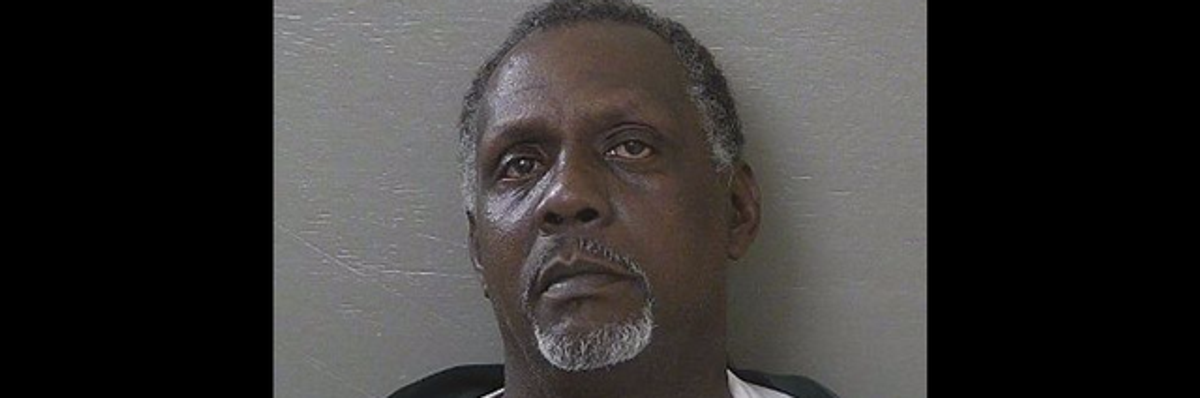
Robert Spellman was sentence last week to 20 years in prison for stealing ten cartons of cigarettes from a local convenience store. (Photo: Escambia County Jail)
Ten years after the behavior of over-leveraged and fraudulent banks created a global financial disaster that resulted in hundreds of billions of dollars in losses; a multi-trillion bailout using public money; and millions of people losing their homes to foreclosure, but saw not one high-level financial executive go to jail, a man in Florida has been sentenced to a 20-year prison term for stealing $600 worth of cigarettes from a local convenience store.
According to the Associated Press, "Robert Spellman, 48, received the lengthy sentence after a jury in Pensacola convicted him of burglary and grand theft last month." As the Pensacola News Journal reports:
He went into the Circle K in the 200 block of West Cervantes Street and took 10 cartons of cigarettes from a locked manager's office in the stock room.
He was found nearby, matched a description of the suspect, was wearing the same clothing and had the cigarettes, according to the State Attorney's Office.
Spellman had 14 felony and 31 misdemeanor convictions prior to this charge, so his 20-year sentence qualifies him as a habitual felony offender.
While the average carton contains 200 cigarettes, that means Spellman will now serve approximately 3.65 days in prison for each of the 2,000 cigarettes he allegedly stole.
Asked in 2016 about why no high-level bankers went to jail after the 2008 crash, former Attorney General Eric Holder lamented that reality by claiming the DOJ just coudn't make the cases stick, though said he wished it had been possible:
Writing about the tenth anniversary of the 2008 crash last month in Rolling Stone, journalist Matt Taibbi noted that while "everyone in the upper echelon of the finance community got Paid In Full in the bailout, even the exact people who screwed up the worst," those whose suffered most of the "miserable story turned out to be poor, nonwhite, and elderly."
Though it's likely that most poor, nonwhite, and elderly Americans didn't need to be told that.
This country and this world are at a monumental crossroads. US voters have an opportunity to beat back the forces of fascism and confront the billionaires who are rigging the economy, our media system, and our democracy, making it increasingly impossible for ordinary people to get by. We’re not just talking about the election. We’re talking about what must be done once these fascist elements are vanquished from power. We need a bolder set of solutions than what either major party has so far been willing to offer and a working-class movement ready to fight like hell for it. Trump didn't emerge from nowhere. The conditions that fueled MAGA authoritarianism were created by decades of radical neoliberal economic policies and a corrupt political system dominated by corporate interests. They slashed taxes on the super-rich, promising that the benefits would trickle down. They said giveaways to the corporate titans would make life more affordable for the rest of us. It was all bullshit. And when a bitter, betrayed populace searches for someone to blame, right-wing demagogues have little trouble finding scapegoats. People know when they're being lied to, but you won't hear any of this from the corporate media. Only independent journalism—powered and funded by people who believe in building a better world—can deliver truly trustworthy daily news. If you share our vision, please contribute whatever you can to sustain our work. |
Ten years after the behavior of over-leveraged and fraudulent banks created a global financial disaster that resulted in hundreds of billions of dollars in losses; a multi-trillion bailout using public money; and millions of people losing their homes to foreclosure, but saw not one high-level financial executive go to jail, a man in Florida has been sentenced to a 20-year prison term for stealing $600 worth of cigarettes from a local convenience store.
According to the Associated Press, "Robert Spellman, 48, received the lengthy sentence after a jury in Pensacola convicted him of burglary and grand theft last month." As the Pensacola News Journal reports:
He went into the Circle K in the 200 block of West Cervantes Street and took 10 cartons of cigarettes from a locked manager's office in the stock room.
He was found nearby, matched a description of the suspect, was wearing the same clothing and had the cigarettes, according to the State Attorney's Office.
Spellman had 14 felony and 31 misdemeanor convictions prior to this charge, so his 20-year sentence qualifies him as a habitual felony offender.
While the average carton contains 200 cigarettes, that means Spellman will now serve approximately 3.65 days in prison for each of the 2,000 cigarettes he allegedly stole.
Asked in 2016 about why no high-level bankers went to jail after the 2008 crash, former Attorney General Eric Holder lamented that reality by claiming the DOJ just coudn't make the cases stick, though said he wished it had been possible:
Writing about the tenth anniversary of the 2008 crash last month in Rolling Stone, journalist Matt Taibbi noted that while "everyone in the upper echelon of the finance community got Paid In Full in the bailout, even the exact people who screwed up the worst," those whose suffered most of the "miserable story turned out to be poor, nonwhite, and elderly."
Though it's likely that most poor, nonwhite, and elderly Americans didn't need to be told that.
Ten years after the behavior of over-leveraged and fraudulent banks created a global financial disaster that resulted in hundreds of billions of dollars in losses; a multi-trillion bailout using public money; and millions of people losing their homes to foreclosure, but saw not one high-level financial executive go to jail, a man in Florida has been sentenced to a 20-year prison term for stealing $600 worth of cigarettes from a local convenience store.
According to the Associated Press, "Robert Spellman, 48, received the lengthy sentence after a jury in Pensacola convicted him of burglary and grand theft last month." As the Pensacola News Journal reports:
He went into the Circle K in the 200 block of West Cervantes Street and took 10 cartons of cigarettes from a locked manager's office in the stock room.
He was found nearby, matched a description of the suspect, was wearing the same clothing and had the cigarettes, according to the State Attorney's Office.
Spellman had 14 felony and 31 misdemeanor convictions prior to this charge, so his 20-year sentence qualifies him as a habitual felony offender.
While the average carton contains 200 cigarettes, that means Spellman will now serve approximately 3.65 days in prison for each of the 2,000 cigarettes he allegedly stole.
Asked in 2016 about why no high-level bankers went to jail after the 2008 crash, former Attorney General Eric Holder lamented that reality by claiming the DOJ just coudn't make the cases stick, though said he wished it had been possible:
Writing about the tenth anniversary of the 2008 crash last month in Rolling Stone, journalist Matt Taibbi noted that while "everyone in the upper echelon of the finance community got Paid In Full in the bailout, even the exact people who screwed up the worst," those whose suffered most of the "miserable story turned out to be poor, nonwhite, and elderly."
Though it's likely that most poor, nonwhite, and elderly Americans didn't need to be told that.