SUBSCRIBE TO OUR FREE NEWSLETTER
Daily news & progressive opinion—funded by the people, not the corporations—delivered straight to your inbox.
5
#000000
#FFFFFF
To donate by check, phone, or other method, see our More Ways to Give page.
Daily news & progressive opinion—funded by the people, not the corporations—delivered straight to your inbox.
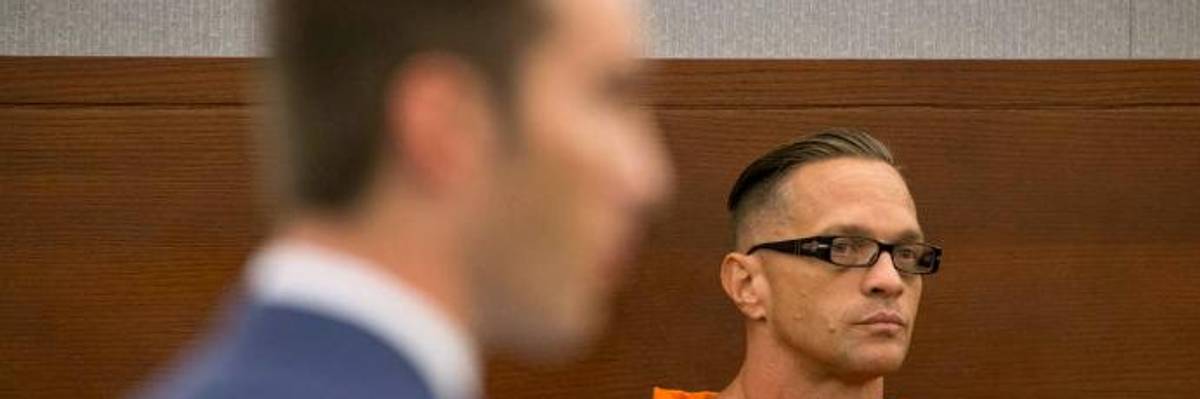
Scott Raymond Dozier appears at hearing about his execution at the Regional Justice Center on Sept. 11, 2017, in Las Vegas, Nevada. (Photo: Richard Brian/Las Vegas Review-Journal)
A Nevada judge halted an execution scheduled for 8pm local time on Wednesday after the pharmaceutical company Alvogen filed suit alleging the state illegally obtained its sedative midazolam--which has been part of multiple previous botched executions in other states and was one of three drugs Nevada planned to include in a cocktail that's never been used for lethal injection in the United States.
Alvogen's complaint, filed Tuesday, pointed out that "past attempts by other states to use the medicine in lethal injections have been extremely controversial, and have led to widespread concern that prisoners have been exposed to cruel and unusual treatment." The company alleged Nevada purchased the drug "by subterfuge with the undisclosed and improper intent to use it for the upcoming execution in complete disregard of plaintiff's rights."
While Assistant Solicitor General Jordan Smith claimed the company's "whole action is just PR damage control" and reportedly argued that Clark County District Court Judge Elizabeth Gonzalez had "no authority to stay the execution," the judge issued a temporary restraining order that bars the state from using midazolam and set another hearing for September 10, effectively delaying the execution of 47-year-old Scott Raymond Dozier.
The condemned man was sentenced to death in 2007 for a first-degree murder conviction in Nevada following a previous second-degree murder conviction in Arizona. Although Dozier waived his appeals in 2016 and told reporters he wishes to be put to death rather than held in prison, human rights advocates have not wavered in opposing plans for his execution.
Noting that "eyewitness accounts of recent executions using midazolam are full of grizzly details," ACLU Nevada's legal director Amy Rose wrote in a blog post on Wednesday. "It is deeply troubling that Nevada government officials are barreling ahead with execution when the chances of torturing Dozier are so high."
"These executions are not justice--they are inhumane and unacceptable," Rose added. "Capital punishment is an intolerable denial of civil liberties and is inconsistent with the fundamental values of our democratic system. A government that would risk torturing someone to death is not dispensing justice or serving the public good."
The "risky combination of drugs" Nevada planned to used to kill Dozier also included the painkiller fentanyl and the paralytic cisatracurium.
"A second pharmaceutical company, Sandoz, also raised objections at Wednesday's hearing to the use of one of its drugs--the muscle-paralyzing substance cisatracurium--in Dozier's execution. But the company did not immediately ask to formally join Alvogen's lawsuit," The Associated Press reported. "A third company, Pfizer, last year demanded Nevada return the third drug intended for use in the execution, the powerful opioid fentanyl. But the state refused."
Alvogen's lawsuit is only the second time a drug company has tried to halt an execution over the use of its products, the AP noted, citing Robert Dunham, executive director of the Death Penalty Information Center. The first attempt--by a different company in Arkansas--failed last year.
Nathan O'Neal of KSNV News 3, an NBC affiliate, and Las Vegas Review-Journal reporter David Ferrara said on Twitter Wednesday that Smith plans to file an emergency appeal with Nevada's Supreme Court to force the execution to proceed, but the high court has not yet received the filing.
This country and this world are at a monumental crossroads. US voters have an opportunity to beat back the forces of fascism and confront the billionaires who are rigging the economy, our media system, and our democracy, making it increasingly impossible for ordinary people to get by. We’re not just talking about the election. We’re talking about what must be done once these fascist elements are vanquished from power. We need a bolder set of solutions than what either major party has so far been willing to offer and a working-class movement ready to fight like hell for it. Trump didn't emerge from nowhere. The conditions that fueled MAGA authoritarianism were created by decades of radical neoliberal economic policies and a corrupt political system dominated by corporate interests. They slashed taxes on the super-rich, promising that the benefits would trickle down. They said giveaways to the corporate titans would make life more affordable for the rest of us. It was all bullshit. And when a bitter, betrayed populace searches for someone to blame, right-wing demagogues have little trouble finding scapegoats. People know when they're being lied to, but you won't hear any of this from the corporate media. Only independent journalism—powered and funded by people who believe in building a better world—can deliver truly trustworthy daily news. If you share our vision, please contribute whatever you can to sustain our work. |
A Nevada judge halted an execution scheduled for 8pm local time on Wednesday after the pharmaceutical company Alvogen filed suit alleging the state illegally obtained its sedative midazolam--which has been part of multiple previous botched executions in other states and was one of three drugs Nevada planned to include in a cocktail that's never been used for lethal injection in the United States.
Alvogen's complaint, filed Tuesday, pointed out that "past attempts by other states to use the medicine in lethal injections have been extremely controversial, and have led to widespread concern that prisoners have been exposed to cruel and unusual treatment." The company alleged Nevada purchased the drug "by subterfuge with the undisclosed and improper intent to use it for the upcoming execution in complete disregard of plaintiff's rights."
While Assistant Solicitor General Jordan Smith claimed the company's "whole action is just PR damage control" and reportedly argued that Clark County District Court Judge Elizabeth Gonzalez had "no authority to stay the execution," the judge issued a temporary restraining order that bars the state from using midazolam and set another hearing for September 10, effectively delaying the execution of 47-year-old Scott Raymond Dozier.
The condemned man was sentenced to death in 2007 for a first-degree murder conviction in Nevada following a previous second-degree murder conviction in Arizona. Although Dozier waived his appeals in 2016 and told reporters he wishes to be put to death rather than held in prison, human rights advocates have not wavered in opposing plans for his execution.
Noting that "eyewitness accounts of recent executions using midazolam are full of grizzly details," ACLU Nevada's legal director Amy Rose wrote in a blog post on Wednesday. "It is deeply troubling that Nevada government officials are barreling ahead with execution when the chances of torturing Dozier are so high."
"These executions are not justice--they are inhumane and unacceptable," Rose added. "Capital punishment is an intolerable denial of civil liberties and is inconsistent with the fundamental values of our democratic system. A government that would risk torturing someone to death is not dispensing justice or serving the public good."
The "risky combination of drugs" Nevada planned to used to kill Dozier also included the painkiller fentanyl and the paralytic cisatracurium.
"A second pharmaceutical company, Sandoz, also raised objections at Wednesday's hearing to the use of one of its drugs--the muscle-paralyzing substance cisatracurium--in Dozier's execution. But the company did not immediately ask to formally join Alvogen's lawsuit," The Associated Press reported. "A third company, Pfizer, last year demanded Nevada return the third drug intended for use in the execution, the powerful opioid fentanyl. But the state refused."
Alvogen's lawsuit is only the second time a drug company has tried to halt an execution over the use of its products, the AP noted, citing Robert Dunham, executive director of the Death Penalty Information Center. The first attempt--by a different company in Arkansas--failed last year.
Nathan O'Neal of KSNV News 3, an NBC affiliate, and Las Vegas Review-Journal reporter David Ferrara said on Twitter Wednesday that Smith plans to file an emergency appeal with Nevada's Supreme Court to force the execution to proceed, but the high court has not yet received the filing.