SUBSCRIBE TO OUR FREE NEWSLETTER
Daily news & progressive opinion—funded by the people, not the corporations—delivered straight to your inbox.
5
#000000
#FFFFFF
To donate by check, phone, or other method, see our More Ways to Give page.
Daily news & progressive opinion—funded by the people, not the corporations—delivered straight to your inbox.
A central provision of the historic Voting Rights Act of 1965 faced heavy fire Wednesday from the right-leaning members of the U.S. Supreme Court, indicating that this "bulwark against racial discrimination in voting" is under real threat.
The Supreme Court Justices took in oral arguments regarding Section 5 of the VRA, the point of contention in Shelby County v. Holder, which requires all or parts of 16 "covered" states with long histories and contemporary records of voting discrimination to get federal clearance before making any changes to their voting laws.
Recalling earlier racial statements made by GOP nominee Mitt Romney of "gifts" to minority groups, Justice Antonin Scalia inflamed many civil rights proponents when he suggested that the continuation of Section 5 represented the "perpetuation of racial entitlement." Adding, "Whenever a society adopts racial entitlements, it is very difficult to get out of them through the normal political processes."
Progressive advocacy group Demos responded to the statement calling it "a shameless inversion of history," adding, "Section 5 of the Voting Rights Act has stood as a bulwark against racial discrimination in voting. It is widely recognized as one of the most effective and important civil rights laws ever enacted in this country."
Chief Justice John G. Roberts Jr. also challenged the defense with a skeptical question about whether people in the South are more racist than those in the North.
Justice Anthony M. Kennedy, who many look to as the swing vote in this case, asked how much longer Alabama must live "under the trusteeship of the United States government."
"The Marshall Plan was very good, too--the Northwest Ordinance, the Morrill Act--but times change," Kennedy added, indicating skepticism over the continuation of the rule.
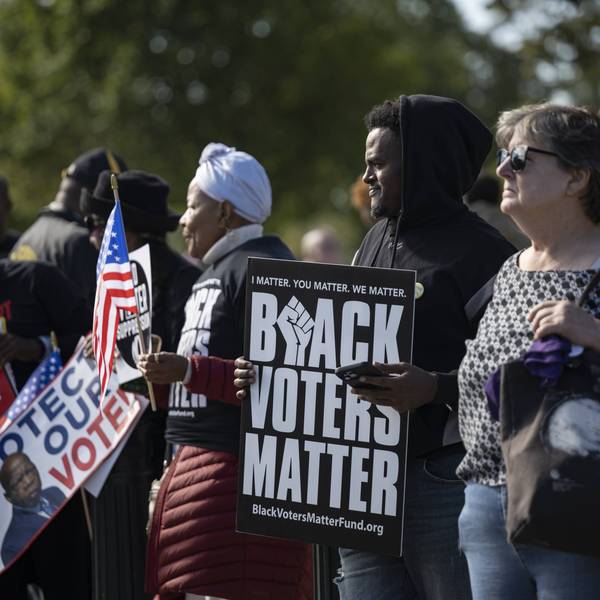
Before heading inside to hear the arguments, hundreds of civil and voting rights advocates rallied on the Supreme Court steps Wednesday morning.
"The literacy tests may be gone but we still need Section 5 and that is why we are here today," Congressman John Lewis (D-Ga.) told the crowd.
"The Voting Rights Act restored justice, equality, and fairness to our country's most sacred right," added Rep. Ruben Hinojosa (D-Tex.), chairman of the Congressional Hispanic Caucus. "We are now witnessing unprecedented attacks on the right to vote and now more than ever."
_____________________
Dear Common Dreams reader, It’s been nearly 30 years since I co-founded Common Dreams with my late wife, Lina Newhouser. We had the radical notion that journalism should serve the public good, not corporate profits. It was clear to us from the outset what it would take to build such a project. No paid advertisements. No corporate sponsors. No millionaire publisher telling us what to think or do. Many people said we wouldn't last a year, but we proved those doubters wrong. Together with a tremendous team of journalists and dedicated staff, we built an independent media outlet free from the constraints of profits and corporate control. Our mission has always been simple: To inform. To inspire. To ignite change for the common good. Building Common Dreams was not easy. Our survival was never guaranteed. When you take on the most powerful forces—Wall Street greed, fossil fuel industry destruction, Big Tech lobbyists, and uber-rich oligarchs who have spent billions upon billions rigging the economy and democracy in their favor—the only bulwark you have is supporters who believe in your work. But here’s the urgent message from me today. It's never been this bad out there. And it's never been this hard to keep us going. At the very moment Common Dreams is most needed, the threats we face are intensifying. We need your support now more than ever. We don't accept corporate advertising and never will. We don't have a paywall because we don't think people should be blocked from critical news based on their ability to pay. Everything we do is funded by the donations of readers like you. When everyone does the little they can afford, we are strong. But if that support retreats or dries up, so do we. Will you donate now to make sure Common Dreams not only survives but thrives? —Craig Brown, Co-founder |
A central provision of the historic Voting Rights Act of 1965 faced heavy fire Wednesday from the right-leaning members of the U.S. Supreme Court, indicating that this "bulwark against racial discrimination in voting" is under real threat.
The Supreme Court Justices took in oral arguments regarding Section 5 of the VRA, the point of contention in Shelby County v. Holder, which requires all or parts of 16 "covered" states with long histories and contemporary records of voting discrimination to get federal clearance before making any changes to their voting laws.
Recalling earlier racial statements made by GOP nominee Mitt Romney of "gifts" to minority groups, Justice Antonin Scalia inflamed many civil rights proponents when he suggested that the continuation of Section 5 represented the "perpetuation of racial entitlement." Adding, "Whenever a society adopts racial entitlements, it is very difficult to get out of them through the normal political processes."
Progressive advocacy group Demos responded to the statement calling it "a shameless inversion of history," adding, "Section 5 of the Voting Rights Act has stood as a bulwark against racial discrimination in voting. It is widely recognized as one of the most effective and important civil rights laws ever enacted in this country."
Chief Justice John G. Roberts Jr. also challenged the defense with a skeptical question about whether people in the South are more racist than those in the North.
Justice Anthony M. Kennedy, who many look to as the swing vote in this case, asked how much longer Alabama must live "under the trusteeship of the United States government."
"The Marshall Plan was very good, too--the Northwest Ordinance, the Morrill Act--but times change," Kennedy added, indicating skepticism over the continuation of the rule.
Before heading inside to hear the arguments, hundreds of civil and voting rights advocates rallied on the Supreme Court steps Wednesday morning.
"The literacy tests may be gone but we still need Section 5 and that is why we are here today," Congressman John Lewis (D-Ga.) told the crowd.
"The Voting Rights Act restored justice, equality, and fairness to our country's most sacred right," added Rep. Ruben Hinojosa (D-Tex.), chairman of the Congressional Hispanic Caucus. "We are now witnessing unprecedented attacks on the right to vote and now more than ever."
_____________________
A central provision of the historic Voting Rights Act of 1965 faced heavy fire Wednesday from the right-leaning members of the U.S. Supreme Court, indicating that this "bulwark against racial discrimination in voting" is under real threat.
The Supreme Court Justices took in oral arguments regarding Section 5 of the VRA, the point of contention in Shelby County v. Holder, which requires all or parts of 16 "covered" states with long histories and contemporary records of voting discrimination to get federal clearance before making any changes to their voting laws.
Recalling earlier racial statements made by GOP nominee Mitt Romney of "gifts" to minority groups, Justice Antonin Scalia inflamed many civil rights proponents when he suggested that the continuation of Section 5 represented the "perpetuation of racial entitlement." Adding, "Whenever a society adopts racial entitlements, it is very difficult to get out of them through the normal political processes."
Progressive advocacy group Demos responded to the statement calling it "a shameless inversion of history," adding, "Section 5 of the Voting Rights Act has stood as a bulwark against racial discrimination in voting. It is widely recognized as one of the most effective and important civil rights laws ever enacted in this country."
Chief Justice John G. Roberts Jr. also challenged the defense with a skeptical question about whether people in the South are more racist than those in the North.
Justice Anthony M. Kennedy, who many look to as the swing vote in this case, asked how much longer Alabama must live "under the trusteeship of the United States government."
"The Marshall Plan was very good, too--the Northwest Ordinance, the Morrill Act--but times change," Kennedy added, indicating skepticism over the continuation of the rule.
Before heading inside to hear the arguments, hundreds of civil and voting rights advocates rallied on the Supreme Court steps Wednesday morning.
"The literacy tests may be gone but we still need Section 5 and that is why we are here today," Congressman John Lewis (D-Ga.) told the crowd.
"The Voting Rights Act restored justice, equality, and fairness to our country's most sacred right," added Rep. Ruben Hinojosa (D-Tex.), chairman of the Congressional Hispanic Caucus. "We are now witnessing unprecedented attacks on the right to vote and now more than ever."
_____________________