SUBSCRIBE TO OUR FREE NEWSLETTER
Daily news & progressive opinion—funded by the people, not the corporations—delivered straight to your inbox.
5
#000000
#FFFFFF
To donate by check, phone, or other method, see our More Ways to Give page.
Daily news & progressive opinion—funded by the people, not the corporations—delivered straight to your inbox.
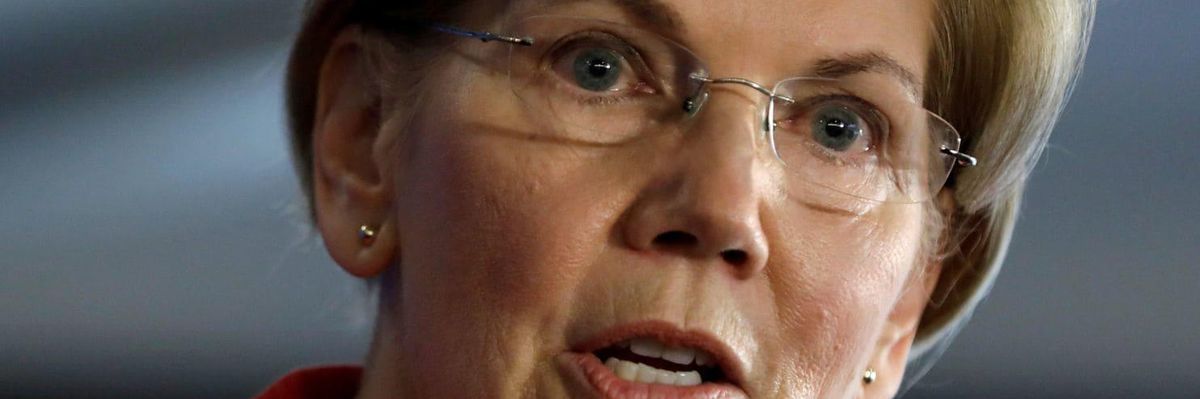
Sen. Elizabeth Warren (D-Mass.) at the National Press Club in Washington in August. (Photo: Yuri Gripas/Reuters)
It has begun.
The field of candidates for the 2020 Democratic presidential nomination is starting to form, with Sen. Elizabeth Warren (Mass.) announcing Monday that she has launched a campaign "exploratory committee" -- the same step that former housing and urban development secretary Julian Castro took earlier in December. Spoiler alert: Exploratory committees always come to the same conclusion. They're both running.
Actually, who isn't running? At this point, by some counts, as many as 30 potential Democratic candidates either have expressed interest in taking the plunge or have significant constituencies urging them to do so. If you thought the 2016 GOP debates were crowded, just wait. This year, Democrats may have to debate in shifts, or perhaps stand on risers like a choir.
And, no, they won't all be singing the same tune. That's a good thing. Even more than it needs new blood, the party needs new ideas. In the wake of President Trump's nihilistic vandalism, the next president will have much to do -- not just healing the nation, but moving it forward.
Democratic hopefuls should have a vigorous argument about Medicare-for-all. They should have fact-based debates about comprehensive immigration reform, renewing our infrastructure, worker-friendly trade policy, the Middle East wars and the best ways to confront climate change.
And they should spend zero time worrying about whether the party is being pulled too far to the left or the right. One thing Trump's election has shown is that the left-right axis on which we traditionally situate politicians is irrelevant to many voters. I'm old enough to remember when the Republican Party supported a muscular foreign policy, believed in fiscal discipline and wanted to rein in entitlements. Post-Trump, Republicans are ready to pull out of Syria, exchange fist bumps for sky-high deficits and paint themselves as staunch defenders of socialized medicine, though they do not call it that.
So should retiring Democratic Rep. John Delaney of Maryland -- an announced candidate who skipped the "exploratory" nonsense -- be seen as a "centrist" because he supports letting companies repatriate money at a lower tax rate, with the revenue to be spent on infrastructure? Or is he a "progressive," as he claims, because of his support for bold steps against climate change, including a carbon tax?
Labels are not going to sort this field out. Let's see whose ideas catch fire.
To those who bemoan coverage of the "horse race" aspect of the contest: Sorry. That's what a campaign is, and it is ridiculous to try to assess any race without noting who's ahead and who's behind.
It is also ridiculous to give too much weight to polls taken months before the first debate, and more than a year before anyone actually casts a vote. With those caveats, a mid-December poll of Democrats in Iowa, whose caucus is the first primary contest, showed former vice president Joe Biden leading all potential contenders with 32 percent support, followed by Sen. Bernie Sanders (I-Vt.) with 19 percent, rising star Beto O'Rourke, a congressman from Texas, with 11 percent, Warren with 8 percent, Sen. Kamala D. Harris (Calif.) with 5 percent, Sen. Cory Booker (N.J.) with 4 percent, former New York mayor Michael R. Bloomberg with 3 percent and Sen. Amy Klobuchar (Minn.) with 3 percent.
That's good news for all of the above. Biden and Sanders have run national campaigns, and their support is surely boosted by superior name recognition. Still, if they choose to run, they have a head start. O'Rourke should be especially happy, since he had no national profile at all before his electrifying -- but unsuccessful -- 2016 campaign against Republican Sen. Ted Cruz, who should have waltzed to reelection but, instead, almost got sent home to Houston.
Warren should be pleased, too. She has systematically laid the groundwork for her candidacy, traveling widely around the country, establishing connections, displaying her prowess as a fundraiser. Her appeal as a champion of the beleaguered middle class could resonate at a time when the phrase "economic populism" defines an increasingly powerful, if still fuzzy, strain of thought.
Bloomberg can spend billions of his own dollars campaigning, if he chooses, but might encounter a public wary of sending another wealthy Manhattanite to the White House. Harris, Booker and Klobuchar should be delighted to be on the map. And at least two other senators -- Sherrod Brown of Ohio and Kirsten Gillibrand of New York -- seem likely to be major players before this is over.
And keep this in mind: On New Year's Day 2015, no rational person thought Donald Trump would become president. Candidate X may be offstage, waiting to pounce. Buckle up.
Dear Common Dreams reader, It’s been nearly 30 years since I co-founded Common Dreams with my late wife, Lina Newhouser. We had the radical notion that journalism should serve the public good, not corporate profits. It was clear to us from the outset what it would take to build such a project. No paid advertisements. No corporate sponsors. No millionaire publisher telling us what to think or do. Many people said we wouldn't last a year, but we proved those doubters wrong. Together with a tremendous team of journalists and dedicated staff, we built an independent media outlet free from the constraints of profits and corporate control. Our mission has always been simple: To inform. To inspire. To ignite change for the common good. Building Common Dreams was not easy. Our survival was never guaranteed. When you take on the most powerful forces—Wall Street greed, fossil fuel industry destruction, Big Tech lobbyists, and uber-rich oligarchs who have spent billions upon billions rigging the economy and democracy in their favor—the only bulwark you have is supporters who believe in your work. But here’s the urgent message from me today. It's never been this bad out there. And it's never been this hard to keep us going. At the very moment Common Dreams is most needed, the threats we face are intensifying. We need your support now more than ever. We don't accept corporate advertising and never will. We don't have a paywall because we don't think people should be blocked from critical news based on their ability to pay. Everything we do is funded by the donations of readers like you. When everyone does the little they can afford, we are strong. But if that support retreats or dries up, so do we. Will you donate now to make sure Common Dreams not only survives but thrives? —Craig Brown, Co-founder |
It has begun.
The field of candidates for the 2020 Democratic presidential nomination is starting to form, with Sen. Elizabeth Warren (Mass.) announcing Monday that she has launched a campaign "exploratory committee" -- the same step that former housing and urban development secretary Julian Castro took earlier in December. Spoiler alert: Exploratory committees always come to the same conclusion. They're both running.
Actually, who isn't running? At this point, by some counts, as many as 30 potential Democratic candidates either have expressed interest in taking the plunge or have significant constituencies urging them to do so. If you thought the 2016 GOP debates were crowded, just wait. This year, Democrats may have to debate in shifts, or perhaps stand on risers like a choir.
And, no, they won't all be singing the same tune. That's a good thing. Even more than it needs new blood, the party needs new ideas. In the wake of President Trump's nihilistic vandalism, the next president will have much to do -- not just healing the nation, but moving it forward.
Democratic hopefuls should have a vigorous argument about Medicare-for-all. They should have fact-based debates about comprehensive immigration reform, renewing our infrastructure, worker-friendly trade policy, the Middle East wars and the best ways to confront climate change.
And they should spend zero time worrying about whether the party is being pulled too far to the left or the right. One thing Trump's election has shown is that the left-right axis on which we traditionally situate politicians is irrelevant to many voters. I'm old enough to remember when the Republican Party supported a muscular foreign policy, believed in fiscal discipline and wanted to rein in entitlements. Post-Trump, Republicans are ready to pull out of Syria, exchange fist bumps for sky-high deficits and paint themselves as staunch defenders of socialized medicine, though they do not call it that.
So should retiring Democratic Rep. John Delaney of Maryland -- an announced candidate who skipped the "exploratory" nonsense -- be seen as a "centrist" because he supports letting companies repatriate money at a lower tax rate, with the revenue to be spent on infrastructure? Or is he a "progressive," as he claims, because of his support for bold steps against climate change, including a carbon tax?
Labels are not going to sort this field out. Let's see whose ideas catch fire.
To those who bemoan coverage of the "horse race" aspect of the contest: Sorry. That's what a campaign is, and it is ridiculous to try to assess any race without noting who's ahead and who's behind.
It is also ridiculous to give too much weight to polls taken months before the first debate, and more than a year before anyone actually casts a vote. With those caveats, a mid-December poll of Democrats in Iowa, whose caucus is the first primary contest, showed former vice president Joe Biden leading all potential contenders with 32 percent support, followed by Sen. Bernie Sanders (I-Vt.) with 19 percent, rising star Beto O'Rourke, a congressman from Texas, with 11 percent, Warren with 8 percent, Sen. Kamala D. Harris (Calif.) with 5 percent, Sen. Cory Booker (N.J.) with 4 percent, former New York mayor Michael R. Bloomberg with 3 percent and Sen. Amy Klobuchar (Minn.) with 3 percent.
That's good news for all of the above. Biden and Sanders have run national campaigns, and their support is surely boosted by superior name recognition. Still, if they choose to run, they have a head start. O'Rourke should be especially happy, since he had no national profile at all before his electrifying -- but unsuccessful -- 2016 campaign against Republican Sen. Ted Cruz, who should have waltzed to reelection but, instead, almost got sent home to Houston.
Warren should be pleased, too. She has systematically laid the groundwork for her candidacy, traveling widely around the country, establishing connections, displaying her prowess as a fundraiser. Her appeal as a champion of the beleaguered middle class could resonate at a time when the phrase "economic populism" defines an increasingly powerful, if still fuzzy, strain of thought.
Bloomberg can spend billions of his own dollars campaigning, if he chooses, but might encounter a public wary of sending another wealthy Manhattanite to the White House. Harris, Booker and Klobuchar should be delighted to be on the map. And at least two other senators -- Sherrod Brown of Ohio and Kirsten Gillibrand of New York -- seem likely to be major players before this is over.
And keep this in mind: On New Year's Day 2015, no rational person thought Donald Trump would become president. Candidate X may be offstage, waiting to pounce. Buckle up.
It has begun.
The field of candidates for the 2020 Democratic presidential nomination is starting to form, with Sen. Elizabeth Warren (Mass.) announcing Monday that she has launched a campaign "exploratory committee" -- the same step that former housing and urban development secretary Julian Castro took earlier in December. Spoiler alert: Exploratory committees always come to the same conclusion. They're both running.
Actually, who isn't running? At this point, by some counts, as many as 30 potential Democratic candidates either have expressed interest in taking the plunge or have significant constituencies urging them to do so. If you thought the 2016 GOP debates were crowded, just wait. This year, Democrats may have to debate in shifts, or perhaps stand on risers like a choir.
And, no, they won't all be singing the same tune. That's a good thing. Even more than it needs new blood, the party needs new ideas. In the wake of President Trump's nihilistic vandalism, the next president will have much to do -- not just healing the nation, but moving it forward.
Democratic hopefuls should have a vigorous argument about Medicare-for-all. They should have fact-based debates about comprehensive immigration reform, renewing our infrastructure, worker-friendly trade policy, the Middle East wars and the best ways to confront climate change.
And they should spend zero time worrying about whether the party is being pulled too far to the left or the right. One thing Trump's election has shown is that the left-right axis on which we traditionally situate politicians is irrelevant to many voters. I'm old enough to remember when the Republican Party supported a muscular foreign policy, believed in fiscal discipline and wanted to rein in entitlements. Post-Trump, Republicans are ready to pull out of Syria, exchange fist bumps for sky-high deficits and paint themselves as staunch defenders of socialized medicine, though they do not call it that.
So should retiring Democratic Rep. John Delaney of Maryland -- an announced candidate who skipped the "exploratory" nonsense -- be seen as a "centrist" because he supports letting companies repatriate money at a lower tax rate, with the revenue to be spent on infrastructure? Or is he a "progressive," as he claims, because of his support for bold steps against climate change, including a carbon tax?
Labels are not going to sort this field out. Let's see whose ideas catch fire.
To those who bemoan coverage of the "horse race" aspect of the contest: Sorry. That's what a campaign is, and it is ridiculous to try to assess any race without noting who's ahead and who's behind.
It is also ridiculous to give too much weight to polls taken months before the first debate, and more than a year before anyone actually casts a vote. With those caveats, a mid-December poll of Democrats in Iowa, whose caucus is the first primary contest, showed former vice president Joe Biden leading all potential contenders with 32 percent support, followed by Sen. Bernie Sanders (I-Vt.) with 19 percent, rising star Beto O'Rourke, a congressman from Texas, with 11 percent, Warren with 8 percent, Sen. Kamala D. Harris (Calif.) with 5 percent, Sen. Cory Booker (N.J.) with 4 percent, former New York mayor Michael R. Bloomberg with 3 percent and Sen. Amy Klobuchar (Minn.) with 3 percent.
That's good news for all of the above. Biden and Sanders have run national campaigns, and their support is surely boosted by superior name recognition. Still, if they choose to run, they have a head start. O'Rourke should be especially happy, since he had no national profile at all before his electrifying -- but unsuccessful -- 2016 campaign against Republican Sen. Ted Cruz, who should have waltzed to reelection but, instead, almost got sent home to Houston.
Warren should be pleased, too. She has systematically laid the groundwork for her candidacy, traveling widely around the country, establishing connections, displaying her prowess as a fundraiser. Her appeal as a champion of the beleaguered middle class could resonate at a time when the phrase "economic populism" defines an increasingly powerful, if still fuzzy, strain of thought.
Bloomberg can spend billions of his own dollars campaigning, if he chooses, but might encounter a public wary of sending another wealthy Manhattanite to the White House. Harris, Booker and Klobuchar should be delighted to be on the map. And at least two other senators -- Sherrod Brown of Ohio and Kirsten Gillibrand of New York -- seem likely to be major players before this is over.
And keep this in mind: On New Year's Day 2015, no rational person thought Donald Trump would become president. Candidate X may be offstage, waiting to pounce. Buckle up.