SUBSCRIBE TO OUR FREE NEWSLETTER
Daily news & progressive opinion—funded by the people, not the corporations—delivered straight to your inbox.
5
#000000
#FFFFFF
To donate by check, phone, or other method, see our More Ways to Give page.
When should we be alarmed about so much wealth in so few hands?
The Great Recession and its anemic recovery only deepened the economic inequality that's drawn so much attention in its wake. Nearly all wealth and income gains since then have flowed to the top one-tenth of America's richest 1 percent.
The very wealthiest 400 Americans command dizzying fortunes. Their combined net worth, as catalogued in the 2015 Forbes 400 list, is $2.34 trillion. You can't make this list unless you're worth a cool $1.7 billion.
"America's skewed wealth is one of the most critical issues of our time."
These 400 rich people -- including Bill Gates, Donald Trump, Oprah Winfrey, and heirs to the Wal-Mart fortune -- have roughly as much wealth as the bottom 61 percent of the population, or over 190 million people added together, according to a new report I co-authored.
That equals the wealth of the nation's entire African-American population, plus a third of the Latino population combined.
A few of those 400 individuals are generous philanthropists. But extreme inequality of this sort undermines social mobility, democracy, and economic stability. Even if you celebrate successful entrepreneurship, isn't there a point things go too far?
To me, 400 people having more money than 190 million of their compatriots is just that point.
Concentrating wealth to this extent gives rich donors far too much political power, including the wherewithal to shape the rules that govern our economy. Half of all political contributions in the 2016 presidential campaign have come from just 158 families, according to research by The New York Times.
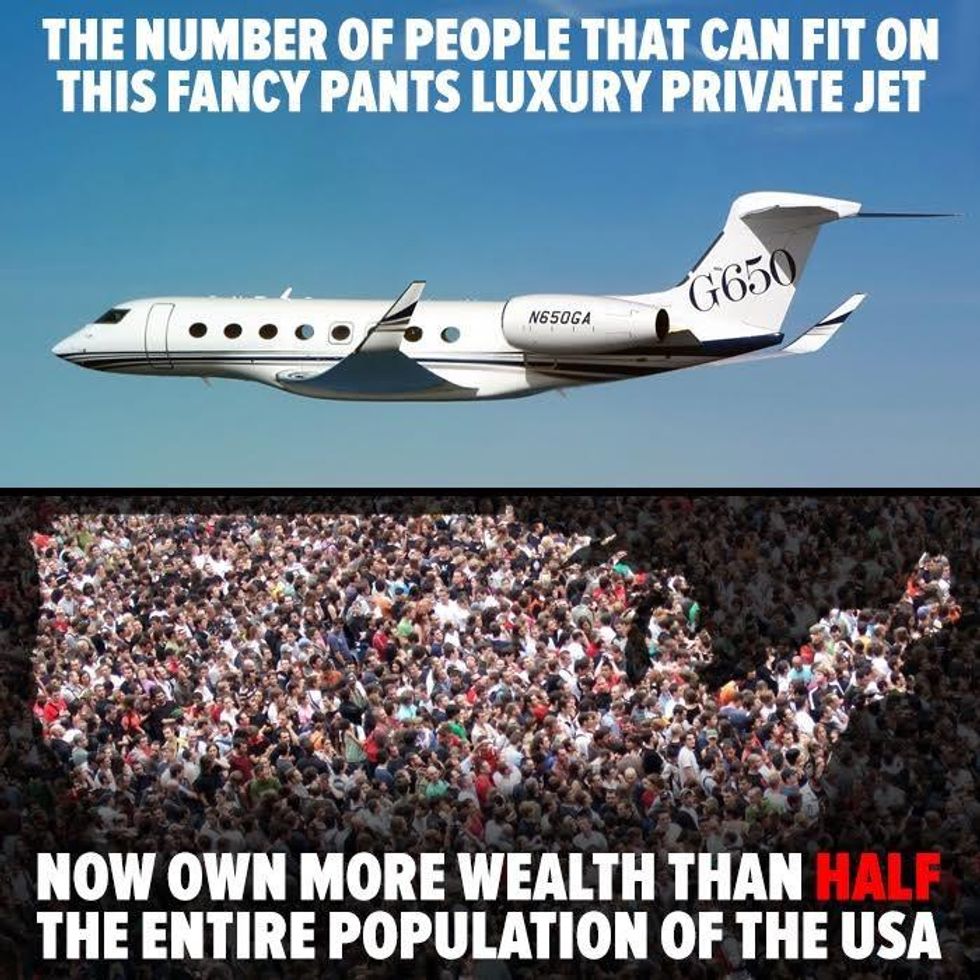
The wealth concentration doesn't stop there. The richest 20 individuals alone own more wealth than the entire bottom half of the U.S. population.
This group -- which includes Gates, Warren Buffet, the Koch brothers, Mark Zuckerberg, and Google co-founders Larry Page and Sergey Brin, among others -- is small enough to fit on a private jet. But together they've hoarded as much wealth as 152 million of their fellow Americans.
Many of the richest 400 Americans amassed their wealth through successful companies and innovation. But they've all benefited enormously from a system of trade, tax, and regulatory rules tipped in favor of the wealthy at the expense of wage earners.
Tax policies, for instance, routinely target income from investments at lower rates than wages from work. These rules disproportionately benefit the Forbes 400, especially those working in finance.
This dominance endures across generations. As the French economist Thomas Piketty has warned, the United States is becoming an aristocracy dominated by people who've inherited great wealth and power.
Do we want the next generation of politics to be dominated by the heirs of Amazon founder Jeff Bezos or Wal-Mart heir Jim Walton? If not, it'll take strong and strategic public policies to reverse these trends.
Raising the minimum wage so all full-time workers can make enough money to live on would be a start.
And overhauling the campaign finance system so the richest Americans can no longer dictate which political candidates will be viable is a crucial next step. In the 2016 presidential race, Bernie Sanders is the lone top-tier candidate who isn't receiving massive contributions from what he calls "the billionaire class."
These policies may reduce inequality, but they won't slow the concentration of wealth. Achieving that goal will require reinstituting the progressive income tax policies of previous generations. Given today's economy, this should include a wealth tax on billionaires.
America's skewed wealth is one of the most critical issues of our time. Unless we defuse this threat to our democracy, we're destined to become a society governed by the sons and daughters of today's billionaires.
When should we be alarmed about so much wealth in so few hands?
The Great Recession and its anemic recovery only deepened the economic inequality that's drawn so much attention in its wake. Nearly all wealth and income gains since then have flowed to the top one-tenth of America's richest 1 percent.
The very wealthiest 400 Americans command dizzying fortunes. Their combined net worth, as catalogued in the 2015 Forbes 400 list, is $2.34 trillion. You can't make this list unless you're worth a cool $1.7 billion.
"America's skewed wealth is one of the most critical issues of our time."
These 400 rich people -- including Bill Gates, Donald Trump, Oprah Winfrey, and heirs to the Wal-Mart fortune -- have roughly as much wealth as the bottom 61 percent of the population, or over 190 million people added together, according to a new report I co-authored.
That equals the wealth of the nation's entire African-American population, plus a third of the Latino population combined.
A few of those 400 individuals are generous philanthropists. But extreme inequality of this sort undermines social mobility, democracy, and economic stability. Even if you celebrate successful entrepreneurship, isn't there a point things go too far?
To me, 400 people having more money than 190 million of their compatriots is just that point.
Concentrating wealth to this extent gives rich donors far too much political power, including the wherewithal to shape the rules that govern our economy. Half of all political contributions in the 2016 presidential campaign have come from just 158 families, according to research by The New York Times.
The wealth concentration doesn't stop there. The richest 20 individuals alone own more wealth than the entire bottom half of the U.S. population.
This group -- which includes Gates, Warren Buffet, the Koch brothers, Mark Zuckerberg, and Google co-founders Larry Page and Sergey Brin, among others -- is small enough to fit on a private jet. But together they've hoarded as much wealth as 152 million of their fellow Americans.
Many of the richest 400 Americans amassed their wealth through successful companies and innovation. But they've all benefited enormously from a system of trade, tax, and regulatory rules tipped in favor of the wealthy at the expense of wage earners.
Tax policies, for instance, routinely target income from investments at lower rates than wages from work. These rules disproportionately benefit the Forbes 400, especially those working in finance.
This dominance endures across generations. As the French economist Thomas Piketty has warned, the United States is becoming an aristocracy dominated by people who've inherited great wealth and power.
Do we want the next generation of politics to be dominated by the heirs of Amazon founder Jeff Bezos or Wal-Mart heir Jim Walton? If not, it'll take strong and strategic public policies to reverse these trends.
Raising the minimum wage so all full-time workers can make enough money to live on would be a start.
And overhauling the campaign finance system so the richest Americans can no longer dictate which political candidates will be viable is a crucial next step. In the 2016 presidential race, Bernie Sanders is the lone top-tier candidate who isn't receiving massive contributions from what he calls "the billionaire class."
These policies may reduce inequality, but they won't slow the concentration of wealth. Achieving that goal will require reinstituting the progressive income tax policies of previous generations. Given today's economy, this should include a wealth tax on billionaires.
America's skewed wealth is one of the most critical issues of our time. Unless we defuse this threat to our democracy, we're destined to become a society governed by the sons and daughters of today's billionaires.
When should we be alarmed about so much wealth in so few hands?
The Great Recession and its anemic recovery only deepened the economic inequality that's drawn so much attention in its wake. Nearly all wealth and income gains since then have flowed to the top one-tenth of America's richest 1 percent.
The very wealthiest 400 Americans command dizzying fortunes. Their combined net worth, as catalogued in the 2015 Forbes 400 list, is $2.34 trillion. You can't make this list unless you're worth a cool $1.7 billion.
"America's skewed wealth is one of the most critical issues of our time."
These 400 rich people -- including Bill Gates, Donald Trump, Oprah Winfrey, and heirs to the Wal-Mart fortune -- have roughly as much wealth as the bottom 61 percent of the population, or over 190 million people added together, according to a new report I co-authored.
That equals the wealth of the nation's entire African-American population, plus a third of the Latino population combined.
A few of those 400 individuals are generous philanthropists. But extreme inequality of this sort undermines social mobility, democracy, and economic stability. Even if you celebrate successful entrepreneurship, isn't there a point things go too far?
To me, 400 people having more money than 190 million of their compatriots is just that point.
Concentrating wealth to this extent gives rich donors far too much political power, including the wherewithal to shape the rules that govern our economy. Half of all political contributions in the 2016 presidential campaign have come from just 158 families, according to research by The New York Times.
The wealth concentration doesn't stop there. The richest 20 individuals alone own more wealth than the entire bottom half of the U.S. population.
This group -- which includes Gates, Warren Buffet, the Koch brothers, Mark Zuckerberg, and Google co-founders Larry Page and Sergey Brin, among others -- is small enough to fit on a private jet. But together they've hoarded as much wealth as 152 million of their fellow Americans.
Many of the richest 400 Americans amassed their wealth through successful companies and innovation. But they've all benefited enormously from a system of trade, tax, and regulatory rules tipped in favor of the wealthy at the expense of wage earners.
Tax policies, for instance, routinely target income from investments at lower rates than wages from work. These rules disproportionately benefit the Forbes 400, especially those working in finance.
This dominance endures across generations. As the French economist Thomas Piketty has warned, the United States is becoming an aristocracy dominated by people who've inherited great wealth and power.
Do we want the next generation of politics to be dominated by the heirs of Amazon founder Jeff Bezos or Wal-Mart heir Jim Walton? If not, it'll take strong and strategic public policies to reverse these trends.
Raising the minimum wage so all full-time workers can make enough money to live on would be a start.
And overhauling the campaign finance system so the richest Americans can no longer dictate which political candidates will be viable is a crucial next step. In the 2016 presidential race, Bernie Sanders is the lone top-tier candidate who isn't receiving massive contributions from what he calls "the billionaire class."
These policies may reduce inequality, but they won't slow the concentration of wealth. Achieving that goal will require reinstituting the progressive income tax policies of previous generations. Given today's economy, this should include a wealth tax on billionaires.
America's skewed wealth is one of the most critical issues of our time. Unless we defuse this threat to our democracy, we're destined to become a society governed by the sons and daughters of today's billionaires.