

SUBSCRIBE TO OUR FREE NEWSLETTER
Daily news & progressive opinion—funded by the people, not the corporations—delivered straight to your inbox.
5
#000000
#FFFFFF
To donate by check, phone, or other method, see our More Ways to Give page.
Daily news & progressive opinion—funded by the people, not the corporations—delivered straight to your inbox.
Note: Today, the U.S. Department of Justice announced that five major banks have agreed to plead guilty to felony charges and pay criminal fines in connection with the foreign exchange market. Four agreed to plead guilty to conspiring to currency manipulation; a fifth will plead guilty to manipulating benchmark interest rates.
There are two messages in today's plea deal: First, criminality is rampant on Wall Street. Second, the era of too-big-to-jail is alive and well. Even as they beat their chests announcing how tough they are, government regulators refuse to apply to the giant banks the same rules that apply to everyone else.
The illegal acts to which the five banks have admitted wrongdoing weren't accidents or technical violations. They were intentional violations of the law. They were conducted in concert with purported competitors. And they were hidden through use of code words.
Many of the five banks are repeat lawbreakers, and the Department of Justice deserves credit for revisiting a prior non-prosecution agreement, and now prosecuting prior crimes at the giant company UBS. But the lesson for the DOJ should be that it never should have entered into deferred and non-prosecution agreements in the first place, and it should cease using them for future corporate wrongdoing. They are simply escapes from criminal pleas with no demonstrable deterrent effect.
It is being reported that the U.S. Securities and Exchange Commission has granted a waiver to the banks from rules that would otherwise require the agency to revoke the banks' authority to undertake certain securities activities. If these reports are accurate, this action is disgraceful and intolerable. Congress must investigate this dereliction of duty at the agency.
Important questions remain about this plea deal: Will individual executives be prosecuted? And did the DOJ charge the parent companies in this case to avoid triggering potential sanctions with real and significant business consequences for the banks, including charter revocation hearings? The public deserves answers to these questions. In that information is some insight into whether the government continues to protect the megabanks - those colloquially labeled "too big to jail."
What becomes clear is that regulators genuinely are afraid of enforcing the law when it comes to the megabanks. As a result, and notwithstanding today's announcement and others like it, these banks are not deterred from violating the law - indeed, they are literally not subject to the same standards as other banks and other companies. A democratic society cannot tolerate having banks above the law. There's a solution to this problem: break them up.
Public Citizen is a nonprofit consumer advocacy organization that champions the public interest in the halls of power. We defend democracy, resist corporate power and work to ensure that government works for the people - not for big corporations. Founded in 1971, we now have 500,000 members and supporters throughout the country.
(202) 588-1000
"This is brazen genocide denial," said the policy director for the Armenian National Committee of America.
The office of Vice President JD Vance made multiple posts commemorating the Armenian genocide on Tuesday, but was forced to take them down because the Trump administration doesn't formally recognize that the genocide happened.
Vance's X account posted a photo of the vice president and his wife, Usha, attending a wreath-laying ceremony at a memorial in the Armenian city of Yerevan. The post said the Vances were there "to honor the victims of the 1915 Armenian genocide."
But the post was swiftly taken down, with a Vance spokesperson blaming it on a staff member.
"This is an account managed by staff that primarily exists to share photos and videos of the vice president's activities," they said. "For the vice president's views on the substance of the question, I refer you to the comments he made earlier on the tarmac in response to the pool's question."
This was referring to Vance's comments to reporters about visiting the memorial, which were posted by an official White House account. "I'm the first vice president to ever visit Armenia. They asked us to visit the site... I wanted to go and pay my respects."
That post has since been deleted as well.
Alex Galitsky, the policy director for the Armenian National Committee of America (ANCA) reacted: "This is brazen genocide denial. An insult to the memory of the 1.5 million victims of the Armenian Genocide—and an affront to a community that fought tirelessly for decades to ensure recognition of that crime."
Historians widely agree that the Ottoman Empire's systemic killing and deportation of mostly Christian Armenians during the First World War constitutes one of the 20th century's worst genocides. According to the United States Holocaust Memorial Museum:
There were approximately 1.5 million Armenians living in the multiethnic Ottoman Empire in 1915. At least 664,000 and possibly as many as 1.2 million died during the genocide, either in massacres and individual killings, or from systematic ill treatment, exposure, and starvation.
But the government of Turkey continues to adamantly deny the genocide committed by its predecessor state to this day. And due to Turkey's status as a NATO ally, US presidents dating back more than half a century have likewise refused to describe the historic crime as a "genocide."
This began to change in 2019, when Congress passed a historic resolution finally recognizing the genocide more than a century after it began. In 2021, then-President Joe Biden became the first US president to formally acknowledge the genocide without ambiguity.
But in April 2025, after President Donald Trump returned to office, he rolled this acknowledgment back, referring to the mass killing as a "great catastrophe" and "one of the worst disasters of the 20th century" while evading the term "genocide."
Julien Zarifian, a professor of US history at the University of Poitiers in France, wrote that "Trump's reversal seemed to make genocide recognition taboo not only in the White House, but in the whole executive branch."
The return to a denialist stance put the US back into line not only with Turkey, but with Azerbaijan, with which Armenia has been locked in conflict over the disputed Nagorno‑Karabakh region for decades.
In 2023, more than 100,000 Armenians—virtually the whole population—were forced to flee the territory in what has been described as an ethnic cleansing by Azerbaijan, which occupied large parts of the area.
While the US has remained formally neutral in the conflict, it has provided hundreds of millions of dollars of security assistance to Azerbaijan under presidents of both parties, which critics say has emboldened Azerbaijan to act more aggressively. Azerbaijan notably has the steadfast backing of Turkey in the conflict, as well as key US ally Israel.
Vance's visit to Armenia was the first leg of a trip that continued to Azerbaijan, where he met with its leaders to discuss ending the conflict and to shore up an agreement that would give the US greater access to the region's natural resources.
Last August, Trump boasted of brokering a “peace deal” between the two nations, but Azerbaijan had not signed anything—only agreed to further talks.
One of the provisions of the deal pushed by the Trump administration is that Armenia would drop any legal claims against Azerbaijan over its human rights abuses, which Just Security analysts David J. Simon and Kathryn Hemmer said would be "thereby depriving Nagorno-Karabakh’s 150,000 victims of justice."
During a summit with Azerbaijani President Ilham Aliyev, Vance laid on the flattery: "Other than President Trump, the only leader in the world that has really good relations with both the Turks and the Israelis is President Aliyev," he said. "That means one, the food must be really good here, or two, he must be really charming. I can confirm that he's very charming."
Gev Iskajyan, the advocacy director of ANCA, responded: "Vance thinks Aliyev is really charming. Especially when he’s committing war crimes, rigging his own elections, or ethnically cleansing an entire people."

"The trade powers Trump is illegally usurping are expressly granted to Congress under the Constitution," said Rep. Don Beyer.
Republicans in the US House on Tuesday tried—and narrowly failed—to advance a measure containing language that would have temporarily blocked votes on resolutions disapproving of President Donald Trump’s tariffs.
Democrats voted unanimously to defeat the measure, and were joined by just three House Republicans—Don Bacon of Nebraska, Thomas Massie of Kentucky, and Kevin Kiley of California—in a final vote of 214 in favor to 217 opposed.
As reported by MS NOW, House Republicans tucked language preventing challenges to Trump's tariff policies into a rule setting up floor consideration for legislation related to US energy security.
While a similar provision was passed in the House in September before expiring at the end of January, Speaker Mike Johnson (R-La.) was unable to cobble together votes to get it passed this time.
Rep. Don Beyer (D-Va.) celebrated what he described as a "heartening" victory, while expressing concern that the vast majority of Republicans were comfortable letting the president take their constitutionally mandated power over taxation.
"Most Republicans again tried to surrender Congress’ power as a coequal branch of government to check a president who is behaving like a mad king," Beyer wrote in a social media post. "The trade powers Trump is illegally usurping are expressly granted to Congress under the Constitution."
Matt Fuller, director of congressional reporting at MS NOW, similarly argued that "it's a lot more notable to me that 214 House Republicans voted to hand Donald Trump unchecked authority to levy tariffs until August than it is that three House Republicans said 'no.'"
While Tuesday's vote suggests a narrowly divided House, Punchbowl News co-founder Jake Sherman argued that it actually represented a "watershed moment" that could open the door to several defeats for the Trump administration on the House floor in the coming days, as Democrats prepare to hammer the GOP with tariff disapproval resolutions.
"Now Democrats have the opportunity to force unlimited votes on the president's global tariffs, putting Republicans on the spot all the time," Sherman explained in a Wednesday social media post. "If Dems handle this well, this is going to get bad for rank and file House Republicans. And it will piss off Trump."
Sherman's assessment of the situation was echoed by the Wednesday edition of Politico Playbook, which noted that Rep. Gregory Meeks (D-NY) is already teeing up a resolution to overturn Trump's tariffs against Canada that is set for a vote on Wednesday afternoon.
"Given the current mood in the House—every single Dem showed up to vote last night, while plenty of Republicans are uncomfortable with tariffs—Johnson looks all but certain to lose," Politico declared.
Matt Maasdam, a Democratic US House candidate running in Michigan's 7th Congressional District, started putting pressure on incumbent Rep. Tom Barrett (R-Mich.) the morning after the Michigan Republican voted to protect Trump from tariff resolutions.
"Tom Barrett has voted over and over to protect the Trump tariffs that make costs go up," wrote Maasdam on social media. "The tariffs on Canada hit Michigan hard. Auto parts for a car made here cross the border multiple times—in a trade war, it’s our workers and businesses who get hurt."
"It is Trump’s power grab in legislative garb," said one expert.
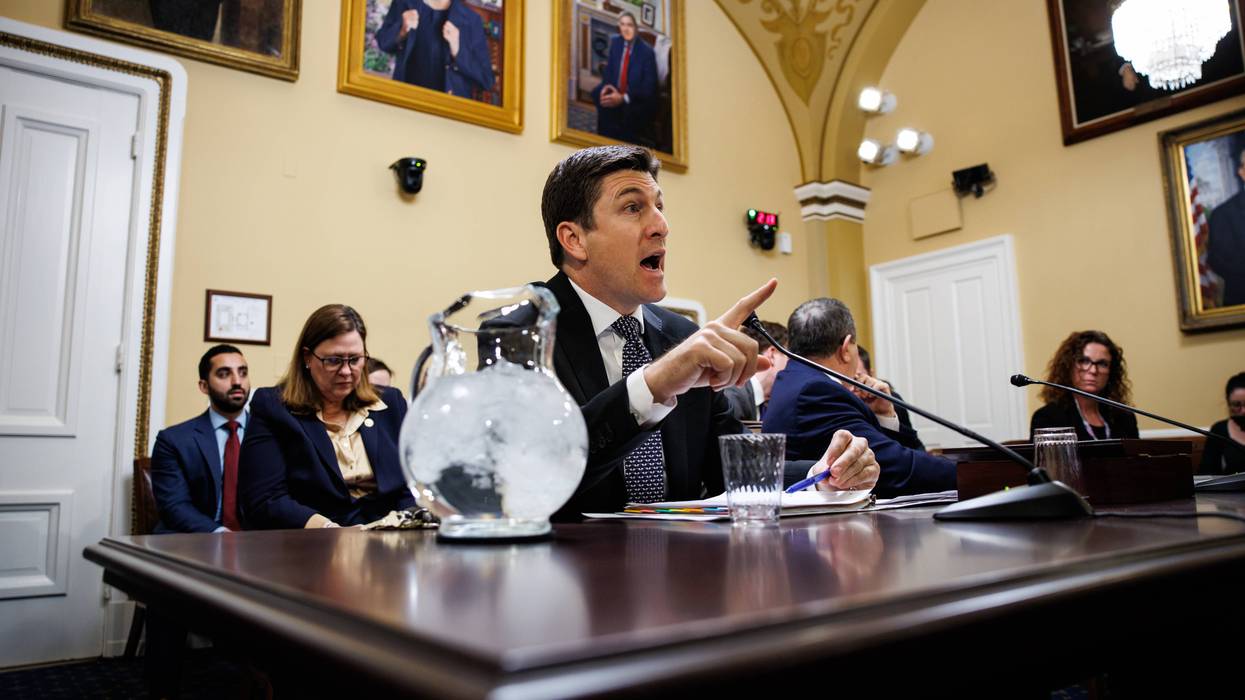
Congressional Republicans on Tuesday held hearings on a pair of bills that watchdogs, election experts, and Democratic lawmakers characterized as brazen and dangerous efforts to suppress voter turnout in service of President Donald Trump's broader assault on democracy—which has included a call for the GOP to "nationalize the voting."
Tuesday's hearings, held by the House Committees on Rules and Administration, featured a revived version of the Safeguard American Voter Eligibility Act (SAVE) Act and Rep. Bryan Steil's (R-Wis.) newly introduced Make Elections Great Again (MEGA) Act, which one analyst described as possibly the "most dangerous attack on voting rights ever" unveiled in the US Congress.
During his opening remarks at the House Administration Committee hearing on the MEGA Act, the panel's ranking member, Rep. Joe Morelle (D-NY), said that "this scheme is not just how Republicans plan to take over our elections, it's how they plan to take over our country."
"Republicans know that they have one hope at winning the next election: change the rules of the game, destroy the rule of law, and desert any last remaining shred of allegiance to the United States Constitution," Morelle added.
@RepJoeMorelle on the anti-voting MEGA Act:
“This scheme is not just how Republicans plan to take over our elections, it’s how they plan to take over our country.”
👇Learn more:https://t.co/kkm6ISuedX pic.twitter.com/g2kRbLIxGX
— Democracy Docket (@DemocracyDocket) February 10, 2026
Both the SAVE Act—which is expected to get a House vote this week—and the MEGA Act would impose severe restrictions on voting access by effectively eliminating voter registration by mail, implementing nationwide photo ID requirements, banning universal mail-in ballots for federal elections, allowing massive voter roll purges, and threatening nonpartisan election officials with imprisonment if they fail to uphold the bills' strict voter documentation requirements.
If passed, the SAVE Act would require anyone registering to vote in federal elections to furnish documentary proof of US citizenship, such as a passport or birth certificate, in person. The Brennan Center for Justice has estimated that 21 million people in the US "lack ready access to these documents," noting that "half of all Americans don’t have a passport, for example, and millions of married women who have changed their names might need to jump through extra hoops to vote."
"Make no mistake: The SAVE Act would stop millions of American citizens from voting," the Brennan Center wrote in an analysis of the legislation on Tuesday. "It would be the most restrictive voting bill ever passed by Congress. It is Trump’s power grab in legislative garb."
The co-chairs of the Not Above the Law Coalition placed the voter suppression bills in the context of Trump's "yearslong campaign of election lies and conspiracy to overturn the 2020 results" as well as "his recent attempts to nationalize election administration, and weaponization of the Department of Justice to intimidate voters and officials."
"Republicans are falling in line by attempting to silence American voters under the guise of 'election integrity,'" the coalition said. "House Republicans are doing Trump's bidding instead of holding him accountable. The real threats to election integrity sit in the White House and among those enabling his authoritarian agenda. Our democracy depends on rejecting this charade and confronting Trump's documented attacks on free and fair elections."
The Trump White House has publicly endorsed the SAVE Act amid mounting fears that the president—animated by false claims of large-scale voter fraud—is moving to undermine the midterm elections later this year.
"It will be up to Democrats to hold their ground and ensure the SAVE Act’s ultimate defeat. It will be up to all of us to not be fooled by the myths and the lies—and protect our elections so they remain free and fair," wrote Brennan Center president Michael Waldman. "And we should stand with election officials who now face threats of groundless criminal prosecution for doing their jobs."
"For voters, who must have the most powerful voice in our democracy," Waldman added, "the stakes are high, and getting higher."