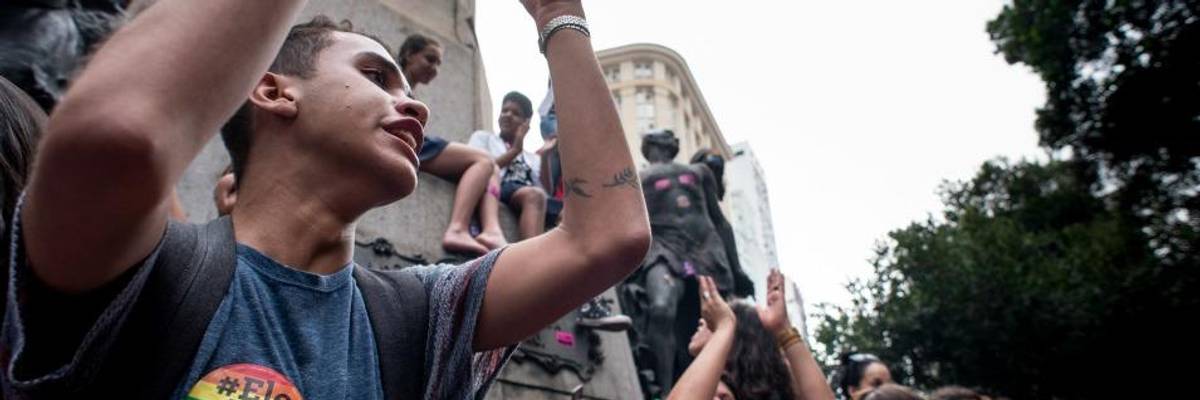
Anti-Bolsonaro protesters chanted the slogan "Ele Nao," or "Not Him" at a demonstration on September 29, 2018 in Rio de Janeiro, Brazil. (Photo by Raphael Dias/Getty Images)
As Trump Applauds Brazil's New Fascist President, Bolsonaro Wastes No Time Attacking Environment and Marginalized Brazilians
Two days into his term, Bolsonaro has already unveiled orders infringing on the rights of indigenous and LGBTQ Brazilians
Brazilian President Jair Bolsonaro--whose inauguration on New Year's Day was lauded by U.S. President Donald Trump--wasted no time Wednesday introducing policies targeting the environment, indigenous Brazilians, the LGBTQ community, and other marginalized populations, realizing the worst fears of progressives who have protested the openly misogynist, pro-torture president.
On his first day in office, Bolsonaro introduced an executive order that will effectively take away land rights for indigenous Brazilians and descendants of former slaves and gave control of Amazon lands to the agriculture ministry; eliminated LGBTQ rights from the purview of the country's human rights ministry; and set the minimum wage lower than the rate his predecessor's government had budgeted for.
The executive orders are "only the first step on meeting Bolsonaro's campaign promises of dismantling environmental governance, stripping indigenous peoples of their rights, and opening up indigenous lands for business," said Observatorio do Clima, a network of Brazilian civil society groups.
Bolsonaro's health minister also indicated on Wednesday that the new government's attacks on indigenous Brazilians would go much further, with spending cuts on healthcare for those communities.
In keeping with his general disdain for cultural, gender, and ethnic diversity, Bolsonaro will reportedly soon close an agency dedicated to promoting diversity in public schools.
"Latin American civil society needs to play a crucial role in preventing the countries of the region from following Bolsonaro's tide...A combination of intellectual and journalistic commitment against the advance of fascism, strict citizen scrutiny, international observation, solidarity, and unity can show that those of us who believe in democracy and human rights are more." --Renata Avila, human rights lawayerLGBTQ activist Symmy Larrat told the Associated Press that she expects issues affecting her community to be ignored by Bolsonaro's government, and likely made far worse, considering the president's description of himself as a "proud homophobe."
"We don't see any signs there will be any other government infrastructure to handle LGBT issues," Larrat told the AP.
In the U.S., the Trump administration has reacted positively to Bolsonaro's inauguration, with former UN ambassador Nikki Haley tweeting Tuesday, "It's great to have another U.S.-friendly leader in South America" and predicting that the president will help to fight against "dictatorships in Venezuela and Cuba"--despite Bolsonaro's praise for his own country's military dictatorship which ruled Brazil for two decades.
Human rights lawyer Renata Avila wrote Thursday that such praise by powerful far-right politicians make it imperative for progressives around the world to join in Brazilians' fight to "neutralize" the destruction Bolsonaro is intent on causing.
To "help Brazilians resist the attacks on the most vulnerable," Avila wrote at Open Democracy, journalists and others must take concrete steps including elevating "the profiles of newly elected progressives in Brazil," supporting strong progressive local governments in Brazilian cities, and serving as international watchdogs of Bolsonaro's effects on the Brazilian people, considering that "it is highly likely that the establishment press will try to normalize Bolsonaro if the beneficiaries of his policies are large corporations and global financial groups."
"Likewise, Latin American civil society needs to play a crucial role in preventing the countries of the region from following Bolsonaro's tide," Avila wrote. "The local and global stakes are too high, from abandoning the Palestine struggle for liberation to possible military intervention in Venezuela."
"That is why I am launching a broad call of action and suggesting some starting points," she continued. "A combination of intellectual and journalistic commitment against the advance of fascism, strict citizen scrutiny, international observation, solidarity, and unity can show that those of us who believe in democracy and human rights are more."
We are at a crossroads
This country and this world are at a monumental crossroads. In a few short weeks, US voters will have an opportunity to beat back the forces of fascism and confront the billionaires who are rigging the economy, our media system, and our democracy, making it increasingly impossible for ordinary people to get by. We’re not just talking about the election. We’re talking about what must be done once these fascist elements are vanquished from power. We need a bolder set of solutions than what either major party has so far been willing to offer and a working-class movement ready to fight like hell for it. Trump didn't emerge from nowhere. The conditions that fueled MAGA authoritarianism were created by decades of radical neoliberal economic policies and a corrupt political system dominated by corporate interests. They slashed taxes on the super-rich, promising that the benefits would trickle down. They said giveaways to the corporate titans would make life more affordable for the rest of us. It was all bullshit. And when a bitter, betrayed populace searches for someone to blame, right-wing demagogues have little trouble finding scapegoats. People know when they're being lied to, but you won't hear any of this from the corporate media. Only independent journalism—powered and funded by people who believe in building a better world—can deliver truly trustworthy daily news. Our Fall Campaign is underway, and we need your help. To power our newsroom through the rest of the year, we need to raise $125,000 by midnight on October 31. So if you share our vision, please contribute whatever you can to sustain our work. |
Brazilian President Jair Bolsonaro--whose inauguration on New Year's Day was lauded by U.S. President Donald Trump--wasted no time Wednesday introducing policies targeting the environment, indigenous Brazilians, the LGBTQ community, and other marginalized populations, realizing the worst fears of progressives who have protested the openly misogynist, pro-torture president.
On his first day in office, Bolsonaro introduced an executive order that will effectively take away land rights for indigenous Brazilians and descendants of former slaves and gave control of Amazon lands to the agriculture ministry; eliminated LGBTQ rights from the purview of the country's human rights ministry; and set the minimum wage lower than the rate his predecessor's government had budgeted for.
The executive orders are "only the first step on meeting Bolsonaro's campaign promises of dismantling environmental governance, stripping indigenous peoples of their rights, and opening up indigenous lands for business," said Observatorio do Clima, a network of Brazilian civil society groups.
Bolsonaro's health minister also indicated on Wednesday that the new government's attacks on indigenous Brazilians would go much further, with spending cuts on healthcare for those communities.
In keeping with his general disdain for cultural, gender, and ethnic diversity, Bolsonaro will reportedly soon close an agency dedicated to promoting diversity in public schools.
"Latin American civil society needs to play a crucial role in preventing the countries of the region from following Bolsonaro's tide...A combination of intellectual and journalistic commitment against the advance of fascism, strict citizen scrutiny, international observation, solidarity, and unity can show that those of us who believe in democracy and human rights are more." --Renata Avila, human rights lawayerLGBTQ activist Symmy Larrat told the Associated Press that she expects issues affecting her community to be ignored by Bolsonaro's government, and likely made far worse, considering the president's description of himself as a "proud homophobe."
"We don't see any signs there will be any other government infrastructure to handle LGBT issues," Larrat told the AP.
In the U.S., the Trump administration has reacted positively to Bolsonaro's inauguration, with former UN ambassador Nikki Haley tweeting Tuesday, "It's great to have another U.S.-friendly leader in South America" and predicting that the president will help to fight against "dictatorships in Venezuela and Cuba"--despite Bolsonaro's praise for his own country's military dictatorship which ruled Brazil for two decades.
Human rights lawyer Renata Avila wrote Thursday that such praise by powerful far-right politicians make it imperative for progressives around the world to join in Brazilians' fight to "neutralize" the destruction Bolsonaro is intent on causing.
To "help Brazilians resist the attacks on the most vulnerable," Avila wrote at Open Democracy, journalists and others must take concrete steps including elevating "the profiles of newly elected progressives in Brazil," supporting strong progressive local governments in Brazilian cities, and serving as international watchdogs of Bolsonaro's effects on the Brazilian people, considering that "it is highly likely that the establishment press will try to normalize Bolsonaro if the beneficiaries of his policies are large corporations and global financial groups."
"Likewise, Latin American civil society needs to play a crucial role in preventing the countries of the region from following Bolsonaro's tide," Avila wrote. "The local and global stakes are too high, from abandoning the Palestine struggle for liberation to possible military intervention in Venezuela."
"That is why I am launching a broad call of action and suggesting some starting points," she continued. "A combination of intellectual and journalistic commitment against the advance of fascism, strict citizen scrutiny, international observation, solidarity, and unity can show that those of us who believe in democracy and human rights are more."
Brazilian President Jair Bolsonaro--whose inauguration on New Year's Day was lauded by U.S. President Donald Trump--wasted no time Wednesday introducing policies targeting the environment, indigenous Brazilians, the LGBTQ community, and other marginalized populations, realizing the worst fears of progressives who have protested the openly misogynist, pro-torture president.
On his first day in office, Bolsonaro introduced an executive order that will effectively take away land rights for indigenous Brazilians and descendants of former slaves and gave control of Amazon lands to the agriculture ministry; eliminated LGBTQ rights from the purview of the country's human rights ministry; and set the minimum wage lower than the rate his predecessor's government had budgeted for.
The executive orders are "only the first step on meeting Bolsonaro's campaign promises of dismantling environmental governance, stripping indigenous peoples of their rights, and opening up indigenous lands for business," said Observatorio do Clima, a network of Brazilian civil society groups.
Bolsonaro's health minister also indicated on Wednesday that the new government's attacks on indigenous Brazilians would go much further, with spending cuts on healthcare for those communities.
In keeping with his general disdain for cultural, gender, and ethnic diversity, Bolsonaro will reportedly soon close an agency dedicated to promoting diversity in public schools.
"Latin American civil society needs to play a crucial role in preventing the countries of the region from following Bolsonaro's tide...A combination of intellectual and journalistic commitment against the advance of fascism, strict citizen scrutiny, international observation, solidarity, and unity can show that those of us who believe in democracy and human rights are more." --Renata Avila, human rights lawayerLGBTQ activist Symmy Larrat told the Associated Press that she expects issues affecting her community to be ignored by Bolsonaro's government, and likely made far worse, considering the president's description of himself as a "proud homophobe."
"We don't see any signs there will be any other government infrastructure to handle LGBT issues," Larrat told the AP.
In the U.S., the Trump administration has reacted positively to Bolsonaro's inauguration, with former UN ambassador Nikki Haley tweeting Tuesday, "It's great to have another U.S.-friendly leader in South America" and predicting that the president will help to fight against "dictatorships in Venezuela and Cuba"--despite Bolsonaro's praise for his own country's military dictatorship which ruled Brazil for two decades.
Human rights lawyer Renata Avila wrote Thursday that such praise by powerful far-right politicians make it imperative for progressives around the world to join in Brazilians' fight to "neutralize" the destruction Bolsonaro is intent on causing.
To "help Brazilians resist the attacks on the most vulnerable," Avila wrote at Open Democracy, journalists and others must take concrete steps including elevating "the profiles of newly elected progressives in Brazil," supporting strong progressive local governments in Brazilian cities, and serving as international watchdogs of Bolsonaro's effects on the Brazilian people, considering that "it is highly likely that the establishment press will try to normalize Bolsonaro if the beneficiaries of his policies are large corporations and global financial groups."
"Likewise, Latin American civil society needs to play a crucial role in preventing the countries of the region from following Bolsonaro's tide," Avila wrote. "The local and global stakes are too high, from abandoning the Palestine struggle for liberation to possible military intervention in Venezuela."
"That is why I am launching a broad call of action and suggesting some starting points," she continued. "A combination of intellectual and journalistic commitment against the advance of fascism, strict citizen scrutiny, international observation, solidarity, and unity can show that those of us who believe in democracy and human rights are more."