SUBSCRIBE TO OUR FREE NEWSLETTER
Daily news & progressive opinion—funded by the people, not the corporations—delivered straight to your inbox.
5
#000000
#FFFFFF
To donate by check, phone, or other method, see our More Ways to Give page.
Governments of Republican-leaning states are seemingly always banging the drum of austerity: decreasing corporate taxes, slashing spending, and cutting programs. But red states' ideology and their preferences at the voting booth are not reflected in their state budgets, as a new study found that those locales are the greatest beneficiaries of federal money.
According to an analysis by The Hill reporter Reid Wilson of new data (pdf) published by Pew Charitable Trusts on Monday, "the average state that voted against [President Barack] Obama twice relied on federal funding for an average of 33.8 percent of itsbudget." In contrast, "Among the 27 states that voted for Obama twice, federal grants made up 29.9 percent of the average state budget."
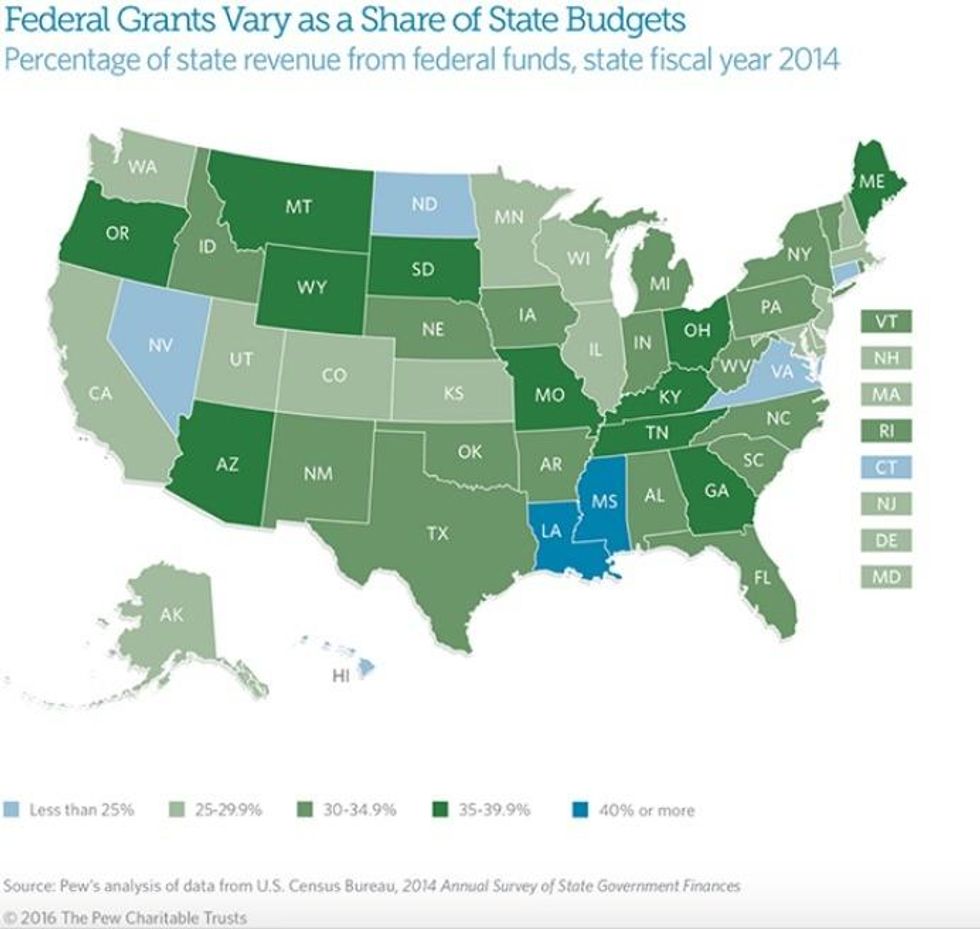
Mississippi and Louisiana each claim more than 40 percent of their budget from federal grants in 2014, followed by Tennessee, Kentucky, Missouri, and Georgia, which each receive more than 36 percent. Each of these states voted for Sen. John McCain in 2008 and Mitt Romney in 2012.
Alternately, pro-Obama states including Virginia, Connecticut, Hawaii, and Nevada all rely on federal money for less than a quarter of their state revenue. Federal dollars account for 30.8 percent of overall state budgets in 2014, which Pew notes is the lowest level since the 2007 recession.
"Republican states rely more heavily on federal dollars as a share of their budgets than do more Democratic states, largely because Southern states, especially, are more likely to have a higher percentage of residents living in poverty," The Hill notes. States use these funds to pay for programs in areas ranging from education to transportation to healthcare.

Further, according to a separate Pew analysis, roughly one-third of federal dollars went to retirement benefits, including Social Security and federal pensions, while one quarter went to non-retirement benefits, namely Medicare. Grants, the largest of which is Medicaid, made up roughly one-sixth of federal spending.
States that collect more revenue from other sources, like taxes and service charges, are less reliant on federal dollars.
Anne Stauffer, director of Pew's fiscal federalism project, explained to Wilson that this is reflected in states with higher poverty levels, like Louisiana and Mississippi, that have a higher percentage of residents receiving Medicaid and a lower number of individuals paying income taxes.
One outlier Pew found is North Dakota, which was the state least reliant on federal money in 2014, largely due to the state's booming oil industry. "The drop in global oil prices is likely to change that equation," Wilson notes.
Underscoring the cyclical nature of poverty and austerity, a recent analysis by the Economic Policy Institute found that the fiscal policy imposed by Republicans on the federal, state, and local levels is largely responsible for the slow pace of recovery from the recession, as Common Dreams reported.
Governments of Republican-leaning states are seemingly always banging the drum of austerity: decreasing corporate taxes, slashing spending, and cutting programs. But red states' ideology and their preferences at the voting booth are not reflected in their state budgets, as a new study found that those locales are the greatest beneficiaries of federal money.
According to an analysis by The Hill reporter Reid Wilson of new data (pdf) published by Pew Charitable Trusts on Monday, "the average state that voted against [President Barack] Obama twice relied on federal funding for an average of 33.8 percent of itsbudget." In contrast, "Among the 27 states that voted for Obama twice, federal grants made up 29.9 percent of the average state budget."
Mississippi and Louisiana each claim more than 40 percent of their budget from federal grants in 2014, followed by Tennessee, Kentucky, Missouri, and Georgia, which each receive more than 36 percent. Each of these states voted for Sen. John McCain in 2008 and Mitt Romney in 2012.
Alternately, pro-Obama states including Virginia, Connecticut, Hawaii, and Nevada all rely on federal money for less than a quarter of their state revenue. Federal dollars account for 30.8 percent of overall state budgets in 2014, which Pew notes is the lowest level since the 2007 recession.
"Republican states rely more heavily on federal dollars as a share of their budgets than do more Democratic states, largely because Southern states, especially, are more likely to have a higher percentage of residents living in poverty," The Hill notes. States use these funds to pay for programs in areas ranging from education to transportation to healthcare.
Further, according to a separate Pew analysis, roughly one-third of federal dollars went to retirement benefits, including Social Security and federal pensions, while one quarter went to non-retirement benefits, namely Medicare. Grants, the largest of which is Medicaid, made up roughly one-sixth of federal spending.
States that collect more revenue from other sources, like taxes and service charges, are less reliant on federal dollars.
Anne Stauffer, director of Pew's fiscal federalism project, explained to Wilson that this is reflected in states with higher poverty levels, like Louisiana and Mississippi, that have a higher percentage of residents receiving Medicaid and a lower number of individuals paying income taxes.
One outlier Pew found is North Dakota, which was the state least reliant on federal money in 2014, largely due to the state's booming oil industry. "The drop in global oil prices is likely to change that equation," Wilson notes.
Underscoring the cyclical nature of poverty and austerity, a recent analysis by the Economic Policy Institute found that the fiscal policy imposed by Republicans on the federal, state, and local levels is largely responsible for the slow pace of recovery from the recession, as Common Dreams reported.
Governments of Republican-leaning states are seemingly always banging the drum of austerity: decreasing corporate taxes, slashing spending, and cutting programs. But red states' ideology and their preferences at the voting booth are not reflected in their state budgets, as a new study found that those locales are the greatest beneficiaries of federal money.
According to an analysis by The Hill reporter Reid Wilson of new data (pdf) published by Pew Charitable Trusts on Monday, "the average state that voted against [President Barack] Obama twice relied on federal funding for an average of 33.8 percent of itsbudget." In contrast, "Among the 27 states that voted for Obama twice, federal grants made up 29.9 percent of the average state budget."
Mississippi and Louisiana each claim more than 40 percent of their budget from federal grants in 2014, followed by Tennessee, Kentucky, Missouri, and Georgia, which each receive more than 36 percent. Each of these states voted for Sen. John McCain in 2008 and Mitt Romney in 2012.
Alternately, pro-Obama states including Virginia, Connecticut, Hawaii, and Nevada all rely on federal money for less than a quarter of their state revenue. Federal dollars account for 30.8 percent of overall state budgets in 2014, which Pew notes is the lowest level since the 2007 recession.
"Republican states rely more heavily on federal dollars as a share of their budgets than do more Democratic states, largely because Southern states, especially, are more likely to have a higher percentage of residents living in poverty," The Hill notes. States use these funds to pay for programs in areas ranging from education to transportation to healthcare.
Further, according to a separate Pew analysis, roughly one-third of federal dollars went to retirement benefits, including Social Security and federal pensions, while one quarter went to non-retirement benefits, namely Medicare. Grants, the largest of which is Medicaid, made up roughly one-sixth of federal spending.
States that collect more revenue from other sources, like taxes and service charges, are less reliant on federal dollars.
Anne Stauffer, director of Pew's fiscal federalism project, explained to Wilson that this is reflected in states with higher poverty levels, like Louisiana and Mississippi, that have a higher percentage of residents receiving Medicaid and a lower number of individuals paying income taxes.
One outlier Pew found is North Dakota, which was the state least reliant on federal money in 2014, largely due to the state's booming oil industry. "The drop in global oil prices is likely to change that equation," Wilson notes.
Underscoring the cyclical nature of poverty and austerity, a recent analysis by the Economic Policy Institute found that the fiscal policy imposed by Republicans on the federal, state, and local levels is largely responsible for the slow pace of recovery from the recession, as Common Dreams reported.