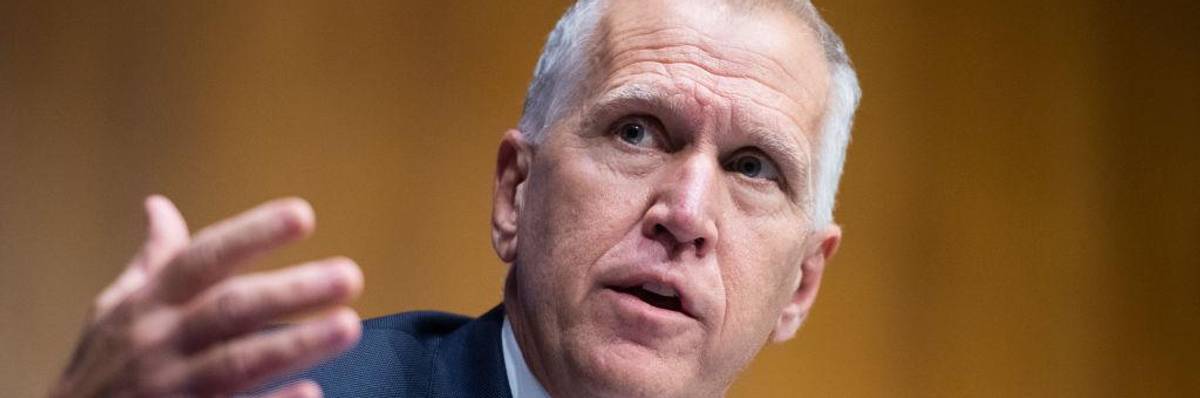
Senator Thom Tillis (above), who authored the felony streaming legislation, launched a "discussion draft" of the so-called Digital Copyright Act. (Photo by Tom Williams-Pool/Getty Images)
The CASE Act Is Just the Beginning of the Next Copyright Battle
Internet users and innovators, as well as the basic legal norms that have supported online expression for decades, are under attack.
As we feared, the "Copyright Alternative in Small-Claims Enforcement Act"--the CASE Act--that we've been fighting in various forms for two years has been included in a "must-pass" spending bill. This new legislation means Internet users could face up to $30,000 in penalties for sharing a meme or making a video, with liability determined not by neutral judges but by biased bureaucrats.
The CASE Act is supposed to be a solution to the complicated problem of online copyright infringement. In reality, it creates a system that will harm everyday users who, unlike the big players, won't have the time and capacity to negotiate this new bureaucracy. In essence, it creates a new "Copyright Claims Board" in the Copyright Office that will be empowered to adjudicate copyright infringement claims, unless the accused received a notice, recognizes what it means, and opts out--in a very specific manner, within a limited time period. The Board will be staffed by "claims officers," not judges or juries. You can appeal their rulings, but only on a limited basis, so you may be stuck with whatever amount the "claims board" decides you owe. Large, well-resourced players will not be affected, as they will have the resources to track notices and simply refuse to participate. The rest of us? We'll be on the hook.
It is a hot mess of a bill that will rewrite decades of copyright law, give the Copyright Office (hardly a neutral player) the keys to the Internet, and drastically undermine speech and innovation in the name of policing copyright infringement.
The relief bill also included an altered version of a felony streaming bill that is, thankfully, not as destructive as it could have been. While the legislation as written is troubling, an earlier version would have been even more dangerous, targeting not only large-scale, for-profit streaming services, but everyday users as well.
We're continuing the fight against the CASE Act, but today brings even bigger problems. Senator Thom Tillis, who authored the felony streaming legislation, launched a "discussion draft" of the so-called Digital Copyright Act. Put simply, it is a hot mess of a bill that will rewrite decades of copyright law, give the Copyright Office (hardly a neutral player) the keys to the Internet, and drastically undermine speech and innovation in the name of policing copyright infringement. Read more analysis of this catastrophic bill here.
Internet users and innovators, as well as the basic legal norms that have supported online expression for decades, are under attack. With your help, we will be continuing to fight back, as we have for thirty years, into 2021 and beyond. Fair use has a posse, and we hope you'll join it.
We are at a crossroads
This country and this world are at a monumental crossroads. In a few short weeks, US voters will have an opportunity to beat back the forces of fascism and confront the billionaires who are rigging the economy, our media system, and our democracy, making it increasingly impossible for ordinary people to get by. We’re not just talking about the election. We’re talking about what must be done once these fascist elements are vanquished from power. We need a bolder set of solutions than what either major party has so far been willing to offer and a working-class movement ready to fight like hell for it. Trump didn't emerge from nowhere. The conditions that fueled MAGA authoritarianism were created by decades of radical neoliberal economic policies and a corrupt political system dominated by corporate interests. They slashed taxes on the super-rich, promising that the benefits would trickle down. They said giveaways to the corporate titans would make life more affordable for the rest of us. It was all bullshit. And when a bitter, betrayed populace searches for someone to blame, right-wing demagogues have little trouble finding scapegoats. People know when they're being lied to, but you won't hear any of this from the corporate media. Only independent journalism—powered and funded by people who believe in building a better world—can deliver truly trustworthy daily news. Our Fall Campaign is underway, and we need your help. To power our newsroom through the rest of the year, we need to raise $125,000 by midnight on October 31. So if you share our vision, please contribute whatever you can to sustain our work. |
As we feared, the "Copyright Alternative in Small-Claims Enforcement Act"--the CASE Act--that we've been fighting in various forms for two years has been included in a "must-pass" spending bill. This new legislation means Internet users could face up to $30,000 in penalties for sharing a meme or making a video, with liability determined not by neutral judges but by biased bureaucrats.
The CASE Act is supposed to be a solution to the complicated problem of online copyright infringement. In reality, it creates a system that will harm everyday users who, unlike the big players, won't have the time and capacity to negotiate this new bureaucracy. In essence, it creates a new "Copyright Claims Board" in the Copyright Office that will be empowered to adjudicate copyright infringement claims, unless the accused received a notice, recognizes what it means, and opts out--in a very specific manner, within a limited time period. The Board will be staffed by "claims officers," not judges or juries. You can appeal their rulings, but only on a limited basis, so you may be stuck with whatever amount the "claims board" decides you owe. Large, well-resourced players will not be affected, as they will have the resources to track notices and simply refuse to participate. The rest of us? We'll be on the hook.
It is a hot mess of a bill that will rewrite decades of copyright law, give the Copyright Office (hardly a neutral player) the keys to the Internet, and drastically undermine speech and innovation in the name of policing copyright infringement.
The relief bill also included an altered version of a felony streaming bill that is, thankfully, not as destructive as it could have been. While the legislation as written is troubling, an earlier version would have been even more dangerous, targeting not only large-scale, for-profit streaming services, but everyday users as well.
We're continuing the fight against the CASE Act, but today brings even bigger problems. Senator Thom Tillis, who authored the felony streaming legislation, launched a "discussion draft" of the so-called Digital Copyright Act. Put simply, it is a hot mess of a bill that will rewrite decades of copyright law, give the Copyright Office (hardly a neutral player) the keys to the Internet, and drastically undermine speech and innovation in the name of policing copyright infringement. Read more analysis of this catastrophic bill here.
Internet users and innovators, as well as the basic legal norms that have supported online expression for decades, are under attack. With your help, we will be continuing to fight back, as we have for thirty years, into 2021 and beyond. Fair use has a posse, and we hope you'll join it.