SUBSCRIBE TO OUR FREE NEWSLETTER
Daily news & progressive opinion—funded by the people, not the corporations—delivered straight to your inbox.
5
#000000
#FFFFFF
To donate by check, phone, or other method, see our More Ways to Give page.
Daily news & progressive opinion—funded by the people, not the corporations—delivered straight to your inbox.
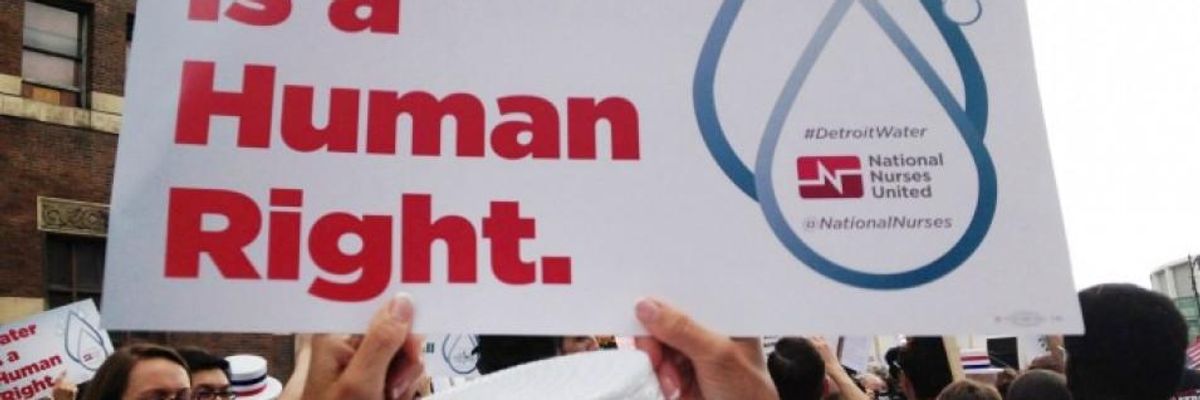
A demonstrator holds a sign during a Detroit water shutoffs rally in 2014. (Photo: uusc4all/CC BY-NC-ND 2.0)
Ten years ago today, the United Nations General Assembly adopted a resolution affirming that water and sanitation are fundamental human rights "essential for the full enjoyment of the right to life." Two months later, the UN Human Rights Council clarified that governments have the primary responsibility to deliver these new rights but called upon member states and international organizations to assist countries of the global South who might struggle to fulfill their new obligations.
This was an historic development in the long search for water justice. Water was not included in the 1948 Universal Declaration of Human Rights as it seemed to be a limitless resource available to all. But a perfect storm of global water depletion and destruction, growing poverty and inequality, and rising water rates for residents - often the result of the privatization of water services - led to a full blown human rights crisis by the turn of the 21st century. With billions living without access to clean water and sanitation, the call for water justice was born.
The fight to recognize the human right to water was surprisingly fierce and bitter. It was opposed by the private water utilities and the bottled water industry, the World Bank that was promoting water privatization in developing countries, the World Water Council, and many wealthy countries of the North, including Great Britain, Canada and the United States.
Food & Water Watch played an important role in achieving this pivotal mandate. Wenonah Hauter (Executive Director) and I attended many conferences around the world promoting the human right to water and stood up to the "Lords of Water," as I called them. I was in the balcony of the General Assembly on July 28, 2010, when it overwhelmingly adopted this historic resolution and I remember feeling that, in defining water and sanitation as an issue of justice rather than charity, the human family had just taken an evolutionary step forward.
There have been real and tangible results. Over four dozen countries have either amended their constitutions or introduced new laws to guarantee the human right to water. Communities in the global South have used the UN resolution to fight foreign companies destroying their water sources and gone to court to gain access to local water supplies.
The right to water has been used to fight water shut offs around the world and is a pivotal argument that Food & Water Watch has made to stop water shutoffs in U.S. cities during the time of COVID-19 and beyond. The human right to water is also the foundation of the WATER Act, which would ensure that every person has access to safe clean water in the United States.
To fight water privatization, many towns and cities have become "Blue Communities," a Canadian initiative that is spreading around the world. Almost 25 million people now live in official Blue Communities that have pledged to protect water as a human right, a public trust and public service and to phase out bottled water on municipal premises and at municipal events. These cities include Montreal, Vancouver, Los Angeles, Paris, Berlin and Brussels.
However, we are in a race against time as industries like fracking and bottled water divert, pollute, over-extract and mismanage the world's dwindling water supplies. Massive drought is threatening lives and livelihoods around the world. The UN warns that two-thirds of the global population could be living in water-stressed countries in just five short years. Here in the U.S., drought is on the rise, as are water rates.At least 2 million Americans do not have access to running water and basic sanitation.
The COVID-19 pandemic has thrown a huge spotlight on the water crisis as half the population of the world has no place to wash their hands with soap and warm water. As a result, some of the aid money coming from northern countries and the UN will provide clean water and sanitation to those most in peril. Perhaps this will lead to real change. Last year, almost 2 million children died from dirty water and poor sanitation. This is a travesty.
Let us vow to fulfill the pledge taken by the nations of the world ten years ago. Water is a human right.
Dear Common Dreams reader, It’s been nearly 30 years since I co-founded Common Dreams with my late wife, Lina Newhouser. We had the radical notion that journalism should serve the public good, not corporate profits. It was clear to us from the outset what it would take to build such a project. No paid advertisements. No corporate sponsors. No millionaire publisher telling us what to think or do. Many people said we wouldn't last a year, but we proved those doubters wrong. Together with a tremendous team of journalists and dedicated staff, we built an independent media outlet free from the constraints of profits and corporate control. Our mission has always been simple: To inform. To inspire. To ignite change for the common good. Building Common Dreams was not easy. Our survival was never guaranteed. When you take on the most powerful forces—Wall Street greed, fossil fuel industry destruction, Big Tech lobbyists, and uber-rich oligarchs who have spent billions upon billions rigging the economy and democracy in their favor—the only bulwark you have is supporters who believe in your work. But here’s the urgent message from me today. It's never been this bad out there. And it's never been this hard to keep us going. At the very moment Common Dreams is most needed, the threats we face are intensifying. We need your support now more than ever. We don't accept corporate advertising and never will. We don't have a paywall because we don't think people should be blocked from critical news based on their ability to pay. Everything we do is funded by the donations of readers like you. When everyone does the little they can afford, we are strong. But if that support retreats or dries up, so do we. Will you donate now to make sure Common Dreams not only survives but thrives? —Craig Brown, Co-founder |
Ten years ago today, the United Nations General Assembly adopted a resolution affirming that water and sanitation are fundamental human rights "essential for the full enjoyment of the right to life." Two months later, the UN Human Rights Council clarified that governments have the primary responsibility to deliver these new rights but called upon member states and international organizations to assist countries of the global South who might struggle to fulfill their new obligations.
This was an historic development in the long search for water justice. Water was not included in the 1948 Universal Declaration of Human Rights as it seemed to be a limitless resource available to all. But a perfect storm of global water depletion and destruction, growing poverty and inequality, and rising water rates for residents - often the result of the privatization of water services - led to a full blown human rights crisis by the turn of the 21st century. With billions living without access to clean water and sanitation, the call for water justice was born.
The fight to recognize the human right to water was surprisingly fierce and bitter. It was opposed by the private water utilities and the bottled water industry, the World Bank that was promoting water privatization in developing countries, the World Water Council, and many wealthy countries of the North, including Great Britain, Canada and the United States.
Food & Water Watch played an important role in achieving this pivotal mandate. Wenonah Hauter (Executive Director) and I attended many conferences around the world promoting the human right to water and stood up to the "Lords of Water," as I called them. I was in the balcony of the General Assembly on July 28, 2010, when it overwhelmingly adopted this historic resolution and I remember feeling that, in defining water and sanitation as an issue of justice rather than charity, the human family had just taken an evolutionary step forward.
There have been real and tangible results. Over four dozen countries have either amended their constitutions or introduced new laws to guarantee the human right to water. Communities in the global South have used the UN resolution to fight foreign companies destroying their water sources and gone to court to gain access to local water supplies.
The right to water has been used to fight water shut offs around the world and is a pivotal argument that Food & Water Watch has made to stop water shutoffs in U.S. cities during the time of COVID-19 and beyond. The human right to water is also the foundation of the WATER Act, which would ensure that every person has access to safe clean water in the United States.
To fight water privatization, many towns and cities have become "Blue Communities," a Canadian initiative that is spreading around the world. Almost 25 million people now live in official Blue Communities that have pledged to protect water as a human right, a public trust and public service and to phase out bottled water on municipal premises and at municipal events. These cities include Montreal, Vancouver, Los Angeles, Paris, Berlin and Brussels.
However, we are in a race against time as industries like fracking and bottled water divert, pollute, over-extract and mismanage the world's dwindling water supplies. Massive drought is threatening lives and livelihoods around the world. The UN warns that two-thirds of the global population could be living in water-stressed countries in just five short years. Here in the U.S., drought is on the rise, as are water rates.At least 2 million Americans do not have access to running water and basic sanitation.
The COVID-19 pandemic has thrown a huge spotlight on the water crisis as half the population of the world has no place to wash their hands with soap and warm water. As a result, some of the aid money coming from northern countries and the UN will provide clean water and sanitation to those most in peril. Perhaps this will lead to real change. Last year, almost 2 million children died from dirty water and poor sanitation. This is a travesty.
Let us vow to fulfill the pledge taken by the nations of the world ten years ago. Water is a human right.
Ten years ago today, the United Nations General Assembly adopted a resolution affirming that water and sanitation are fundamental human rights "essential for the full enjoyment of the right to life." Two months later, the UN Human Rights Council clarified that governments have the primary responsibility to deliver these new rights but called upon member states and international organizations to assist countries of the global South who might struggle to fulfill their new obligations.
This was an historic development in the long search for water justice. Water was not included in the 1948 Universal Declaration of Human Rights as it seemed to be a limitless resource available to all. But a perfect storm of global water depletion and destruction, growing poverty and inequality, and rising water rates for residents - often the result of the privatization of water services - led to a full blown human rights crisis by the turn of the 21st century. With billions living without access to clean water and sanitation, the call for water justice was born.
The fight to recognize the human right to water was surprisingly fierce and bitter. It was opposed by the private water utilities and the bottled water industry, the World Bank that was promoting water privatization in developing countries, the World Water Council, and many wealthy countries of the North, including Great Britain, Canada and the United States.
Food & Water Watch played an important role in achieving this pivotal mandate. Wenonah Hauter (Executive Director) and I attended many conferences around the world promoting the human right to water and stood up to the "Lords of Water," as I called them. I was in the balcony of the General Assembly on July 28, 2010, when it overwhelmingly adopted this historic resolution and I remember feeling that, in defining water and sanitation as an issue of justice rather than charity, the human family had just taken an evolutionary step forward.
There have been real and tangible results. Over four dozen countries have either amended their constitutions or introduced new laws to guarantee the human right to water. Communities in the global South have used the UN resolution to fight foreign companies destroying their water sources and gone to court to gain access to local water supplies.
The right to water has been used to fight water shut offs around the world and is a pivotal argument that Food & Water Watch has made to stop water shutoffs in U.S. cities during the time of COVID-19 and beyond. The human right to water is also the foundation of the WATER Act, which would ensure that every person has access to safe clean water in the United States.
To fight water privatization, many towns and cities have become "Blue Communities," a Canadian initiative that is spreading around the world. Almost 25 million people now live in official Blue Communities that have pledged to protect water as a human right, a public trust and public service and to phase out bottled water on municipal premises and at municipal events. These cities include Montreal, Vancouver, Los Angeles, Paris, Berlin and Brussels.
However, we are in a race against time as industries like fracking and bottled water divert, pollute, over-extract and mismanage the world's dwindling water supplies. Massive drought is threatening lives and livelihoods around the world. The UN warns that two-thirds of the global population could be living in water-stressed countries in just five short years. Here in the U.S., drought is on the rise, as are water rates.At least 2 million Americans do not have access to running water and basic sanitation.
The COVID-19 pandemic has thrown a huge spotlight on the water crisis as half the population of the world has no place to wash their hands with soap and warm water. As a result, some of the aid money coming from northern countries and the UN will provide clean water and sanitation to those most in peril. Perhaps this will lead to real change. Last year, almost 2 million children died from dirty water and poor sanitation. This is a travesty.
Let us vow to fulfill the pledge taken by the nations of the world ten years ago. Water is a human right.