SUBSCRIBE TO OUR FREE NEWSLETTER
Daily news & progressive opinion—funded by the people, not the corporations—delivered straight to your inbox.
5
#000000
#FFFFFF
To donate by check, phone, or other method, see our More Ways to Give page.
Daily news & progressive opinion—funded by the people, not the corporations—delivered straight to your inbox.
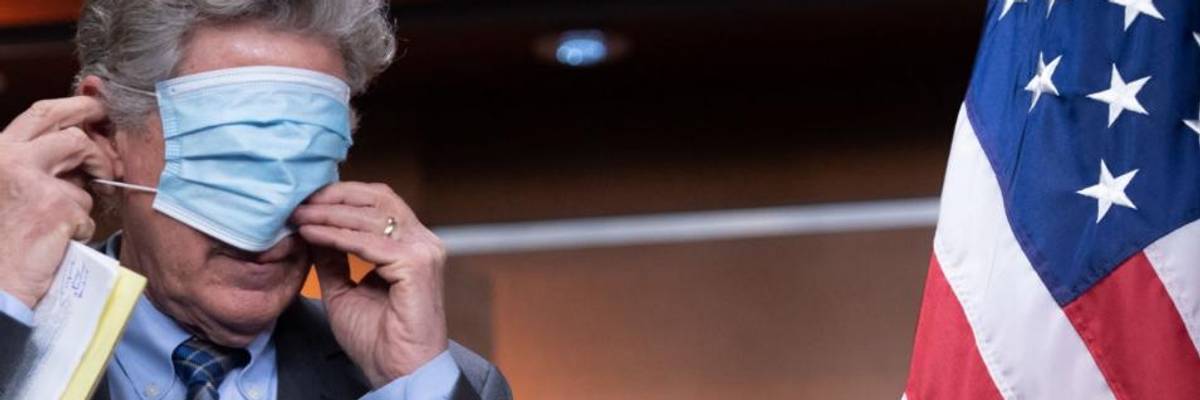
US Representative Frank Pallone, Democrat of New Jersey, puts on a mask during a press conference about COVID-19 testing on Capitol Hill in Washington, DC, May 27, 2020. (Photo: Saul Loeb/ AFP/ via Getty Images)
mericans have at various times in our past battled horrific bouts with infectious disease. And Americans have lived through times of sheer economic desperation. But we've never -- until this corona spring -- experienced both at once.
The stats out this week have made this grim landmark "official." Over 100,000 Americans now dead from Covid-19. Over 40 million claims for unemployment insurance. No nation on Earth has lost as many people to the coronavirus. No rich nation on Earth has a population less economically secure.
The United States is becoming, commentators have begun to contend, a "failed state." We don't, to be sure, have warlord gangs speeding through our neighborhoods, brandishing automatic weapons out of open-top jeeps. But we do have fanboys of our nation's top elected leader carrying long guns into legislative chambers and screaming red-faced at lawmakers they despise.
"Societies with smaller gaps between their rich and everyone else, the latest research shows, consistently do better fighting infectious disease than more unequal societies."
"We are one trigger-pull away," laments veteran Mideast journalist Lucian Truscott IV, "from what happens every day in places like Kabul and Mogadishu and Tripoli."
Our core institutions, adds Jacobin editor Seth Ackerman, betray "a deep lack of administrative capacity," be those institutions the bureaucracies that deal with safety-net benefits or the mail or even elections. State unemployment offices run on obsolete 1960s-era software that only "old retired former programmers" know how to fix.
The corona pandemic has put a spotlight on that obsolete software -- and so much more.
"The crisis demanded a response that was swift, rational, and collective," notes George Packer in the Atlantic. "The United States reacted instead like Pakistan or Belarus -- like a country with shoddy infrastructure and a dysfunctional government whose leaders were too corrupt or stupid to head off mass suffering."
So who to blame? Donald Trump makes an obvious and deserving target. But the failures of our ruling order predate his troubled and reckless administration. Our "chronic ills" -- everything from "a corrupt political class" to a "heartless economy" -- have gone, Packer points out, "untreated for years."
How can we halt our national descent into full-bore "failed state" status? Taking a moment to contemplate how a "successful state" operates might be a good place to start.
In a successful state, people thoughtfully identify the problems they share in common and democratically debate a variety of possible solutions. But this democratic dialogue doesn't just happen. Democratic dialogues only unfold effectively and efficiently when people actually share common problems.
That commonality has been disappearing in the United States over the past half-century. The culprit? Rising economic inequality. Our richest have become ever more rich and lead lives ever more distant from the lives Americans of modest means lead. The problems that vex average Americans -- paying the rent, finding health care, affording college -- keep no rich people awake at night.
On paper, that shouldn't matter. Our democracy has many more average-income than high-income people. Our government's priorities ought to reflect the concerns average-income people share. But the wealthy in the United States don't just have lots more wealth than everyone else. They have lots more power, and that power works to ensure that government addresses their problems, not ours.
The corona pandemic, political scientists Jacob Hacker and Paul Pierson observed earlier this week, has "laid bare" this fundamental inequality dynamic. The clearest case in point: Our ruling Republican Party's major-domos have gone "to the mat for the superrich." They have "twisted relief bills to provide unrelated tax cuts and no-strings bailouts, shuttered the Senate amid a national health and economic crisis," and "continued to float toxic ideas in an election year" -- like "making people give up some of their Social Security benefits in return for a financial lifeline today."
If these two political scientists -- authors of the soon-to-be-published Let Them Eat Tweets: How the Right Rules in an Age of Extreme Inequality -- are painting an accurate picture, we ought to see the same sort of political processes at play in other deeply unequal societies facing crises like pandemics. Turns out we do.
To be more specific: Societies with smaller gaps between their rich and everyone else, the latest research shows, consistently do better fighting infectious disease than more unequal societies.
So finds Mauro Guillen, a professor of management at the University of Pennsylvania's Wharton business school. His new working paper, The Politics of Pandemics: Democracy, State Capacity, and Economic Inequality, examines how epidemic outbreaks have played out in 146 countries since 1995.
Inequality, Guillen's research shows, makes epidemics "much, much worse, especially in terms of the number of people affected."
Why should that be the case? For starters, notes a Wharton introduction to Guillen's work, inequality "undermines people's compliance with epidemic containment policies such as social distancing and sheltering in place because people at the low end of the socioeconomic scale cannot afford to stay at home."
Successful states have the capacity -- the resources -- to make compliance more likely and treatment more effective. They provide safety-net supports. They don't need to go hunting for masks and ventilators. They have more robust public systems in place for dealing with emergencies.
But many exceedingly rich people have little interest in supporting public systems of any sort. They don't send their kids to public school or frolic in public parks or ride to work on public transportation. They live in an exclusive private world and like things that way. They see spending for building up public capacity as just another excuse to raise taxes on the wealthy.
The predictable result: In societies where wealth concentrates, public support systems wither. Communities lose the capacity to confront and overcome unexpected change.
"State capacity is a bulwark against the occurrence and ill effects of crises and emergencies," as Wharton's Guillen concludes, "while economic inequality exacerbates them."
We need a vaccine to beat the coronavirus. But more equality might help a good bit, too.
Dear Common Dreams reader, It’s been nearly 30 years since I co-founded Common Dreams with my late wife, Lina Newhouser. We had the radical notion that journalism should serve the public good, not corporate profits. It was clear to us from the outset what it would take to build such a project. No paid advertisements. No corporate sponsors. No millionaire publisher telling us what to think or do. Many people said we wouldn't last a year, but we proved those doubters wrong. Together with a tremendous team of journalists and dedicated staff, we built an independent media outlet free from the constraints of profits and corporate control. Our mission has always been simple: To inform. To inspire. To ignite change for the common good. Building Common Dreams was not easy. Our survival was never guaranteed. When you take on the most powerful forces—Wall Street greed, fossil fuel industry destruction, Big Tech lobbyists, and uber-rich oligarchs who have spent billions upon billions rigging the economy and democracy in their favor—the only bulwark you have is supporters who believe in your work. But here’s the urgent message from me today. It's never been this bad out there. And it's never been this hard to keep us going. At the very moment Common Dreams is most needed, the threats we face are intensifying. We need your support now more than ever. We don't accept corporate advertising and never will. We don't have a paywall because we don't think people should be blocked from critical news based on their ability to pay. Everything we do is funded by the donations of readers like you. When everyone does the little they can afford, we are strong. But if that support retreats or dries up, so do we. Will you donate now to make sure Common Dreams not only survives but thrives? —Craig Brown, Co-founder |
mericans have at various times in our past battled horrific bouts with infectious disease. And Americans have lived through times of sheer economic desperation. But we've never -- until this corona spring -- experienced both at once.
The stats out this week have made this grim landmark "official." Over 100,000 Americans now dead from Covid-19. Over 40 million claims for unemployment insurance. No nation on Earth has lost as many people to the coronavirus. No rich nation on Earth has a population less economically secure.
The United States is becoming, commentators have begun to contend, a "failed state." We don't, to be sure, have warlord gangs speeding through our neighborhoods, brandishing automatic weapons out of open-top jeeps. But we do have fanboys of our nation's top elected leader carrying long guns into legislative chambers and screaming red-faced at lawmakers they despise.
"Societies with smaller gaps between their rich and everyone else, the latest research shows, consistently do better fighting infectious disease than more unequal societies."
"We are one trigger-pull away," laments veteran Mideast journalist Lucian Truscott IV, "from what happens every day in places like Kabul and Mogadishu and Tripoli."
Our core institutions, adds Jacobin editor Seth Ackerman, betray "a deep lack of administrative capacity," be those institutions the bureaucracies that deal with safety-net benefits or the mail or even elections. State unemployment offices run on obsolete 1960s-era software that only "old retired former programmers" know how to fix.
The corona pandemic has put a spotlight on that obsolete software -- and so much more.
"The crisis demanded a response that was swift, rational, and collective," notes George Packer in the Atlantic. "The United States reacted instead like Pakistan or Belarus -- like a country with shoddy infrastructure and a dysfunctional government whose leaders were too corrupt or stupid to head off mass suffering."
So who to blame? Donald Trump makes an obvious and deserving target. But the failures of our ruling order predate his troubled and reckless administration. Our "chronic ills" -- everything from "a corrupt political class" to a "heartless economy" -- have gone, Packer points out, "untreated for years."
How can we halt our national descent into full-bore "failed state" status? Taking a moment to contemplate how a "successful state" operates might be a good place to start.
In a successful state, people thoughtfully identify the problems they share in common and democratically debate a variety of possible solutions. But this democratic dialogue doesn't just happen. Democratic dialogues only unfold effectively and efficiently when people actually share common problems.
That commonality has been disappearing in the United States over the past half-century. The culprit? Rising economic inequality. Our richest have become ever more rich and lead lives ever more distant from the lives Americans of modest means lead. The problems that vex average Americans -- paying the rent, finding health care, affording college -- keep no rich people awake at night.
On paper, that shouldn't matter. Our democracy has many more average-income than high-income people. Our government's priorities ought to reflect the concerns average-income people share. But the wealthy in the United States don't just have lots more wealth than everyone else. They have lots more power, and that power works to ensure that government addresses their problems, not ours.
The corona pandemic, political scientists Jacob Hacker and Paul Pierson observed earlier this week, has "laid bare" this fundamental inequality dynamic. The clearest case in point: Our ruling Republican Party's major-domos have gone "to the mat for the superrich." They have "twisted relief bills to provide unrelated tax cuts and no-strings bailouts, shuttered the Senate amid a national health and economic crisis," and "continued to float toxic ideas in an election year" -- like "making people give up some of their Social Security benefits in return for a financial lifeline today."
If these two political scientists -- authors of the soon-to-be-published Let Them Eat Tweets: How the Right Rules in an Age of Extreme Inequality -- are painting an accurate picture, we ought to see the same sort of political processes at play in other deeply unequal societies facing crises like pandemics. Turns out we do.
To be more specific: Societies with smaller gaps between their rich and everyone else, the latest research shows, consistently do better fighting infectious disease than more unequal societies.
So finds Mauro Guillen, a professor of management at the University of Pennsylvania's Wharton business school. His new working paper, The Politics of Pandemics: Democracy, State Capacity, and Economic Inequality, examines how epidemic outbreaks have played out in 146 countries since 1995.
Inequality, Guillen's research shows, makes epidemics "much, much worse, especially in terms of the number of people affected."
Why should that be the case? For starters, notes a Wharton introduction to Guillen's work, inequality "undermines people's compliance with epidemic containment policies such as social distancing and sheltering in place because people at the low end of the socioeconomic scale cannot afford to stay at home."
Successful states have the capacity -- the resources -- to make compliance more likely and treatment more effective. They provide safety-net supports. They don't need to go hunting for masks and ventilators. They have more robust public systems in place for dealing with emergencies.
But many exceedingly rich people have little interest in supporting public systems of any sort. They don't send their kids to public school or frolic in public parks or ride to work on public transportation. They live in an exclusive private world and like things that way. They see spending for building up public capacity as just another excuse to raise taxes on the wealthy.
The predictable result: In societies where wealth concentrates, public support systems wither. Communities lose the capacity to confront and overcome unexpected change.
"State capacity is a bulwark against the occurrence and ill effects of crises and emergencies," as Wharton's Guillen concludes, "while economic inequality exacerbates them."
We need a vaccine to beat the coronavirus. But more equality might help a good bit, too.
mericans have at various times in our past battled horrific bouts with infectious disease. And Americans have lived through times of sheer economic desperation. But we've never -- until this corona spring -- experienced both at once.
The stats out this week have made this grim landmark "official." Over 100,000 Americans now dead from Covid-19. Over 40 million claims for unemployment insurance. No nation on Earth has lost as many people to the coronavirus. No rich nation on Earth has a population less economically secure.
The United States is becoming, commentators have begun to contend, a "failed state." We don't, to be sure, have warlord gangs speeding through our neighborhoods, brandishing automatic weapons out of open-top jeeps. But we do have fanboys of our nation's top elected leader carrying long guns into legislative chambers and screaming red-faced at lawmakers they despise.
"Societies with smaller gaps between their rich and everyone else, the latest research shows, consistently do better fighting infectious disease than more unequal societies."
"We are one trigger-pull away," laments veteran Mideast journalist Lucian Truscott IV, "from what happens every day in places like Kabul and Mogadishu and Tripoli."
Our core institutions, adds Jacobin editor Seth Ackerman, betray "a deep lack of administrative capacity," be those institutions the bureaucracies that deal with safety-net benefits or the mail or even elections. State unemployment offices run on obsolete 1960s-era software that only "old retired former programmers" know how to fix.
The corona pandemic has put a spotlight on that obsolete software -- and so much more.
"The crisis demanded a response that was swift, rational, and collective," notes George Packer in the Atlantic. "The United States reacted instead like Pakistan or Belarus -- like a country with shoddy infrastructure and a dysfunctional government whose leaders were too corrupt or stupid to head off mass suffering."
So who to blame? Donald Trump makes an obvious and deserving target. But the failures of our ruling order predate his troubled and reckless administration. Our "chronic ills" -- everything from "a corrupt political class" to a "heartless economy" -- have gone, Packer points out, "untreated for years."
How can we halt our national descent into full-bore "failed state" status? Taking a moment to contemplate how a "successful state" operates might be a good place to start.
In a successful state, people thoughtfully identify the problems they share in common and democratically debate a variety of possible solutions. But this democratic dialogue doesn't just happen. Democratic dialogues only unfold effectively and efficiently when people actually share common problems.
That commonality has been disappearing in the United States over the past half-century. The culprit? Rising economic inequality. Our richest have become ever more rich and lead lives ever more distant from the lives Americans of modest means lead. The problems that vex average Americans -- paying the rent, finding health care, affording college -- keep no rich people awake at night.
On paper, that shouldn't matter. Our democracy has many more average-income than high-income people. Our government's priorities ought to reflect the concerns average-income people share. But the wealthy in the United States don't just have lots more wealth than everyone else. They have lots more power, and that power works to ensure that government addresses their problems, not ours.
The corona pandemic, political scientists Jacob Hacker and Paul Pierson observed earlier this week, has "laid bare" this fundamental inequality dynamic. The clearest case in point: Our ruling Republican Party's major-domos have gone "to the mat for the superrich." They have "twisted relief bills to provide unrelated tax cuts and no-strings bailouts, shuttered the Senate amid a national health and economic crisis," and "continued to float toxic ideas in an election year" -- like "making people give up some of their Social Security benefits in return for a financial lifeline today."
If these two political scientists -- authors of the soon-to-be-published Let Them Eat Tweets: How the Right Rules in an Age of Extreme Inequality -- are painting an accurate picture, we ought to see the same sort of political processes at play in other deeply unequal societies facing crises like pandemics. Turns out we do.
To be more specific: Societies with smaller gaps between their rich and everyone else, the latest research shows, consistently do better fighting infectious disease than more unequal societies.
So finds Mauro Guillen, a professor of management at the University of Pennsylvania's Wharton business school. His new working paper, The Politics of Pandemics: Democracy, State Capacity, and Economic Inequality, examines how epidemic outbreaks have played out in 146 countries since 1995.
Inequality, Guillen's research shows, makes epidemics "much, much worse, especially in terms of the number of people affected."
Why should that be the case? For starters, notes a Wharton introduction to Guillen's work, inequality "undermines people's compliance with epidemic containment policies such as social distancing and sheltering in place because people at the low end of the socioeconomic scale cannot afford to stay at home."
Successful states have the capacity -- the resources -- to make compliance more likely and treatment more effective. They provide safety-net supports. They don't need to go hunting for masks and ventilators. They have more robust public systems in place for dealing with emergencies.
But many exceedingly rich people have little interest in supporting public systems of any sort. They don't send their kids to public school or frolic in public parks or ride to work on public transportation. They live in an exclusive private world and like things that way. They see spending for building up public capacity as just another excuse to raise taxes on the wealthy.
The predictable result: In societies where wealth concentrates, public support systems wither. Communities lose the capacity to confront and overcome unexpected change.
"State capacity is a bulwark against the occurrence and ill effects of crises and emergencies," as Wharton's Guillen concludes, "while economic inequality exacerbates them."
We need a vaccine to beat the coronavirus. But more equality might help a good bit, too.