SUBSCRIBE TO OUR FREE NEWSLETTER
Daily news & progressive opinion—funded by the people, not the corporations—delivered straight to your inbox.
5
#000000
#FFFFFF
To donate by check, phone, or other method, see our More Ways to Give page.
Daily news & progressive opinion—funded by the people, not the corporations—delivered straight to your inbox.
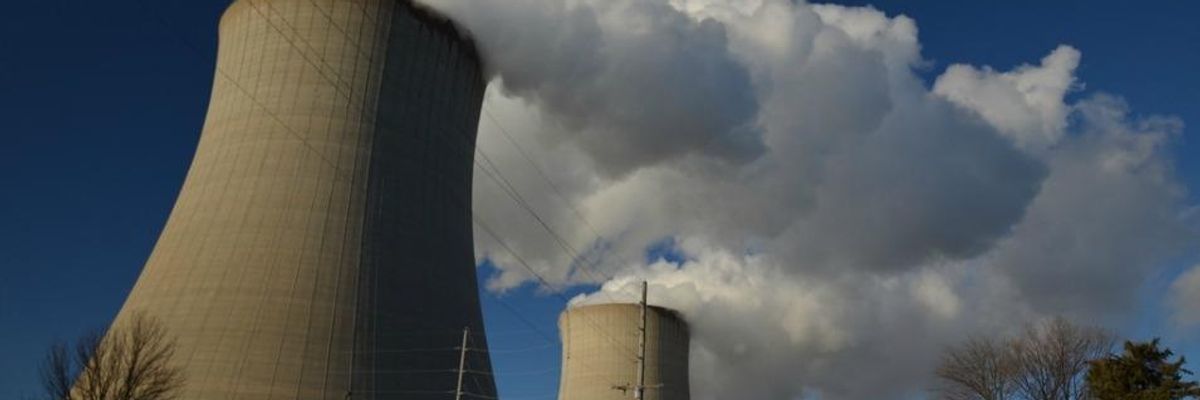
The nuclear power plant in Byron, Illinois. (Photo: Michael Kappel/flickr/cc)
The Green New Deal resolution is a bold and necessary path forward to tackle the climate crisis. To be successful, it must leave nuclear power behind.
As momentum around the Green New Deal turns into concrete proposals, we must recognize why nuclear power is a discredited and dishonest distraction, not a solution.
With just a decade left to stop the worst effects of climate change, we must dramatically transform how we produce, use and pay for energy. And as momentum around the Green New Deal turns into concrete proposals, we must recognize why nuclear power is a discredited and dishonest distraction, not a solution.
To reduce global greenhouse gas emissions by 40 to 60 percent by 2030, and down to zero by 2050, we need cost-effective, proven energy generation technology that can be scaled up to meet these benchmarks. Nuclear power does not and will not ever meet these criteria.
After 60 years, despite massive subsidies, the nuclear industry is dying of its own accord. Why? Because it's too expensive, too dangerous and dirty, and takes too long to deploy. Reactors are closing across the country, and major corporations have declared bankruptcy.
Nuclear power simply cannot compete against safer, cleaner, and cheaper renewable energy. Nuclear power is also expensive. Nuclear's subsidies have been buried in hundreds of spending bills, it's costs externalized to the environment and future generations, and its bills literally unpaid, defaulted on or passed to taxpayers. Conservative estimates suggest that the nuclear industry has received more than $85 billion in subsidies. A centrist estimate might double that.
For 60 years, nuclear power has posed a serious risk to people and our planet. It will be the same for the next 10,000 years. Our children and generations of their children will be forced to endure the radioactive pollution and fallout from devastating accidents like 3 Mile Island, Fukashima, and Chernobyl, and the permanent waste that no one can safely store. The risks of nuclear proliferation and the spread of dangerous weapons and technology only adds to this.
Nuclear power is too slow to scale up to our current challenge. Far too slow. In 1997, when the historic Kyoto Protocol was signed, nuclear power's share of electricity generation globally was around 17 percent. Now, after two decades, the aging fleet of reactors account for barely 10 percent of global electricity generation and about 4.4 percent of global commercial primary energy consumption. Even the nuclear industry's grandiose and preposterously expensive proposal to build two new nuclear reactors a month, from now to 2050, would be far too little and far too late.
The endless talk of a new nuclear technology that will magically transform this problem is a pipe dream that has a proven record of failure. Hundreds of billions were spent on "breeder" reactors and other esoteric designs and not a single one has yielded a commercial scale reactor.
Continuing to subsidize and retool current reactors will re-direct massive resources that should be put into renewables, while doing nothing to slow global warming.
And continuing to subsidize and retool current reactors will re-direct massive resources that should be put into renewables, while doing nothing to slow global warming.
The task ahead is indeed daunting if we are to turn around global greenhouse gas emissions in the time we have. We must move from a 20th-century energy system based on dirty, dangerous, and expensive fossil fuel and nuclear power to a 21st-century energy system based on renewables.
The solution is a massive commitment to ramping up renewable energy coupled with energy storage while applying modern energy efficiency technologies to decrease demand. Wind and solar are cheap, clean, and proven to work. We must focus all resources on scaling those up.
Some have suggested that climate change is so dire that all options must be on the table. But that's an ideology, not a strategy. We must choose the technologies that will not produce greenhouse gases and can be scaled up quickly, safely, and at lowest cost. That means the path ahead must be based on renewable energy. If we want to stop the worse of the climate crisis and pull humanity back from the apocalypse, this is the only way forward.
Dear Common Dreams reader, It’s been nearly 30 years since I co-founded Common Dreams with my late wife, Lina Newhouser. We had the radical notion that journalism should serve the public good, not corporate profits. It was clear to us from the outset what it would take to build such a project. No paid advertisements. No corporate sponsors. No millionaire publisher telling us what to think or do. Many people said we wouldn't last a year, but we proved those doubters wrong. Together with a tremendous team of journalists and dedicated staff, we built an independent media outlet free from the constraints of profits and corporate control. Our mission has always been simple: To inform. To inspire. To ignite change for the common good. Building Common Dreams was not easy. Our survival was never guaranteed. When you take on the most powerful forces—Wall Street greed, fossil fuel industry destruction, Big Tech lobbyists, and uber-rich oligarchs who have spent billions upon billions rigging the economy and democracy in their favor—the only bulwark you have is supporters who believe in your work. But here’s the urgent message from me today. It's never been this bad out there. And it's never been this hard to keep us going. At the very moment Common Dreams is most needed, the threats we face are intensifying. We need your support now more than ever. We don't accept corporate advertising and never will. We don't have a paywall because we don't think people should be blocked from critical news based on their ability to pay. Everything we do is funded by the donations of readers like you. When everyone does the little they can afford, we are strong. But if that support retreats or dries up, so do we. Will you donate now to make sure Common Dreams not only survives but thrives? —Craig Brown, Co-founder |
The Green New Deal resolution is a bold and necessary path forward to tackle the climate crisis. To be successful, it must leave nuclear power behind.
As momentum around the Green New Deal turns into concrete proposals, we must recognize why nuclear power is a discredited and dishonest distraction, not a solution.
With just a decade left to stop the worst effects of climate change, we must dramatically transform how we produce, use and pay for energy. And as momentum around the Green New Deal turns into concrete proposals, we must recognize why nuclear power is a discredited and dishonest distraction, not a solution.
To reduce global greenhouse gas emissions by 40 to 60 percent by 2030, and down to zero by 2050, we need cost-effective, proven energy generation technology that can be scaled up to meet these benchmarks. Nuclear power does not and will not ever meet these criteria.
After 60 years, despite massive subsidies, the nuclear industry is dying of its own accord. Why? Because it's too expensive, too dangerous and dirty, and takes too long to deploy. Reactors are closing across the country, and major corporations have declared bankruptcy.
Nuclear power simply cannot compete against safer, cleaner, and cheaper renewable energy. Nuclear power is also expensive. Nuclear's subsidies have been buried in hundreds of spending bills, it's costs externalized to the environment and future generations, and its bills literally unpaid, defaulted on or passed to taxpayers. Conservative estimates suggest that the nuclear industry has received more than $85 billion in subsidies. A centrist estimate might double that.
For 60 years, nuclear power has posed a serious risk to people and our planet. It will be the same for the next 10,000 years. Our children and generations of their children will be forced to endure the radioactive pollution and fallout from devastating accidents like 3 Mile Island, Fukashima, and Chernobyl, and the permanent waste that no one can safely store. The risks of nuclear proliferation and the spread of dangerous weapons and technology only adds to this.
Nuclear power is too slow to scale up to our current challenge. Far too slow. In 1997, when the historic Kyoto Protocol was signed, nuclear power's share of electricity generation globally was around 17 percent. Now, after two decades, the aging fleet of reactors account for barely 10 percent of global electricity generation and about 4.4 percent of global commercial primary energy consumption. Even the nuclear industry's grandiose and preposterously expensive proposal to build two new nuclear reactors a month, from now to 2050, would be far too little and far too late.
The endless talk of a new nuclear technology that will magically transform this problem is a pipe dream that has a proven record of failure. Hundreds of billions were spent on "breeder" reactors and other esoteric designs and not a single one has yielded a commercial scale reactor.
Continuing to subsidize and retool current reactors will re-direct massive resources that should be put into renewables, while doing nothing to slow global warming.
And continuing to subsidize and retool current reactors will re-direct massive resources that should be put into renewables, while doing nothing to slow global warming.
The task ahead is indeed daunting if we are to turn around global greenhouse gas emissions in the time we have. We must move from a 20th-century energy system based on dirty, dangerous, and expensive fossil fuel and nuclear power to a 21st-century energy system based on renewables.
The solution is a massive commitment to ramping up renewable energy coupled with energy storage while applying modern energy efficiency technologies to decrease demand. Wind and solar are cheap, clean, and proven to work. We must focus all resources on scaling those up.
Some have suggested that climate change is so dire that all options must be on the table. But that's an ideology, not a strategy. We must choose the technologies that will not produce greenhouse gases and can be scaled up quickly, safely, and at lowest cost. That means the path ahead must be based on renewable energy. If we want to stop the worse of the climate crisis and pull humanity back from the apocalypse, this is the only way forward.
The Green New Deal resolution is a bold and necessary path forward to tackle the climate crisis. To be successful, it must leave nuclear power behind.
As momentum around the Green New Deal turns into concrete proposals, we must recognize why nuclear power is a discredited and dishonest distraction, not a solution.
With just a decade left to stop the worst effects of climate change, we must dramatically transform how we produce, use and pay for energy. And as momentum around the Green New Deal turns into concrete proposals, we must recognize why nuclear power is a discredited and dishonest distraction, not a solution.
To reduce global greenhouse gas emissions by 40 to 60 percent by 2030, and down to zero by 2050, we need cost-effective, proven energy generation technology that can be scaled up to meet these benchmarks. Nuclear power does not and will not ever meet these criteria.
After 60 years, despite massive subsidies, the nuclear industry is dying of its own accord. Why? Because it's too expensive, too dangerous and dirty, and takes too long to deploy. Reactors are closing across the country, and major corporations have declared bankruptcy.
Nuclear power simply cannot compete against safer, cleaner, and cheaper renewable energy. Nuclear power is also expensive. Nuclear's subsidies have been buried in hundreds of spending bills, it's costs externalized to the environment and future generations, and its bills literally unpaid, defaulted on or passed to taxpayers. Conservative estimates suggest that the nuclear industry has received more than $85 billion in subsidies. A centrist estimate might double that.
For 60 years, nuclear power has posed a serious risk to people and our planet. It will be the same for the next 10,000 years. Our children and generations of their children will be forced to endure the radioactive pollution and fallout from devastating accidents like 3 Mile Island, Fukashima, and Chernobyl, and the permanent waste that no one can safely store. The risks of nuclear proliferation and the spread of dangerous weapons and technology only adds to this.
Nuclear power is too slow to scale up to our current challenge. Far too slow. In 1997, when the historic Kyoto Protocol was signed, nuclear power's share of electricity generation globally was around 17 percent. Now, after two decades, the aging fleet of reactors account for barely 10 percent of global electricity generation and about 4.4 percent of global commercial primary energy consumption. Even the nuclear industry's grandiose and preposterously expensive proposal to build two new nuclear reactors a month, from now to 2050, would be far too little and far too late.
The endless talk of a new nuclear technology that will magically transform this problem is a pipe dream that has a proven record of failure. Hundreds of billions were spent on "breeder" reactors and other esoteric designs and not a single one has yielded a commercial scale reactor.
Continuing to subsidize and retool current reactors will re-direct massive resources that should be put into renewables, while doing nothing to slow global warming.
And continuing to subsidize and retool current reactors will re-direct massive resources that should be put into renewables, while doing nothing to slow global warming.
The task ahead is indeed daunting if we are to turn around global greenhouse gas emissions in the time we have. We must move from a 20th-century energy system based on dirty, dangerous, and expensive fossil fuel and nuclear power to a 21st-century energy system based on renewables.
The solution is a massive commitment to ramping up renewable energy coupled with energy storage while applying modern energy efficiency technologies to decrease demand. Wind and solar are cheap, clean, and proven to work. We must focus all resources on scaling those up.
Some have suggested that climate change is so dire that all options must be on the table. But that's an ideology, not a strategy. We must choose the technologies that will not produce greenhouse gases and can be scaled up quickly, safely, and at lowest cost. That means the path ahead must be based on renewable energy. If we want to stop the worse of the climate crisis and pull humanity back from the apocalypse, this is the only way forward.