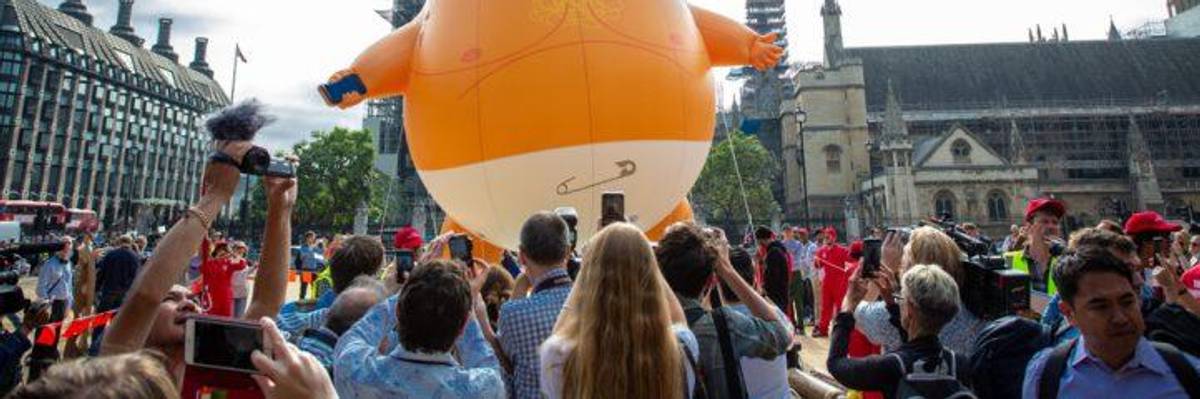
Anti-Trump protesters float a giant "baby Trump" in London. (Shutterstock)
What's Behind Trump's Assault on Europe
Trump is attacking Europe and siding with Russia for political — and not just personal — reasons
Donald Trump didn't fly to Europe to meet with NATO, European leaders, and Russian President Vladimir Putin. He got there by stepping through the looking glass.
Once on the other side, Trump made a series of extraordinary statements that have effectively turned U.S. foreign policy upside down. He accused Germany of being "totally controlled by Russia." He declared that the European Union is a "foe" of the United States. He told British Prime Minister Theresa May that she should forget about negotiating with the EU and sue the institution instead.
And, just days after the U.S. intelligence community and special counsel Robert Mueller confirmed once again that the Russian government interfered in the 2016 elections, Trump said that he believed in Putin's claims of Russian innocence.
Why on earth would Trump embark on this surrealistic misadventure in foreign policy? True, his first instinct seems to be to disrupt. His statements also reveal his preference for "strong" leaders over "weak." Perhaps, as some intelligence community insiders claim, the Russian president even has some dirt with which to blackmail Trump.
In fact, Trump's statements and actions on this European trip aren't just his own idiosyncratic style. Trump's erratic behavior reflects a very specific worldview. Trump is attacking Europe and siding with Russia for political -- and not just personal -- reasons.
A segment of the U.S. right wing, which has now coalesced around Trump, has always been skeptical about Europe. It has long decried the social democratic ideals baked into the European system, at both a national and a European Union level. Indeed, any U.S. politician that leans in that direction inevitably gets branded a European socialist, as John McCain accused Barack Obama of being in the 2008 presidential campaign.
Then there are the more pacifist inclinations of Europe. Donald Rumsfeld famously divided the continent between "old Europe" and "new Europe," with the former refusing to back the U.S. invasion of Iraq. Support for the U.S. misadventure largely came from East-Central Europe, while EU stalwarts France and Germany expressed the greatest skepticism.
These trends converge in the Euroskepticism expressed by the American Enterprise Institute and media outlets like Fox News and The Weekly Standard, a sentiment that gathered strength in the 1990s and heavily influenced the George W. Bush administration. The European Union represented, in their criticisms, a kind of super-socialism that was spreading eastward and threatening U.S. global dominance.
The other major contribution to Trump's worldview comes from Europe itself. Right-wing nationalist movements and governments throughout the continent have tried to unravel the European Union. The movement scored its first victory with the Brexit referendum in 2016. But Euroskeptic governments have also taken over in Hungary, the Czech Republic, Austria, and Italy.
These Euroskeptics view Brussels as an outside force trying to impose foreign customs on nations -- unacceptable economic policies, unacceptable numbers of immigrants, unacceptable political requirements. The Polish and Hungarian governments are establishing illiberal regimes that challenge freedom of the press, judicial independence, and the free functioning of civil society. The two countries are risking all-out conflict with the EU.
But there's another strong Euroskeptic voice: Vladimir Putin.
Under Putin, Russia has supplied rhetorical and financial support for far-right wing parties throughout Europe -- the National Front in France, the Freedom Party in Austria, the Northern League in Italy. There is considerable issue overlap. Putin and the Euroskeptics are anti-immigrant and anti-liberal and favor nationalist and law-and-order policies.
But Putin also sees opportunity in Euroskepticism. A weaker EU won't be able to attract new, post-Soviet members like Ukraine or Moldova. A weaker EU will be more dependent on Russian energy exports. A weaker EU would have less power to criticize Russia's political and foreign policy conduct.
Which brings us back to Donald Trump. The president has declared Europe an enemy because of its trade policies. But that's just a red herring. He actually has a more systemic critique of the EU that coincides with the worldview of Vladimir Putin, Europe's right-wing nationalists, and Euroskeptics among America's conservatives.
This is very bad news. If the crisis in transatlantic relations were just about trade, it could be handled by some hardnosed negotiating. If the disputes with the EU and NATO were simply about Trump's disruptive style, then everything could be resolved by a regime change at the polls in 2020.
But Trump has launched a much larger, ideological assault on European institutions and values. What's worse: It's part of the same attack on liberal values here in the United States.
Forget about NATO: Maybe we need a transatlantic alliance against Trump.
Urgent. It's never been this bad.
Dear Common Dreams reader, It’s been nearly 30 years since I co-founded Common Dreams with my late wife, Lina Newhouser. We had the radical notion that journalism should serve the public good, not corporate profits. It was clear to us from the outset what it would take to build such a project. No paid advertisements. No corporate sponsors. No millionaire publisher telling us what to think or do. Many people said we wouldn't last a year, but we proved those doubters wrong. Together with a tremendous team of journalists and dedicated staff, we built an independent media outlet free from the constraints of profits and corporate control. Our mission from the outset was simple. To inform. To inspire. To ignite change for the common good. Building Common Dreams was not easy. Our survival was never guaranteed. When you take on the most powerful forces—Wall Street greed, fossil fuel industry destruction, Big Tech lobbyists, and uber-rich oligarchs who have spent billions upon billions rigging the economy and democracy in their favor—the only bulwark you have is supporters who believe in your work. But here’s the urgent message from me today. It’s never been this bad out there. And it’s never been this hard to keep us going. At the very moment Common Dreams is most needed and doing some of its best and most important work, the threats we face are intensifying. Right now, with just four days to go in our Spring Campaign, we are not even halfway to our goal. When everyone does the little they can afford, we are strong. But if that support retreats or dries up, so do we. Can you make a gift right now to make sure Common Dreams not only survives but thrives? There is no backup plan or rainy day fund. There is only you. —Craig Brown, Co-founder |
Donald Trump didn't fly to Europe to meet with NATO, European leaders, and Russian President Vladimir Putin. He got there by stepping through the looking glass.
Once on the other side, Trump made a series of extraordinary statements that have effectively turned U.S. foreign policy upside down. He accused Germany of being "totally controlled by Russia." He declared that the European Union is a "foe" of the United States. He told British Prime Minister Theresa May that she should forget about negotiating with the EU and sue the institution instead.
And, just days after the U.S. intelligence community and special counsel Robert Mueller confirmed once again that the Russian government interfered in the 2016 elections, Trump said that he believed in Putin's claims of Russian innocence.
Why on earth would Trump embark on this surrealistic misadventure in foreign policy? True, his first instinct seems to be to disrupt. His statements also reveal his preference for "strong" leaders over "weak." Perhaps, as some intelligence community insiders claim, the Russian president even has some dirt with which to blackmail Trump.
In fact, Trump's statements and actions on this European trip aren't just his own idiosyncratic style. Trump's erratic behavior reflects a very specific worldview. Trump is attacking Europe and siding with Russia for political -- and not just personal -- reasons.
A segment of the U.S. right wing, which has now coalesced around Trump, has always been skeptical about Europe. It has long decried the social democratic ideals baked into the European system, at both a national and a European Union level. Indeed, any U.S. politician that leans in that direction inevitably gets branded a European socialist, as John McCain accused Barack Obama of being in the 2008 presidential campaign.
Then there are the more pacifist inclinations of Europe. Donald Rumsfeld famously divided the continent between "old Europe" and "new Europe," with the former refusing to back the U.S. invasion of Iraq. Support for the U.S. misadventure largely came from East-Central Europe, while EU stalwarts France and Germany expressed the greatest skepticism.
These trends converge in the Euroskepticism expressed by the American Enterprise Institute and media outlets like Fox News and The Weekly Standard, a sentiment that gathered strength in the 1990s and heavily influenced the George W. Bush administration. The European Union represented, in their criticisms, a kind of super-socialism that was spreading eastward and threatening U.S. global dominance.
The other major contribution to Trump's worldview comes from Europe itself. Right-wing nationalist movements and governments throughout the continent have tried to unravel the European Union. The movement scored its first victory with the Brexit referendum in 2016. But Euroskeptic governments have also taken over in Hungary, the Czech Republic, Austria, and Italy.
These Euroskeptics view Brussels as an outside force trying to impose foreign customs on nations -- unacceptable economic policies, unacceptable numbers of immigrants, unacceptable political requirements. The Polish and Hungarian governments are establishing illiberal regimes that challenge freedom of the press, judicial independence, and the free functioning of civil society. The two countries are risking all-out conflict with the EU.
But there's another strong Euroskeptic voice: Vladimir Putin.
Under Putin, Russia has supplied rhetorical and financial support for far-right wing parties throughout Europe -- the National Front in France, the Freedom Party in Austria, the Northern League in Italy. There is considerable issue overlap. Putin and the Euroskeptics are anti-immigrant and anti-liberal and favor nationalist and law-and-order policies.
But Putin also sees opportunity in Euroskepticism. A weaker EU won't be able to attract new, post-Soviet members like Ukraine or Moldova. A weaker EU will be more dependent on Russian energy exports. A weaker EU would have less power to criticize Russia's political and foreign policy conduct.
Which brings us back to Donald Trump. The president has declared Europe an enemy because of its trade policies. But that's just a red herring. He actually has a more systemic critique of the EU that coincides with the worldview of Vladimir Putin, Europe's right-wing nationalists, and Euroskeptics among America's conservatives.
This is very bad news. If the crisis in transatlantic relations were just about trade, it could be handled by some hardnosed negotiating. If the disputes with the EU and NATO were simply about Trump's disruptive style, then everything could be resolved by a regime change at the polls in 2020.
But Trump has launched a much larger, ideological assault on European institutions and values. What's worse: It's part of the same attack on liberal values here in the United States.
Forget about NATO: Maybe we need a transatlantic alliance against Trump.
Donald Trump didn't fly to Europe to meet with NATO, European leaders, and Russian President Vladimir Putin. He got there by stepping through the looking glass.
Once on the other side, Trump made a series of extraordinary statements that have effectively turned U.S. foreign policy upside down. He accused Germany of being "totally controlled by Russia." He declared that the European Union is a "foe" of the United States. He told British Prime Minister Theresa May that she should forget about negotiating with the EU and sue the institution instead.
And, just days after the U.S. intelligence community and special counsel Robert Mueller confirmed once again that the Russian government interfered in the 2016 elections, Trump said that he believed in Putin's claims of Russian innocence.
Why on earth would Trump embark on this surrealistic misadventure in foreign policy? True, his first instinct seems to be to disrupt. His statements also reveal his preference for "strong" leaders over "weak." Perhaps, as some intelligence community insiders claim, the Russian president even has some dirt with which to blackmail Trump.
In fact, Trump's statements and actions on this European trip aren't just his own idiosyncratic style. Trump's erratic behavior reflects a very specific worldview. Trump is attacking Europe and siding with Russia for political -- and not just personal -- reasons.
A segment of the U.S. right wing, which has now coalesced around Trump, has always been skeptical about Europe. It has long decried the social democratic ideals baked into the European system, at both a national and a European Union level. Indeed, any U.S. politician that leans in that direction inevitably gets branded a European socialist, as John McCain accused Barack Obama of being in the 2008 presidential campaign.
Then there are the more pacifist inclinations of Europe. Donald Rumsfeld famously divided the continent between "old Europe" and "new Europe," with the former refusing to back the U.S. invasion of Iraq. Support for the U.S. misadventure largely came from East-Central Europe, while EU stalwarts France and Germany expressed the greatest skepticism.
These trends converge in the Euroskepticism expressed by the American Enterprise Institute and media outlets like Fox News and The Weekly Standard, a sentiment that gathered strength in the 1990s and heavily influenced the George W. Bush administration. The European Union represented, in their criticisms, a kind of super-socialism that was spreading eastward and threatening U.S. global dominance.
The other major contribution to Trump's worldview comes from Europe itself. Right-wing nationalist movements and governments throughout the continent have tried to unravel the European Union. The movement scored its first victory with the Brexit referendum in 2016. But Euroskeptic governments have also taken over in Hungary, the Czech Republic, Austria, and Italy.
These Euroskeptics view Brussels as an outside force trying to impose foreign customs on nations -- unacceptable economic policies, unacceptable numbers of immigrants, unacceptable political requirements. The Polish and Hungarian governments are establishing illiberal regimes that challenge freedom of the press, judicial independence, and the free functioning of civil society. The two countries are risking all-out conflict with the EU.
But there's another strong Euroskeptic voice: Vladimir Putin.
Under Putin, Russia has supplied rhetorical and financial support for far-right wing parties throughout Europe -- the National Front in France, the Freedom Party in Austria, the Northern League in Italy. There is considerable issue overlap. Putin and the Euroskeptics are anti-immigrant and anti-liberal and favor nationalist and law-and-order policies.
But Putin also sees opportunity in Euroskepticism. A weaker EU won't be able to attract new, post-Soviet members like Ukraine or Moldova. A weaker EU will be more dependent on Russian energy exports. A weaker EU would have less power to criticize Russia's political and foreign policy conduct.
Which brings us back to Donald Trump. The president has declared Europe an enemy because of its trade policies. But that's just a red herring. He actually has a more systemic critique of the EU that coincides with the worldview of Vladimir Putin, Europe's right-wing nationalists, and Euroskeptics among America's conservatives.
This is very bad news. If the crisis in transatlantic relations were just about trade, it could be handled by some hardnosed negotiating. If the disputes with the EU and NATO were simply about Trump's disruptive style, then everything could be resolved by a regime change at the polls in 2020.
But Trump has launched a much larger, ideological assault on European institutions and values. What's worse: It's part of the same attack on liberal values here in the United States.
Forget about NATO: Maybe we need a transatlantic alliance against Trump.