

SUBSCRIBE TO OUR FREE NEWSLETTER
Daily news & progressive opinion—funded by the people, not the corporations—delivered straight to your inbox.
5
#000000
#FFFFFF
To donate by check, phone, or other method, see our More Ways to Give page.
Daily news & progressive opinion—funded by the people, not the corporations—delivered straight to your inbox.
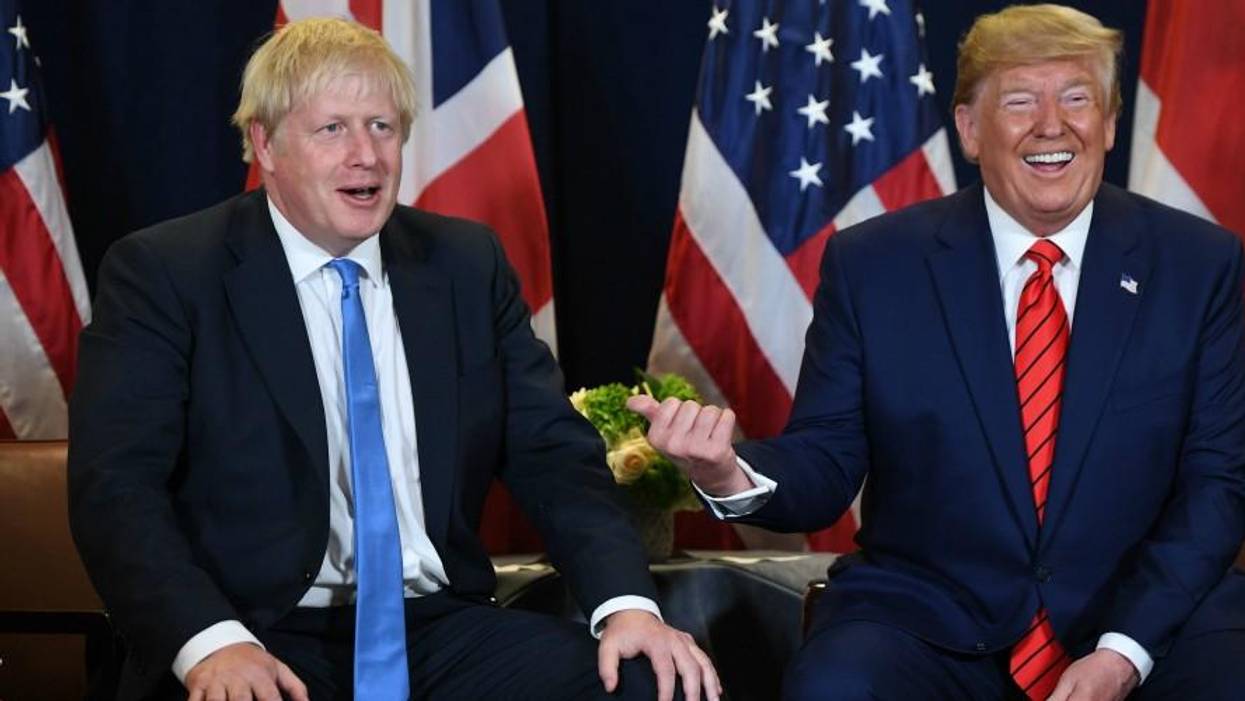
The cat is out of the bag: Boris Johnson is dancing to Donald Trump's tune, regardless of the damage this might cause to Britain. His promises to maintain Britain's 'high standards' after Brexit are not worth the paper they're written on.
That's the only conclusion that can be drawn from a set of leaked papers detailing trade talks between US and UK officials over the last 3 years. The minutes, redacted versions of which Jeremy Corbyn held up at last Tuesday's leaders debate, were posted by an anonymous source on the discussion website, Reddit. They show how the US administration has already successfully bullied Britain into taking a harder Brexit position, which is good for Trump's geopolitical games and US big business, but bad for Britain's economy and British welfare.
The papers show US officials pushing Britain to an ever harder Brexit position, clear that they don't want Britain to be a 'satellite of the EU' in the way Switzerland is. They even threaten that if the UK continued to push certain EU positions in international forums--something the UK is still bound to do--it could undermine negotiations on a US trade deal.
Papers from the time of Theresa May's 'Chequers plan' are illuminating because the administration is clearly furious at May's promise of long-term alignment with EU standards which would prevent the dilution of British food regulations which US agribusiness hopes to benefit from. US negotiators saw this as a "worst case scenario" and threatened to raise it with Trump ahead of his UK visit.
One of the most significant changes which Johnson made to May's Brexit deal was a weakening of the alignment to EU standards, suggesting US bullying worked. But it's particularly worrying that economic modelling seen by the trade officials showed this was likely to be good for the US, but much less so for "UK welfare and GDP gains."
We already suspected that the US was pushing lower food standards in Britain post-Brexit. That's because US food standards are far more favourable to big business than EU standards, and the only way to help US business increase its penetration into British markers is to undermine current regulation.
We already suspected that the US was pushing lower food standards in Britain post-Brexit. That's because US food standards are far more favourable to big business than EU standards, and the only way to help US business increase its penetration into British markers is to undermine current regulation. US officials explicitly mention the infamous chlorine-washed chickens, promising to help the British government sell the concept to a sceptical British public. They attack attempts to reduce sugar in food, the protection of regional products (like Stilton cheese and Cornish pasties) and even nutritional labelling, which they say is more harmful than it is useful.
While US officials are eager to give US experts and multinational corporations better "participation" in standard-setting in Britain post Brexit, they are deeply critical of Parliament sticking its nose into such issues. They call the European Parliament's decision to temporarily ban the Monsanto-owned chemical glyphosate "unhelpful".
Although the trade deal could exacerbate the drivers of climate change, US officials report they're "banned" from mentioning greenhouse gas emissions reductions. In fact, the US seems interested in introducing a 'corporate court system' in a US-UK deal, formally known as 'investor state dispute settlement' or ISDS, a mechanism regularly used in other trade deals to make government action on climate change more difficult. ISDS would allow thousands of US multinationals access to secretive tribunals, for the first time, where they can sue the British government for treating them 'unfairly'. Unfairness, in this context, could mean phasing out coal-fired power or banning fracking.
The papers show both sides are deeply interested in a so-called e-commerce chapter, which is aimed at creating new rules for the digital economy. The problem is that these rules would lock in the power of internet giants like Facebook, Google and Amazon, making it harder for governments to tax and regulate these corporations, and making Labour's proposals for a public broadband service all but impossible.
Across all service sectors, the US wants sweeping liberalisation, based on a so-called 'negative list'--unless you specifically list it, assume it will be opened up to US corporate penetration. This could mean parts of the NHS being further opened up (the US expresses an interest in nursing) and would make bringing formerly public services like mail or rail companies back into public ownership that much harder.
Moreover, US officials repeat Trump's concerns that countries like Britain aren't paying enough for our medicines, with a special concern about cutting edge biological medicines used in the treatment of many cancers. Introducing a US-style pricing regime would make such drugs unaffordable to the NHS. Incredibly, trade negotiators received special lobbying from pharmaceutical corporations as part of the trade talks.
Both the British and American sides agree that these talks should be secret--exempt from freedom of information rules--and it's clear to see why. The papers reveal the British government being subject to bullying by the biggest country on earth. Far from taking back control, Britain has clearly entered into a relationship where we hold none of the cards.
They make a mockery of Boris Johnson's manifesto pledge to protect British public services and standards--that would be absolutely impossible under the type of trade deal being discussed here. And they justify Labour's focus on the US trade deal at this election. This deal is at the centre of the divergent views the two biggest parties have about what sort of country they want to build after 12 December. On the one side, we could have a government which tries to fight inequality and climate change by constraining corporate power through tax, regulation and decent public services. On the other, one that will ignore the interests of their own electorate to kowtow to the biggest corporations in the world.
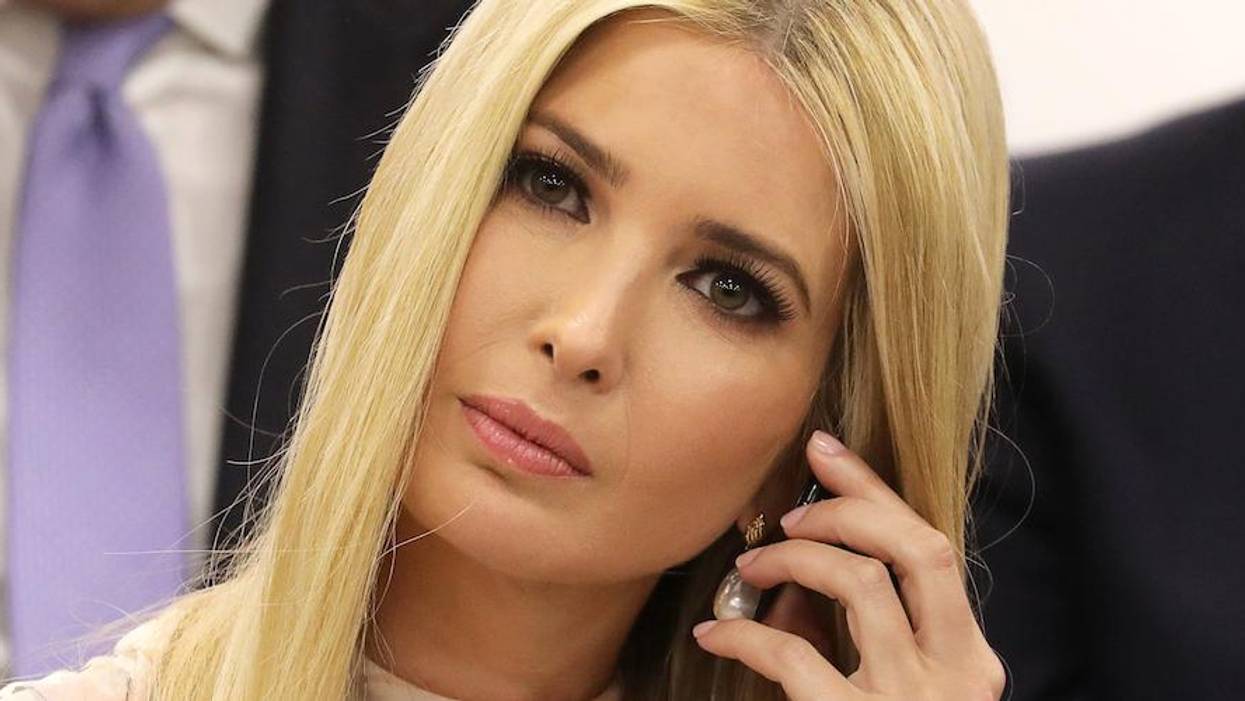
Social media users inserted images of Ivanka Trump into pictures of historical events to show how nepotism doesn't always translate into acceptance after a viral video of the First Daughter and senior White House advisor awkwardly interrupting a group of world leaders at the G20 summit went viral over the weekend.
The video, which was posted to Instagram by the office of French President Emmanuel Macron, shows Ivanka jumping into a conversation between Macron, Canadian Prime Minister Justin Trudeau, British Prime Minister Theresa May, and International Monetary Fund managing director Christine Lagarde. Ivanka was at the conference with her father, President Donald Trump.
According to The New York Times:
In the clip, Ms. Trump seemed to be looking to find a place to jump into this diplomatic game of double Dutch. First Mrs. May spoke: "As soon as you charge them with that economic aspect of it, a lot of people start listening who otherwise wouldn't listen."
And then Ms. Trump jumped in: "And the same with the defense side of it, in terms of the whole business that's been, sort of, male-dominated."
Ms. Lagarde, who was standing next to the president's daughter, swiveled her head and blinked several times as she listened.
The video went viral over the weekend, with observers like Rep. Alexandria Ocasio-Cortez (D-N.Y.) pointing out that "being someone's daughter actually isn't a career qualification."
The hashtag #UnwantedIvanka was started by Crooked Media's Erin Gloria Ryan, who asked her followers on Twitter to "please photoshop Ivanka the unwelcome interloper boxing way above her weight" in historical pictures.
"And hashtag it #unwantedivanka because these are delightful and deserve to be seen," tweeted Ryan.
Twitter users jumped at the opportunity, placing Ivanka at Lyndon Johnson's swearing in after the assassination of President John F. Kennedy....
Lincoln's assassination...
And the Yalta conference.
Of course, as lawyer Darren Kaplan noted, "you don't need photoshop" to show Ivanka inserting herself where she's unwanted.
"Here's an actual photo of Ivanka posing with an Olympic medal that someone else trained and sacrificed their entire life to earn," said Kaplan.
Ivanka and her father returned to the U.S. on Sunday.
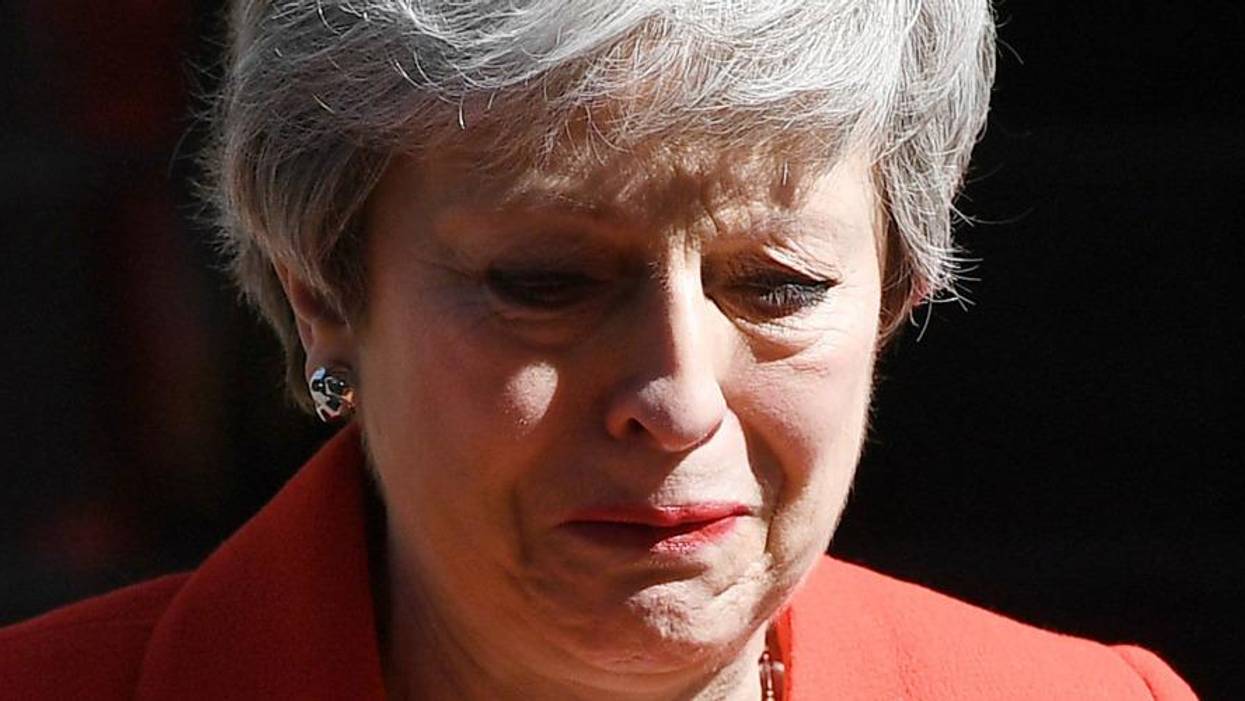
Characterized by critics and political observers as an ignominous end of her three years as leader of the Tory Party and captain of the right-wing ship trying to steer the country toward Brexit, U.K. Prime Minister Theresa May announced her official resignation on Friday morning as she finally admitted defeat.
Though she said in a speech outside 10 Downing Street that she had "done everything" she could "to convince MPs to back" her Brexit deal, "Sadly, I have not been able to do so."
May said she will serve until June 7 and then step aside.
Unmoved by the remarks, and noting her disastrous record as prime minister, The New Statesman's Stephen Bush commented that May "bowed out with the rampant shamelessness that has typified her public statements, and leaves one hell of a mess behind her."
As CNN reports:
May was forced into making Friday's announcement after losing the support of her Cabinet, many of whom were fed up with the ongoing turmoil over Brexit.
The last straw for Cabinet ministers appears to have been the latest version of May's Brexit plan, which she unveiled on Tuesday. In an attempt to win over opposition lawmakers, May offered the House of Commons the chance to vote on a second referendum--a concession that was bitterly opposed by some senior members of her government.
Her fate was sealed by the leadership of the 1922 Committee--which represents the interests of rank-and-file lawmakers in May's Conservative Party--who threatened to change party rules to allow a vote of no-confidence. May survived an earlier confidence vote in December last year, and under current rules was immune to challenge for another year.
One minister, who spoke with The Daily Beast's Jamie Ross, characterized her troubled three-year run as prime minister and ultimate failures this way: "She fucked up, then she fucked off."
According to Ross:
May will leave no lasting legacy. The sole purpose of her leadership was to win domestic support for a deal with the European Union that would allow Britain to leave the bloc in a relatively painless manner. The deal was resoundingly rejected three times and her only answer was to try to get lawmakers to vote on it yet again, with minor tweaks. Her most important supporters, finally sick of living in Groundhog Day, decided enough was enough.
In response to May's resignation, Labour Leader Jeremy Corbyn--who earlier this week said in Parliament that May's time "was over" as he called for a new general election--issued a statement on Friday saying, "Theresa May is right to resign. She's now accepted what the country's known for months: she can't govern, and nor can her divided and disintegrating party."
"The burning injustices she promised to tackle three years ago are even starker today," Corbyn added. "The Conservative party has utterly failed the country over Brexit and is unable to improve people's lives or deal with their most pressing needs."
Political activist Nikhil Goyal said that "May has been one of the worst PMs in British history. She lives behind a shameful racist and anti-worker legacy."
With speculation that Boris Johnson, the former right-wing mayor of London, stands the best chance at succeeding May as the Tory's leader, Corbyn said that whoever the party selects "must let the people decide our country's future, through an immediate General Election."
The Labour Party itself backed that call shortly later:
London Mayor Sadiq Khan, a member of the Labour Party, said that while he didn't "agree with Theresa May on much," he had "some sympathy" for her given that hard-line "Brexit extremists" had made negotiating a deal impossible.
"It is totally unacceptable for Britain's future to be decided by these same people," Khan said in a statement. "The British people, particularly the next generation, deserve far better than this."
MP Caroline Lucas, co-leader of the left-wing Green Party, agreed May's task to deliver a Brexit deal was an impossible one that no prime minister could likely deliver and argued her resignation only clarified the need for a second national referendum on Brexit.
"While May was almost uniquely ill-equipped to be negotiator we needed, truth is she was given impossible job," Lucas said in a tweet. "Case for #PeoplesVote stronger than ever."

Small and independent parties won big in local elections in the U.K. on Thursday as the country's two largest parties suffered decisive defeats.
The Greens, a left-wing party, posted their biggest gain in years.
"We've broken through on to the councils to become the new voice," party co-leader Sian Berry told The Guardian.
The Liberal Democrats, a centrist party that opposes Brexit, also saw large gains.
"The Lib Dems were written off at one point but we're coming back very, very strongly," said party leader Vince Cable.
By contrast, Prime Minister Theresa May's Conservatives lost over 1,200 seats and opposition party Labour lost 100. The results were largely interpreted as a rejection of the continuing debate over Brexit as the country delayed its departure from the E.U. for another six months.
British commentators were quick to note the connection between the country's increasingly dysfunctional national politics and the trickle-down effect to local elections.
In a column for the BBC, pollster John Curtice said that voters were sending a message to politicians: "A plague on both your houses."
"That seems to have been the key message to emerge from the ballot boxes," said Curtice.
The Guardian editorial board cautioned the two main parties on the future, citing the European Parliamentary elections coming later in the month.
"With European elections impending, there is a lesson for both Labour and the Tories," said The Guardian. "They cannot easily profit as the Brexit process drifts on and on, but their insurgent rivals might."
Tom Newton Dunn, politics editor for The Sun, said in a tweet that the results were "another unwanted record" for May.
Labour Leader Jeremy Corbyn, in remarks to ITV, said that the results mean the country has to deal with Brexit, one way or another.
"An arrangement has to be made, a deal has to be done, Parliament has to resolve this issue," said Corbyn. "I think that is very, very clear."
May, on the other hand, took the results to mean that the country wants Parliament to "deliver Brexit."
"How she got that from these results is beyond me," said Ian Dunt, the editor of politics.co.uk.
Twitter user @SheRa_Marley, however, had a pretty good idea.

With a humorous video, the British Labour Party delivered a succinct message to voters on Monday: offering tax cuts to the rich while cutting social programs hurts communities and does nothing to promote economic growth.
Labour released its latest video on social media three days ahead of the country's local elections to urge voters to reject the Conservative Party's familiar claims that cutting taxes for corporations and the wealthy will encourage companies to hire more workers and hand out raises.
The woman narrating the 2.5-minute video begins by explaining, "Today we're going to find out who's better for the economy. Ordinary people...or billionaires?"
Watch:
With raises, business loans, and financial support for those unable to work, five working Britons are given back the money they lost thanks to austerity measures pushed by the Conservatives. The quintet quickly put that money back into their local economies.
Meanwhile, a billionaire is given a tax cut that he simply pockets, musing that he'll most likely "send it to the Cayman Islands with the rest, I guess."
"So as you can see, getting money into the hands of ordinary people does a lot more for the economy than giving tax cuts to billionaires," the narrator says. "Let's rebuild Britain for the many, and not just the few."
About 84 percent of the income tax cuts introduced last year benefited the top half of British earners, while government maintained billions of pounds in welfare cuts introduced in 2015 and added a PS1.5 billion benefit freeze, taking about PS200 from families in the bottom half of income distribution.
With Britons voting on more than 8,200 seats and 250 local councils, the May 2 local elections are considered a major test for Prime Minister Theresa May, who has cut disability benefits, family tax credits, and other supports. Conservatives will attempt to hold on to more than half of the seats that are up for grabs.
The Labour Party has pushed a message in recent weeks about the effects the austerity measures have had on communities around the country. On social media, supporters applauded Labour for its simple, effective video debunking Conservatives' claims that national programs like disability support and pensions must be cut to save money while corporations are given tax cuts.
Rob Delaney, an American comedian who lives in the U.K. and vocally supports the National Health Service and other programs for the public good, also offered praise to the Labour Party--and called on the Democratic Party in the U.S. to employ similar tactics to spread the clear message that Republican policies have harmed working families while showering the richest Americans with even more wealth.

A journalist whose work focused on Northern Ireland's troubled past was killed Thursday night in the latest in a series of militant escalations that are increasing in frequency as the United Kingdom and Ireland reckon with Brexit.
Clashes broke out Thursday in the Northern Ireland city of Derry as police forces attempted to raid suspected militant homes.
Lyra McKee was shot, allegedly by dissidents, during the violence. McKee died shortly thereafter.
The raid came in advance of Easter Sunday, which has significance for Northern Irish republicans who want to reunify Northern Ireland with the Republic of Ireland and see the continued division of the island as a leftover from centuries of brutal British colonial rule.
Reaction to McKee's death from leaders on both sides of the Irish Sea stressed the importance of her work and the senselessness of the shooting.
Leo Varadkar, Ireland's Taoiseach (Prime Minister), issued a statement condemning the violence in the country to the north.
"We are all full of sadness after last night's events," said Varadkar. "We cannot allow those who want to propagate violence, fear, and hate to drag us back to the past."
"My thoughts are with the family and loved ones of Lyra McKee, senselessly killed while doing her job as a journalist," said Labour Leader Jeremy Corbyn. "This shocking attack is a reminder of the vital importance of protecting the Good Friday Agreement and Northern Ireland peace process."
Michelle O'Neill, the deputy leader of the Irish party Sinn Fein, said she was "shocked and saddened" by the attack and hoped it would not reopen old wounds.
"The murder of this young woman is a human tragedy for her family," said O'Neill, "but it is also an attack on all the people of this community, an attack on our peace process and an attack on the Good Friday Agreement."
Thursday's shooting is the third violent incident involving dissidents in four months. In January republican militants set off a car bomb outside a Derry courthouse. Two months later, another group of pro-unification dissidents sent at least four, and possibly five, bombs to locations across Britain.
That's a major escalation over recent years; Northern Ireland has been largely quiet since 2007. The country, which is one of four in the U.K., has gone through a generally peaceful spell of time since the 1998 Good Friday Agreement, which began to put an end to "The Troubles"--the Irish and Northern Irish name for the sectarian war that raged along the Northern Irish border for decades.
A number of stressors, chief among them the political instability that comes from the U.K.'s ongoing Brexit struggles, may be to blame for the recent increase in violence.
The U.K., which includes Northern Ireland, has continually put off leaving the E.U. through Brexit. The terms of the departure, which could result in a militarized border with Ireland and subsequent reigniting of "The Troubles," are still up in the air.
As Jochen Bittner put it in The New York Times:
In London, Prime Minister Theresa May has vowed to respect the peace accord and avoid a hard border in Ireland. But neither she nor anyone else has yet explained how not to control a border that separates a European Union country from a nonunion country. Mrs. May's Brexit plan leaves open the possibility of at least customs checks along the border; without a plan in place, a hard border will almost certainly be needed.
That's led to a situation where nobody knows what will happen, or when. The deadline for departure was recently extended to October 31 after May couldn't convince Parliament to sign off on her deal.
The New Yorker's Amy Davidson Sorkin laid out the situation in a recent essay on the effects of Brexit on Northern Ireland:
This is the paradox and the tragedy: Brexit fundamentally conflicts with the Good Friday Agreement, but the U.K. government is in a state of denial about that conflict. It insists that it is committed both to Brexit and to the peace accord: Brexiteers claim that they can maintain a "frictionless" open border with the Republic of Ireland after Brexit--in the same place that the newly hardened border with the E.U. will be.
Relations between the two countries are strained due to Brexit, but, as one unnamed U.K. official told Politico, there aren't a lot of options for either country--so they'll have to make do.
"You can't do without the relationship," said the U.K. official of relations between Ireland and the U.K. "It will survive because it has to. The ties are too strong."
Whatever happens, today the city of Derry, the countries of Northern Ireland and Ireland, and writers across the world are all mourning McKee.
Her supporters in the journalism world shared some of their favorite pieces McKee wrote on "The Troubles" and growing up in Northern Ireland.
And at an emotional ceremony honoring the writer's life just hours after her death, McKee's partner Sara Canning delivered a message of peace.
"Lyra's death must not be in vain," said Canning.

In the latest development of the seemingly never-ending Brexit saga, beleaguered British Prime Minister Theresa May promised to step down from office--but only once Parliament accepted her deal to leave the European Union, a caveat that generated frustration from the country's fed-up population and opposition parties.
The announcement marks the beginning of the end of the May era, which began after her predecessor David Cameron resigned after the British people chose Brexit in a stunning vote on June 23, 2016.
Per The Irish Times:
Her offer to step down after her withdrawal agreement is passed came in response to calls from a number of Conservative backbenchers for her to name the date of her departure in return for their help in pushing the deal through parliament.
May told her fellow lawmakers in the Conservative Party of her decision in a closed-door meeting Wednesday, reported The Irish Independent.
Brexit is currently under a postponement negotiated with the EU that would see the country exit the continental federation on May 22 if Parliament accepts May's deal or April 12 if it does not.
The political opposition was less kind to May, pointing out that a change of government under the circumstances laid out by May was akin to a threat.
"Theresa May's pledge to Tory MPs to stand down if they vote for her deal shows once and for all that her chaotic Brexit negotiations have been about party management, not principles or the public interest," said Labour Leader Jeremy Corbyn.
"A change of government can't be a Tory stitch-up," Corbyn added, "the people must decide."
"If Brexit ends up being forced through on the basis of a deal no one supports--indeed a deal so bad that the PM has to promise to resign to get it through--it will make an already bad project even worse," said Scotland's First Minister Nicola Sturgeon.
Reporting from The New York Times Wednesday afternoon indicated that May's announcement left EU members and citizens more, not less, confused about Britain's next moves in the Brexit process.
"If you compared Britain to a sphinx, the sphinx would be an open book by comparison," said European Commission president Jean-Claude Juncker.
Deepak Saxena, an Indian PhD student at Trinity College in Dublin, Ireland, wryly noted his own country's past with Britain in a tweet about the Brexit crisis.
"I am an Indian and I can tell you that Brits take forever to leave," said Saxena.
Reaction on social media focused on May's management of the crisis and what many saw as the crocodile tears from those in her own party.
"Woman promises she will put away can of petrol after the house has burnt down," said author Sathnam Sanghera.
"Do you think over on Tory twitter they're doing Endgame 'Avenge the fallen' posters for Theresa May?" wondered journalist Stephen Ackroyd.
"If you wanted another reason to dislike uk politics watching turncoat tories big up @theresa_may on news shows will surely deliver," radio host Matthew Wright tweeted.
Then again, some commentators pointed out, given the terms of May's resignation and the U.K. Parliament's attempts to Brexit thus far, there's a possibility she'll never leave.

The British Parliament's petitions website crashed Thursday morning as over a million of Britons attempted to make their opposition to Prime Minister Theresa May's Brexit plan known.
Hours after May chastised members of Parliament for rejecting her Brexit plan a second time, an anti-Brexit petition was gathering about 1,500 signatures per minute when it crashed the website for 40 minutes. The site then briefly went up before failing again.
As of this writing, more than one million people had signed the petition demanding that May's invocation of Article 50 of the European Union's Lisbon Treaty, which allows a country to formally withdraw from the EU, be revoked.
"The government repeatedly claims exiting the E.U. is the will of the people," reads the petition. "We need to put a stop to this claim by proving the strength of public support now for remaining in the E.U. A people's vote may not happen, so vote now."
The petition quickly reached the 100,000-signature threshold to force a debate in Parliament over the proposal after being posted on the government website Wednesday evening.
The site crashed as May was headed to Brussels to ask that the E.U. give her an extension for formalizing Brexit till June 30. May had originally planned for the U.K. to officially leave the E.U. by March 29, but Parliament has twice rejected her plan by wide margins in the past two months, most recently in a 242-391 vote on March 12.
May's current plan involves a "soft" version of the Brexit plan, which 52 percent of voters in the United Kingdom supported in a June 2016 referendum.
In contrast to a "hard" deal which would have involved a complete withdrawal from the E.U., May's deal would include less stringent controls on immigration into the U.K. and would retain its participation in the E.U.'s single market.
Critics of May's deal argue that a "soft" Brexit would still damage the nation's economy.
As Jen Kirby explained at Vox last November after May reached her deal with the E.U., "every political camp within the UK has found something to hate in this agreement":
The hardline "Brexiteers" in her party are virulently opposed--though it's unlikely they'd be pleased by any deal. They see May's deal as preventing the U.K. from reclaiming control of its borders and laws, and blocking it from making trade deals with other countries...
Labour has its own disagreements about Brexit within the party, but it has collectively rejected May's deal, saying it doesn't meet their required pillars for a satisfactory Brexit...
The bottom line: Few are satisfied with this compromise, because the U.K. is splintered between those who want out of the E.U. and those who never wanted to leave in the first place. No side actually "wins" with this deal.
Labour Party leader Jeremy Corbyn called May's continued attempts to salvage the deal and move towards a withdrawal from the E.U. in June "unacceptable and reckless."
Before Parliament rejected May's deal for a first time in January--by the largest margin in the British government's history--Corbyn was among those who called for a new election if the plan failed.
On social media, other critics called for a new Brexit referndum and new elections as a way to put controversy behind the country.

The United Kingdom's Tory government is on the verge of total collapse, and many believe Prime Minister Theresa May could soon be on her way out.
Following May's abrupt decision to postpone a vote on her widely condemned Brexit plan after it became clear the 600-page agreement would be soundly rejected by Parliament, the prime minister on Wednesday will face a no-confidence vote brought by members of her own party that could ultimately oust her from power--if she doesn't offer to step down first.
But in a speech on the floor of Parliament ahead of the planned vote, Labour leader Jeremy Corbyn accused the Conservative government of "running away" from May's Brexit crisis and argued the outcome of the no-confidence vote "is utterly irrelevant to the lives of people across our country."
Watch:
"The time for dithering and delay by this government is over," Corbyn said. "The prime minister has negotiated her deal, she's told us it's the best and only deal available. There can be no more excuses, no more running away."
"Put it before Parliament and let's have the vote," the Labour leader continued. "Whatever happens with her Conservative leadership vote today, it is utterly irrelevant to the lives of people across our country. It does nothing to solve the government's inability to get a deal that works for the whole country. She's already been found in contempt of Parliament. Will she now put this deal before Parliament and halt this escalating crisis which is so damaging to the lives of so many people in this country?"

After leaders of the European Union on Sunday unanimously approved British Prime Minister Theresa May's Brexit plan--which is the product of over a year of chaotic negotiations that saw key Tory cabinet ministers resign in protest--Labour leader Jeremy Corbyn immediately vowed to oppose the deal in Parliament, arguing it "gives us less say over our future, and puts jobs and living standards at risk."
"This is a bad deal for the country," Corbyn wrote on Facebook. "It is the result of a miserable failure of negotiation that leaves us with the worst of all worlds... That is why Labour will oppose this deal in parliament. We will work with others to block a no deal outcome, and ensure that Labour's alternative plan for a sensible deal to bring the country together is on the table."
Labour's alternative, Corbyn continued, "includes a permanent customs union with a U.K. say, a strong single market deal and guarantees on workers' rights, consumer, and environmental protections."
Labour's "six tests" for an acceptable Brexit agreement can be read here.
Now that EU leaders have approved May's Brexit deal, the agreement will be put before Parliament, where it is likely to face backlash from both sides of the political aisle.
With debate on the deal set to begin early next month, activists are already planning to flood the streets outside Parliament and demand that MPs vote down the agreement.
"Theresa May's Brexit deal is the worst of all worlds. When MPs debate the deal, let's protest outside Parliament--and demand they vote the deal down," reads one protest event page, which tentatively set demonstrations for Dec. 11.