SUBSCRIBE TO OUR FREE NEWSLETTER
Daily news & progressive opinion—funded by the people, not the corporations—delivered straight to your inbox.
5
#000000
#FFFFFF
To donate by check, phone, or other method, see our More Ways to Give page.
Daily news & progressive opinion—funded by the people, not the corporations—delivered straight to your inbox.
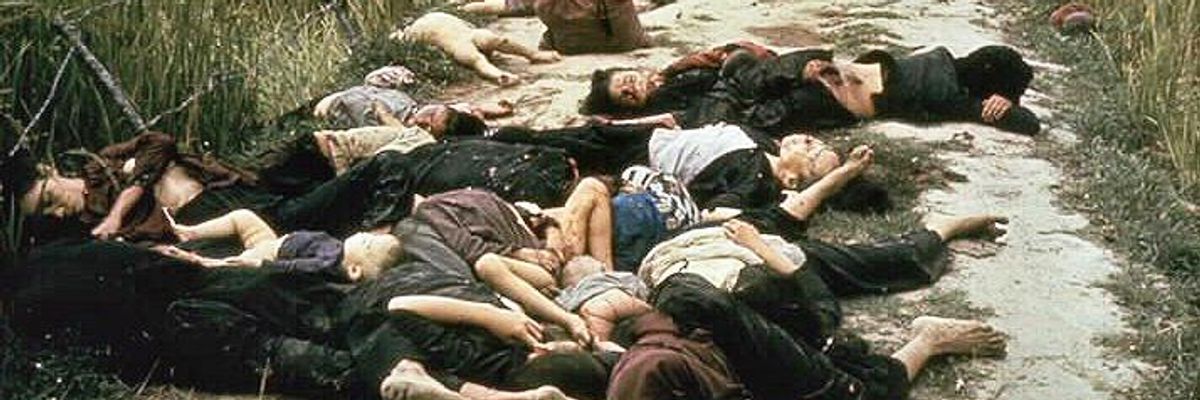
Photo taken by United States Army photographer Ronald L. Haeberle on March 16, 1968 in the aftermath of the My Lai massacre showing mostly women and children dead on a road. (Photo: Wikimedia Commons)
"From Ia Drang to Khe Sanh, from Hue to Saigon and countless villages in between, they pushed through jungles and rice paddies, heat and monsoon, fighting heroically to protect the ideals we hold dear as Americans. Through more than a decade of combat, over air, land, and sea, these proud Americans upheld the highest traditions of our Armed Forces."
OK, I get it. Soldiers suffer, soldiers die in the wars we wage, and the commander in chief has to, occasionally, toss cliches on their graves.
The words are those of Barack Obama, five-plus years ago, issuing a Memorial Day proclamation establishing a 13-year commemoration of the Vietnam War, for which, apparently, about $65 million was appropriated.
Veterans for Peace calls it money allocated to rewrite history and has begun a counter-campaign called Full Disclosure, the need for which is more glaring than ever, considering that there is close to zero political opposition to the unleashed American empire and its endless war on terror.
Just the other day, for instance, 89 senators quietly voted to pass the 2018 National Defense Authorization Act, signing off on a $700 billion defense budget, which ups annual military spending by $80 billion and, as Common Dreams reported, "will dump a larger sum of money into the military budget than even President Donald Trump asked for while also authorizing the production of 94 F-35 jets, two dozen more than the Pentagon requested."
And of course there's no controversy here, no media clamor demanding to know where the money will come from. "Money for war just is. Like the tides," Adam Johnson of Fairness and Accuracy in Reporting tweeted, as quoted by Common Dreams.
Oh quiet profits! The Full Disclosure campaign rips away the lies that allow America's wars to continue: GIs slogging through jungles and rice paddies to protect the ideals we hold dear. These words are not directed at the people who put Obama into office, who did so believing he would end the Bush wars. The fact that he continued them mocks the "value" we call democracy, indeed, turns it into a hollow shell.
The U.S. Air Force dropped over 6 million tons of bombs and other ordnance on Vietnam, Laos and Cambodia between 1964 and 1973, more than it expended in World War II, Howard Machtinger notes at the Full Disclosure website. And more than 19 million gallons of toxic chemicals, including the infamous Agent Orange, were dumped on the Vietnam countryside.
"Accurate estimates are hard to come by," he writes, "but as many as three million Vietnamese were likely killed, including two million civilians, hundreds of thousands seriously injured and disabled, millions of internally displaced, croplands and forests destroyed: incredible destruction -- physical, environmental, institutional, and psychological. The term ecocide was coined to try to capture the devastation of the Vietnamese landscape."
And: "All Vietnamese, as a matter of course, were referred to as 'gooks.' So the distinction between combatants and non-combatants, which had been eroding throughout 20th century warfare, virtually disappeared."
And then there was the war's effect on the soldiers who fought it and the "moral damage" so many suffered: "To date," Machtinger writes, "estimates of veteran suicides range from a low of 9,000 to 150,000, the latter almost triple the number of U.S. deaths during the actual conflict."
So I pause in the midst of these numbers, this data, letting the words and the memories wash over me: Agent Orange, napalm, gook, My Lai. Such words link only with terrible irony to the cliches of Obama's proclamation: solemn reverence . . . honor . . . heads held high . . . the ideals we hold dear.
The first set of words sickened a vast segment of the American public and caused the horror of "Vietnam Syndrome" to cripple and emasculate the military-industrial complex for a decade and a half. Slowly, the powers that be regrouped, redefined how we fought our wars: without widespread national sacrifice or a universal draft; and with smart bombs and even smarter public relations, ensuring that most of the American public could watch our clean, efficient wars in the comfort of their living rooms.
What was also necessary was to marginalize the anti-war voices that shut down the Vietnam War. This was accomplished politically, beginning with the surrender of the Democratic Party to its military-industrial funders in the wake of George McGovern's 1972 presidential campaign. Eventually, endless war became the new normal, and blotting the shame of our "loss" in Vietnam from the historical record became a priority.
The Full Disclosure campaign is saying: no way. One aspect of this campaign is an interactive exhibit of the 1968 My Lai massacre, in which American soldiers rounded up and killed more than 500 villagers. The exhibit was created by the Chicago chapter of Vets for Peace, which hopes to raise enough money to take it on a national tour and rekindle public awareness of the reality of war.
A slice of that reality can be found in a New Yorker article written in 2015 by Seymour Hersh, the reporter who broke the story some four and a half decades earlier. In the article, Hersh revisits the story of one of the GI participants in My Lai, Paul Meadlo:
After being told by (Lt. William) Calley to 'take care of this group,' one Charlie Company soldier recounted, Meadlo and a fellow-soldier 'were actually playing with the kids, telling the people where to sit down and giving the kids candy.' When Calley returned and said that he wanted them dead, the soldier said, 'Meadlo just looked at him like he couldn't believe it. He says, "Waste them?" When Calley said yes, another soldier testified, Meadlo and Calley 'opened up and started firing.' But then Meadlo 'started to cry.'
And that's the war, and those are our values, buried with the dead villagers in a mass grave.
Dear Common Dreams reader, It’s been nearly 30 years since I co-founded Common Dreams with my late wife, Lina Newhouser. We had the radical notion that journalism should serve the public good, not corporate profits. It was clear to us from the outset what it would take to build such a project. No paid advertisements. No corporate sponsors. No millionaire publisher telling us what to think or do. Many people said we wouldn't last a year, but we proved those doubters wrong. Together with a tremendous team of journalists and dedicated staff, we built an independent media outlet free from the constraints of profits and corporate control. Our mission has always been simple: To inform. To inspire. To ignite change for the common good. Building Common Dreams was not easy. Our survival was never guaranteed. When you take on the most powerful forces—Wall Street greed, fossil fuel industry destruction, Big Tech lobbyists, and uber-rich oligarchs who have spent billions upon billions rigging the economy and democracy in their favor—the only bulwark you have is supporters who believe in your work. But here’s the urgent message from me today. It's never been this bad out there. And it's never been this hard to keep us going. At the very moment Common Dreams is most needed, the threats we face are intensifying. We need your support now more than ever. We don't accept corporate advertising and never will. We don't have a paywall because we don't think people should be blocked from critical news based on their ability to pay. Everything we do is funded by the donations of readers like you. When everyone does the little they can afford, we are strong. But if that support retreats or dries up, so do we. Will you donate now to make sure Common Dreams not only survives but thrives? —Craig Brown, Co-founder |
"From Ia Drang to Khe Sanh, from Hue to Saigon and countless villages in between, they pushed through jungles and rice paddies, heat and monsoon, fighting heroically to protect the ideals we hold dear as Americans. Through more than a decade of combat, over air, land, and sea, these proud Americans upheld the highest traditions of our Armed Forces."
OK, I get it. Soldiers suffer, soldiers die in the wars we wage, and the commander in chief has to, occasionally, toss cliches on their graves.
The words are those of Barack Obama, five-plus years ago, issuing a Memorial Day proclamation establishing a 13-year commemoration of the Vietnam War, for which, apparently, about $65 million was appropriated.
Veterans for Peace calls it money allocated to rewrite history and has begun a counter-campaign called Full Disclosure, the need for which is more glaring than ever, considering that there is close to zero political opposition to the unleashed American empire and its endless war on terror.
Just the other day, for instance, 89 senators quietly voted to pass the 2018 National Defense Authorization Act, signing off on a $700 billion defense budget, which ups annual military spending by $80 billion and, as Common Dreams reported, "will dump a larger sum of money into the military budget than even President Donald Trump asked for while also authorizing the production of 94 F-35 jets, two dozen more than the Pentagon requested."
And of course there's no controversy here, no media clamor demanding to know where the money will come from. "Money for war just is. Like the tides," Adam Johnson of Fairness and Accuracy in Reporting tweeted, as quoted by Common Dreams.
Oh quiet profits! The Full Disclosure campaign rips away the lies that allow America's wars to continue: GIs slogging through jungles and rice paddies to protect the ideals we hold dear. These words are not directed at the people who put Obama into office, who did so believing he would end the Bush wars. The fact that he continued them mocks the "value" we call democracy, indeed, turns it into a hollow shell.
The U.S. Air Force dropped over 6 million tons of bombs and other ordnance on Vietnam, Laos and Cambodia between 1964 and 1973, more than it expended in World War II, Howard Machtinger notes at the Full Disclosure website. And more than 19 million gallons of toxic chemicals, including the infamous Agent Orange, were dumped on the Vietnam countryside.
"Accurate estimates are hard to come by," he writes, "but as many as three million Vietnamese were likely killed, including two million civilians, hundreds of thousands seriously injured and disabled, millions of internally displaced, croplands and forests destroyed: incredible destruction -- physical, environmental, institutional, and psychological. The term ecocide was coined to try to capture the devastation of the Vietnamese landscape."
And: "All Vietnamese, as a matter of course, were referred to as 'gooks.' So the distinction between combatants and non-combatants, which had been eroding throughout 20th century warfare, virtually disappeared."
And then there was the war's effect on the soldiers who fought it and the "moral damage" so many suffered: "To date," Machtinger writes, "estimates of veteran suicides range from a low of 9,000 to 150,000, the latter almost triple the number of U.S. deaths during the actual conflict."
So I pause in the midst of these numbers, this data, letting the words and the memories wash over me: Agent Orange, napalm, gook, My Lai. Such words link only with terrible irony to the cliches of Obama's proclamation: solemn reverence . . . honor . . . heads held high . . . the ideals we hold dear.
The first set of words sickened a vast segment of the American public and caused the horror of "Vietnam Syndrome" to cripple and emasculate the military-industrial complex for a decade and a half. Slowly, the powers that be regrouped, redefined how we fought our wars: without widespread national sacrifice or a universal draft; and with smart bombs and even smarter public relations, ensuring that most of the American public could watch our clean, efficient wars in the comfort of their living rooms.
What was also necessary was to marginalize the anti-war voices that shut down the Vietnam War. This was accomplished politically, beginning with the surrender of the Democratic Party to its military-industrial funders in the wake of George McGovern's 1972 presidential campaign. Eventually, endless war became the new normal, and blotting the shame of our "loss" in Vietnam from the historical record became a priority.
The Full Disclosure campaign is saying: no way. One aspect of this campaign is an interactive exhibit of the 1968 My Lai massacre, in which American soldiers rounded up and killed more than 500 villagers. The exhibit was created by the Chicago chapter of Vets for Peace, which hopes to raise enough money to take it on a national tour and rekindle public awareness of the reality of war.
A slice of that reality can be found in a New Yorker article written in 2015 by Seymour Hersh, the reporter who broke the story some four and a half decades earlier. In the article, Hersh revisits the story of one of the GI participants in My Lai, Paul Meadlo:
After being told by (Lt. William) Calley to 'take care of this group,' one Charlie Company soldier recounted, Meadlo and a fellow-soldier 'were actually playing with the kids, telling the people where to sit down and giving the kids candy.' When Calley returned and said that he wanted them dead, the soldier said, 'Meadlo just looked at him like he couldn't believe it. He says, "Waste them?" When Calley said yes, another soldier testified, Meadlo and Calley 'opened up and started firing.' But then Meadlo 'started to cry.'
And that's the war, and those are our values, buried with the dead villagers in a mass grave.
"From Ia Drang to Khe Sanh, from Hue to Saigon and countless villages in between, they pushed through jungles and rice paddies, heat and monsoon, fighting heroically to protect the ideals we hold dear as Americans. Through more than a decade of combat, over air, land, and sea, these proud Americans upheld the highest traditions of our Armed Forces."
OK, I get it. Soldiers suffer, soldiers die in the wars we wage, and the commander in chief has to, occasionally, toss cliches on their graves.
The words are those of Barack Obama, five-plus years ago, issuing a Memorial Day proclamation establishing a 13-year commemoration of the Vietnam War, for which, apparently, about $65 million was appropriated.
Veterans for Peace calls it money allocated to rewrite history and has begun a counter-campaign called Full Disclosure, the need for which is more glaring than ever, considering that there is close to zero political opposition to the unleashed American empire and its endless war on terror.
Just the other day, for instance, 89 senators quietly voted to pass the 2018 National Defense Authorization Act, signing off on a $700 billion defense budget, which ups annual military spending by $80 billion and, as Common Dreams reported, "will dump a larger sum of money into the military budget than even President Donald Trump asked for while also authorizing the production of 94 F-35 jets, two dozen more than the Pentagon requested."
And of course there's no controversy here, no media clamor demanding to know where the money will come from. "Money for war just is. Like the tides," Adam Johnson of Fairness and Accuracy in Reporting tweeted, as quoted by Common Dreams.
Oh quiet profits! The Full Disclosure campaign rips away the lies that allow America's wars to continue: GIs slogging through jungles and rice paddies to protect the ideals we hold dear. These words are not directed at the people who put Obama into office, who did so believing he would end the Bush wars. The fact that he continued them mocks the "value" we call democracy, indeed, turns it into a hollow shell.
The U.S. Air Force dropped over 6 million tons of bombs and other ordnance on Vietnam, Laos and Cambodia between 1964 and 1973, more than it expended in World War II, Howard Machtinger notes at the Full Disclosure website. And more than 19 million gallons of toxic chemicals, including the infamous Agent Orange, were dumped on the Vietnam countryside.
"Accurate estimates are hard to come by," he writes, "but as many as three million Vietnamese were likely killed, including two million civilians, hundreds of thousands seriously injured and disabled, millions of internally displaced, croplands and forests destroyed: incredible destruction -- physical, environmental, institutional, and psychological. The term ecocide was coined to try to capture the devastation of the Vietnamese landscape."
And: "All Vietnamese, as a matter of course, were referred to as 'gooks.' So the distinction between combatants and non-combatants, which had been eroding throughout 20th century warfare, virtually disappeared."
And then there was the war's effect on the soldiers who fought it and the "moral damage" so many suffered: "To date," Machtinger writes, "estimates of veteran suicides range from a low of 9,000 to 150,000, the latter almost triple the number of U.S. deaths during the actual conflict."
So I pause in the midst of these numbers, this data, letting the words and the memories wash over me: Agent Orange, napalm, gook, My Lai. Such words link only with terrible irony to the cliches of Obama's proclamation: solemn reverence . . . honor . . . heads held high . . . the ideals we hold dear.
The first set of words sickened a vast segment of the American public and caused the horror of "Vietnam Syndrome" to cripple and emasculate the military-industrial complex for a decade and a half. Slowly, the powers that be regrouped, redefined how we fought our wars: without widespread national sacrifice or a universal draft; and with smart bombs and even smarter public relations, ensuring that most of the American public could watch our clean, efficient wars in the comfort of their living rooms.
What was also necessary was to marginalize the anti-war voices that shut down the Vietnam War. This was accomplished politically, beginning with the surrender of the Democratic Party to its military-industrial funders in the wake of George McGovern's 1972 presidential campaign. Eventually, endless war became the new normal, and blotting the shame of our "loss" in Vietnam from the historical record became a priority.
The Full Disclosure campaign is saying: no way. One aspect of this campaign is an interactive exhibit of the 1968 My Lai massacre, in which American soldiers rounded up and killed more than 500 villagers. The exhibit was created by the Chicago chapter of Vets for Peace, which hopes to raise enough money to take it on a national tour and rekindle public awareness of the reality of war.
A slice of that reality can be found in a New Yorker article written in 2015 by Seymour Hersh, the reporter who broke the story some four and a half decades earlier. In the article, Hersh revisits the story of one of the GI participants in My Lai, Paul Meadlo:
After being told by (Lt. William) Calley to 'take care of this group,' one Charlie Company soldier recounted, Meadlo and a fellow-soldier 'were actually playing with the kids, telling the people where to sit down and giving the kids candy.' When Calley returned and said that he wanted them dead, the soldier said, 'Meadlo just looked at him like he couldn't believe it. He says, "Waste them?" When Calley said yes, another soldier testified, Meadlo and Calley 'opened up and started firing.' But then Meadlo 'started to cry.'
And that's the war, and those are our values, buried with the dead villagers in a mass grave.