SUBSCRIBE TO OUR FREE NEWSLETTER
Daily news & progressive opinion—funded by the people, not the corporations—delivered straight to your inbox.
5
#000000
#FFFFFF
To donate by check, phone, or other method, see our More Ways to Give page.
President Obama should call on us to be the next "greatest generation."
During his 2008 campaign, he spoke of working for the moment when the rise of the oceans would begin to slow and our planet would begin to heal. During the 2012 election campaign, he was mocked for that statement.
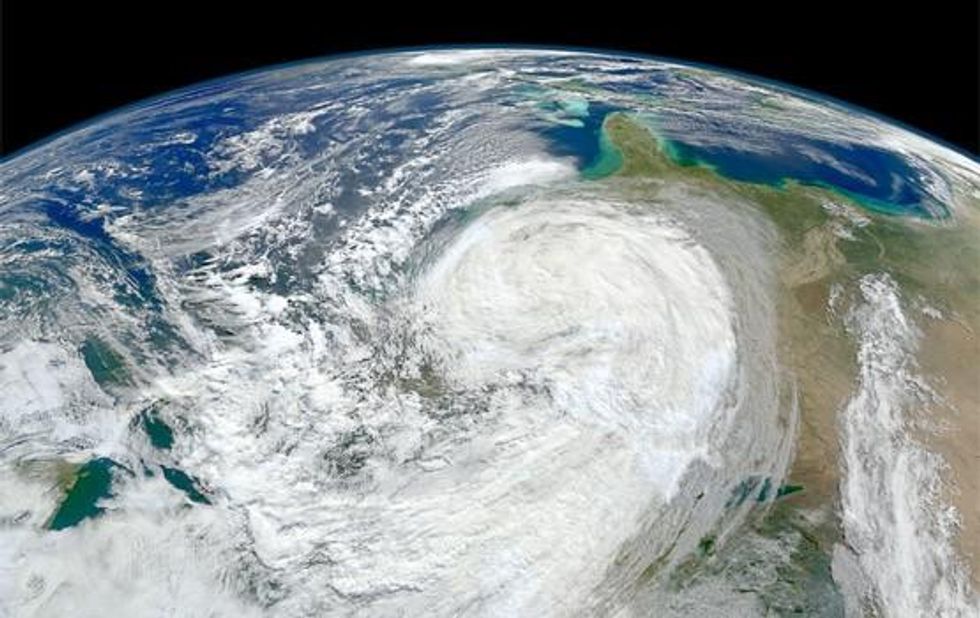
But no one was laughing this fall when waves swept over lower Manhattan and towns up and down the eastern seaboard; nor this summer when much of the US midwest suffered from drought and brave firefighters battled unprecedented fires across the west. Obama spoke in Monday's inaugural address of our responsibility to "preserve our planet", recognizing that "the failure to do so would betray our children and future generations".
So can we expect the president to take the sort of leadership on the climate that many have hoped for since his 2008 campaign? In particular, will he stand up to the pressure of the fossil fuel lobby?
Here are the top things he can do to turn those intentions into the actions that would be up to the scale of the problem. Many of them can happen without the consent of congressional Republicans.
First, President Obama proposed a national conversation on climate during his first post-2012 election press conference. He should launch that conversation with clear statements about the urgency of the climate science, an explanation of what is at stake, and a call to all Americans to be part of the change.
It's important that he not dumb this down. We need to know what it means to have experienced record-breaking temperatures, floods, droughts, wild fires, melting ice caps, and extreme storms. When given a full account of a threat, the American people have risen to big challenges in the past. We did it during the second world war when millions enlisted in the military, grew "victory gardens", recycled, and went to work in factories to aid the war effort. He should call on us to be the next "greatest generation."
The billions of dollars raised by such a tax could help pay down the deficit, pay for investments in the clean energy economy, or be rebated directly to every American.
Second, he should drop the "all of the above" approach to energy development. As Bill McKibben of 350.org shows, 80 percent of the fossil fuel now in the ground must stay there if we are to stabilize an increasingly chaotic climate. That means instead of giving subsidies, tax breaks, and a regulatory pass to fossil fuel companies, these advantages should instead be given to businesses developing renewables and energy efficiency.
Third, he should propose a straightforward tax on carbon. This approach actually has the support of such Republicans as George Shultz, as well as former top aides to Mitt Romney and John McCain. Even ExxonMobile says it could support such a tax. A carbon tax would send the right market signal, nudging our economy toward one that is safe for the planet. The billions of dollars raised by such a tax could help pay down the deficit, pay for investments in the clean energy economy, or be rebated directly to every American.
Finally, Obama should use the regulatory authority he already has. He should put a permanent stop to the Keystone XL pipeline, which would transport some of the most carbon-intensive, polluting oil on the planet across the American heartland. He should instruct the Environmental Protection Agency to move ahead aggressively with regulation of existing power plants, which account for 40 percent of the country's greenhouse gas emissions.
Stepping up to the climate challenge need not compete with the other goals he outlined in his inauguration speech. Building a clean energy economy will produce good jobs that lift more people into the middle class and build a sustainable and widely shared prosperity. Reducing fossil fuel pollutants will improve our health and reduce healthcare costs.
Less reliance on fossil fuels will bolster our security. And we could avoid spending untold sums cleaning up after massive storms and adapting to droughts and rising sea levels.
Obama's speech shows he has the potential to be not just an historic president but a transformational one. Hopes have been raised and dashed before, though. If there was ever a moment for Barack Obama to take a stand and establish a legacy, this is it.
Eighty percent of Americans agree that inaction on climate change would have serious consequences. The fact that he need not run for re-election frees him from the need to placate the oil and coal lobby. And scientists agree we have only a few years to change directions if we are to avert a climate catastrophe that would dash the hopes of generations to come.
This project is far too big for any one person, even the president of the United States. Our best hope is an inside-outside strategy - one in which the Obama administration reaches out to those who are already on the front lines battling the climate crisis, as well as those who are just now coming to recognize the threat we face. And those on the outside must reciprocate.
Obama says we can lead the way together. People across the country and the globe have been doing so. Now is the time for the president to join them and take the bold actions that will serve generations to come.
President Obama should call on us to be the next "greatest generation."
During his 2008 campaign, he spoke of working for the moment when the rise of the oceans would begin to slow and our planet would begin to heal. During the 2012 election campaign, he was mocked for that statement.
But no one was laughing this fall when waves swept over lower Manhattan and towns up and down the eastern seaboard; nor this summer when much of the US midwest suffered from drought and brave firefighters battled unprecedented fires across the west. Obama spoke in Monday's inaugural address of our responsibility to "preserve our planet", recognizing that "the failure to do so would betray our children and future generations".
So can we expect the president to take the sort of leadership on the climate that many have hoped for since his 2008 campaign? In particular, will he stand up to the pressure of the fossil fuel lobby?
Here are the top things he can do to turn those intentions into the actions that would be up to the scale of the problem. Many of them can happen without the consent of congressional Republicans.
First, President Obama proposed a national conversation on climate during his first post-2012 election press conference. He should launch that conversation with clear statements about the urgency of the climate science, an explanation of what is at stake, and a call to all Americans to be part of the change.
It's important that he not dumb this down. We need to know what it means to have experienced record-breaking temperatures, floods, droughts, wild fires, melting ice caps, and extreme storms. When given a full account of a threat, the American people have risen to big challenges in the past. We did it during the second world war when millions enlisted in the military, grew "victory gardens", recycled, and went to work in factories to aid the war effort. He should call on us to be the next "greatest generation."
The billions of dollars raised by such a tax could help pay down the deficit, pay for investments in the clean energy economy, or be rebated directly to every American.
Second, he should drop the "all of the above" approach to energy development. As Bill McKibben of 350.org shows, 80 percent of the fossil fuel now in the ground must stay there if we are to stabilize an increasingly chaotic climate. That means instead of giving subsidies, tax breaks, and a regulatory pass to fossil fuel companies, these advantages should instead be given to businesses developing renewables and energy efficiency.
Third, he should propose a straightforward tax on carbon. This approach actually has the support of such Republicans as George Shultz, as well as former top aides to Mitt Romney and John McCain. Even ExxonMobile says it could support such a tax. A carbon tax would send the right market signal, nudging our economy toward one that is safe for the planet. The billions of dollars raised by such a tax could help pay down the deficit, pay for investments in the clean energy economy, or be rebated directly to every American.
Finally, Obama should use the regulatory authority he already has. He should put a permanent stop to the Keystone XL pipeline, which would transport some of the most carbon-intensive, polluting oil on the planet across the American heartland. He should instruct the Environmental Protection Agency to move ahead aggressively with regulation of existing power plants, which account for 40 percent of the country's greenhouse gas emissions.
Stepping up to the climate challenge need not compete with the other goals he outlined in his inauguration speech. Building a clean energy economy will produce good jobs that lift more people into the middle class and build a sustainable and widely shared prosperity. Reducing fossil fuel pollutants will improve our health and reduce healthcare costs.
Less reliance on fossil fuels will bolster our security. And we could avoid spending untold sums cleaning up after massive storms and adapting to droughts and rising sea levels.
Obama's speech shows he has the potential to be not just an historic president but a transformational one. Hopes have been raised and dashed before, though. If there was ever a moment for Barack Obama to take a stand and establish a legacy, this is it.
Eighty percent of Americans agree that inaction on climate change would have serious consequences. The fact that he need not run for re-election frees him from the need to placate the oil and coal lobby. And scientists agree we have only a few years to change directions if we are to avert a climate catastrophe that would dash the hopes of generations to come.
This project is far too big for any one person, even the president of the United States. Our best hope is an inside-outside strategy - one in which the Obama administration reaches out to those who are already on the front lines battling the climate crisis, as well as those who are just now coming to recognize the threat we face. And those on the outside must reciprocate.
Obama says we can lead the way together. People across the country and the globe have been doing so. Now is the time for the president to join them and take the bold actions that will serve generations to come.
President Obama should call on us to be the next "greatest generation."
During his 2008 campaign, he spoke of working for the moment when the rise of the oceans would begin to slow and our planet would begin to heal. During the 2012 election campaign, he was mocked for that statement.
But no one was laughing this fall when waves swept over lower Manhattan and towns up and down the eastern seaboard; nor this summer when much of the US midwest suffered from drought and brave firefighters battled unprecedented fires across the west. Obama spoke in Monday's inaugural address of our responsibility to "preserve our planet", recognizing that "the failure to do so would betray our children and future generations".
So can we expect the president to take the sort of leadership on the climate that many have hoped for since his 2008 campaign? In particular, will he stand up to the pressure of the fossil fuel lobby?
Here are the top things he can do to turn those intentions into the actions that would be up to the scale of the problem. Many of them can happen without the consent of congressional Republicans.
First, President Obama proposed a national conversation on climate during his first post-2012 election press conference. He should launch that conversation with clear statements about the urgency of the climate science, an explanation of what is at stake, and a call to all Americans to be part of the change.
It's important that he not dumb this down. We need to know what it means to have experienced record-breaking temperatures, floods, droughts, wild fires, melting ice caps, and extreme storms. When given a full account of a threat, the American people have risen to big challenges in the past. We did it during the second world war when millions enlisted in the military, grew "victory gardens", recycled, and went to work in factories to aid the war effort. He should call on us to be the next "greatest generation."
The billions of dollars raised by such a tax could help pay down the deficit, pay for investments in the clean energy economy, or be rebated directly to every American.
Second, he should drop the "all of the above" approach to energy development. As Bill McKibben of 350.org shows, 80 percent of the fossil fuel now in the ground must stay there if we are to stabilize an increasingly chaotic climate. That means instead of giving subsidies, tax breaks, and a regulatory pass to fossil fuel companies, these advantages should instead be given to businesses developing renewables and energy efficiency.
Third, he should propose a straightforward tax on carbon. This approach actually has the support of such Republicans as George Shultz, as well as former top aides to Mitt Romney and John McCain. Even ExxonMobile says it could support such a tax. A carbon tax would send the right market signal, nudging our economy toward one that is safe for the planet. The billions of dollars raised by such a tax could help pay down the deficit, pay for investments in the clean energy economy, or be rebated directly to every American.
Finally, Obama should use the regulatory authority he already has. He should put a permanent stop to the Keystone XL pipeline, which would transport some of the most carbon-intensive, polluting oil on the planet across the American heartland. He should instruct the Environmental Protection Agency to move ahead aggressively with regulation of existing power plants, which account for 40 percent of the country's greenhouse gas emissions.
Stepping up to the climate challenge need not compete with the other goals he outlined in his inauguration speech. Building a clean energy economy will produce good jobs that lift more people into the middle class and build a sustainable and widely shared prosperity. Reducing fossil fuel pollutants will improve our health and reduce healthcare costs.
Less reliance on fossil fuels will bolster our security. And we could avoid spending untold sums cleaning up after massive storms and adapting to droughts and rising sea levels.
Obama's speech shows he has the potential to be not just an historic president but a transformational one. Hopes have been raised and dashed before, though. If there was ever a moment for Barack Obama to take a stand and establish a legacy, this is it.
Eighty percent of Americans agree that inaction on climate change would have serious consequences. The fact that he need not run for re-election frees him from the need to placate the oil and coal lobby. And scientists agree we have only a few years to change directions if we are to avert a climate catastrophe that would dash the hopes of generations to come.
This project is far too big for any one person, even the president of the United States. Our best hope is an inside-outside strategy - one in which the Obama administration reaches out to those who are already on the front lines battling the climate crisis, as well as those who are just now coming to recognize the threat we face. And those on the outside must reciprocate.
Obama says we can lead the way together. People across the country and the globe have been doing so. Now is the time for the president to join them and take the bold actions that will serve generations to come.