SUBSCRIBE TO OUR FREE NEWSLETTER
Daily news & progressive opinion—funded by the people, not the corporations—delivered straight to your inbox.
5
#000000
#FFFFFF
To donate by check, phone, or other method, see our More Ways to Give page.
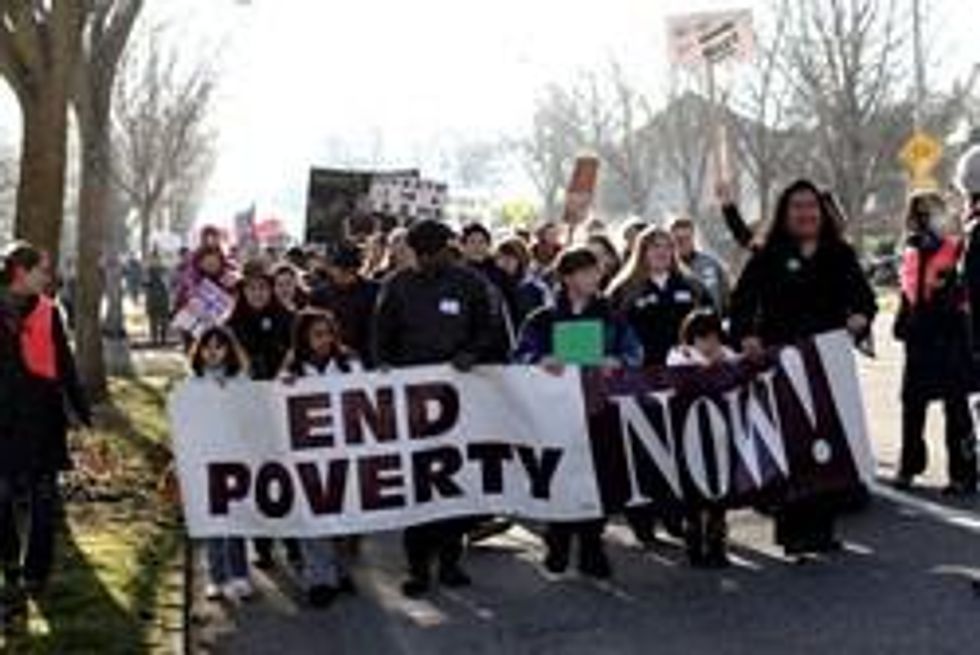
It's just astonishing to us how long this campaign has gone on with no discussion of what's happening to poor people. Official Washington continues to see poverty with tunnel vision - "out of sight, out of mind."
And we're not speaking just of Paul Ryan and his Draconian budget plan or Mitt Romney and their fellow Republicans. Tipping their hats to America's impoverished while themselves seeking handouts from billionaires and corporations is a bad habit that includes President Obama, who of all people should know better.
Oddly, though, for all his rhetorical skills, Obama hasn't made a single speech devoted to poverty since he moved into the White House.
Five years ago, he was one of the few politicians who would talk about it. Here he is in July 2007, speaking in Anacostia, one of the poorest parts of Washington, D.C.:
"The moral question about poverty in America -- How can a country like this allow it? -- has an easy answer: we can't. The political question that follows -- What do we do about it? - has always been more difficult. But now that we're finally seeing the beginnings of an answer, this country has an obligation to keep trying."
Barack Obama the candidate said he wanted to spend billions on a nationwide program similar to Geoffrey Canada's Harlem Children Zone in New York City, widely praised for its focus on comprehensive child development. In the last three years, only $40 million have been spent with another $60 million scheduled for local community grants.
Obama's White House team insisted their intentions were good, but the depth of the economic meltdown passed along by their predecessors has kept them from doing more. And yes, billions have been spent on direct aid to families in the form of welfare, food stamps, housing vouchers and other payments. What's needed, as Paul Tough at the Times and others say, is a less scattershot, more comprehensive program that gets to the root of the problem, focusing on education and mentoring. Not easy to do when a disaffected middle class that votes says hey, what about us? -- and the wealthy one percent who lay out the fat campaign contributions simply say, so what?
Just a few days ago, The Chronicle of Philanthropy issued a report on charitable giving. Among its findings: "Rich people who live in neighborhoods with many other wealthy people give a smaller share of their incomes to charity than rich people who live in more economically diverse communities." Responding to that study, social psychologist Paul Piff told National Public Radio, "The more wealth you have, the more focused on your own self and your own needs you become, and the less attuned to the needs of other people you also become."
Those few who dedicate themselves to keeping the poor ever in sight realize how grave the situation really is. The Associated Press reports that, "The number of Americans with incomes at or below 125 percent of the poverty level is expected to reach an all-time high of 66 million this year." A family of four earning 125 percent of the federal poverty level makes about $28,800 a year, according to government figures.
That number's important because 125 percent is the income limit to qualify for legal aid, but although that family may qualify for help, budgets for legal services have been slashed, too, and pro bono work at the big law firms has fallen victim to downsizing. So it's not surprising, the AP goes on to say, that there's a crisis in America's civil courts because people slammed by the financial meltdown -- overwhelmed by foreclosure, debt collection and bankruptcy cases - can't afford legal representation and have to represent themselves, creating gridlock in our justice system -- and one more hammer blow for the poor.
We know, we know: It is written that, "The poor will always be with us." But when it comes to our "out of sight, out of mind" population of the poor, you have to think we can help reduce their number, ease the suffering, and speak out, with whatever means at hand, on their behalf and against those who would prefer they remain invisible. Speak out: that means you and me, and yes, Mr. President, you, too. You once told the big bankers on Wall Street that you were all that stood between them and the pitchforks of an angry public. How about telling the poor you will make sure our government stands between them and the cliff?
It's just astonishing to us how long this campaign has gone on with no discussion of what's happening to poor people. Official Washington continues to see poverty with tunnel vision - "out of sight, out of mind."
And we're not speaking just of Paul Ryan and his Draconian budget plan or Mitt Romney and their fellow Republicans. Tipping their hats to America's impoverished while themselves seeking handouts from billionaires and corporations is a bad habit that includes President Obama, who of all people should know better.
Oddly, though, for all his rhetorical skills, Obama hasn't made a single speech devoted to poverty since he moved into the White House.
Five years ago, he was one of the few politicians who would talk about it. Here he is in July 2007, speaking in Anacostia, one of the poorest parts of Washington, D.C.:
"The moral question about poverty in America -- How can a country like this allow it? -- has an easy answer: we can't. The political question that follows -- What do we do about it? - has always been more difficult. But now that we're finally seeing the beginnings of an answer, this country has an obligation to keep trying."
Barack Obama the candidate said he wanted to spend billions on a nationwide program similar to Geoffrey Canada's Harlem Children Zone in New York City, widely praised for its focus on comprehensive child development. In the last three years, only $40 million have been spent with another $60 million scheduled for local community grants.
Obama's White House team insisted their intentions were good, but the depth of the economic meltdown passed along by their predecessors has kept them from doing more. And yes, billions have been spent on direct aid to families in the form of welfare, food stamps, housing vouchers and other payments. What's needed, as Paul Tough at the Times and others say, is a less scattershot, more comprehensive program that gets to the root of the problem, focusing on education and mentoring. Not easy to do when a disaffected middle class that votes says hey, what about us? -- and the wealthy one percent who lay out the fat campaign contributions simply say, so what?
Just a few days ago, The Chronicle of Philanthropy issued a report on charitable giving. Among its findings: "Rich people who live in neighborhoods with many other wealthy people give a smaller share of their incomes to charity than rich people who live in more economically diverse communities." Responding to that study, social psychologist Paul Piff told National Public Radio, "The more wealth you have, the more focused on your own self and your own needs you become, and the less attuned to the needs of other people you also become."
Those few who dedicate themselves to keeping the poor ever in sight realize how grave the situation really is. The Associated Press reports that, "The number of Americans with incomes at or below 125 percent of the poverty level is expected to reach an all-time high of 66 million this year." A family of four earning 125 percent of the federal poverty level makes about $28,800 a year, according to government figures.
That number's important because 125 percent is the income limit to qualify for legal aid, but although that family may qualify for help, budgets for legal services have been slashed, too, and pro bono work at the big law firms has fallen victim to downsizing. So it's not surprising, the AP goes on to say, that there's a crisis in America's civil courts because people slammed by the financial meltdown -- overwhelmed by foreclosure, debt collection and bankruptcy cases - can't afford legal representation and have to represent themselves, creating gridlock in our justice system -- and one more hammer blow for the poor.
We know, we know: It is written that, "The poor will always be with us." But when it comes to our "out of sight, out of mind" population of the poor, you have to think we can help reduce their number, ease the suffering, and speak out, with whatever means at hand, on their behalf and against those who would prefer they remain invisible. Speak out: that means you and me, and yes, Mr. President, you, too. You once told the big bankers on Wall Street that you were all that stood between them and the pitchforks of an angry public. How about telling the poor you will make sure our government stands between them and the cliff?
It's just astonishing to us how long this campaign has gone on with no discussion of what's happening to poor people. Official Washington continues to see poverty with tunnel vision - "out of sight, out of mind."
And we're not speaking just of Paul Ryan and his Draconian budget plan or Mitt Romney and their fellow Republicans. Tipping their hats to America's impoverished while themselves seeking handouts from billionaires and corporations is a bad habit that includes President Obama, who of all people should know better.
Oddly, though, for all his rhetorical skills, Obama hasn't made a single speech devoted to poverty since he moved into the White House.
Five years ago, he was one of the few politicians who would talk about it. Here he is in July 2007, speaking in Anacostia, one of the poorest parts of Washington, D.C.:
"The moral question about poverty in America -- How can a country like this allow it? -- has an easy answer: we can't. The political question that follows -- What do we do about it? - has always been more difficult. But now that we're finally seeing the beginnings of an answer, this country has an obligation to keep trying."
Barack Obama the candidate said he wanted to spend billions on a nationwide program similar to Geoffrey Canada's Harlem Children Zone in New York City, widely praised for its focus on comprehensive child development. In the last three years, only $40 million have been spent with another $60 million scheduled for local community grants.
Obama's White House team insisted their intentions were good, but the depth of the economic meltdown passed along by their predecessors has kept them from doing more. And yes, billions have been spent on direct aid to families in the form of welfare, food stamps, housing vouchers and other payments. What's needed, as Paul Tough at the Times and others say, is a less scattershot, more comprehensive program that gets to the root of the problem, focusing on education and mentoring. Not easy to do when a disaffected middle class that votes says hey, what about us? -- and the wealthy one percent who lay out the fat campaign contributions simply say, so what?
Just a few days ago, The Chronicle of Philanthropy issued a report on charitable giving. Among its findings: "Rich people who live in neighborhoods with many other wealthy people give a smaller share of their incomes to charity than rich people who live in more economically diverse communities." Responding to that study, social psychologist Paul Piff told National Public Radio, "The more wealth you have, the more focused on your own self and your own needs you become, and the less attuned to the needs of other people you also become."
Those few who dedicate themselves to keeping the poor ever in sight realize how grave the situation really is. The Associated Press reports that, "The number of Americans with incomes at or below 125 percent of the poverty level is expected to reach an all-time high of 66 million this year." A family of four earning 125 percent of the federal poverty level makes about $28,800 a year, according to government figures.
That number's important because 125 percent is the income limit to qualify for legal aid, but although that family may qualify for help, budgets for legal services have been slashed, too, and pro bono work at the big law firms has fallen victim to downsizing. So it's not surprising, the AP goes on to say, that there's a crisis in America's civil courts because people slammed by the financial meltdown -- overwhelmed by foreclosure, debt collection and bankruptcy cases - can't afford legal representation and have to represent themselves, creating gridlock in our justice system -- and one more hammer blow for the poor.
We know, we know: It is written that, "The poor will always be with us." But when it comes to our "out of sight, out of mind" population of the poor, you have to think we can help reduce their number, ease the suffering, and speak out, with whatever means at hand, on their behalf and against those who would prefer they remain invisible. Speak out: that means you and me, and yes, Mr. President, you, too. You once told the big bankers on Wall Street that you were all that stood between them and the pitchforks of an angry public. How about telling the poor you will make sure our government stands between them and the cliff?