SUBSCRIBE TO OUR FREE NEWSLETTER
Daily news & progressive opinion—funded by the people, not the corporations—delivered straight to your inbox.
5
#000000
#FFFFFF
To donate by check, phone, or other method, see our More Ways to Give page.


Daily news & progressive opinion—funded by the people, not the corporations—delivered straight to your inbox.
Fasting can be a way of mourning, of cleansing, of meditation, of focus.

The three melt-downs, four explosions, scattered fuel rods and continual gusher of radioactive water into the Pacific Ocean at Fukushima have torn a deadly hole in the fabric of our ability to survive on this planet.
Its corporate perpetrators were repeatedly warned by tens of thousands of citizen activists not to build these reactors in an earthquake zone that has been washed by tsunamis. Not only did they build them, they took down a natural 85-foot-high sea wall in the process that might have greatly lessened the damage of the tsunami that did come.
The disaster that has struck Fukushima has much about it that's unique. But it's just the tip of the radioactive iceberg that is the global atomic reactor industry.
There are other reactor sites threatened by earthquakes and tsunamis. Among them is Diablo Canyon, whose two reactors could be turned to rubble by the multiple fault lines that surround it, spewing radiation that would irradiate California's Central Valley and send a lethal cloud across the U.S.
There are other reactors threatened by suicidal siting, such as the triple reactor complex at South Carolina's Oconee, downriver from a dam whose failure could send also send a wall of water into multiple cores.
Throughout the world more than 400 rust bucket reactors are aging dangerously, riddled with operator error, shoddy construction, leaky cooling systems, least-cost corner cutting and official lies.
In all cases, the revolution in renewables has made them economically obsolete. The long-dead hype of a failed "too cheap to meter" technology has been buried by a Solartopian vision, a green-powered Earth in the process of being born.
What would speed that process most is the rapid shutdown of a these old-tech dinosaurs that do nothing but cost us money and harm our planet and our health.
For decades we were told commercial reactors could not explode. But five have done just that.
The industry said that radiation releases could do no harm at Hiroshima and Nagasaki, during the atmospheric bomb tests, with medical x-rays, with atomic waste storage, at Three Mile Island, Chernobyl, Fukushima, and of course at the next major melt-down and the one after that and the one after that.
The automatic industry response is always the same: "not enough radiation has escaped to harm anyone." Push a button, no matter what the disaster, no matter where the radiation goes and how little anybody knows about it, that's what they say now, and will say yet again each time another nuke bites the radioactive dust.
So today we live in fear not only of what's happening at Fukushima, but of what is all-too-certain to come next.
This must finally stop. If we are to have an economic, ecological or biological future on this planet, all atomic reactor construction must halt, and all operating reactors must be phased out as fast as possible.
To honor this vision, we won't eat from dawn to dusk on March 11.
It's a small, symbolic step. But one we feel is worth taking. Feel free to join us!
Save

How can President Obama be so right and so wrong in the same moment? On the one hand, he warns us that sharply rising income inequality "is the defining challenge of our time" and pledges to reverse "a dangerous and growing inequality and lack of upward mobility. ..." But then he once again turns to the same hacks in the Democratic Party who helped create this problem to fix it.
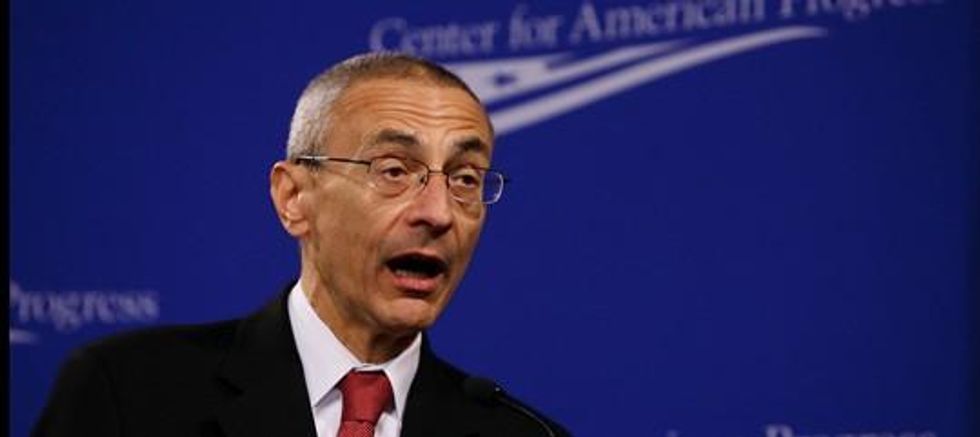
His tough speech on income inequality earlier this month was delivered at the Center for American Progress, founded by John Podesta. As chief of staff to Bill Clinton, Podesta helped lead the charge to deregulate Wall Street, which resulted in the banking bubble that wiped out the savings of tens of millions of Americans.
But instead of chastising Podesta for the errors of his ways, Obama in 2008 appointed him to oversee his presidential transition team. That led to the appointment of Lawrence Summers and Timothy Geithner, two former Clinton officials responsible for the banking meltdown, to repair it. Just this past week, it was announced that John Podesta would be reappointed as a senior adviser to the Obama White House.
John Podesta should not be confused with his brother Tony, although both were founding partners of the Podesta Group, a lobbying firm that has represented Walmart, Lockheed Martin, Bank of America and BP along with dozens of other multinational corporations.
Tony still heads the lobbying firm, but John left when he joined the Clinton administration and subsequently founded the Center for American Progress, a think tank that attracts major funding from defense, energy and pharmaceutical companies. Sometimes the Podesta brothers work on opposite sides of the policy street, but both are big contributors to the Democratic Party, and it doesn't hurt for lobbyist Tony to have the same last name as brother John, an Obama insider.
"Some prospective clients, in fact, will contact Mr. [Tony] Podesta because of his brother's ties to Mr. Obama," The New York Times reported in a 2010 profile on Tony. The newspaper quoted him as saying, "People approach us and say, 'Can you call your brother and get him to call the president?' and we'll say, 'No.' It's not what we do. We don't do access lobbying." Sure you don't, but anyway, John, when he periodically moves out of the White House revolving door into the Washington policy swirl, milks the same types of corporate clients as his brother.
As The New York Times reported after John Podesta's recent appointment, he will "arrive at the White House after having run an organization that has taken millions of dollars in corporate donations in recent years and has its own team of lobbyists who have pushed an agenda that sometimes echoes the interests of these corporate supporters."
Podesta will be welcomed at the White House by chief of staff Denis McDonough who was a senior fellow at CAP, and Obama communications director Jennifer Palmieri who was a lobbyist for the organization. They are the faces of the so-called progressive wing of the Democratic Party that, like the president himself, will talk a good game of reducing income inequality, while catering to the interests of the very corporations that have initiated the problem.
The pattern was set by Obama when, in his successful race for the presidency, he decided to shun public financing and instead shamefully courted the Wall Street fat cats who bankrolled him handsomely. It is not surprising then that in his major speech on income inequality, there was no mention of the role of the big banks in fostering this inequality.
Democrats bear as much responsibility as Republicans for allowing our once promising democracy to degenerate into a plutocracy of the irresponsible super-rich. It is they who betrayed the New Deal legacy of Franklin Delano Roosevelt to rein in the Wall Street greed that caused so much suffering for ordinary folks. Obama is great at bemoaning a reality that his party helped establish:
"Since 1979, our economy has more than doubled in size, but most of that growth has flowed to a fortunate few. ... Whereas in the past, the average CEO made about 20 to 30 times the income of the average worker, today's CEO now makes 273 times more. And meanwhile, a family in the top 1 percent has a net worth 288 times higher than the typical family, which is a record for this country."
The Podesta brothers are not your typical family, but Obama hasn't noticed.
The election is over, and President Barack Obama will continue as the 44th president of the United States. There will be much attention paid by the pundit class to the mechanics of the campaigns, to the techniques of microtargeting potential voters, the effectiveness of get-out-the-vote efforts. The media analysts will fill the hours on the cable news networks, proffering post-election chestnuts about the accuracy of polls, or about either candidate's success with one demographic or another. Missed by the mainstream media, but churning at the heart of our democracy, are social movements, movements without which President Obama would not have been re-elected.
President Obama is a former community organizer himself. What happens when the community organizer in chief becomes the commander in chief? Who does the community organizing then? Interestingly, he offered a suggestion when speaking at a small New Jersey campaign event when he was first running for president. Someone asked him what he would do about the Middle East. He answered with a story about the legendary 20th-century organizer A. Philip Randolph meeting with President Franklin Delano Roosevelt. Randolph described to FDR the condition of black people in America, the condition of working people. Reportedly, FDR listened intently, then replied: "I agree with everything you have said. Now, make me do it." That was the message Obama repeated.
There you have it. Make him do it. You've got an invitation from the president himself.
For years during the Bush administration, people felt they were hitting their heads against a brick wall. With the first election of President Obama, the wall had become a door, but it was only open a crack. The question was, Would it be kicked open or slammed shut? That is not up to that one person in the White House, no matter how powerful. That is the work of movements.
Ben Jealous is a serious organizer with a long list of accomplishments, and a longer list of things to get done, as the president and CEO of the National Association for the Advancement of Colored People. 2013, he notes, is a year of significant anniversaries, among them the 150th anniversary of President Abraham Lincoln's Emancipation Proclamation, the 50th anniversary of the 1963 March on Washington, as well as the 50th anniversaries of the assassination of Medgar Evers and the Birmingham, Ala., church bombing that killed four young African-American girls. President Obama's 2013 Inauguration will occur on Martin Luther King Jr. Day. Jealous told me on election night, as Mitt Romney was about to give his concession speech, "We have to stay in movement mode."
Young immigrants are doing just that. Undocumented students, getting arrested in sit-ins in politicians' offices, are the modern-day civil-rights movement. There are other vibrant movements as well, like Occupy Wall Street, like the fight for marriage equality, which won four out of four statewide initiatives on Election Day. In the aftermath of Superstorm Sandy, and despite the enormous resources expended by the fossil-fuel industry to cloud the issue, climate change and what to do about it is now a topic that President Obama hints he will address, saying, in his victory address in election night, "Democracy in a nation of 300 million can be noisy and messy and complicated. ... We want our children to live in an America that isn't burdened by debt, that isn't weakened by inequality, that isn't threatened by the destructive power of a warming planet."
It was pressure from grass-roots activists protesting in front of the White House that pushed Obama to delay a decision on the controversial Keystone XL pipeline, proposed to run from Canada to the Gulf of Mexico. More than 1,200 people were arrested at a series of protests at the White House one year ago. Now a group is blocking the construction of the southern leg of that pipeline, risking arrest and even injury, with direct-action blockades in tree-sits and tripods in Winnsboro, Texas, two hours east of Dallas.
When those who are used to having the president's ear whisper their demands to him in the Oval Office, if he can't point out the window and say, "If I do as you ask, they will storm the Bastille," if there is no one out there, then he is in big trouble. That's when he agrees with you. What about when he doesn't?
The president of the United States is the most powerful person on Earth. But there is a force more powerful: People organized around this country, fighting for a more just, sustainable world. Now the real work begins.
Denis Moynihan contributed research to this column.
The Common Dreams 2012 Reader Survey results are in.
Between Nov. 1st and 12PM EST Monday, 15,767 of our readers weighed in on a wide variety of issues - including who they would vote for for US President Tuesday.

* * *
The Presidential results:
| Stewart Alexander/Alejandro Mendoza Socialist Party | 0.2% |
| Rocky Anderson/Luis J. Rodriguez Justice Party | 2.2% |
| Virgil Goode/Jim Clymer Constitution Party | 0.1% |
| Gary Johnson/Jim Gray Libertarian Party | 1.3% |
| Barack Obama/Joe Biden Democratic Party | 73.8% |
| Mitt Romney/Paul Ryan Republican Party | 1.2% |
| Jill Stein/Cheri Honkala Green Party | 18.0% |
| None of the above/Write-in | 3.1% |
The results by age group show a sharp difference. Obama has the support of 80% of those 67 years old and older; Jill Stein comes in first among readers between the ages of 21-35:
| Candidates | 21-35 | 36-50 | 51-65 | 66-79 | 80+ | Total |
| Rocky Anderson/Luis J. Rodriguez Justice Party | 8.5% | 1.9% | 2.2% | 1.8% | 2.0% | 2.2% |
| Barack Obama/Joe Biden Democratic Party | 37.7% | 62.4% | 73.0% | 78.8% | 80.8% | 73.8% |
| Jill Stein/Cheri Honkala Green Party | 44.3% | 25.8% | 18.3% | 14.8% | 12.2% | 18.0% |
On the Ballot issues facing voters around the country on Election Day, readers overwhelmingly supported the progressive positions:
| YES | NO | UNDECIDED | |
| California's Prop 37: Label GMO Foods | 93.5% | 2.8% | 3.6% |
| YES | NO | UNDECIDED | |
| Legalizing Same-Sex Marriage | 91.2% | 4.3% | 4.5% |
| BOTH YES | MEDICAL ONLY | BOTH NO | UNDECIDED | |
| Legalize Marijuana/Legalize Medical Marijuana | 79.7% | 14.0% | 1.9% | 4.4% |
| YES | NO | UNDECIDED | |
| Weaken Reproductive Rights | 3.7% | 92.8% | 3.5% |
How our readers self-identify on the political spectrum:
| Radical | 8.1% |
| Progressive | 48.0% |
| Liberal | 25.0% |
| Moderate | 4.5% |
| Conservative | 1.1% |
| Other | 13.3% |
# # #
Jill Stein, presidential candidate for the US Green Party, was arrested in Winnsboro, Texas on Wednesday after attempting to bring supplies to anti-tar sands campaigners who have been staging a blockade of the Keystone XL pipeline there for well over a month.
"Everyone needs to step up resistance to climate-killing emissions," said Stein, who willingly risked arrest in order to show solidarity with the activists. "Romney and Obama are only talking about the symptoms of climate change in terms of destruction caused by Hurricane Sandy; the blockaders are addressing the cause."
Stein was taken to the Wood County jail and charged with criminal trespassing, a class B misdemeanor, said Kim Huynh, a spokesman for the Tar Sands Blockade.
According to a statement by her campaign, Stein was joined by seven others, including three blockaders and four members of the press. They were delivering fresh fruits and vegetables, trail mix, and Halloween candy. They were not warned of imminent arrests, the released statement said, and the arresting officers did not self-identify as police.
Here's Dr. Jill Stein's testimonial video she took before her resupply mission this morning, explaining why she joined Tar Sands Blockade:
Prior to running for office, Jill Stein, a 62-year old physician and mother of two, had never been arrested. This, however, is the second time she's been arrested during her campaign. The first took place in Hampstead, New York after she and her vice presidential running mate, Cheri Honkala, were arrested in early October outside the presidential debate between Barack Obama and Mitt Romney after being barred from entering the debate venue.
"Climate change means more frequent severe storms that lead to massive flooding and destruction," said Stein, speaking at the ongoing protests in Texas against the proposed Keystone XL natural gas project. "We will see more destructive storms than Sandy in the years to come. We have to stop spending our tax dollars to build homes in low-lying coastal areas and flood plains. The billions spent rebuilding the NYC subway system must reflect that sea levels will continue to rise." Stein noted that the flooding of the NYC subway system had been predicted in several recent climate change reports prepared for the state government.
"A major reason why our political and business leaders have failed to take action on climate change is because too many of them believe that it will be cheaper to deal with the consequences of climate change than to reduce it. The economic and human costs from Hurricane Sandy shows this to be the wrong calculation," said Stein.
Meanwhile, the police and hired security from TransCanada--the Canadian pipeline company that owns Keystone XL--has intensified its attack on the tree sitters, now in their second month of maintaining the blockade from high in the trees above the clear-cutting and pipe-laying below.
A series of updates from the Tar Sands Blockade from Wednesday's events follow:
**UPDATE 10:30PM -- Directly from Pika from her perch:
I'm sitting in this pine tree under fllood lights and the watchful eyes of cops, just thinking about all the implications of this pipeline and that the destruction I see 70 feet below me is just one tiny part. I feel grief, but I also feel strong!
I don't have any food or water. I couldn't get it high enough quickly enough, so the cops cut it down.
It's starting to get a little chilly.
Thanks so much for all the amazing support!!
***UPDATE 8:30PM - Pika amazingly climbed up in her tree higher than the cherry picker could reach. In response, police cut her platform and climb line from her tree and retreated the cherry picker, leaving her in the tree with just the rope she has on her person and her resourcefulness. She's currently on a limb about 70 feet in the air, chillin.
Law enforcement hasn't left the scene, and they are there with noisy, generator-powered flood lights to induce sleep deprivation. Pika's supporters haven't left the scene entirely, either. Four Tar Sands Blockade supporters will be holding vigil for her through the night.
While it is a dangerous situation and it is certainly an exercise of extraordinarily questionable judgement on the part of the police, Pika is an experienced climber and we expect her to be fine.
Lauren on the other hand has been booked for the night in Nacogdoches County Jail. Her charges are Fourth Degree (State) Felony Criminal Mischief, Class A Misdemeanor Resisting Arrest, and Class B Misdemeanor Criminal Trespass. We won't know until tomorrow when she visits with a judge what her bail will be.
***UPDATE 6:00PM - Lauren has been removed from her platform and is under arrest. Pika is still holding strong. Our #NEWomenRising are inspirations!
***UPDATE 5:15PM - Nacogdoces Sheriff's Department has returned to the scene in Sacul, Texas with cherry pickers. It appears they are intent on physically removing the sitters from their platforms.
***UPDATE 3:15PM - Dr. Jill Stein has been released from Wood County Jail on a Class B Misdemeanor Criminal Trespass charge. You did know she's the Green Party's presidential hopeful, right?
***UPDATE 2:15PM - From Winnsboro, we expect Dr. Jill Stein to be released within an hour. In Sacul, things are still calm.
***UPDATE 10:30AM - In Winnsboro, Dr. Jill Stein has been arrested, taken to Wood County Jail, and is awaiting processing. The freelance reporter has been released from detainment without arrest or charge.
A statement from Dr. Jill Stein:
"I'm here to connect the dots between super storm Sandy and the record heat, drought, and fire we've seen this year - and this Tar Sands pipeline, which will make all of these problems much worse. And I'm here to connect the dots between climate devastation and pipeline politicians - both Obama and Romney - who are competing, as we saw in the debates, for the role of Puppet In Chief for the fossil fuel industry. Both deserve that title. Obama's record of "drill baby drill" has gone beyond the harm done by George Bush. Mitt Romney promises more of the same."
***UPDATE 10:00AM - In Sacul, Six Nacogdoches County Sheriffs are conferring with TransCanada, inspecting rigging of tree sits, taking pictures, and making phone calls. Otherwise, Pika and Lauren are sitting tall. In Winnsboro, a police situation has complicated updates from Dr. Jill Stein's Tree Blockade resupply efforts, though confirmed updates are forthcoming. We believe Dr. Stein's arrest is eminent.
***UPDATE 9:15AM - In Sacul, TransCanada construction contractors have cleared a path thru a pile of felled trees and have moved some of the heavy equipment onsite. Three machines, an excavator, feller buncher, and a timber forwarder, are still immobilized by the tree sits.
# # #
Eclipsed by the wake of the final presidential debate between Mitt Romney and President Barack Obama, four third-party candidates took the stage last night in Chicago: Gary Johnson of the Libertarian Party, Jill Stein of the Green Party, Rocky Anderson of the Justice Party and Virgil Goode of the Constitution Party.
In an event sponsored by the Free and Equal Elections Foundation, arguably the most well-known person present was moderator Larry King.
Though they represented the poles of the political spectrum, the four nominees agreed on a number of issues unheard of in the previous debates. The ineffectiveness of the War on Drugs and the imperative to cut defense spending were echoed across the board.
The Commission on Presidential Debates excludes parties with less than 15 percent support nationwide. So far, the only candidate who has met that criteria is billionaire Ross Perot, who debated Bill Clinton and George H W Bush in 1992.
A second third-party debate will be held on October 30. Tuesday's debate was broadcasted by Al Jazeera and Russia Today--which can be viewed below--but largely ignored by all major US cable news networks.
It's hard to understand the kind of person who would be taken in by Mitt Romney's absolutely unsubstantiated claims that he'll be able to magically produce 23 million new jobs in the next four years, and raise take-home pay while he's at it.

Do people really think Mitt is a magician?
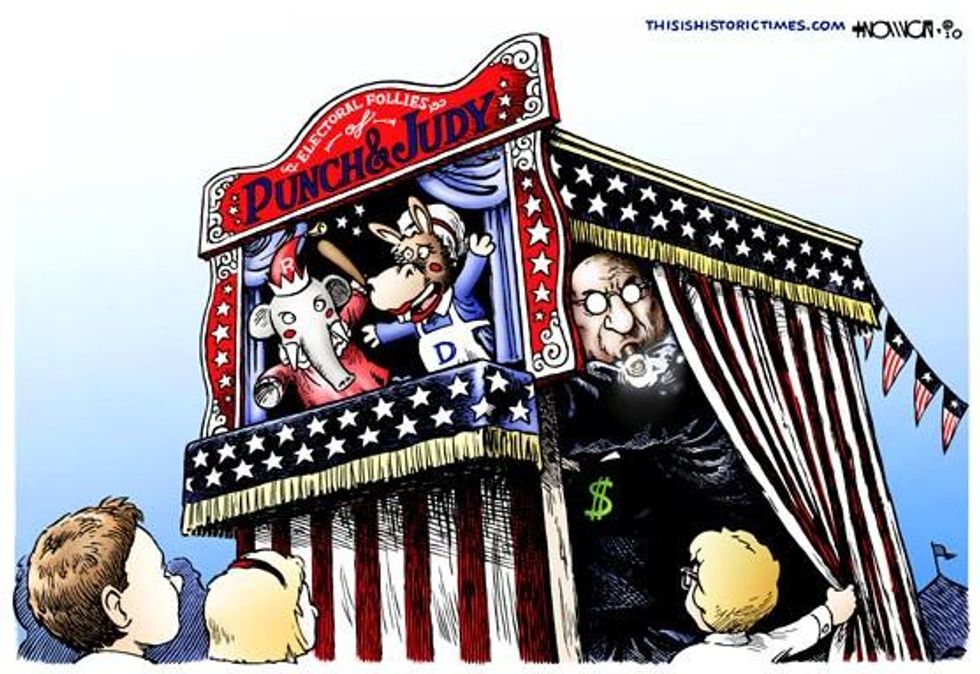
Watching him struggle to appear mild-mannered and fangless during the debates--an effort that translated into a zombie-like smirk--I began to understand him as the puppet he is, a marionette whose strings are pulled by the cabal behind the curtain: the Koch brothers and their ilk, along with Big Fossil Fuel, Big Pharma, Big Chemical, Big Ag, Big Free Trade, Big Finance, you name it.
Now, it's true that that gang has their tentacles in Obama too. You can see the strain the President is under, trying to please his popular base while also keeping his pockets open for the big under-the-table donations that keep his campaign afloat.
Guys like the Kochs hedge their bets. Whichever of the two parties wins, they'll carry on just fine.
But if it's Romney/Ryan, their agenda will take a great leap forward.
We'll automate and outsource jobs like crazy, to satisfy Wall Street--the hell with Main Street.
We'll drill and frack and mine and bulldoze our way to oblivion, and call it Kingdom Come.
We'll appoint more social conservatives to the Supreme Court, and put women back where they belong: barefoot and pregnant in the kitchen.
We'll drastically increase our military spending, at the expense of social welfare programs. Those who dare to ask for help with affording health care, education, or retirement, not to mention simply being able to eat regularly and keep a roof overhead, will be asked coldly: Can't you borrow from your parents? Or, are there no workhouses?
Not only that, but the first thing we'll do in office--day one!--is pick a fight with the Chinese over currency manipulation.
Yes, Obama is the better of the two choices, for all the reasons he has laid out himself during the Presidential debates.
We must re-elect him, and continue to work to strengthen the progressive movement over the next four years, so we don't backslide in 2016.
But part of this work must be to stand up for true democracy in our supposedly democratic nation.
The detention of Jill Stein and Cheri Honkala last week was reprehensible, and I am glad to see they are filing suit--at least that way more people will know what happened to them when they tried to enter Hofstra University to participate in the presidential debate there.
You wouldn't know from reading the mainstream media that Stein and Honkala were taken by police to a secret detention facility and handcuffed tightly to metal chairs for eight hours, without being allowed to consult their lawyers or staff.
Thank goodness for Amy Goodman, who broke this story and has refused to let it die, broadcasting "alternative debates" on Democracy Now! that give the other three candidates on the November ballot a chance to have their views heard on national television.
Goodman is a model for the kind of alert, engaged and impassioned citizenry we desperately need in the coming decade, when the economic and environmental challenges we face are going to be increasingly dire.
We don't need more goon cops in riot gear to maintain order, we need more ordinary people taking the time and energy and yes, the risk, to stand up for our rights to a safe, sustainable future.
After we re-elect Obama, those of us who understand what is at stake need to get to work with redoubled energy on building a broad coalition of people who care about our future and are willing to lead the way in making the necessary changes to ensure that human civilization survives on this planet.
This is a struggle that concerns all of us: we need to work across ethnicities, across gender, and across nationalities to engage the young and the old, the faith-based groups, centrists and leftists, the elites and the working class.
We can't let a few shortsighted, greedy, impossibly foolish billionaires hijack our future. It's ours to save--or to lose.
Save
Only two states--Florida and Montana--will take up questions about abortion this November, although the issue remains a controversial question for candidates everywhere.
Voters in Florida and Montana will decide on election day whether to weaken reproductive rights in those states, and -- in Florida -- pave the way for even stronger restrictions in the future.
Montana's referendum would require parental consent for abortion for anyone younger than 16, while a constitutional amendment in Florida will determine if public funds can be spent on abortion or health coverage that includes abortion -- and could pave the way for future parental consent efforts.
* * *
"This proposed amendment provides that public funds may not be expended for any abortion or for health-benefits coverage that includes coverage of abortion. This prohibition does not apply to an expenditure required by federal law, a case in which a woman suffers from a physical disorder, physical injury, or physical illness that would place her in danger of death unless an abortion is performed, or a case of rape or incest. This proposed amendment provides that the State Constitution may not be interpreted to create broader rights to an abortion than those contained in the United States Constitution. With respect to abortion, this proposed amendment overrules court decisions which conclude that the right of privacy under Article I, Section 23 of the State Constitution is broader in scope than that of the United States Constitution."

Florida's Amendment 6 would prohibit public funds for abortion or for health coverage that includes coverage of abortion. It would amend the state constitution to prevent state courts from interpreting the Florida Constitution's right to privacy to provide any rights to choice that are broader than provided under the federal Constitution, and which forbids the use of any state funds for abortion except as required by federal law (i.e., in cases of rape, incest, or to protect the life of the mother).
The Florida state constitution includes a right to privacy that in 1989 led to a court ruling blocking a law requiring parental consent for abortions, but narrowing the definition of privacy could help possible future efforts to restrict abortion rights, such as parental consent.
No on 6
Yes on 6
Public Polling on Florida Amendment 6
| DATE | POLLSTER | YES | NO | UNDECIDED |
| 9/27-9/30 | Suffolk Univ/WSVN-TV | 44% | 40% | 5% |
* * *
"LR-120 prohibits a physician from performing an abortion on a minor under 16 years of age unless a physician notifies a parent or legal guardian of the minor at least 48 hours prior to the procedure. Notice is not required if: (1) there is a medical emergency; (2) it is waived by a youth court in a sealed proceeding; or (3) it is waived by the parent or guardian. A person who performs an abortion in violation of the act, or who coerces a minor to have an abortion, is subject to criminal prosecution and civil liability."

Montana's Referendum 120 seeks to change the existing law to require anyone younger than 16 to notify at least one parent at least 48 hours before the procedure, if she plans to have an abortion, and would make it a crime for a physician to perform an abortion on anyone under 16 without parental notification except in a medical emergency or when a youth court, parent or guardian waives the requirement.
No on 120
Yes on 120
Public Polling on Montana Amendment 120
| DATE | POLLSTER | YES | NO | UNDECIDED |
| 9/27-9/30 | Montana State University | 70.3% | 21.5% | 8.2% |
| 9/17-9/19 | Mason Dixon Polling & Research | 65% | 28% | 7% |
# # #
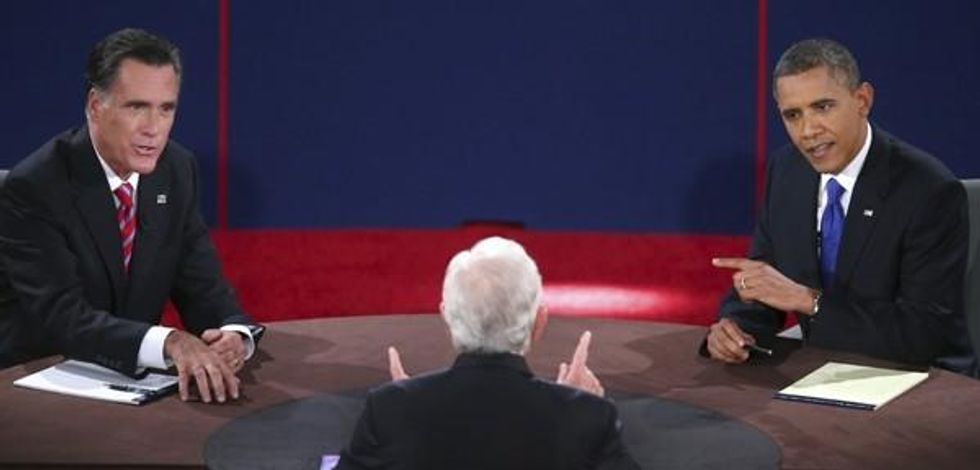
Mitt Romney's just not that into foreign policy.
The hapless Republican nominee for president spent most of the only foreign-policy debate of the 2012 fall campaign mumbling lines like:
"I want to underscore the--the same point the president made..."

The hapless Republican nominee for president spent most of the only foreign-policy debate of the 2012 fall campaign mumbling lines like:
"I want to underscore the--the same point the president made..."
"That was something I concurred with..."
"I supported his--his action there..."
"I don't blame the administration..."
"...do as the president has done..."
"... and feel the president was right..."
"I congratulate him for what he has done."
On drones, on Syria, even on Libya, Romney agreed with the president. Romney even appeared to shift his stance on the withdrawal of US forces from Afghanistan, steering toward a position that suddenly parallels the administration plan for a 2014 exit strategy. Senate Foreign Relations Committee chairman John Kerry, D-Massachusetts, described Romney as an "inexperienced" "Etch-A-Sketch candidate" who is not ready to be president.
Brent Bozell, an iconic and well-regarded conservative who serves as president of the Media Research Center, messaged forty-five minutes into the debate: "Something is wrong with Romney tonight. He's refusing to challenge Obama's failed policies. He's sounding LIKE Obama. This is terrible."
Undecided voters surveyed by CBS agreed, indicating in a snap poll that Obama had won the commander-in-chief test by a staggering 53-23 margin. That was a wider margin than Romney got after the first debate that was broadly seen as his big win.
All of this was good news for Obama, if not necessarily for the national discourse. In too many senses, Monday night's debate was a confirmation of the bipartisan consensus on foreign policy that so frustrates Americans who want a broader debate on fundamental questions of war and peace, globalization and human rights. And it was a reminder that alternative candidates, such as Green party presidential nominee Jill Stein and Libertarian Gary Johnson, should have been included in these debates.
But there were only two candidates on stage. And one of them, the guy who was supposed to be making a case for removing the incumbent, kept echoing the president.
Again and again, Romney agreed with Obama's approaches to international issues. Sometimes, he did so explicitly. Sometimes, he simply restated Obama administration policies as if he had developed them himself.
In case anyone missed the point, the president was at the ready with lines like: "I'm glad that Governor Romney agrees with the steps that we're taking" and "I'm pleased that you are now endorsing our policy..."
But Obama was not satisfied to rest on the laurels from Romney.
The Democratic president knew he needed as strong showing in the last of a cycle of debates that began with an Obama performance so weak that it renewed Romney's run. And Obama got it.
Midway through the debate, Romney repeated the right-wing talk radio fantasy that Obama began his presidency with "an apology tour" of the Middle East. He griped that the president "skipped Israel" on his 2009 trip to the region.
Obama was so ready for that one:
When I went to Israel as a candidate, I didn't take donors, I didn't attend fundraisers, I went to Yad Vashem--the Holocaust museum there, to remind myself [about] the nature of evil and why our bond with Israel will be unbreakable.
Romney did not respond because, of course, Obama was right.
Romney did use his trip last summer to Israel as a vehicle for fundraising, organizing money-raising events and flying in wealthy donors from the United States.
It was one of several points throughout the evening where a pointed one-liner from the president shut down a Romney line of attack.
Romney ripped Obama on the size of the US Navy, making comparisons with the 1916 fleet size.
Obama responded: "You mention the Navy, and the fact that we have fewer ships than we did in 1916. Well, governor, we also have fewer horses and bayonets. We have these things called aircraft carriers and planes land on them. We have ships that go underwater, nuclear submarines. It's not a game of Battleship, where we're counting ships. It's 'What are our priorities?' "
Romney, so famous for demanding more time to respond, just let that one go, and made no more mention of the Navy.
But the line that may resonate the longest from an otherwise uninspired debate came when the two men sparred over how to "get tough" with China when it comes to trade policy, currency manipulation and offshoring concerns.
Obama was again prepared for Romney.
The Republican went through his litany of complaints about how the president was not doing enough to address the trade deficit and other issues with China.
Then, with just the slightest grin, Obama said:
Governor Romney's right. You are familiar with jobs being shipped overseas, because you invested in companies that were shipping jobs overseas. And, you know, that's your right. I mean, that's how our free market works.
But I've made a different bet on American workers. You know, if we had taken your advice, Governor Romney, about our auto industry, we'd be buying cars from China instead of selling cars to China. If we take your advice with respect to how we change our tax codes so that companies that are in profits overseas don't pay US taxes compared to companies here that are paying taxes, now, that's estimated to create 800,000 jobs. The problem is they won't be here; they'll be in places like China.
In a presidential race that is likely to be decided in manufacturing states such as Ohio and Wisconsin, where too many jobs have been offshored to China, that's what voters want to hear in a presidential debate. And Obama was saying it.
Save
In 2008, Barack Obama rekindled faith in the America electoral process for many, and revived the deeper promise of American democracy, bringing to the foreground of the national political experience a brilliant and compassionate African American candidate.

When Obama actually won the presidency, it was one of the exciting political moments in my lifetime, and rather reassuring as a sequel to the dark years of George W. Bush's presidency. Of course, many Americans didn't share such positive feelings, and an important embittered minority believed that the election of a liberal-minded black man was the lowest point ever reached in national politics, challenging this segment of society that now was deeply alienated from the prevailing political current to mobilize their forces so as to win back control of the country on behalf of white Christian Americans, and also a time to indulge such absurd scenarios as an imminent Muslim takeover of the society.
Such polarization, gave rise to an Islamophobic surge that revived the mood of fear and paranoia that followed upon the 9/11 attacks and was reinforced by evangelical enthusiasm for Israel. In this regard, the Obama phenomenon was a mixed blessing as it contributed to a rising tide of rightest politics in the United States that poses unprecedented dangers for the country and the world.
Nevertheless, as mentioned, Obama's campaign and election was at the time a most welcome development, although not entirely free from doubts. From the outset my hopes were tinged with concerns, although I did my best to suspend disbelief. All along I found little evidence that Obama's leadership would liberate the governing process from its threefold bondage to Wall Street, the Pentagon, and Israel. Such a political will to mount such a challenge was never in evidence, and never materialized.
Even in lucid moments, however, I reasoned it was important to elect Obama, despite his endorsement of a woefully deficient set of foreign policy assumptions, because more would be done to give assistance to those impoverished and hit by unemployment and home foreclosures, better judges and diplomats would be appointed, and more attention would be given to climate change. After four years, I continue to believe that these differences matter sufficiently to make it irresponsible not to support Obama and the Democratic Party, especially in so-called swing states.
And if there was excitement in much of America during the 2008 electoral campaigned, it was mild compared with pro-Obama sentiments in the rest of the world four years ago, which reached dizzying heights after his victory. This enthusiasm was a compound of several elements: Obama's success lifted confidence throughout the world that the United States could again play a benevolent role on the global stage and also because it validated that mythic image of America as a country where it was truly possible for anyone in the society, including members of minorities long discriminated against, to reach the pinnacles of wealth and power provided only that they were sufficiently talented and determined, and some would add, lucky. There remains little doubt that if the peoples of the world were allowed to vote in American elections, as might be appropriate in a globalized world, it would have produced a landslide of unprecedented magnitude in Obama's favor.
All at once in 2008 it became evident that an American presidential election was no longer just a national ritual that bemused outsiders watched as a kind of spectacle but a global event that affected the entire world. In fact the selection of a leader for the United States might be in some respects more important for other societies than for America, and further that the outcome of an American election could have a greater impact on a country in Asia, Africa, and Latin America than the effects of their own national elections, a significance reinforced by intense global media coverage of the American election in real time. In this respect, the 2008 election of Barack Obama made many of us aware that 'political globalization' was now as much a part of our experiences as 'economic globalization.' We were no longer living in a world where the standard map based on the borders of territorial sovereign states depicted the essential organization of political life on the planet. Our globalizing world had made the geopolitical cartography of influence much more spatially elusive, almost impossible to depict visually, but no less real.
Overall, the initial candidacy and election of Obama was, despite my qualms, more about hope than fear. There were concerns to be sure that the McCain/Palin Republican opposition would be dangerous for the world, but such anxieties were relatively subdued, and did not extinguish the strong positive expectations generated by Obama. And these hopes seemed somewhat justified in the first months of his presidency. In April Obama delivered a visionary speech in Prague that articulated a strong commitment to work toward a world without nuclear weapons. The newly elected president also seemed determined to carry out his campaign pledge to end the Iraq War in a responsible fashion, although this welcome move was offset by a disquieting hint that such a demilitarizing move in Iraq would be balanced by an increased commitment to prevailing in the ongoing war for the control of Afghanistan.
In June Obama made a relatively forthcoming speech in Cairo promising a new more positive relationship with the Islamic world as a whole and to the Middle East in particular. The president referred to the long ordeal of the Palestinian people and proclaimed his dedication to achieving a peaceful and just resolution of the Israel/Pa;lestine conflict, including a most reasonable call upon Israel to freeze all settlement expansion while peace negotiations were taking place. That this call on Israel to stop unlawful activity during negotiations was treated by the media as such a bold step tells us just how biased the mainstream attitude toward the conflict had become, and when Israel rejected at Obama 's moderate plea it experienced no adverse consequences, although the White House was put on the defensive because it had dared to push Israel to take a step that was against its wishes. This initiative, followed by its withdrawal, demonstrated to the world the extent to which the United States Government was in Israel's corner, was revealed to all who cared to notice that the only superpower in global politics was a paper tiger when it came to the pursuit of a just outcome of the conflict.
As already indicated, I half expected disappointments in 2008. I worried about Obama's typical liberal effort to demonstrate his tough approach to national security including support for a bloated defense budget in the face of a fiscal and employment crisis, about his lame effort to distinguish between Iraq as a bad war and Afghanistan as a war necessary for American security, and hence a good war. Also, I was disturbed by the way Obama dumped Rev. Jeremiah Wright when he became a liability to his electoral campaign, seemed embarrassed by his friendship with the distinguished Palestinian political historian, Rashid Khalidi, and made Rahm Emanuel chief of staff, as his first major appointment. Obama surrounded himself with economic advisors who were the same folks that had collaborated with the banks, hedge funds, and big brokerage houses in the 1990s to facilitate the huge regressive redistribution of wealth in the spirit of 'casino capitalism.' Unfortunately, these telltale signs of weakness of principle and ideology were an accurate foretaste of what was in store for the country during the next four years, although it apparently never dawned on the Nobel Peace Prize Committee to withhold its coveted award until Obama demonstrated that he was a deserving recipient, which sadly he never did.
What happened during the first term of the Obama presidency is definitely disappointing, although it is only fair to acknowledge that extenuating circumstances existed. Obama was dealt 'a bad hand' in the form of the worst economic crisis since the Great Depression of the 1930s. American society was sliding to the right as exhibited by the rise of the Tea Party, and the election of increasingly reactionary politicians as senators and congressmen, creating the most rightwing Congress in memory. It was difficult to govern in such a setting, and Obama compounded the difficulties by moving more than half way to meet the unreasonable demands of the opposition, and continued to do so even in the face of their clear unwillingness to reciprocate in a corresponding manner. Also, the pressures mounted by Israel and its formidable AIPAC lobby led the White House to back pedal awkwardly with respect to its efforts to create an atmosphere conducive to a balanced peace process for Israel and Palestine. On other issues, as well, Obama followed the pollsters and the party insiders more than principle, and failed to do what was best for the country and the world. After promising to take climate change seriously, Obama led an international effort to avoid imposing legal constraints on carbon emissions, and throughout his reelection campaign in 2012 has done his best to avoid the looming challenge of global warming aside from blandly promoting energy independence and green technology. As a result, the near unanimous scientific consensus on the urgent need for mandatory strict limits on carbon emissions has been disastrously pushed further and further into the background of public consciousness.
For me the 2012 elections have a different tone and relevance, that is not less consequential than in 2008, although absent the uplift. I believe this time around the stakes in the presidential election have been reversed. The upcoming election is more about fear than hope. The outcome is as fateful, or possibly more so, for the American people and the world, especially those living in the Middle East, but fateful also in the sense of avoiding the worst, not hoping for the best, or at least something better. Romney's election, even if he means only 50% of what he is saying, could lead to military confrontation with Iran, a completely free hand for Israel, an effort to undermine and control democratic forces in the main Arab countries, a trade war with China, a deepening of the world financial and employment crises, reduced respect for human rights, especially the reproductive rights of women, and a return to the overt lawlessness of the Bush presidency. Obama if reelected would likely be a more prudent leader, although continuing to throw the weight of American influence mostly on 'the wrong side of history.' In this sense, although prudence is to be preferred to recklessness, there are no major principled differences between the candidates when it comes to foreign policy (on domestic policy there is). Romney proposes that the U.S. stay longer in Afghanistan, move closer to an attack mode with Iran, and challenge China more vigorously on economic policy, and Obama agrees with all these positions but pursues them in a more nuanced way, with a greater seeming sensitivity to the risks and pitfalls, but nevertheless adhering to the same misguided and regressive policy options.
When fear rather than hope shapes our political consciousness, the effect on the citizenry is likely to be despair. Such an effect induces collective depression and encourages extremisms. What is also scary is the degree to which those who are making us fearful are being aided and abetted by the deep pockets of extremist billionaires who seem clearly to sense their ability in this period to buy enough votes to distort the will of the citizenry, and if they should be successful will step up to the policy window to cash in their chips, which could produce some disastrous results at home and abroad. In the background, of course, is the disappointment with the political consciousness of the citizenry that seems so receptive to such a dysfunctional and menacing political agenda as is being presented to them by the Republican Party; it does inspire confidence that the democratic way can lead toward sustainability, security, and justice in the years ahead.
With such an understanding why not support the Green Party candidacy of Jill Stein and Cheri Honkala? Their positions seem principled and admirable, and their alignments are with the poor and with the environment. Their platform is inspirational and congenial compared to what the Republicans and Democrats offer the American people. But their capacity to govern is untested, and their level of support is minimal.
I ask myself whether a vote for the Green Party in light of these circumstances would be a wasted vote? It evades the question to observe that in some states, say California or Nebraska, the outcome is so clear that takingsides as between the candidates put forward by the Democrats and Republicans is meaningless. The real test is whether it is worth voting for the Green Party candidates as a matter of principle because they are decent enough not to stoop to the dirty games of money and the accommodation of special interests that are poisoning the political process in the United States. At this point, I am not able to resolve my doubts. Is it irresponsible, given what is at stake, not to vote for the lesser of evils? Is it a misunderstanding of modern democracies to expect clear choices based on principled positions, respect for international law and human rights, dedication to environmental protection, sustainable economic policies, and a commitment to social justice for the entire population? Should we not insist on this misunderstanding to avoid ourselves being entrapped in a demeaning morality that overlooks crimes of state? (for instance, drone terror)
I must admit if living in a swing state I would vote for Obama, not having sufficient courage of my convictions to risk symbolic responsibility for a Romney victory!
Save