

SUBSCRIBE TO OUR FREE NEWSLETTER
Daily news & progressive opinion—funded by the people, not the corporations—delivered straight to your inbox.
5
#000000
#FFFFFF
To donate by check, phone, or other method, see our More Ways to Give page.
Daily news & progressive opinion—funded by the people, not the corporations—delivered straight to your inbox.

"This fight has been going on for 240 years," said Likhts'amisyu Clan Wing Chief Dsta'hyl of the Wet'suwet'en Nation. "Now, we are all 'prisoners of conscience' because of what the colonizers have done to us."
Amnesty International on Wednesday made what it called the "unprecedented decision" to designate as Canada's first-ever "prisoner of conscience" an Indigenous leader convicted for actions taken while defending his people's land against a fracked gas pipeline.
Likhts'amisyu Clan Wing Chief Dsta'hyl of the Wet'suwet'en Nation was arrested in 2021 for violating a court order to not obstruct the construction of TC Energy's Coastal GasLink liquefied natural gas (LNG) pipeline. The hereditary chief is currently under house arrest for contempt of court.
"The Canadian state has unjustly criminalized and confined Chief Dsta'hyl for defending the land and rights of the Wet'suwet'en people," Amnesty International Americas director Ana Piquer said in a statement Wednesday. "As a result, Canada joins the shameful list of countries where prisoners of conscience remain under house arrest or behind bars."
"With the utmost respect for Chief Dsta'hyl's critical work to protect Wet'suwet'en land, rights, and the environment we all depend on, Amnesty International demands his immediate and unconditional release and urges Canada to stop the criminalization of Wet'suwet'en and other Indigenous defenders during a global climate emergency," she continued.
"Indigenous peoples are on the frontlines of climate change and will face disproportionate harms if humanity fails to move on from burning fossil fuels," Piquer added. "States must hold up, not lock up, Indigenous land defenders like Chief Dsta'hyl and follow their lead towards a healthier, more sustainable future for all."
According to Amnesty:
Based in part on witness testimony of four large-scale Royal Canadian Mounted Police (RCMP) raids on Wet'suwet'en territory marked by the unlawful use of force... Wet'suwet'en land defenders and their supporters were arbitrarily detained for peacefully defending their land against the construction of the pipeline and exercising their Indigenous rights and their right of peaceful assembly. The rationale for the land defenders' detentions was violating the injunction order (an order which Amnesty International has determined is not in conformity with international law and standards) which makes their detentions arbitrary.
In June and July 2022, the [British Columbia] Prosecution Service decided to charge 20 land defenders with criminal contempt for allegedly disobeying the injunction order to stay away from pipeline construction sites. Seven of the 20 land defenders pleaded guilty because of restrictive bail conditions, as well as the familial, psychological, and financial impacts that the criminal trial process was having on them. Five others had the charges against them dropped.
Canadian authorities, including the RCMP, have answered nonviolent Wet'suwet'en land defense with armed officers including snipers who employed heavy-handed removal tactics. Scores of Wet'suwet'en land defenders, including four hereditary chiefs, have been arrested and charged, as have journalists and legal observers. In December 2021, Coastal GasLink dropped charges against two journalists who were arrested while covering a previous militarized police raid.
In 2022, the Gidimt'en—one of the five clans of the Wet'suwet'en Nation—filed a submission to the United Nations Human Rights Council detailing how their territory and human rights are being violated by Canadian and British Columbian authorities in service of the Coastal GasLink pipeline. The 416-mile conduit carries fracked gas from Michif Piiyii (Metis) territory in northeastern British Columbia to an export terminal in coastal Kitimat, on the land of the xa'isla wawis (Haisla) people.
The Gidimt'en filing noted that "ongoing human rights violations, militarization of Wet'suwet'en lands, forcible removal and criminalization of peaceful land defenders, and irreparable harm due to industrial destruction of Wet'suwet'en lands and cultural sites are occurring despite declarations by federal and provincial governments for reconciliation with Indigenous peoples."
The heavy-handed persecution of the Wet'suwet'en sparked solidarity protests throughout Canada and beyond that focused on the pipeline's impact on First Nations tribes, the environment and climate, and missing and murdered Indigenous women and girls.
Likhts'amisyu Clan members—whose presence in what is today northern British Columbia long predates the existence of Canada—claim they have not been consulted on the Coastal GasLink pipeline, which traverses land that does not belong to the Canadian government.
Dsta'hyl and other Wet'suwet'en leaders argued that they were enforcing ancient tribal trespassing laws. Ironically, they ended up charged with trespassing. During their trial last year, Dsta'hyl and other Likhts'amisyu chiefs asserted that they were fulfilling their duty to protect Wet'suwet'en land—or yintah—by enforcing their traditional trespass law.
In finding Dsta'hyl guilty of contempt of court this February, British Columbia Supreme Court Justice Michael Tammen declared there was no way of "harmonizing colonial law and Indigenous law," which he said "cannot comfortably coexist in the circumstances."
Dsta'hyl said Wednesday: "I've been convicted for protecting our own land while Wet'suwet'en laws have been sidelined. The end goal for us in this struggle is the recognition of Wet'suwet'en law in Canada, and it's unfortunate that the Crown is digging in their heels instead."
"This fight has been going on for 240 years," he added. "We have been incarcerated on the reserves where they have turned us into 'Status Indians.' Now, we are all 'prisoners of conscience' because of what the colonizers have done to us."
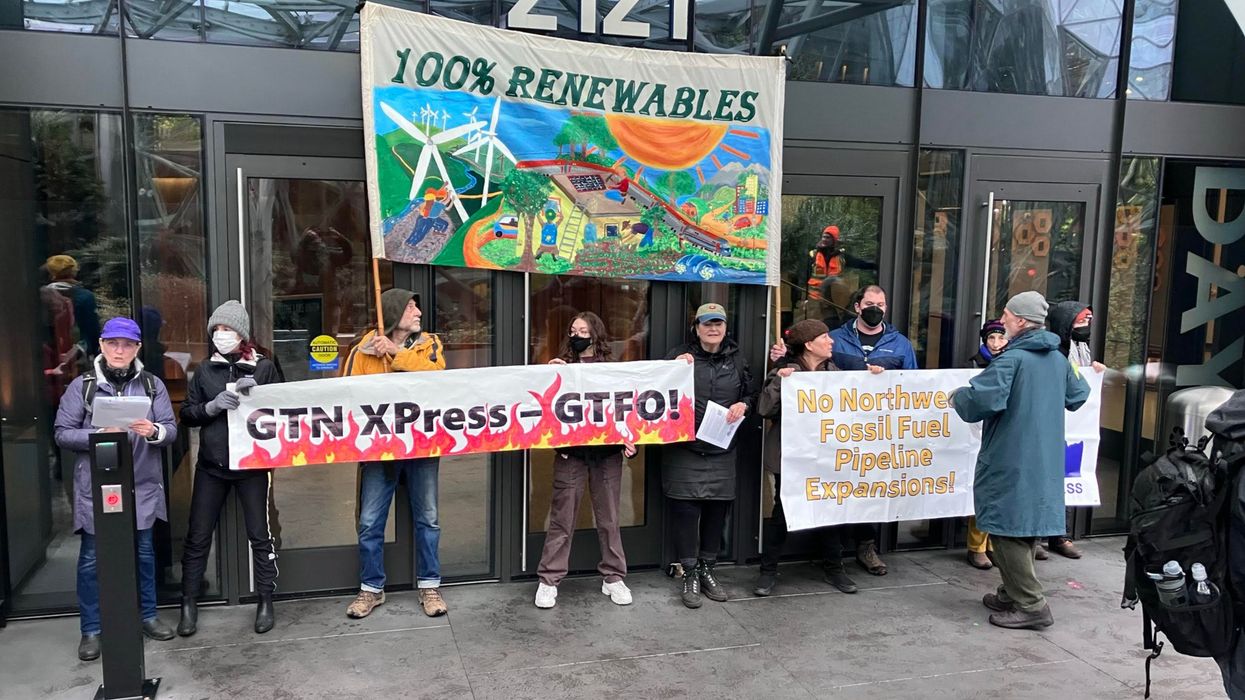
"Amazon is breaking its Climate Pledge by powering new data centers with fracked gas," said one member of the new activist group. "So we came to demand that they honor the pledge."
A recently formed group of climate activists on Wednesday shut down entrances to Amazon's downtown Seattle headquarters to protest the tech titan's plans to link some of its data centers with an upgraded fracked gas pipeline.
Members of the Troublemakers—who describe themselves as "an ever-growing community of people who are committed to taking action for life on Earth"—blockaded the doors to the Day 1 Building on 7th Ave. in opposition to Amazon Web Services' (AWS) plan to connect three data centers near Boardman, Oregon to TC Energy's Gas Transmission Northwest (GTN) XPress Project.
As Common Dreams reported last October, GTN XPress, which has been approved by the Federal Energy Regulatory Commission, would upgrade compressor stations in Kootenai County, Idaho; Sherman County, Oregon; and Walla Walla County, Washington. TC Energy plans to boost the 60-year-old pipeline's capacity by 150 million cubic feet of fracked gas by increasing the conduit's pressure.
"The decision to use fracked gas from the GTN XPress adds to Amazon's carbon emissions problems," the Troublemakers said in a statement. "Amazon's 2022 carbon emissions totaled 71.27 million metric tons, marking an 18% rise from 2020 and a 40% surge since 2019, the year Amazon unveiled its Climate Pledge. This alarming trend is in stark contrast to the global imperative to halve emissions by 2030."
The group wrote in a March 19 letter to Amazon CEO Andy Jassy:
Amazon prides itself on innovation. Using fossil fuel is not innovation... It is relying on a dying technology that is killing the planet. Utilizing GTN XPress would increase Amazon's carbon footprint and contribute greatly to climate change... We urge you to publicly commit to financing solar or wind projects to provide clean energy for Amazon's operations, and reject the GTN XPress.
The Troublemakers are calling on Amazon to:
"We see Amazon's greenwashing every time we pass by Climate Pledge Arena," said Troublemaker Valerie Costa, who was referring to the home of the Seattle Kraken and Seattle Storm professional sports franchises. "Until Amazon drops its plan to buy fracked gas from GTN XPress, we'll keep showing up. Every fossil fuel project in the [Pacific Northwest] will be met with fierce resistance."
Leonard Sklar, a scientist and Troublemaker, asserted that "Amazon is breaking its Climate Pledge by powering new data centers with fracked gas. So we came to demand that they honor the pledge."
"We know they have the power to be 100% renewable energy," he added, "and that's what this moment requires."

"This irresponsible decision will have implications on the health and well-being of communities, as well as lasting impact on generations to come," warned one campaigner.
Elected officials and environmental advocates in the Pacific Northwest on Thursday condemned U.S. regulators for greenlighting a Canadian company's fracked gas pipeline expansion project despite the fossil fuel-driven climate emergency.
The Federal Energy Regulatory Commission (FERC) approved TC Energy's Gas Transmission Northwest (GTN) XPress Project, which would upgrade compressor stations in Kootenai County, Idaho; Sherman County, Oregon; and Walla Walla County, Washington.
"Today's decision by FERC flies in the face of what is morally and economically necessary to protect our communities from the worsening impacts of climate change," declared Democratic Washington Gov. Jay Inslee. "The federal government has finally begun making tremendous climate investments under the Inflation Reduction Act, but this decision essentially digs the hole deeper and locks in long-term capital investments that prevent us from reaching our national and state goals."
Along with Inslee, political opponents of the project include Democratic Oregon Gov. Tina Kotek; U.S. Reps. Earl Blumenauer (D-Ore.), Pramila Jayapal (D-Wash.), and Andrea Salinas (D-Ore.); and U.S. Sens. Maria Cantwell (D-Wash.), Jeff Merkley (D-Ore.), Patty Murray (D-Wash.), Alex Padilla (D-Calif.), and Ron Wyden (D-Ore.).
"Expanding this fossil fuel pipeline for 50 years—until 2073—saddles our children and their children with climate harm and fossil fuel costs," Inslee warned. "This fight isn't over. I'm thankful for the aligned efforts of Gov. Kotek, our senators, and our West Coast attorneys general to make clear why this pipeline is a dangerous detour on our path away from fossil fuels. We are more resolved than ever to keep this pipeline from increasing fossil fuel use."
Advocacy groups are also determined to prevent the expansion.
"FERC failed to listen to senators, governors, state attorneys general, tribes, and the public in its rubber stamp of unnecessary fracked gas in the Northwest," stressed Columbia Riverkeeper staff attorney Audrey Leonard. "The commission's decision violates the public interest and common sense, and we will file a petition for rehearing challenging this project."
"Since the analysis for this project was published, two major TC Energy pipelines have failed, causing safety hazards and spilling fossil fuel," Leonard noted. "If this were to happen in dry, rural, fire-prone lands or in the residential areas where TC Energy's GTN pipeline is located, it would be catastrophic."
Satya Austin-Opper of 350 Deschutes in Oregon stressed that "the GTN Xpress proposal would lock in a huge new influx of fracked gas for decades at the very moment that our communities are experiencing accelerated climate change impacts such as frequent drought and summers of smoke."
"And this pipeline runs right through our community," Austin-Opper continued, also noting the company's recent history. "I'm worried about how devastating the impact would be if the pipeline were to fail, which is certainly a possibility given the unsafe track record of TC Energy's other aging pipelines."
Oil Change International U.S. program co-manager Allie Rosenbluth argued that "with this decision to approve the GTN Xpress expansion, the Biden administration is again failing on its promises to protect environmental justice communities and the climate."
The FERC decision follows a historically hot summer that led United Nations Secretary-General António Guterres to caution that "climate breakdown has begun" and the European Copernicus Climate Change Service's announcement earlier this month that 2023 is on track to be the warmest year ever recorded.
"Any expansion of fossil fuels is incompatible with a livable future," Rosenbluth asserted. "Oregon and Washington must continue to rise to the challenge and safeguard the health and well-being of communities and the climate by challenging FERC's approval of this unnecessary and dangerous gas expansion."
Leaders from Physicians for Social Responsibility (PSR) in both states also highlighted the health impacts of the project.
"FERC's alarming decision to approve the GTN Xpress Project blatantly disregards concerns from community advocates and hundreds of health professionals in Oregon and within our region," said David De La Torre of Oregon PSR. "This irresponsible decision will have implications on the health and well-being of communities, as well as lasting impact on generations to come."
"As wildfires and extreme heat events continue to increase in frequency, straining health services and the well-being of Oregonians, it is imperative that we not continue to approve proposals that accelerate the climate crisis," he added. "We don't need more fracked gas being pumped through our state and communities."
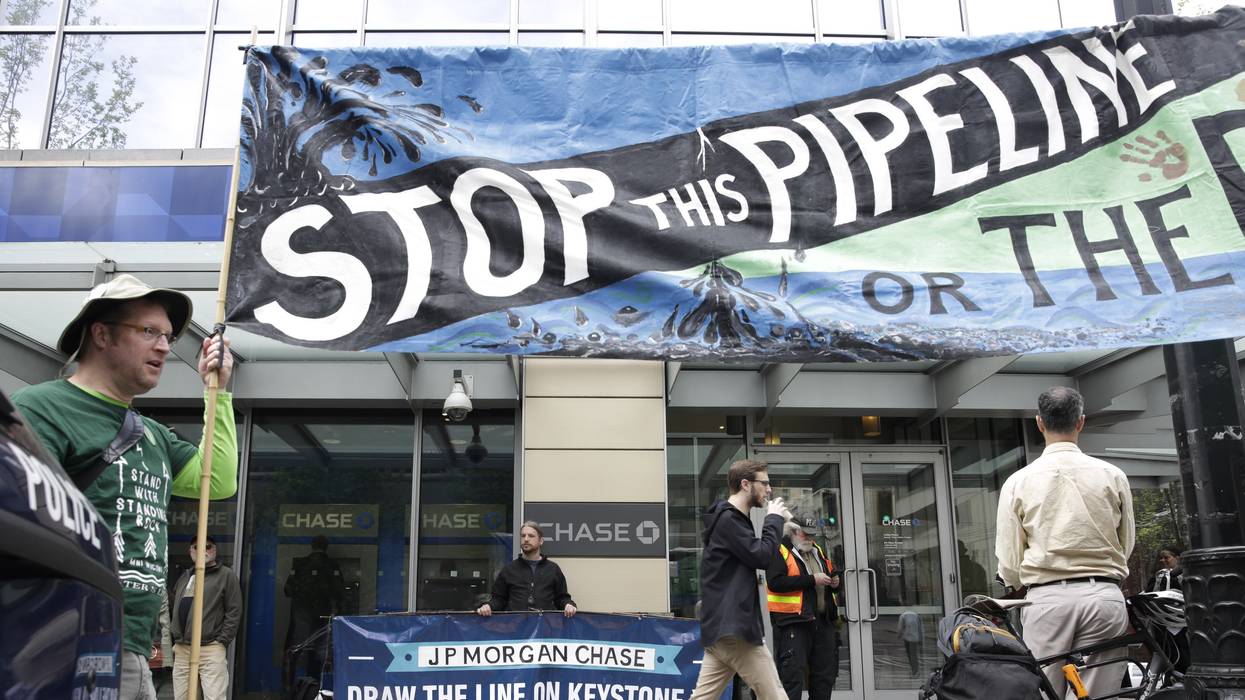
350 Seattle and the Stop GTN Xpress Coalition urge Washington Senators Maria Cantwell and Patty Murray to heed the warning of the International Energy Agency and oppose the GTN Xpress.
When I heard about the ongoing fires in eastern Canada, and the accompanying smoke that covered much of the U.S. East Coast, I was reminded of the Bob Dylan refrain from “Blowin’ in the Wind,” yet with different words: How many fires will it take ’til we know, that it’s past time to stop burning fossil fuels? Do we need the entire country to be covered in smoke before we take all necessary steps to turn the climate crisis around?
While President Joe Biden’s Inflation Reduction Act was a step in the right direction, the International Energy Administration (IEA) has been clear: “If governments are serious about the climate crisis, there can be no new investments in oil, gas, and coal.” Yet TC Energy, the company behind the Keystone Pipeline, seeks approval for a new gas project in the Pacific Northwest called the GTN Xpress. The project would increase the amount of gas coming into the region by expanding an existing pipeline.
350 Seattle and the Stop GTN Xpress Coalition urge Senators Maria Cantwell (D-Wash.) and Patty Murray (D-Wash.) to heed the warning of the IEA and oppose the GTN Xpress.
If the Federal Energy Regulatory Commission were to approve the expansion, it would result in more than 3.47 million tons of greenhouse gas emissions each year—that’s the equivalent of adding 754,000 cars to the road annually.
Here’s the background: GTN’s existing pipeline runs across eastern and southeast Washington, through central Oregon, and into California. The proposed expansion project would push more fracked gas through the existing pipeline by upgrading three existing compressor stations. Compressor stations are fracked gas-powered industrial facilities that control how much gas moves through the pipeline. If the Federal Energy Regulatory Commission (FERC) were to approve the expansion, it would result in more than 3.47 million tons of greenhouse gas emissions each year—that’s the equivalent of adding 754,000 cars to the road annually.
Yet is such a project needed? The answer is an overwhelming no. In a 2022 article, the Sightline Institute analyzed the gas demands of the Northwest in connection with the GTN proposal and concluded that the additional gas is not needed. The article noted that Washington and Oregon will require 100% renewable electricity generation by 2040 and 2045, respectively, meaning that gas will no longer be required for power generation. Additionally, in 2022 Washington passed legislation requiring all-electric heating in new commercial buildings.
Not only is the GTN Xpress unnecessary and bad for the climate, utility customers would likely face increased costs to pay for this expensive infrastructure upgrade. Additionally, nearby communities would see increased air pollution from the compressor stations, as well as face a heightened risk of explosions and fires in the event of an accident. In 2022, the attorneys general of Oregon, Washington, and California made similar arguments against the project in a motion to intervene in the GTN Xpress FERC proceedings.
Opposition to this project is growing. So far, more than 50 local and national organizations ranging from grassroots environmental groups to health professionals have opposed GTN Xpress. In addition to opposition from the attorneys general of Washington, Oregon, and California, several elected representatives from the region have also spoken out against the project; Democratic Oregon Senators Jeff Merkley and Ron Wyden, Governor Tina Kotek of Oregon, and Washington’s own Governor Jay Inslee have all expressed opposition to the GTN proposal.
The websites of both Senators Cantwell and Murray indicate that they see themselves as advocates for the environment. If so, they need to stand by their principles and speak out publicly now against the GTN Xpress. The addition of their voices to the growing opposition to the project could make a difference in FERC’s decision making. FERC is expected to approve or deny this project as early as mid-July, 2023.
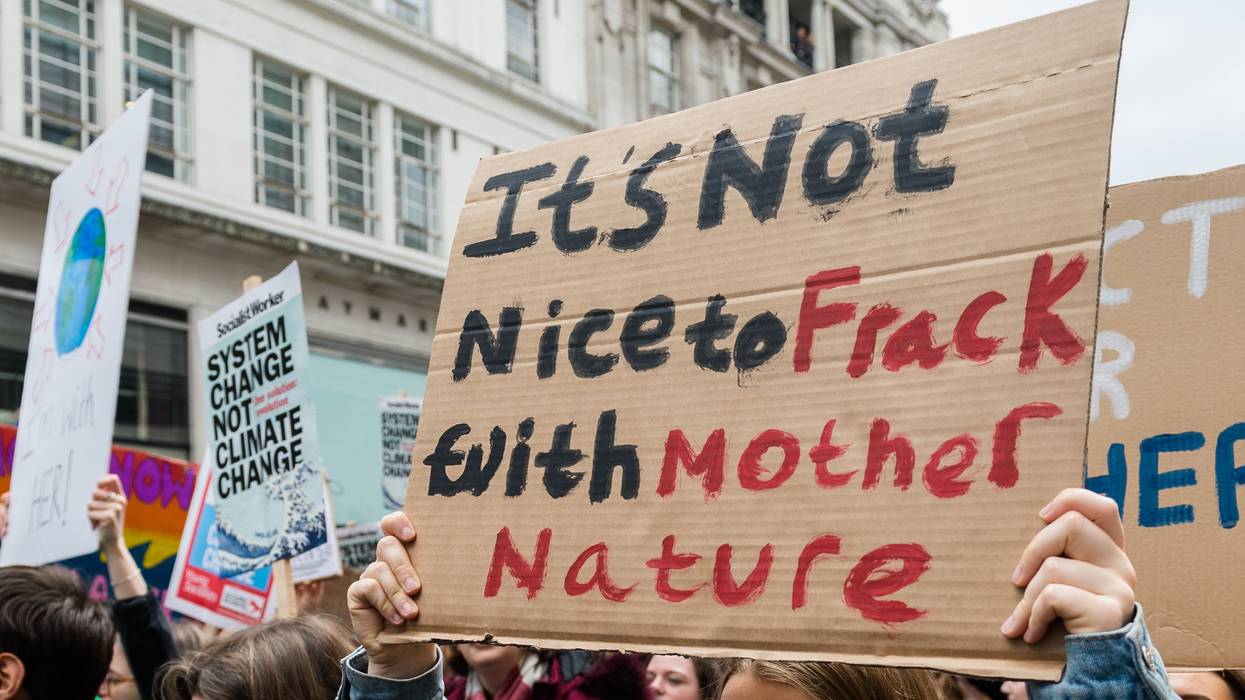
"We see the impact the climate crisis has on people each and every day. And we have a responsibility to sound the alarm," said one doctor. "We urge FERC to prioritize the health of our most vulnerable communities over profit."
As of Monday, more than 500 physicians and other medical professionals had signed on to a letter urging federal regulators to prevent the expansion of a fracked gas pipeline in the Pacific Northwest.
The sign-on campaign comes as the Federal Energy Regulatory Commission (FERC) is expected to weigh in on TC Energy's Gas Transmission Northwest (GTN) Xpress project as soon as this month.
The Canadian company's proposed expansion would boost the capacity of a pipeline that runs through British Columbia, Canada and the U.S. states of Idaho, Washington, Oregon, and California.
"FERC should deny the permit for this pipeline expansion proposal, which is both unnecessary to meet our energy needs and harmful to people in our communities."
"We are in a climate crisis, where we are already experiencing the devastating effects of rising temperatures, the direct result of burning fossil fuels, including so-called 'natural gas,' i.e., methane," the health professionals wrote, noting that methane has more than 80 times the warming power of carbon dioxide over its first 20 years.
Dr. Ann Turner of Oregon Physicians for Social Responsibility (PSR) said that "as medical practitioners, we see the impact the climate crisis has on people each and every day. And we have a responsibility to sound the alarm. We urge FERC to prioritize the health of our most vulnerable communities over profit."
As the letter explains:
TC Energy proposes to increase the amount of gas in its existing pipelines by expanding compressor stations which provide the force which propels gas through pipelines. These compressor stations emit significant amounts of air pollution, both from the operation of the engine which powers the pump as well as from venting. Compressor stations and meter stations vent methane, volatile organic compounds like formaldehyde, particulate matter, nitrogen dioxide, and carbon monoxide. All of these air pollutants have serious health impacts, including increased risks of stroke, cancer, asthma and low birth weight, and premature babies. Compressor stations also produce significant noise pollution. The air and noise pollution from these compressor stations disproportionately harms the rural, low-income, and minority communities that already experience significant health disparities, especially those that are living in proximity to the pipeline expansion project.
"In addition to the health consequences from the pipeline expansion project itself, gas in the GTN pipeline is extracted by fracking in Canada," the letter highlights. "Fracking degrades the environment including contamination of soil, water, and air by toxic chemicals. Communities exposed to these toxins experience elevated rates of birth defects, cancer, and asthma."
"The negative health impacts of methane gas, and its contribution to warming the climate and polluting the air, are unacceptable impacts that disproportionately affect Black, Indigenous, and people of color and low-income communities," the letter adds, arguing that the project is inconsistent with both global and regional goals to reduce planet-heating emissions.
Organizations supporting the letter include Wild Idaho Rising Tide as well as the San Francisco, Oregon, and Washington arms of PSR—which have previously joined other local groups in speaking out against the project alongside regional political figures including U.S. Democratic Sens. Jeff Merkley and Ron Wyden, both of Oregon.
"Idahoans dread FERC approval of the GTN Xpress expansion project, which would force greater fracked gas volumes and hazardous emissions through the aging GTN pipeline," according to Helen Yost of Wild Idaho Rising Tide.
"This expansion project would further threaten and harm the health and safety of rural communities, environments, and recreation economies for decades," she warned. "This proposed expansion does not support the best interests of concerned Northwesterners living and working near compressor stations and the pipeline route."
Dr. Mark Vossler, a board member at Washington PSR, pointed out that "states in the Northwest have made great strides in reducing our dependence on fossil fuels and creating healthier communities."
"I urge FERC to consider the human health impact of the proposed pipeline expansion and respect the leadership of local, state, and tribal governments in addressing the climate crisis," he said. "FERC should deny the permit for this pipeline expansion proposal, which is both unnecessary to meet our energy needs and harmful to people in our communities."