
SUBSCRIBE TO OUR FREE NEWSLETTER
Daily news & progressive opinion—funded by the people, not the corporations—delivered straight to your inbox.
5
#000000
#FFFFFF
To donate by check, phone, or other method, see our More Ways to Give page.


Daily news & progressive opinion—funded by the people, not the corporations—delivered straight to your inbox.
"In the richest country in the history of the world, a secure and dignified retirement should be available to every American, not just the extremely wealthy."
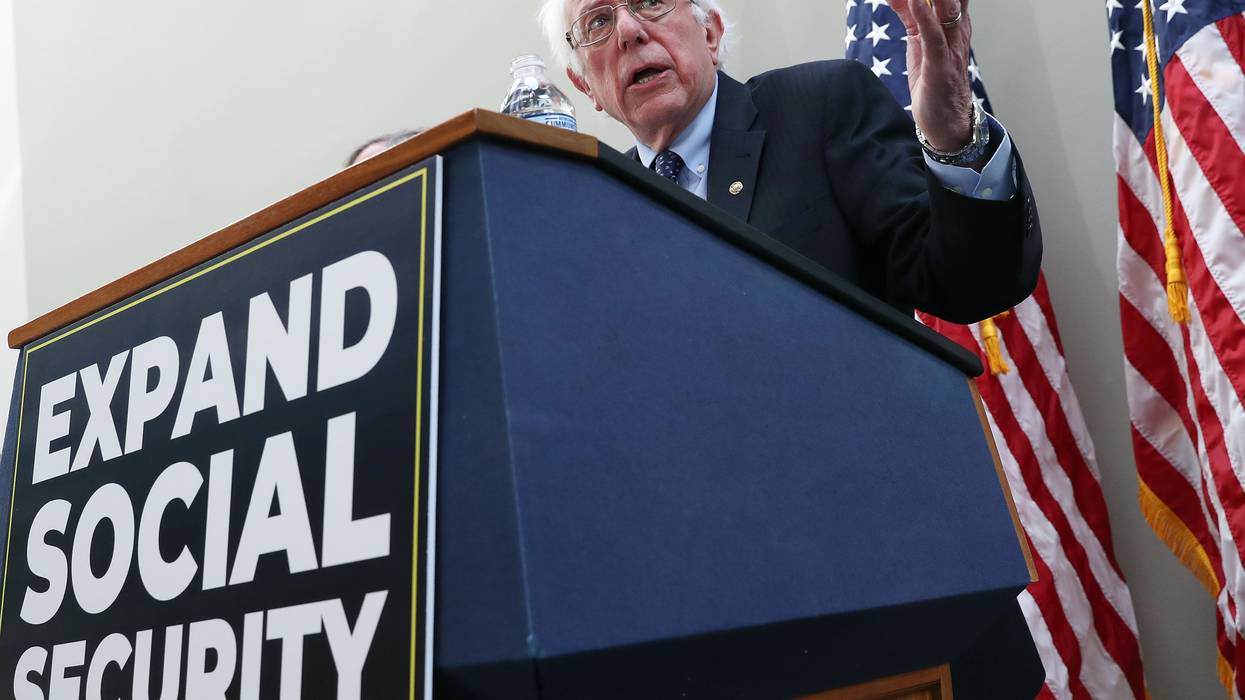
A report published Wednesday by the U.S. Senate committee chaired by Independent Vermont Sen. Bernie Sanders exposed "the depth of the retirement crisis in America" while exploring "solutions that will allow all of our people to retire with dignity and security—not just the very wealthy."
The report—entitled A Secure Retirement for All—was released ahead of a Wednesday morning Senate Committee on Health, Education, Labor, and Pensions (HELP) hearing on the retirement crisis. The publication revealed that nearly half of Americans age 55 and older have no retirement savings. It also found that half of Americans age 65 and older are living on less than $30,000 per year, while 1 in people are fighting to survive on less than $15,000 annually.
Other key findings include:
"Given the enormous growth of the economy over the past several decades, one might expect that the outlook for retirees is improving," the report states. "Yet, today nearly half of all Americans are at risk of a financially insecure retirement."
"For many, retiring on Social Security alone means that some months you can afford to either keep the lights on or get your prescription refilled," the publication adds. "The cost of healthcare in retirement is an enormous cost driver, for which many find themselves unprepared."
The report offers two main solutions to the retirement crisis: expanding and strengthening Social Security—"the most successful government program in our nation's history"—and enacting "Retirement Security for All" legislation that ensures every worker can save for retirement via their paychecks and guarantees lifetime monthly payments.
Last year, Sanders—along with Sen. Elizabeth Warren (D-Mass.) and Reps. Jan Schakowsky (D-Ill.) and Val Hoyle (D-Ore.)—introduced the Social Security Expansion Act, which would increase monthly benefits by at least $200 and extend the program's solvency for decades by lifting the cap on the maximum amount of income subject to the Social Security payroll tax.
The Social Security Administration's chief actuary said that had the bill been signed into law last year, the program would be able to pay full benefits to every eligible American for 75 years, without any tax increase for 93% of U.S. workers earning less than $250,000 per year.
"In the richest country in the history of the world, a secure and dignified retirement should be available to every American, not just the extremely wealthy," Sanders said on Wednesday. "Right now, more than half of older Americans have no retirement savings. More than 50% of our nation’s seniors are trying to survive on an income of less than $30,000 a year. That is absurd. Congress must address the retirement crisis facing working-class Americans across our country."

"Nothing but the power of corporate leaders to rig rules in their favor can explain this double standard."
Millions of people in the United States have little to nothing in retirement savings, a consequence of low-wage jobs that give workers minimal room to stash money away.
Meanwhile, at the end of 2021, the nation's top CEOs held an estimated $9 billion in rapidly growing special retirement accounts that aren't available to their employees—a double standard established by the U.S. tax code.
That double standard is the subject of A Tale of Two Retirements, a new report published Thursday by the Institute for Policy Studies (IPS) and Jobs With Justice. The report says that while "ordinary employees with access to 401(k) plans face strict limits on the amounts they can set aside, tax-free, for their golden years," highly paid executives of major corporations "have unlimited tax-deferred compensation accounts" known as top hat plans.
"The sections of the U.S. tax code related to employer-provided, tax-deferred retirement accounts impose one set of strict rules on ordinary workers and another set of far more flexible rules for corporate top brass," the report notes. "Employees with 401(k) plans face hard caps on the amounts they can set aside in these accounts every year. By contrast, Section 409A of the tax code allows top corporate executives to place unlimited amounts in special 'non-qualified tax-deferred compensation' accounts."
The funds in such plans are only taxed when they are withdrawn, allowing executives to reap the benefits of years of investment returns tax-free.
The new analysis shows that "at more than 20 low-wage employers, executives have sufficient deferred compensation funds to generate monthly retirement checks larger than their workers' median annual pay," pointing specifically to Walmart CEO Doug McMillon (who held over $169 million in his deferred compensation account at the end of last year) and former Home Depot CEO and current board chair Craig Menear (who has nearly $15 million in a deferred compensation account).
Home Depot employees aren't nearly as well-positioned for retirement. According to the researchers behind the new report, 53% of those eligible to participate in Home Depot's 401(k) plan have zero balances. Menear's top hat account balance is "enough to generate a monthly retirement check three times larger than the company’s median worker pay of just $30,100," the report notes.
The executive with the largest top hat account among S&P 500 company heads is Paul Saville, CEO of the homebuilding giant NVR, Inc. At the end of 2022, Saville held $488 million in his deferred compensation account—which could yield $3 million a month in retirement checks for the rest of his life.
"That's 1,513 times as much as a typical American retiree could expect to receive in monthly Social Security and 401(k) benefits," IPS and Jobs With Justice note.
Sarah Anderson, global economy director at IPS and a co-author of the new report, said that "there's no rational argument for allowing wealthy executives to shelter unlimited amounts of compensation from taxes while ordinary workers have strict limits on their annual 401(k) contributions."
"Nothing but the power of corporate leaders to rig rules in their favor can explain this double standard," Anderson argued.
"Perhaps most importantly, we need to expand Social Security, the key pillar for retirement security for most Americans, particularly low- and moderate-income families who receive little to no tax benefits."
For workers under the age of 50, the annual 401(k) contribution limit is $22,500 in 2023—a ceiling that the overwhelming majority of workers with access to a 401(k) won't hit.
"Nationwide, just 35% of working-age adults have tax-deferred 401(k)-type defined contribution plans through their employer and another 13% have defined benefit or cash balance plans. Some 42% of Americans age 56-64 have zero retirement account savings, according to the U.S. Census Bureau," the new report observes. "Americans who are unable to save for retirement need to rely on Social Security, which pays an average monthly benefit of $1,784, as of March 2023."
The report adds that while companies "often match a portion of employee 401(k) contributions," that benefit is "meaningless for the many low-wage workers who cannot afford to set aside any of their wages."
Furthermore, roughly half of U.S. workers in the private sector have no access to an employer-provided retirement plan.
"For decades now, large U.S. corporations have been making workers' retirement futures less secure by abandoning traditional pensions in favor of 401(k) plans," the report points out. "In 1984, more than 30 million Americans had defined benefit pensions through which employers bore the financial risks for their workers' retirement security. By 2020, that number had declined to just 12 million, and private sector workers were approximately 3.5 times as likely to have a defined contribution plan as a traditional pension."
IPS and Jobs With Justice highlight a number of potential policy changes that could help combat the stark and worsening retirement divide between ordinary workers—who are facing a full-fledged retirement income crisis—and executives, including changes to the tax provisions that let rich executives shelter their compensation.
"Perhaps most importantly, we need to expand Social Security, the key pillar for retirement security for most Americans, particularly low- and moderate-income families who receive little to no tax benefits," the report states. "Funding for expansion could come from lifting the wage cap on payroll taxes so that CEOs and other high earners pay roughly the same share of their total income into the Social Security fund as ordinary workers."
Scott Klinger, report co-author and senior equitable development specialist at Jobs With Justice, said that "rather than giving corporate CEOs unfair special retirement tax benefits not available to those they employ, Congress should eliminate the cap on payroll taxes paid by corporate executives so that Social Security benefits can be strengthened, especially for the 40% of American workers for whom Social Security is their sole retirement income."
As older Americans face a looming "retirement crisis," presidential candidate for the Democratic nomination, Bernie Sanders, has come out swinging against undeclared GOP rival Jeb Bush, who recently suggested raising the retirement age to 68 or 70.
"I have a hard time understanding what world Gov. Bush and his billionaire backers live in," said Sen. Sanders (I-Vt.), founder of the Senate Defending Social Security Caucus. "When the average Social Security benefit is just $1,328 a month, and more than one-third of our senior citizens rely on Social Security for virtually all of their income, our job must be to expand benefits, not cut them."
"It reflects a callous insensitivity toward working Americans, a lofty patrician blindness toward the lives of the hoi polloi."
--Richard Eskow, Campaign for America's Future
The Center for Economic and Policy Research has stated that raising the retirement age would cut workers' benefits since workers would have to pay more to get the same level of benefits.
The former Florida governor, who will reportedly announce on June 15 that he is officially running for president, made the statements Sunday on CBS's "Face the Nation."
"I think it needs to be phased in over an extended period of time," Bush said of raising the retirement age. "We need to look over the horizon and begin to phase in, over an extended period of time, going from 65 to 68 or 70. ... And that, by itself, will help sustain the retirement system for anybody under the age of 40."
In keeping with the Republican Party's "anti-elderly" platform, Bush's remark indicates that he's privileged and "out of touch," wrote Campaign for America's Future senior fellow Richard Eskow on Monday. "It reflects a callous insensitivity toward working Americans, a lofty patrician blindness toward the lives of the hoi polloi. What kind of person, given vast inherited wealth and power, sets about worsening the financial circumstances of most Americans--without even bothering to learn what those circumstances are?"
In a separate piece published this week, Eskow noted that, along with Bush, most leading Republican presidential candidates are pushing cuts to Social Security, with only former Arkansas Gov. Mike Huckabee opposing such cuts.
Sanders, who supports expanding benefits as opposed to cutting them, described Bush's plan as "just a continuation of the war that the Republicans are waging against working-class Americans to reward billionaires on Wall Street."
The senator has proposed legislation that would eliminate the cap on all taxable income above $250,000 so that millionaires and billionaires pay the same percentage of their income into Social Security as middle-class Americans.
Elder abuse is defined as "harmful acts toward an elderly adult, such as physical abuse, sexual abuse, emotional or psychological abuse, financial exploitation, and neglect." Financial exploitation comes from the banking industry; neglect emanates from the halls of Congress; and emotions are stirred through the stories of impoverished seniors:
Elder abuse is defined as "harmful acts toward an elderly adult, such as physical abuse, sexual abuse, emotional or psychological abuse, financial exploitation, and neglect." Financial exploitation comes from the banking industry; neglect emanates from the halls of Congress; and emotions are stirred through the stories of impoverished seniors:,
From Reno, Nevada: Here I am at an age when I should be thinking about retiring, desperately trying to find a job. I have used my savings...I'm seeking a court injunction to try and save my home.
From Laurel, Maryland: I am over 60, and I was pushed out of my job because of my age. My rent, car note, and electricity are all two months behind. I can barely get food. Utilities will be cut off soon.
From Bend, Oregon: I exhausted all my 401(k) retirement savings...I'm one month away from losing everything and am now on Food Stamps. I'm an unhappy Republican...
In Detroit, Michigan: 74-year-old Willie Smith saw her monthly SNAP benefits cut from $73 to $57. Also in Detroit, 63-year-old J.B. Hillman-Rushell and her 83-year-old mother were going to four different church food pantries for nearly all of their food.
"The Greatest Retirement Crisis in the History of the World"
That's what Forbes calls it. Most retirement-age Americans have little or no savings.
$30 trillion in new wealth has been gained in the U.S. since 2009, six times more than the amount spent on Social Security during that time, and most of it went to older Americans, as it has for the last 30 years. But most of it went to a relatively few people who were already rich. According to the Economic Policy Institute (Figure 20), "the median retirement savings...for all households is close to zero since nearly half of households have no savings in these accounts." Even the upper-middle class (2nd highest quartile) is in trouble, with a median retirement fund, by one estimate, of only $6,000. The National Institute on Retirement Security puts the median retirement account at $12,000 for near-retirement households.
And it's getting worse. The percentage of 75- to 84-year-old seniors falling into povertydoubled from 2005 to 2009. That was before the recession.
Adding to the Insanity: The Threat of Social Security Cuts
Income, for most elderly Americans, comes largely from Social Security. Almost three-quarters of single Social Security recipients 65 or older depend on Social Security for all or most of their income, which averages only about $1,300 per month. Global AgeWatch reports that income security for U.S. seniors is among the worst in the developed world.
It has been estimated that without Social Security benefits 45 percent of seniors would have incomes below the poverty line. Yet the popular and effective program is always under fire by Congress and business for being a wasteful "entitlement." In reality, it's an earned benefit, paid for by lifetime workers who often pay more than they get back, and ultimately providing the major source of income for most of the elderly.
The number of Americans who expect Social Security to be a primary source of retirement income has increased by 40 percent over the past 10 years (25% to 35%). The program needs bolstering, not cutting. This could be accomplished through the removal of the payroll tax ceiling.
The 401(k) -- The Capitalist 'Solution' -- Doesn't Work
The alternative to Social Security is privatization and senior 'care' under the control of private banks, which impose interest charges that claim one out of every three dollars that we spend and 401(k) fees that can take over half of our retirement money. Forbes said, "..The great 401k experiment of the past 30 years has been a disaster. It is now apparent that 401ks will not provide the retirement security promised to workers."
Our Elderly Victims: Too Poor to See a Doctor
Over 200 studies have confirmed a link between financial stress and sickness. Yet 43 percent of sick Americans skipped doctor's visits and/or medication purchases in 2011 because of excessive costs.
Poverty can be fatal. It's estimated that nearly 45,000 Americans die every year because they can't afford health insurance. A Social Security Administration study found that 60+ males in the bottom half of earners live almost 6 years less than those in the top half. Compared to other developed countries, we're continually losing ground, as our ranking has dropped on nearly every major health measure.
Walmart cashier Michelle Croy remembers watching seniors decide between buying food and buying medicine.
It is an agonizing choice: stay hungry or stay sick.