

SUBSCRIBE TO OUR FREE NEWSLETTER
Daily news & progressive opinion—funded by the people, not the corporations—delivered straight to your inbox.
5
#000000
#FFFFFF
To donate by check, phone, or other method, see our More Ways to Give page.
Daily news & progressive opinion—funded by the people, not the corporations—delivered straight to your inbox.
"Why is Trump attacking Ecuador?" asked one leftist news outlet. "Same reason he’s in Iran + Venezuela: oil 'secured' by force, sold as fighting a 'dictatorship' and/or 'drugs.'"
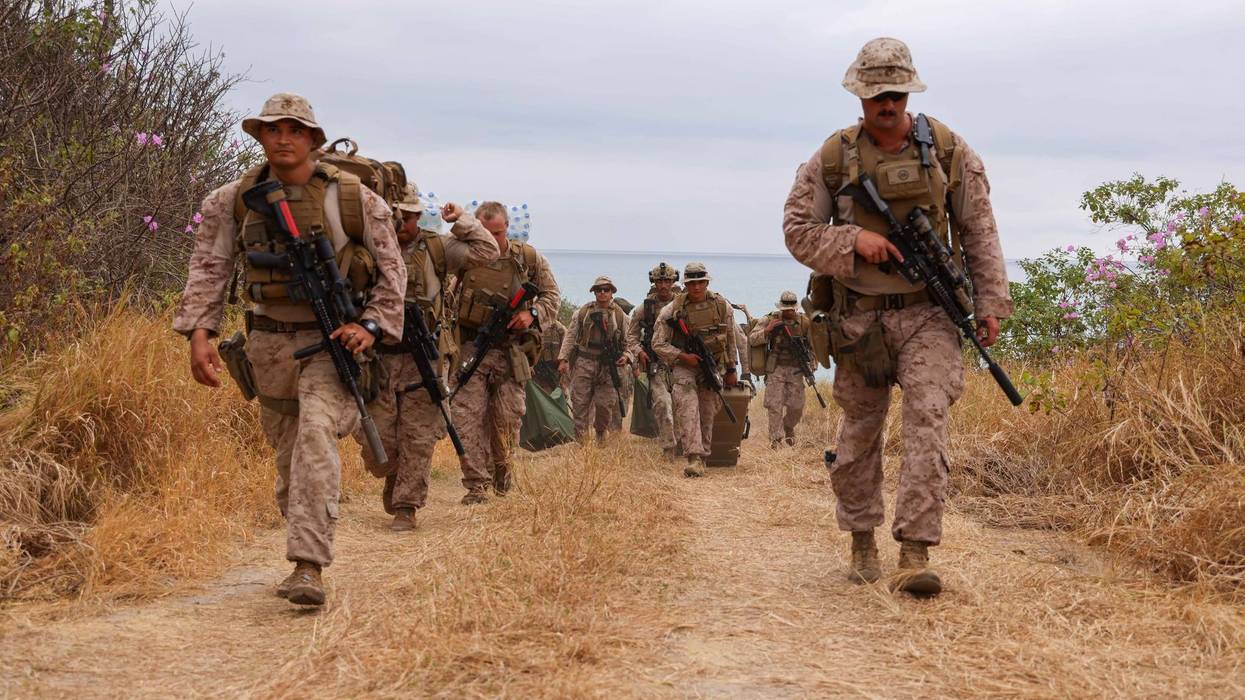
Just over two months after US forces bombed and invaded Venezuela and abducted its alleged drug-trafficking president, the Pentagon on Tuesday announced the launch of a joint campaign with Ecuador to combat "narco-terrorists" in the South American nation.
US Southern Command (SOUTHCOM) announced the operation, which, with the deployment of ground troops, opens a new front in the Trump administration's Operation Southern Spear targeting alleged drug traffickers. The campaign had previously consisted of dozens of airstrikes against boats that the US military claimed were transporting drugs in the Caribbean Sea and Pacific Ocean. More than 150 people have been killed in such bombings.
Right-wing Ecuadorian President Daniel Noboa—a close ally of US President Donald Trump whose family shipping business is allegedly linked to cocaine trafficking—hailed the joint operation as "a new phase against narco-terrorism."
However, many Ecuadorian leftists denounced the operation.
"How can our armed forces allow so much?" asked former President Rafael Correa, who expelled the US military from Ecuador and famously said that he would let the US renew a lease on a controversial air base in Manta only if "they let us put a base in Miami."
Last year, Ecuadorian voters rejected a proposal by Noboa to reopen US military bases in the country that were shuttered by Correa's refusal to renew their leases.
Former National Assembly president and Imbabura Province Gov. Gabriela Rivadeneira noted in a television interview that Ecuador has "the only constitution in the world that prohibits foreign military presence" within its borders.
“As the US militarization advances, organized crime and drug trafficking advance further; this country was safer without foreign bases," she contended.
The announcement of the joint campaign also prompted criticism around the world.
"As Trump deploys US troops in Ecuador, there's a real danger that he'll authorize them to summarily shoot rather than capture drug suspects as legally required," former Human Rights Watch executive director Kenneth Roth said on social media. "In short, to commit more criminal murders."
US climate campaigner Elise Joshi said on X that "Ecuador's corrupt billionaire president Noboa just gave Trump permission to carry out a military operation in the country as he guts public services, Indigenous rights, and free speech."
"Noboa sold out Ecuador to Trump's war against the [Latin American] people," Joshi added. "Shameful."
My sense is that some in the administration have been itching to put US military boots on the ground somewhere for an operation against “narco-terrorists” and then publicly brag about it and Ecuador was more amenable than say Mexico.
— Brian Finucane (@bcfinucane.bsky.social) March 3, 2026 at 7:11 PM
Others questioned the US explanation for the intervention.
"Why is Trump attacking Ecuador?" the leftist magazine In These Times wrote on its X page. "Same reason he’s in Iran + Venezuela: oil 'secured' by force, sold as fighting a 'dictatorship' and/or 'drugs.' Ecuador’s Indigenous organizers forced a pullback in drilling in 2019. Now they face the US military."
Once one of Latin America's most peaceful countries, Ecuador in recent years has become what many observers call a "cocaine superhighway" via which the majority of drugs produced in neighboring Colombia and Peru are shipped to the United States and other international markets. The booming drug trade has sparked a fierce turf war between traffickers that has plunged areas of Ecuador, especially in the coastal province of Guayas, into violence and terror.
The Trump and Noboa administrations have forged closer ties since the US leader's return to office last year, much to the chagrin of many Ecuadorian leftists—who point to the long history of US military invasions and other interventions throughout Latin America, including a CIA-backed coup in Ecuador in 1963.
The Ecuador operation comes amid the US-Israeli war on Iran, which has killed more than 1,000 people, according to the Iranian Red Crescent Society. Iran is the 10th country bombed on orders from US President Donald Trump, the self-proclaimed "president of peace," who has also attacked Afghanistan, Iran, Iraq, Libya, Nigeria, Pakistan, Somalia, Syria, and Yemen.
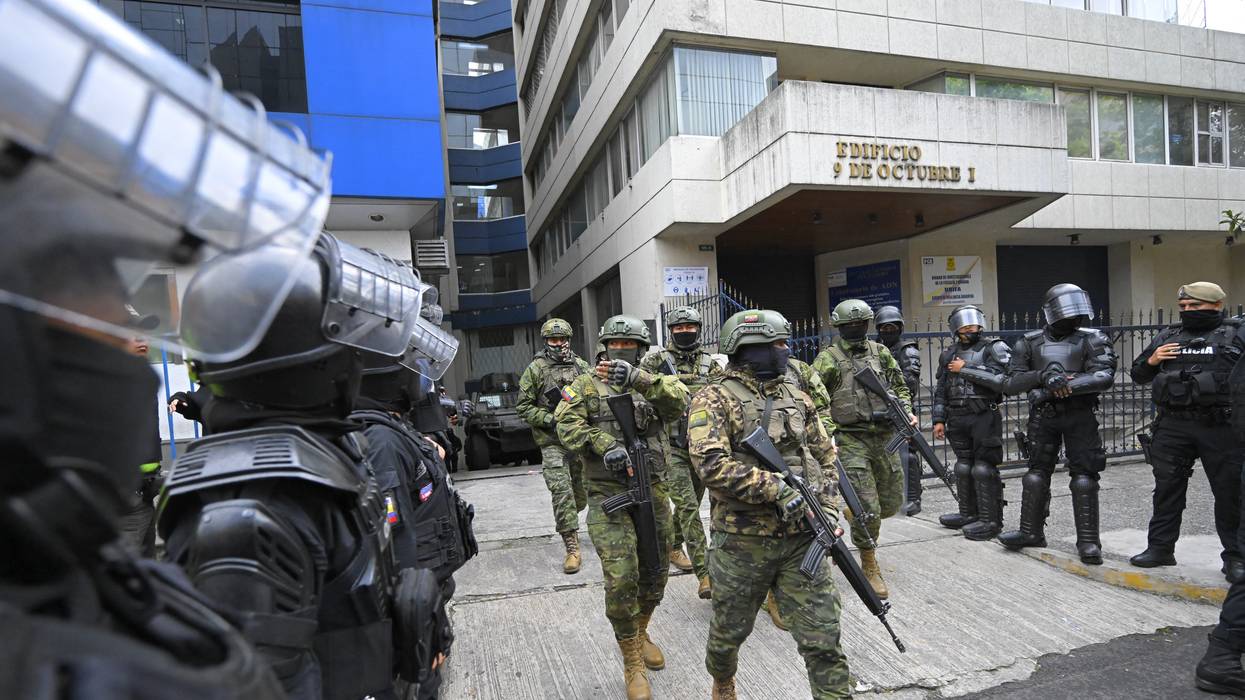
Ecuador's raid of the Mexican embassy in Quito "threatens the security of embassies and diplomats throughout the world," said one expert.
The Biden administration on Sunday faced calls to demand the immediate release of Ecuador's former vice president after Ecuadorian police stormed Mexico's embassy in Quito and forcibly seized the ex-official, a flagrant breach of the 1961 Vienna Convention.
"Ecuador's government has committed a very serious crime, one that threatens the security of embassies and diplomats throughout the world—not least those of the United States, which has threats to its embassies in much of the world," said Mark Weisbrot, co-director of the Center for Economic and Policy Research (CEPR). "The international community cannot allow this to happen."
The move sparked a diplomatic crisis and global outcry, with Latin American leaders slamming the right-wing Ecuadorian government for its "unacceptable infringement" on Mexico's sovereignty and "kidnapping" of Jorge Glas, who served as vice president under Ecuador's leftist former president Rafael Correa. Glas has reportedly been transferred to a maximum-security prison.
Correa supported lawmaker Luisa González in Ecuador's 2023 presidential contest, which she lost to President Daniel Noboa, the son of the richest man in Ecuador.
"The United States is providing crucial diplomatic, military, and material support to Ecuador."
The illegal raid of Mexico's embassy late Friday came hours after the Mexican government granted political asylum to Glas, who has been living in the embassy since December, when he announced he would appeal a judge's decision ordering him back to jail. Glas has been convicted of corruption and imprisoned repeatedly in recent years; the former vice president has said the charges are politically motivated.
CEPR noted Sunday that Ecuadorian Attorney General Diana Salazar "has long engaged in a campaign of lawfare and political persecution against former president Rafael Correa and other figures from the former Correa government."
"The charges against Correa have been shown to have so little credibility, and the evidence is so lacking, that Interpol for years has refused to act on Ecuador's red notice against him," the group said. "Belgium has granted him political asylum, and he can travel freely to almost anywhere in the world without fear of extradition. And last year, a Brazilian Supreme Court judge annulled evidence against Glas after authorities admitted it may have been tampered with."
Weisbrot stressed in his statement that "the United States is providing crucial diplomatic, military, and material support to Ecuador."
"Canada is currently seeking a 'free trade' agreement with Ecuador," Weisbrot added. "All of this should be suspended until Ecuador releases its former vice president, who it has kidnapped from Mexico's embassy."
As the Financial Times reported Sunday, Ecuador's right-wing president "is enjoying soaring popularity among Ecuadoreans and strong support from Washington after declaring an all-out war on drug trafficking." In February, the Biden administration declared its "unwavering support" for Ecuador's government and announced "$2.4 million in additional vehicles and security equipment to support the work of police."
FT noted that Noboa, the scion of a banana empire, has invoked "emergency powers to put troops on the streets and sent the army to take control of gang-ridden jails, using tactics partly borrowed from El Salvador's strongman leader Nayib Bukele."
While Noboa's "aggressive response initially reduced violence and brought a precarious sense of safety to places like Guayaquil," The New York Times observed, the "stability did not last."
"Over the Easter holiday, there were 137 murders in Ecuador, and kidnappings and extortion have worsened," the Times reported.
Thus far, the Biden administration's response to Ecuador's raid on Mexico's embassy has been tepid. In a social media post late Saturday, U.S. State Department spokesperson Matthew Miller wrote that the administration "condemns any violation of the Vienna Convention on Diplomatic Relations, which says that "agents of the receiving state may not enter" embassies "except with the consent of the head of mission."
"We encourage our partners Mexico and Ecuador to resolve their differences in accord with international norms," Miller added.
Ecuadorian police assaulted Roberto Canseco, Mexico's acting ambassador, during Friday's raid.
"This is totally unacceptable," the career diplomat told reporters. "They have hit me, they have pushed me to the ground. I physically tried to prevent them from entering. They searched the Mexican embassy in Quito like criminals."
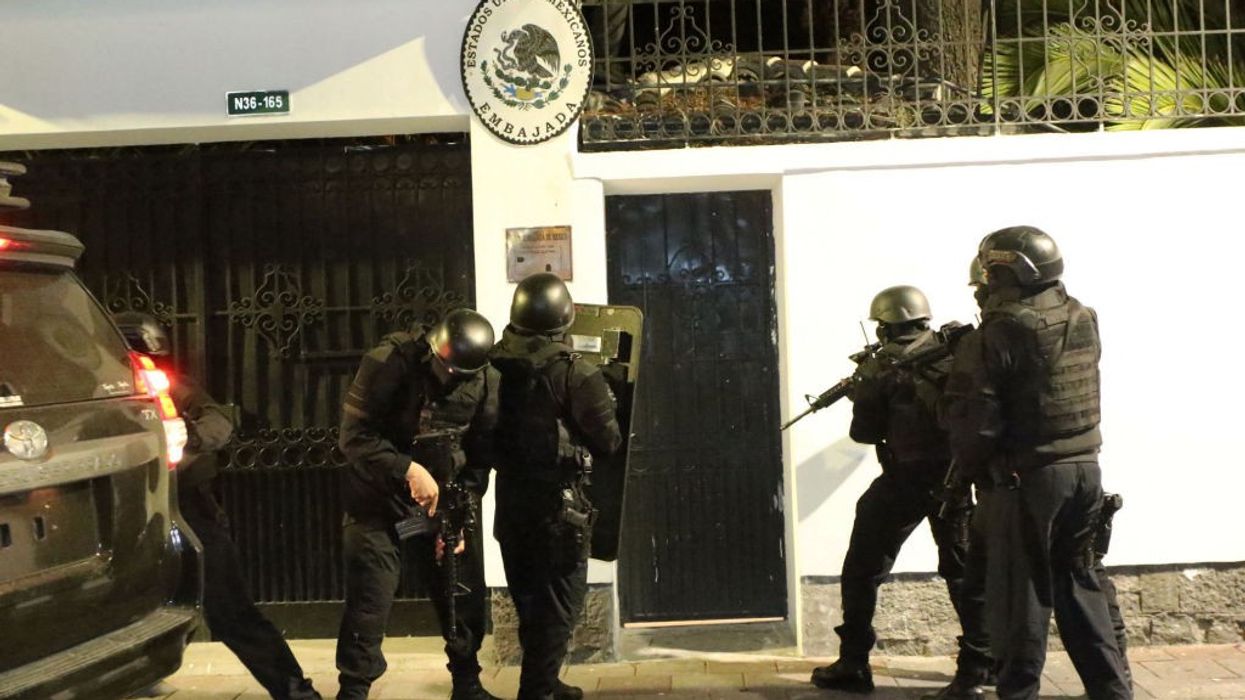
"This is a flagrant violation of international law and the sovereignty of Mexico," said Mexican President Andrés Manuel López Obrador.
Mexico on Friday night announced the suspension of diplomatic relations with Ecuador after police stormed the Mexican Embassy in Quito and kidnapped former Ecuadorian Vice President Jorge Glas, who was granted asylum after being convicted of what he claims are politically motivated corruption charges.
"Alicia Bárcena, our secretary of foreign affairs, has just informed me that police from Ecuador forcibly entered our embassy and detained the former vice president of that country who was a refugee and processing asylum due to the persecution and harassment he faces," Mexican President Andrés Manuel López Obrador said on social media following the raid.
"This is a flagrant violation of international law and the sovereignty of Mexico, which is why I have instructed our chancellor to issue a statement regarding this authoritarian act, proceed legally, and immediately declare the suspension of diplomatic relations with the government of Ecuador," he added.
Bárcena said that "given the flagrant violation of the Vienna Convention on Diplomatic Relations and the injuries suffered by Mexican diplomatic personnel in Ecuador, Mexico announces the immediate breaking of diplomatic relations with Ecuador."
Mexican officials said multiple embassy staff members were injured during the raid. They also said that all Mexican diplomatic staff will immediately leave Ecuador, and that Mexico would appeal to the International Court of Justice to hold Ecuador accountable.
Roberto Canseco, head of chancellery and policy affairs at the embassy, told reporters that "what you have just seen is an outrage against international law and the inviolability of the Mexican Embassy in Ecuador."
"It is barbarism," he added. "It is impossible for them to violate the diplomatic premises as they have done."
Ecuador's government said that Glas—who served as vice president under former leftist President Rafael Correa from 2013-17—was a fugitive who has been "sentenced to imprisonment by the Ecuadorian justice system" and had been granted asylum "contrary to the conventional legal framework."
However, Ecuadorian attorney and political commentator Adrián Pérez Salazar told Al Jazeera that "the fact that there was this grievance does not—at least under international law—justify the forceful breach of an embassy."
"International law is very clear that embassies are not to be touched, and regardless of whatever justifications the Ecuadorian government might have, it is a case where the end does not justify the means," Salazar added.
Numerous Latin American nations including Argentina, Brazil, Chile, Colombia, Cuba, Honduras, Panama, Uruguay, and Venezuela condemned the Ecuadorian raid.
"The action constitutes a clear violation of the American Convention on Diplomatic Asylum and the Vienna Convention on Diplomatic Relations, which, in Article 22, provides that the locations of a diplomatic mission are inviolable and can be accessed by agents of the receiving state only with the consent of the head of mission," the Brazilian Foreign Ministry said in a statement. "The measure carried out by the Ecuadorian government constitutes a serious precedent, and must be subject to strong repudiation, whatever the justification for its implementation."
Honduran President Xiomara Castro de Zelaya—who called the raid "an intolerable act for the international community"—said Saturday that she would convene a special emergency session of the Community of Latin American and Caribbean States on Monday. Castro currently serves as CELAC's president pro tempore.
The Organization of American States General Secretariat issued a statement Saturday rejecting "any action that violates or puts at risk the inviolability of the premises of diplomatic missions and reiterates the obligation that all states have not to invoke norms of domestic law to justify non-compliance with their international obligations."
"In this context, it expresses solidarity with those who were victims of the inappropriate actions that affected the Mexican Embassy in Ecuador," the body added.
It's been a bad week for the inviolability of sovereign diplomatic spaces. Iran and Syria on Monday accused Israel of bombing the Iranian Consulate in Damascus, an attack that killed 16 people including senior Islamic Revolutionary Guard Corps commanders as well as Iranian and Syrian diplomats and other civilians.

The destruction of the rule of law in Ecuador has destroyed much of the foundations of democracy, including in the areas of basic human rights and free elections.
Imagine a developing country where a 43-year-old economist with a PhD from the University of Illinois, who is relatively unknown as a politician, runs for president and wins. Despite the preceding decades of corruption and institutional rot, he puts together a competent government and gets the economic policy right. The numbers tell much of the story: in the 10 years of his presidency, poverty fell by 41 percent; income per person grew at more than twice the rate of the previous 25 years; and public investment and government expenditure on health services doubled as a share of the economy.
These and other gains (e.g., in education) were accompanied by unprecedented levels of political stability, and Ecuador was one of the safest countries in South America.
Welcome to Ecuador in the twenty-first century. That was part one of the story that began when Rafael Correa took office in 2007. But then he left office in 2017, and things went to hell in a hurry, over the past six years. The first president of this period was Lenín Moreno, who came from Correa’s party but within months turned against it. He purged the party of people who were loyal to its original progressive mission, leaving the country’s largest political movement without a political party. He then purged the judiciary, and used it to persecute his opponents. This included Correa himself — who faces an eight-year prison sentence if he comes home. Correa’s charges and trial were a farce, with the court finding that he used “psychic influence” over others to commit crimes. Because it was so obviously a case of political persecution, he was given political asylum in Belgium, and can travel freely to almost anywhere besides Ecuador without fear of extradition.
Guillermo Lasso, the current president and one of Ecuador’s richest people, was elected in 2021. In May, he dissolved the National Assembly and called for new elections. He was facing impeachment and very likely removal from office, over serious allegations of corruption.
The results of this six-year destruction of the rule of law, and policy reversals, were not pretty. Poverty reached its highest level in a decade, just before the pandemic. The most recent data show a poverty rate 17 percent higher than six years ago. Ecuador’s recovery from the pandemic is at the bottom for South America, in terms of real per capita income today. And the country also had one of the worst per capita death rates in the world from the COVID pandemic.
More frightening right now is the spiraling violence. Under Correa, Ecuador’s homicide rate had declined from 18 per 100,000 to just 5.8 (2016) — one of the lowest in Latin America — but has since exploded to a projected 40 for 2023, one of the highest in the hemisphere. And this includes unprecedented political violence, including the August 9 assassination of a presidential candidate, Fernando Villavicencio, who had challenged organized crime.
This recent history is of particular importance right now. Ecuador has a presidential election in less than a week, and the candidates represent opposing sides of the policy choices, goals, values, and interests that brought about the sharply contrasting results of the two preceding episodes.
On one side, from the same wealth strata as Lasso — net worth in the hundreds of millions at least — is Daniel Noboa. He is the son of the banana tycoon Alvaro Noboa, Ecuador’s richest person. Daniel Noboa was elected to the national Assembly in 2021, and is widely seen as representing the status quo. This includes his connections to both Lasso and to organized crime — for example through Lasso’s agriculture minister, Bernardo Manzano, a former senior manager in the Noboa Group, who resigned as minister in a corruption scandal in February.
On the other side is Luisa Gonzalez, previously a minister in the Correa government and a former representative in the National Assembly. She pledges to reverse the damage of the past six years by stepping up the fight against crime and corruption, as well as by increasing public investment in infrastructure, health, and education. Most of her program is based on a continuation of what she sees as the successful policies of the Correa government, with additional efforts, e.g., in public safety, to fix some of the big things that have since been broken.
The choice would seem self-evident. But, as we who live in the United States have learned — especially since 2016 — a lot can depend on the information that large parts of the electorate consume. Most Ecuadorans have probably not heard the most important facts described here. The latest polls show Sunday’s election as too close to call.
The destruction of the rule of law in Ecuador has destroyed much of the foundations of democracy, including in the areas of basic human rights and free elections. Journalists are afraid to write about the richest and most powerful politicians and presidents’ mafia connections; they face death threats if they do. So, too, can key witnesses in major criminal cases, as witnessed last week: seven men arrested in the assassination of Villavicencio were murdered while in jail. They won’t be telling any stories about who recruited or paid them.
The experience of other countries has shown that the kind of governance that has been developing in Ecuador over the past six years — an amalgamation of oligarchs, organized crime and violence, corruption and lack of accountability — can be extremely difficult to reform when it becomes entrenched. Sunday’s election could have a profound and possibly lasting impact on the country’s future.
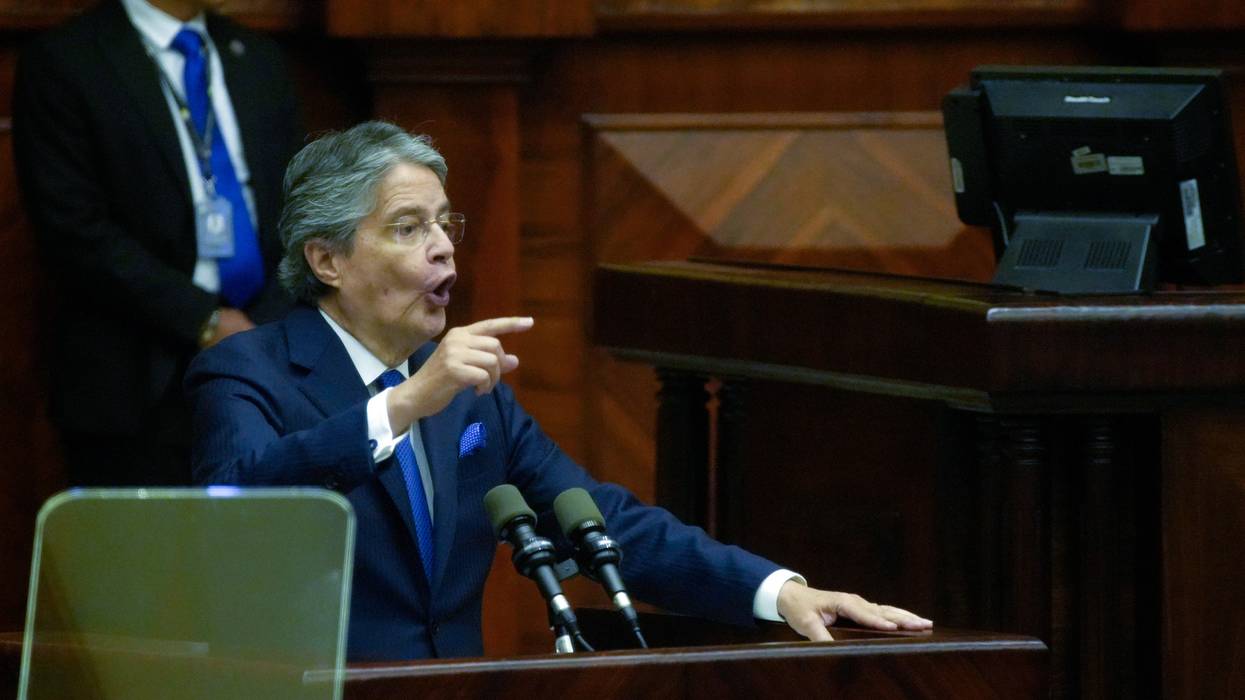
The head of the Andean nation's largest Indigenous rights group accused President Guillermo Lasso of launching a "cowardly self-coup" and pushing the country toward an "imminent dictatorship."
Days before Ecuadorian lawmakers were expected to vote on removing him from office, Guillermo Lasso, Ecuador's deeply unpopular right-wing president, dissolved the country's National Assembly, a move progressive critics called a bid to avoid impeachment.
For the first time ever, Lasso invoked Article 148 of the Ecuadorian Constitution, which gives presidents the power to dissolve the legislature under certain circumstances, including legislative overreach and a "severe political crisis and domestic unrest."
The move, popularly known as "muerte cruzada"—"the death cross"—will allow Lasso to rule by decree for six months. It came a day after the president defended himself before lawmakers during an impeachment trial for allegedly turning a blind eye toward embezzlement.
"Not having the necessary votes to save himself from his imminent dismissal, Lasso launched a cowardly self-coup with the help of the police and the armed forces, without citizen support, becoming an imminent dictatorship," Leonidas Iza, head of the Confederation of Indigenous Nationalities of Ecuador (CONAIE), the country's largest Indigenous rights group, said in denouncing the move.
As Will Freeman, Latin America specialist at the Council on Foreign Relations, explained last week:
The impeachment process originated in a scandal that erupted in January 2023. That month, Ecuadorian journalists denounced members of Lasso's inner circle for allegedly mismanaging public companies and maintaining ties to Albanian mafia groups that have come to dominate Ecuador's lucrative cocaine trafficking routes. The journalists say their information came from a police investigation, although Ecuador's attorney general has claimed the source material was doctored.
After the journalists published leaked audio clips corroborating aspects of their story, one top government appointee, Hernan Luque, became a fugitive from justice. Another businessman allegedly connected to the ring, Rubén Cherres, was found murdered. In March, a majority of Ecuador's National Assembly asked to start impeachment proceedings. Ecuador's Constitutional Court partially granted the request, allowing a vote on the corruption allegations to move forward.
Ousting Lasso from office would require the votes of 92 of the National Assembly's 137 members. The motion to proceed with the impeachment process received 88 votes.
Lasso denies both the corruption allegations and accusations that he dismissed lawmakers in order to derail the impeachment.
"Ecuador needs a new political and social pact that will allow it to get out of the political crisis in which it finds itself," Lasso said during a mandatory nationwide television and radio address, according to teleSUR. "We must move towards a solution that offers hope to families and puts an end to a useless and irrational confrontation."
Article 148 stipulates that the National Electoral Council (CNE) must call presidential and legislative elections within seven days of lawmakers' dismissal, although the electoral process is allowed to take up to six months.
The CNE came under fire during the 2021 presidential election—in which Lasso, a former banker, defeated progressive economist Andrés Arauz—for trying to prevent Arauz from running by, among other things, banning his political party and then outlawing another party he tried to form.
Arauz wanted to have progressive former Ecuadorian President Rafael Correa as his running mate, but the CNE banned him from the ticket. Electoral officials also blocked the Arauz campaign from using Correa's voice or image—but allowed Arauz's opponents to depict the former president in a negative manner.
Correa—who argued that what Lasso is doing is "illegal"—looms large during the current crisis. Although the former president fled Ecuador rather than face trial for what he claims are baseless corruption charges, he still controls the largest bloc of National Assembly lawmakers.
Lasso wasted no time in exercising his new powers.
"Starting today, the national government will issue decrees that will comply with the mandate that you gave me," he said during his address to the public. "I have signed a first decree to reduce taxes on families. It will be sent to the Constitutional Court for its review."
The president promised that "public services will operate normally," and that "the armed forces and the police continue to guarantee security."
As Lasso spoke, state security forces surrounded the National Assembly building to block anyone from entering or leaving the legislature, teleSUR reported.
Nelson Proaño, head of the Ecuadorian military's Joint Command, delivered a brief Wednesday morning address to the nation in which he endorsed Lasso's invocation of Article 148.
"Therefore, it is subject to a constitutional norm and must be fully and completely respected by all citizens," Proaño asserted. "I wish to remind Ecuadorians that the armed forces and the National Police are obedient and nondeliberative institutions and we fulfill our mission strictly abiding by the Constitution."
Freeman wrote last week that "Ecuador is likely headed for a period of increased instability."
"Given the acute challenges Ecuador is already facing—from surging crime to mass migration to a weak economy—that is something ordinary Ecuadorians can hardly afford," he added.
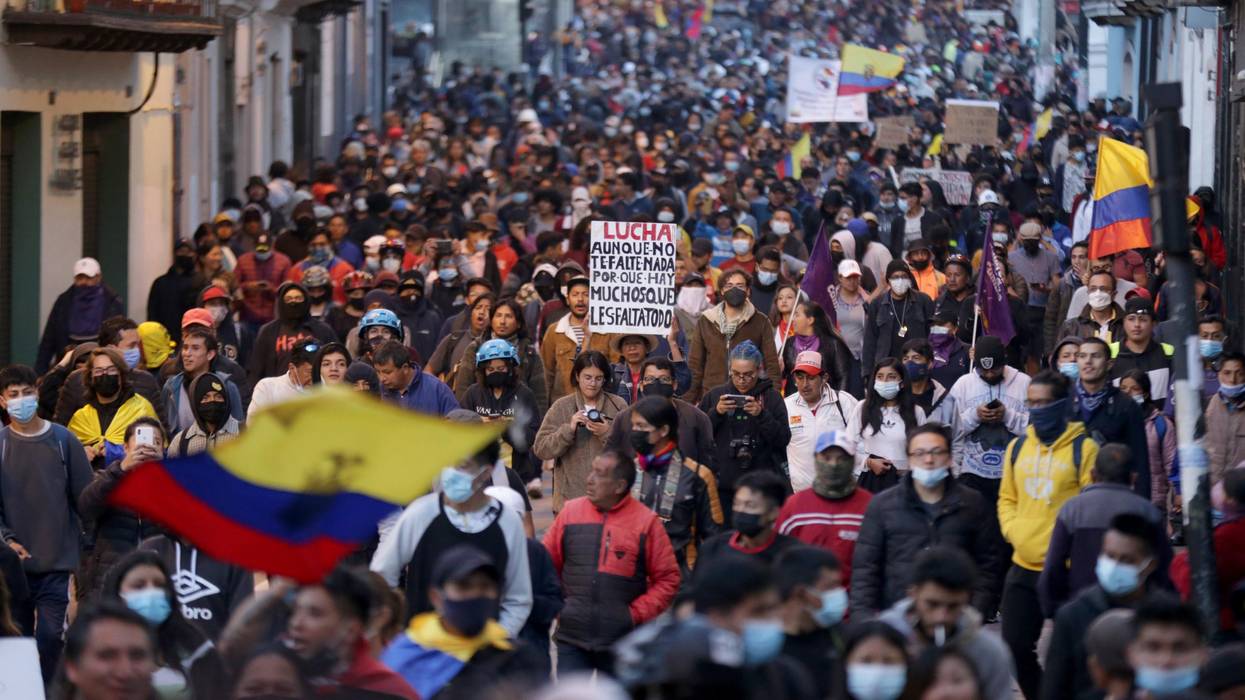
On Monday, protests erupted throughout Ecuador. The demonstrations, coordinated by the CONAIE, or Conderation of Indigenous Nationalities of Ecuador, accompanied by student groups and labor unions, resisted a planned hike in fuel prices.
Without mounting public national, regional, and international pressure, the Lasso government will not be pushed to make any concessions to the Ecuadorian people.
The CONAIE is represented by the environmentalist indigenous Pachakutik Party in the National Assembly in Quito, the second-most powerful party on the left.
The group also put forward 10 demands to the center-right government of President Guillermo Lasso. The demands include a halt to the expansion of oil and mining exploration, as well as a freeze on the price of petroleum and agricultural products.
Protests were first concentrated in the historical downtown of Quito, disrupting businesses, infrastructure, and tourism. I was personally in the area when the protests occurred, forcing me to escape the police's use of tear gas to disperse the crowd.
In the coastal countryside and in the Amazon, protesters have also targeted oil and mining towns, as well as agricultural centers, allegedly leading to the deaths of two mine workers and one protester in the southern highlands.
Some cities have been paralyzed, as protesters have blocked major highways. The Lasso government has implemented swift measures, instructing the use of tear gas against protesters, while also conducting a series of broad arrests and targeted raids.
The leader of the CONAIE Leonidas Iza was arrested and put on trial for sabotage, though he was promptly released as a result of public pressure. Local independent journalists have also been arrested and targeted by the police and military.
These clashes are not new. They have come periodically since 1997 and have been most potent against conservative or neoliberal governments proposing price and tax increases to reduce Ecuador's national debt.
Between 1997 and 2005, the protests deposed three Presidents in Ecuador, showcasing the strength of left-wing activism in Ecuador.
The protests in the late 1990s and early 2000s also helped usher in three consecutive mandates by President Rafael Correa, who championed policies of the populist left and was part of the Pink Tide movement in South America.
Correa's predecessors in the Pink Tide included Lula in Brazil, Evo Morales in Bolivia, Ollanta Humala in Peru, Hugo Chavez in Venezuela, Michelle Bachelet in Chile, and the Kirschners in Argentina.
Correa's tenure was characterized by an expansion of public education, transportation, healthcare, and a vast redistribution of wealth between the rich and poor strata of Ecuador.
Even after 10 years, Correa maintains a high approval rating, oscillating between 55 and 65 percent according to independent polling in Ecuador.
During Correa's tenure, the CONAIE and other indigenous, student, and labor groups played a large role in Ecuadorian politics, being assigned key ministerial positions and holding the balance of power in Congress.
Yet, in 2017, as Correa decided not to run again--citing family reasons--Ecuadorian politics took a hard turn to the right. At the ballot box, Ecuadorians chose to elect Lenin Moreno, who, despite running with Correa's party, governed as a center-right President.
Then-President Moreno focused his tenure on reducing the debt and the deficit, expanding small business, and welcoming international investment and tourism. These priorities came to the detriment of the quality of public services, which sharply decreased as a result of austerity measures.
Such austerity measures, including price hikes for fuel and other essential goods and services, led to mass protests in 2019, where left-wing activists once again took to the streets hoping to reverse the measures and depose Moreno.
The protests were highly violent, leading to the deaths of between 8 and 23 protesters at the hands of state security forces.
Moreno, due to public pressure, canceled the planned price hikes and decided not to run for reelection in 2021. Since then, Moreno's successor, Guillermo Lasso, has continued many of the austerity measures put in place by his successor. A price increase on fuel has once again been put forward, leading to the ongoing protests.
One may question why the two center-right presidents were elected given the popularity of former left-wing President Correa and the tremendous backlash to austerity measures, but the Ecuadorian left is highly divided.
While the center and the right, including Ecuador's financial, political, and media elites, were largely united behind former President Moreno and current President Lasso, the left is split up between a variety of political parties and interest groups, all of which have different policy preferences and priorities.
Like in 2019, these protests will be a test of the determination of the current government for austerity measures and neoliberal policies.
The Lasso government's aggressive response, claiming that they will "not allow the country to be paralyzed," and alluding to the possible use of violence if necessary, may end up uniting the left further and pushing it towards more violent resistance. Unfortunately, the lack of international attention to the protest and Ecuador's contentious political past, present, and future may give the Lasso more leeway in its response.
The protesters should focus their attention on gaining international coverage and recognition, in the hopes of containing the Lasso government's response. Then, a high death toll may be avoided, constitutional and human rights be respected, and the groups' demands be listened to.
Without mounting public national, regional, and international pressure, the Lasso government will not be pushed to make any concessions to the Ecuadorian people.

A judge on Spain's highest court has summoned former U.S. Secretary of State and Central Intelligence Agency Director Mike Pompeo to testify about an alleged Trump administration plot to kill or kidnap jailed WikiLeaks founder Julian Assange, according to a report published on Friday.
Spain's ABC reports National High Court Judge Santiago Pedraz issued the summons, which compels Pompeo to testify as part of an investigation of alleged illicit spying on Assange by Spanish security firm U.C. Global while the Australian was exiled in the Ecuadorean Embassy in London.
Pompeo and former U.S. National Counterintelligence and Security Center Director William Evanina are also being called to testify about an alleged plot revealed last year by Yahoo! News to abduct or possibly murder Assange to avenge WikiLeaks' publication of the "Vault 7" documents exposing CIA electronic warfare and surveillance activities.
According to Yahoo! News' Zach Dorfman, Sean D. Naylor, and Michael Isikoff, discussions over kidnapping or killing Assange occurred "at the highest levels" of the Trump administration, with senior officials requesting "sketches" or
"options" for assassinating him.
"They were seeing blood," one former Trump national security official told the reporters. "There seemed to be no barriers," said another.
U.C. Global whistleblowers allege company founder David Morales worked with the CIA to surveil Assange and Ecuadorean diplomats who worked at the London embassy. Former Ecuadorean President Rafael Correa had angered the Obama and Trump administrations by granting Assange asylum as he resisted going to Sweden to face sex crime allegations over fears he would be extradited to the United States.
Assange is charged in the U.S. with violating the 1917 Espionage Act and the Computer Fraud and Abuse Act for conspiring with whistleblower Chelsea Manning to publish classified documents--which revealed U.S. and allied war crimes and other misdeeds in Afghanistan, Iraq, and around the world--on WikiLeaks over a decade ago.
According to the United Nations Working Group on Arbitrary Detention, Assange has been arbitrarily deprived of his freedom since he was first arrested in London on December 7, 2010. Since then, he has been held under house arrest, confined for seven years in the Ecuadorean Embassy, and jailed in London's Belmarsh Prison, where he currently awaits his fate after a judge recently approved a U.S. extradition request.
Related Content

A decision by U.K. Home Secretary Priti Patel on whether to extradite Assange to the U.S. is reportedly imminent. Press freedom, anti-war, and other advocacy groups have urged Patel to reject the U.S. government's request.
"Assange would be unable to adequately defend himself in the U.S. courts, as the Espionage Act lacks a public interest defense," 20 groups wrote in an April joint letter to Patel. "His prosecution would set a dangerous precedent that could be applied to any media outlet that published stories based on leaked information, or indeed any journalist, publisher, or source anywhere in the world."
Pompeo, who is also wanted in Iran for his role in the January 2020 extralegal assassination of Iranian Gen. Qasem Soleimani in Iraq, is widely considered to be a possible 2024 Republican presidential candidate.

A group of prominent global progressives on Wednesday announced a return of the Belmarsh Tribunal, where participants will put the United States government on informal trial for war crimes and demand freedom for jailed WikiLeaks founder Julian Assange.
"At the Belmarsh Tribunal, we will turn the world the right way up, placing crimes of war, torture, kidnapping, and a litany of other gross human rights abuses on trial."
On October 22, Progressive International's Belmarsh Tribunal, named after the notorious London prison where Assange is imprisoned as he faces possible extradition to the United States, "will try the U.S. government for its crimes of the 21st century--from atrocities in Iraq to torture at Guantanamo Bay to a surveillance program."
"We are convening parliamentarians, journalists, lawyers, and investigators to fight for truth and justice against Assange's extradition to the United States," said Progressive International, which held a similar tribunal last year. "In doing so, the Belmarsh Tribunal turns the tables in the extradition hearing against Julian Assange... a case that will shape the future of journalism for decades to come."
Britain's High Court has been considering the Biden administration's appeal in the extradition case against Assange, with a full appellate hearing scheduled for October 27 and 28.
"WikiLeaks exposed the reality of the War on Terror," said Progressive International. "It revealed war crimes in Iraq and Afghanistan, over 300 incidents of torture, and secret killings by the United States armed forces. For exposing the criminality of the War on Terror, the U.S. and its allies have persecuted, imprisoned, and plotted to assassinate Julian Assange."
Last month, Common Dreams reported that in 2017 the Central Intelligence Agency, under then-Director Mike Pompeo, plotted to kidnap--and possibly murder--Assange to avenge WikiLeaks' publication of the "Vault 7" documents exposing CIA cyber warfare and surveillance activities.
The Belmarsh Tribunal is inspired by the Russell Tribunal, a 1966 event organized by philosophers Bertrand Russell and Jean-Paul Sartre to hold the U.S. accountable for its escalating war crimes in Vietnam.
British historian and activist Tariq Ali, one of the original Belmarsh Tribunal members, will participate in this year's event.
Some of the members of the 2021 Belmarsh Tribunal include German Left Party lawmaker Heike Hansel; Solidarity Party of Afghanistan spokesperson Selay Ghaffar; Greek lawmaker Yanis Varoufakis; former Ecuadorean President Rafael Correa; Italian investigative journalist Stefania Maurizi; ACLU attorney Ben Wizner; and British Labour parliamentarians Apsana Begum, Richard Burgon, Jeremy Corbyn, and John McDonnell.
"At the Belmarsh Tribunal, we will turn the world the right way up," Corbyn tweeted Wednesday, "placing crimes of war, torture, kidnapping, and a litany of other gross human rights abuses on trial."
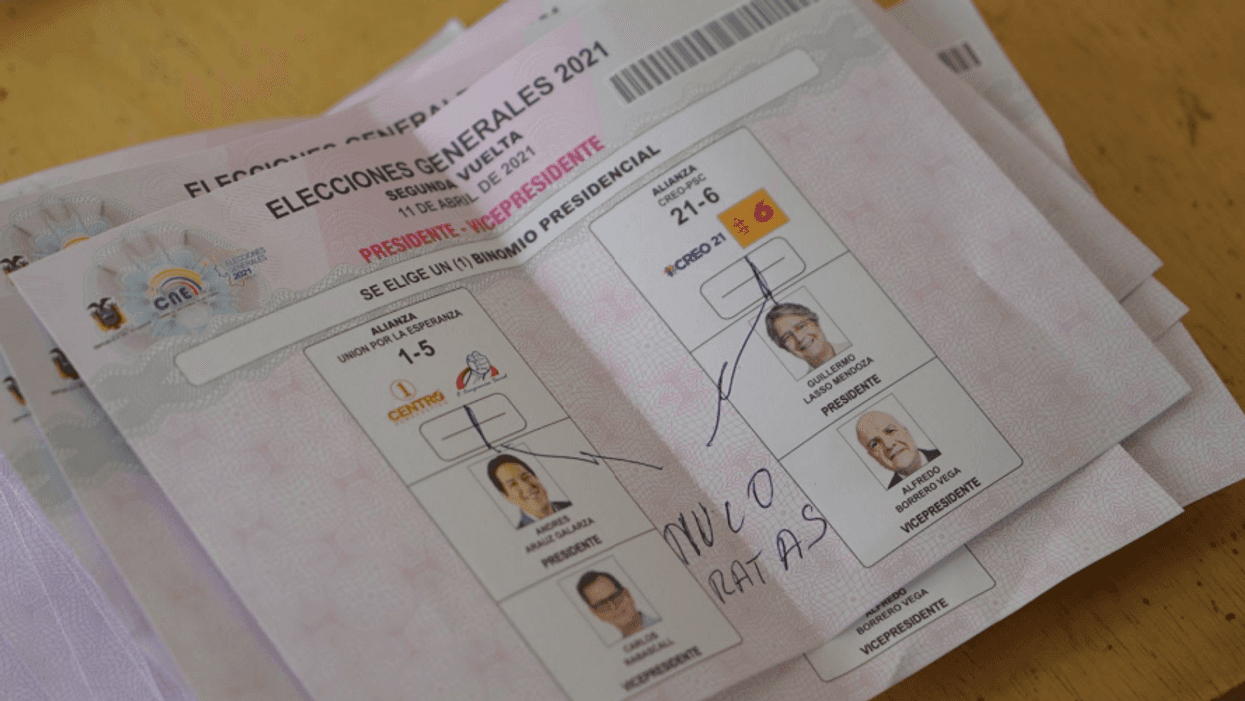
Ecuador's April 11 election that led to a 5-point victory by right-wing banker Guillermo Lasso over progressive candidate Andres Arauz was not what it appeared to be. On the surface, it was a surprisingly clean and professional election, as our CODEPINK official observer delegation witnessed. But a fraud-free process for casting and counting ballots does not mean that the election was free and fair. Behind the scenes was a monumentally unequal playing field and dirty campaign designed to quash an Arauz win.
For starters, Arauz--a 36-year-old follower of the political leanings of former president Rafael Correa and his Citizens Revolution--barely even got on the ballot. The political party he tried to run under was banned by the National Electoral Council (CNE). He and his supporters formed a new political party and that, too, was banned. Eventually they found a small party that let them borrow their slot, but by then it was late December and the first round of elections was on February 7. The other campaigns had a four or five month head start.
Arauz, who was virtually unknown, wanted to have Rafael Correa as his vice president, but the CNE banned Correa from being on the ticket. Even more astounding, the electoral authorities actually prohibited the Arauz campaign from even using Correa's voice or image. But in a show of blatant bias, they didn't banish Correa's image from being used in a negative way by his opponents.
Another intense obstacle was the role of the media. The corporate media dominate all the airwaves in Ecuador, and they were clearly in the Lasso camp. The media led a dirty campaign spreading fake news about Arauz, Correa and their supporters. They scared people by claiming that Arauz was going to de-dollarize the economy. Ecuador has been using the dollar as its currency since 2000, after a financial crisis saw the collapse of its former currency, the sucre. An economist, Arauz was well aware that dollarization had stabilized Ecuador's economy and he never even suggested going back to the sucre.
A particularly absurd accusation came from Colombia, where the country's right-wing attorney general claimed that the National Liberation Army, an armed insurgent group that has been operating in Colombia for decades, made an $80,000 loan to Arauz's campaign. Based on a doctored video that was proven to be false, this accusation nevertheless continued to circulate throughout the press to sully Arauz's character.
"The media smear campaign went hand-in-hand with attacks on the left that had been going on for the past four years under the presidency of Lenin Moreno."
A concerted smear campaign also attacked the legacy of Rafael Correa to scare people away from voting for Arauz. During his time in power from 2007 to 2017, Correa brought economic and political stability to a country that had had seven presidents in ten years. Correa, who has a Ph.D. in economics, completely transformed Ecuador into a modern democracy with a vibrant middle class. He also brought tremendous gains to the poor, reducing poverty from 37 percent to 22 percent, and built critical infrastructure, including highways, hospitals and schools. But the portrayal in the media made Correa out to be a corrupt authoritarian who was a threat to democracy, creating a dilemma for the Arauz campaign about how much to align itself with Correa's legacy.
The media smear campaign went hand-in-hand with attacks on the left that had been going on for the past four years under the presidency of Lenin Moreno. Ironically, Moreno had been Rafael Correa's vice president and ran on the ticket of Correa's Citizens Revolution. But once in power, he orchestrated a kind of "silent coup," betraying Correa, the Citizens Revolution and the progressive policies they stood for. Making common cause with the elites, including Guillermo Lasso, he imposed austerity policies and signed a terrible deal with the IMF that focused on budget cuts, deregulation and reducing workers' rights. In October 2019, there was an uprising against the elimination of a fuel subsidy that would have raised prices on everything from transportation to food. It was put down violently by Moreno's government and many of the protest leaders remain in prison today.
Lasso supported Moreno's austerity measures, the deal with the IMF and the violent crackdown on protesters, yet his campaign successfully managed to create distance between him and Moreno. The narrative spun in the media was that Arauz would continue in the footsteps of Moreno and Correa, as if Moreno had not betrayed the movement.
Moreno viciously lashed out at the left through the misuse of the legal system for political purposes, a tactic known as "lawfare." Jorge Glas, Moreno's vice president who spoke out against his betrayal of the Citizens Movement, was accused of corruption, convicted and put in jail, where he remains under dire conditions. Moreno's government attacked Correa himself, who went into exile in Belgium to avoid being thrown into prison. There are about 30 charges pending against Correa, including a farcical accusation that he had psychic influence over people that led them to become corrupt.
Other top party leaders were hounded and are now either jailed, under house arrest, or forced into exile. The decapitation of the Citizens Revolution meant that Arauz's campaign was significantly weaker than it would have been with their help.
Given all the strikes against Arauz, it is remarkable he did so well. Had it not been for lawfare, a biased CNE and a dirty campaign, he would have won. However, another major factor was the rift between the Citizens Revolution and the indigenous movement that happened under Correa's tenure, which led to calls for a "null vote."
The Confederation of Indigenous Nationalities of Ecuador (CONAIE) and its political party Pachikutik were represented in the first round of voting by Yaku Perez, who did well but didn't make the final cut. Feeling that neither of the two presidential candidates represented the indigenous community, Perez called for people to spoil their ballot by "voting null" (voting is mandatory in Ecuador so a spoiled ballot is the equivalent of boycotting the election).
There was some dissent from the "vote null" position--just days before the election, CONAIE President Jorge Vargas came out in favor of Arauz--but a significant percentage of indigenous peoples voted blank. Roughly 1.7 million Ecuadorians decided to either vote blank or to spoil their ballot. That was a critical factor in the election, given that Lasso won by only about 420,000 votes. Accused of enabling a right-wing victory, some members of Pachakutik argued that they voted null because they believe they can bring down the Lasso government through popular uprisings similar to what occurred in October 2019.
A victory by Arauz would have helped people struggling during this pandemic--Moreno so mismanaged the health situation that Ecuador has one of the world's worst COVID death rates and the economy has been devastated.
Arauz would have also strengthened the left throughout Latin America, promoting the kind of regional integration that took place during the so-called Pink Tide in the early 2000s when a succession of progressive governments took power in Latin America and the Caribbean. New institutions were created such as UNASUR, the Union of South American Nations, and CELAC, the Community of Latin American and Caribbean States. These became a counterbalance to the Organization of American States, which is used as a tool of the U.S. State Department to promote U.S. foreign policy throughout the region. These new regional organizations were part of a much broader vision of regional integration along the lines of the European Union.
If those organizations were as strong now as they had been several years ago, it's likely that Latin America would have been in a better position to deal with the pandemic because they could have bought vaccines together and cooperated on public health policies.
In the coming years, Ecuador's Citizens Revolution will have to use this time to regroup, repair frayed relations with indigenous and union groups, and build a strong social base of support. This social base is something they never really achieved, even under Correa's mandate. They do, however, still have a majority in the National Assembly. The second biggest assembly bloc is the indigenous party Pachakutik, which will undoubtedly be courted by Lasso's government but also has left tendencies. So there may be room to make alliances and fight back against Lasso's austerity policies.
On the regional level, it's a shame that Ecuador won't be helping to swell the ranks of the Pink Tide. But hopefully, other nations in Latin America--such as Peru, Chile, Brazil and even Colombia--have a chance in the coming years to keep the second wave of the Pink Tide afloat.
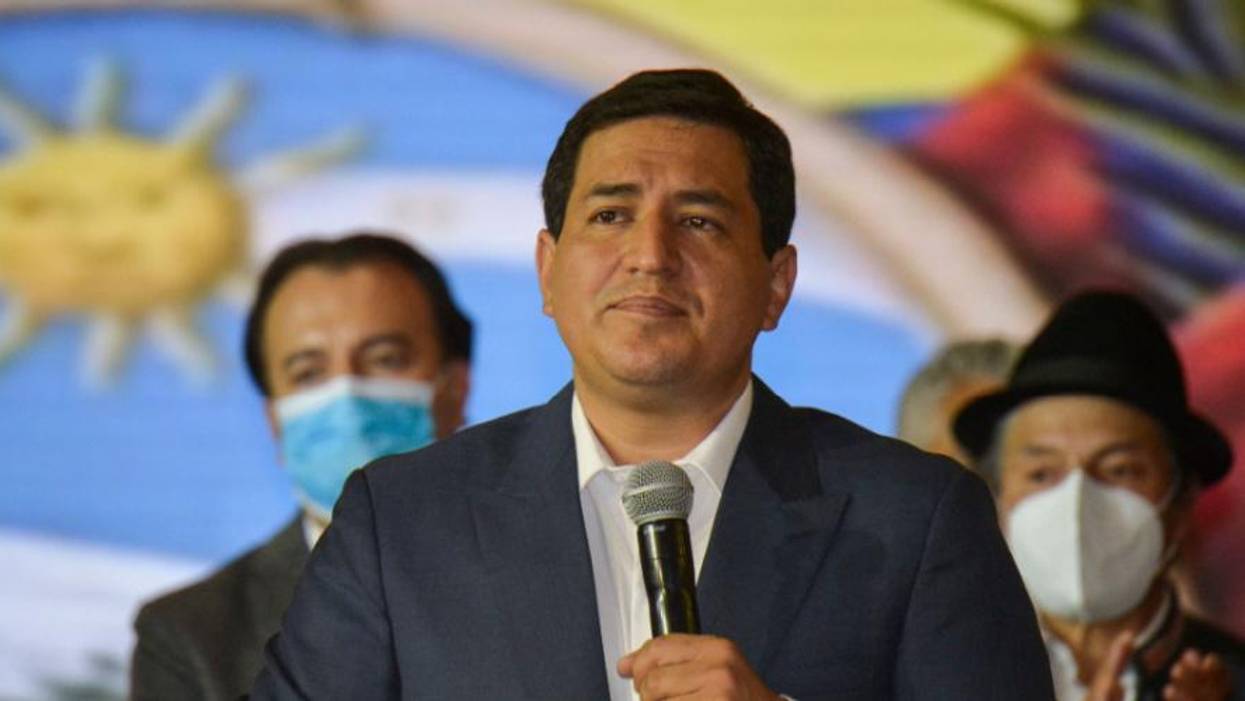
Following left-wing economist Andres Arauz's loss to right-wing former banker Guillermo Lasso in Ecuador's recent presidential election, Progressive International on Monday argued that the disappointing results reflect the unsettling "triumph of lawfare" and underscore the need for progressive forces of all stripes to unify behind an emancipatory vision in order to "defeat the reactionary right" worldwide.
"Only the strategic unity of progressive forces--leftist, Indigenous, feminist, ecologist, and beyond--is strong enough to defeat the reactionary right."
--Progressive International
In a contest that pitted Lasso's neoliberal agenda of privatization and upward redistribution against Arauz's social-democratic plans to improve the welfare of working-class Ecuadorians, many expected Arauz to emerge victorious.
Instead, Arauz--considered a protege of former President Rafael Correa, a champion of the left who implemented policies that increased standards of living for the poor when he governed Ecuador from 2007 to 2017--conceded defeat.
"I congratulate him on his electoral triumph today and I will show him our democratic convictions," Arauz said Sunday night in the wake of Lasso's surprising win. Lasso, a two-time runner-up in presidential elections, received about 53% of ballots to Arauz's 47%.
David Adler, co-founder of Progressive International, a global coalition seeking egalitarian change, commended Arauz for running on a "creative and compassionate" platform of "political-economic transformation that should inspire the world."
In the wake of Arauz's "devastating loss," Adler said, "now is the time for reflection."
According to Adler, "The triumph of lawfare should send a chill through the global community."
Last year, Steve Striffler, a professor of anthropology at University of Massachusetts Boston who studies labor history and Latin American politics, warned that the prosecution of Correa by a judiciary acting on behalf of Ecuador's then-President Lenin Moreno represented an expansion of "lawfare," which he defined as "a well-worn strategy" used by the region's "resurgent right" to sideline progressive political opponents through "manipulation of the judicial system."
"What is new in the case of Ecuador is the scale of this practice," wrote Striffler. "Perverting the legal system in order to subvert the democratic process has become the defining strategy--indeed, the essence--of [Moreno's] government, which is faced with plummeting popularity and an opposition that would win in any fair election. This is not good news for democracy in Ecuador or Latin America."
Striffler's warning looks prescient. Correa--who is now living in his wife's home country of Belgium after his politicized corruption conviction sent him into exile--backed Arauz, but years of right-wing attacks on Correa and his political allies appear to have hurt the leftist movement he spearheaded and his successor's campaign.
Some observers have also suggested that intraleft conflicts over extraction and Indigenous rights in Ecuador, where oil resources helped finance Correa's social programs, played a role in Arauz's defeat.
In February, Arauz led the first round of voting with more than 30% while Lasso barely made it into the final by beating Yaku Perez, an Indigenous candidate from the Pachakutik party, by roughly half a percentage point.
According to France24, "Pachakutik refused to back either candidate in the second round and promoted blank votes."
"Perez publicly annulled his own vote writing, 'Yaku president resistance' on his ballot," the news outlet reported. "Around 16% of votes were invalid, up from 9.55% in the first round."
Progressive International tweeted: "The key lesson of the Ecuadorian election is the core of our internationalist project."
"Only the strategic unity of progressive forces--leftist, Indigenous, feminist, ecologist, and beyond--is strong enough to defeat the reactionary right," the organization continued.
"United we win," the group said. "Divided we lose."