SUBSCRIBE TO OUR FREE NEWSLETTER
Daily news & progressive opinion—funded by the people, not the corporations—delivered straight to your inbox.
5
#000000
#FFFFFF
To donate by check, phone, or other method, see our More Ways to Give page.
Daily news & progressive opinion—funded by the people, not the corporations—delivered straight to your inbox.
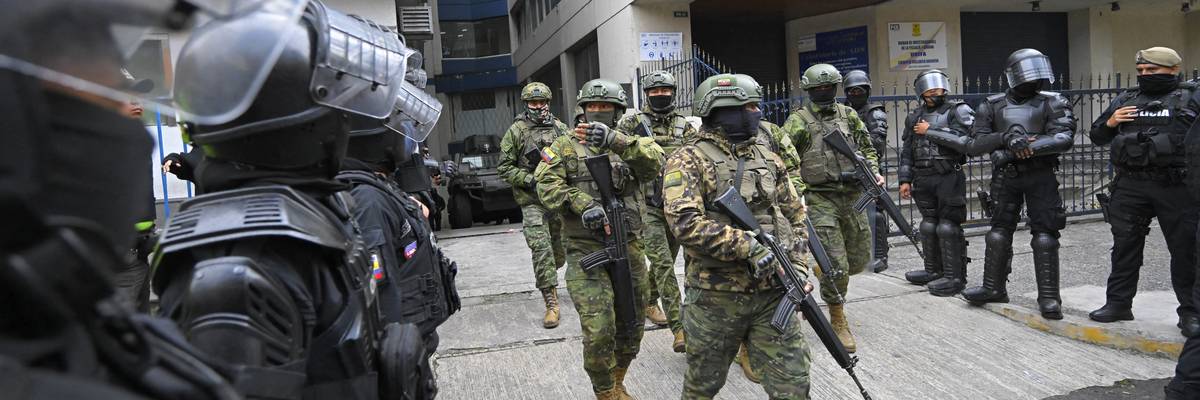
Military and police officers deploy a security operation in Quito, Ecuador on April 6, 2024.
Ecuador's raid of the Mexican embassy in Quito "threatens the security of embassies and diplomats throughout the world," said one expert.
The Biden administration on Sunday faced calls to demand the immediate release of Ecuador's former vice president after Ecuadorian police stormed Mexico's embassy in Quito and forcibly seized the ex-official, a flagrant breach of the 1961 Vienna Convention.
"Ecuador's government has committed a very serious crime, one that threatens the security of embassies and diplomats throughout the world—not least those of the United States, which has threats to its embassies in much of the world," said Mark Weisbrot, co-director of the Center for Economic and Policy Research (CEPR). "The international community cannot allow this to happen."
The move sparked a diplomatic crisis and global outcry, with Latin American leaders slamming the right-wing Ecuadorian government for its "unacceptable infringement" on Mexico's sovereignty and "kidnapping" of Jorge Glas, who served as vice president under Ecuador's leftist former president Rafael Correa. Glas has reportedly been transferred to a maximum-security prison.
Correa supported lawmaker Luisa González in Ecuador's 2023 presidential contest, which she lost to President Daniel Noboa, the son of the richest man in Ecuador.
"The United States is providing crucial diplomatic, military, and material support to Ecuador."
The illegal raid of Mexico's embassy late Friday came hours after the Mexican government granted political asylum to Glas, who has been living in the embassy since December, when he announced he would appeal a judge's decision ordering him back to jail. Glas has been convicted of corruption and imprisoned repeatedly in recent years; the former vice president has said the charges are politically motivated.
CEPR noted Sunday that Ecuadorian Attorney General Diana Salazar "has long engaged in a campaign of lawfare and political persecution against former president Rafael Correa and other figures from the former Correa government."
"The charges against Correa have been shown to have so little credibility, and the evidence is so lacking, that Interpol for years has refused to act on Ecuador's red notice against him," the group said. "Belgium has granted him political asylum, and he can travel freely to almost anywhere in the world without fear of extradition. And last year, a Brazilian Supreme Court judge annulled evidence against Glas after authorities admitted it may have been tampered with."
Weisbrot stressed in his statement that "the United States is providing crucial diplomatic, military, and material support to Ecuador."
"Canada is currently seeking a 'free trade' agreement with Ecuador," Weisbrot added. "All of this should be suspended until Ecuador releases its former vice president, who it has kidnapped from Mexico's embassy."
As the Financial Times reported Sunday, Ecuador's right-wing president "is enjoying soaring popularity among Ecuadoreans and strong support from Washington after declaring an all-out war on drug trafficking." In February, the Biden administration declared its "unwavering support" for Ecuador's government and announced "$2.4 million in additional vehicles and security equipment to support the work of police."
FT noted that Noboa, the scion of a banana empire, has invoked "emergency powers to put troops on the streets and sent the army to take control of gang-ridden jails, using tactics partly borrowed from El Salvador's strongman leader Nayib Bukele."
While Noboa's "aggressive response initially reduced violence and brought a precarious sense of safety to places like Guayaquil," The New York Times observed, the "stability did not last."
"Over the Easter holiday, there were 137 murders in Ecuador, and kidnappings and extortion have worsened," the Times reported.
Thus far, the Biden administration's response to Ecuador's raid on Mexico's embassy has been tepid. In a social media post late Saturday, U.S. State Department spokesperson Matthew Miller wrote that the administration "condemns any violation of the Vienna Convention on Diplomatic Relations, which says that "agents of the receiving state may not enter" embassies "except with the consent of the head of mission."
"We encourage our partners Mexico and Ecuador to resolve their differences in accord with international norms," Miller added.
Ecuadorian police assaulted Roberto Canseco, Mexico's acting ambassador, during Friday's raid.
"This is totally unacceptable," the career diplomat told reporters. "They have hit me, they have pushed me to the ground. I physically tried to prevent them from entering. They searched the Mexican embassy in Quito like criminals."
Dear Common Dreams reader, It’s been nearly 30 years since I co-founded Common Dreams with my late wife, Lina Newhouser. We had the radical notion that journalism should serve the public good, not corporate profits. It was clear to us from the outset what it would take to build such a project. No paid advertisements. No corporate sponsors. No millionaire publisher telling us what to think or do. Many people said we wouldn't last a year, but we proved those doubters wrong. Together with a tremendous team of journalists and dedicated staff, we built an independent media outlet free from the constraints of profits and corporate control. Our mission has always been simple: To inform. To inspire. To ignite change for the common good. Building Common Dreams was not easy. Our survival was never guaranteed. When you take on the most powerful forces—Wall Street greed, fossil fuel industry destruction, Big Tech lobbyists, and uber-rich oligarchs who have spent billions upon billions rigging the economy and democracy in their favor—the only bulwark you have is supporters who believe in your work. But here’s the urgent message from me today. It's never been this bad out there. And it's never been this hard to keep us going. At the very moment Common Dreams is most needed, the threats we face are intensifying. We need your support now more than ever. We don't accept corporate advertising and never will. We don't have a paywall because we don't think people should be blocked from critical news based on their ability to pay. Everything we do is funded by the donations of readers like you. When everyone does the little they can afford, we are strong. But if that support retreats or dries up, so do we. Will you donate now to make sure Common Dreams not only survives but thrives? —Craig Brown, Co-founder |
The Biden administration on Sunday faced calls to demand the immediate release of Ecuador's former vice president after Ecuadorian police stormed Mexico's embassy in Quito and forcibly seized the ex-official, a flagrant breach of the 1961 Vienna Convention.
"Ecuador's government has committed a very serious crime, one that threatens the security of embassies and diplomats throughout the world—not least those of the United States, which has threats to its embassies in much of the world," said Mark Weisbrot, co-director of the Center for Economic and Policy Research (CEPR). "The international community cannot allow this to happen."
The move sparked a diplomatic crisis and global outcry, with Latin American leaders slamming the right-wing Ecuadorian government for its "unacceptable infringement" on Mexico's sovereignty and "kidnapping" of Jorge Glas, who served as vice president under Ecuador's leftist former president Rafael Correa. Glas has reportedly been transferred to a maximum-security prison.
Correa supported lawmaker Luisa González in Ecuador's 2023 presidential contest, which she lost to President Daniel Noboa, the son of the richest man in Ecuador.
"The United States is providing crucial diplomatic, military, and material support to Ecuador."
The illegal raid of Mexico's embassy late Friday came hours after the Mexican government granted political asylum to Glas, who has been living in the embassy since December, when he announced he would appeal a judge's decision ordering him back to jail. Glas has been convicted of corruption and imprisoned repeatedly in recent years; the former vice president has said the charges are politically motivated.
CEPR noted Sunday that Ecuadorian Attorney General Diana Salazar "has long engaged in a campaign of lawfare and political persecution against former president Rafael Correa and other figures from the former Correa government."
"The charges against Correa have been shown to have so little credibility, and the evidence is so lacking, that Interpol for years has refused to act on Ecuador's red notice against him," the group said. "Belgium has granted him political asylum, and he can travel freely to almost anywhere in the world without fear of extradition. And last year, a Brazilian Supreme Court judge annulled evidence against Glas after authorities admitted it may have been tampered with."
Weisbrot stressed in his statement that "the United States is providing crucial diplomatic, military, and material support to Ecuador."
"Canada is currently seeking a 'free trade' agreement with Ecuador," Weisbrot added. "All of this should be suspended until Ecuador releases its former vice president, who it has kidnapped from Mexico's embassy."
As the Financial Times reported Sunday, Ecuador's right-wing president "is enjoying soaring popularity among Ecuadoreans and strong support from Washington after declaring an all-out war on drug trafficking." In February, the Biden administration declared its "unwavering support" for Ecuador's government and announced "$2.4 million in additional vehicles and security equipment to support the work of police."
FT noted that Noboa, the scion of a banana empire, has invoked "emergency powers to put troops on the streets and sent the army to take control of gang-ridden jails, using tactics partly borrowed from El Salvador's strongman leader Nayib Bukele."
While Noboa's "aggressive response initially reduced violence and brought a precarious sense of safety to places like Guayaquil," The New York Times observed, the "stability did not last."
"Over the Easter holiday, there were 137 murders in Ecuador, and kidnappings and extortion have worsened," the Times reported.
Thus far, the Biden administration's response to Ecuador's raid on Mexico's embassy has been tepid. In a social media post late Saturday, U.S. State Department spokesperson Matthew Miller wrote that the administration "condemns any violation of the Vienna Convention on Diplomatic Relations, which says that "agents of the receiving state may not enter" embassies "except with the consent of the head of mission."
"We encourage our partners Mexico and Ecuador to resolve their differences in accord with international norms," Miller added.
Ecuadorian police assaulted Roberto Canseco, Mexico's acting ambassador, during Friday's raid.
"This is totally unacceptable," the career diplomat told reporters. "They have hit me, they have pushed me to the ground. I physically tried to prevent them from entering. They searched the Mexican embassy in Quito like criminals."
The Biden administration on Sunday faced calls to demand the immediate release of Ecuador's former vice president after Ecuadorian police stormed Mexico's embassy in Quito and forcibly seized the ex-official, a flagrant breach of the 1961 Vienna Convention.
"Ecuador's government has committed a very serious crime, one that threatens the security of embassies and diplomats throughout the world—not least those of the United States, which has threats to its embassies in much of the world," said Mark Weisbrot, co-director of the Center for Economic and Policy Research (CEPR). "The international community cannot allow this to happen."
The move sparked a diplomatic crisis and global outcry, with Latin American leaders slamming the right-wing Ecuadorian government for its "unacceptable infringement" on Mexico's sovereignty and "kidnapping" of Jorge Glas, who served as vice president under Ecuador's leftist former president Rafael Correa. Glas has reportedly been transferred to a maximum-security prison.
Correa supported lawmaker Luisa González in Ecuador's 2023 presidential contest, which she lost to President Daniel Noboa, the son of the richest man in Ecuador.
"The United States is providing crucial diplomatic, military, and material support to Ecuador."
The illegal raid of Mexico's embassy late Friday came hours after the Mexican government granted political asylum to Glas, who has been living in the embassy since December, when he announced he would appeal a judge's decision ordering him back to jail. Glas has been convicted of corruption and imprisoned repeatedly in recent years; the former vice president has said the charges are politically motivated.
CEPR noted Sunday that Ecuadorian Attorney General Diana Salazar "has long engaged in a campaign of lawfare and political persecution against former president Rafael Correa and other figures from the former Correa government."
"The charges against Correa have been shown to have so little credibility, and the evidence is so lacking, that Interpol for years has refused to act on Ecuador's red notice against him," the group said. "Belgium has granted him political asylum, and he can travel freely to almost anywhere in the world without fear of extradition. And last year, a Brazilian Supreme Court judge annulled evidence against Glas after authorities admitted it may have been tampered with."
Weisbrot stressed in his statement that "the United States is providing crucial diplomatic, military, and material support to Ecuador."
"Canada is currently seeking a 'free trade' agreement with Ecuador," Weisbrot added. "All of this should be suspended until Ecuador releases its former vice president, who it has kidnapped from Mexico's embassy."
As the Financial Times reported Sunday, Ecuador's right-wing president "is enjoying soaring popularity among Ecuadoreans and strong support from Washington after declaring an all-out war on drug trafficking." In February, the Biden administration declared its "unwavering support" for Ecuador's government and announced "$2.4 million in additional vehicles and security equipment to support the work of police."
FT noted that Noboa, the scion of a banana empire, has invoked "emergency powers to put troops on the streets and sent the army to take control of gang-ridden jails, using tactics partly borrowed from El Salvador's strongman leader Nayib Bukele."
While Noboa's "aggressive response initially reduced violence and brought a precarious sense of safety to places like Guayaquil," The New York Times observed, the "stability did not last."
"Over the Easter holiday, there were 137 murders in Ecuador, and kidnappings and extortion have worsened," the Times reported.
Thus far, the Biden administration's response to Ecuador's raid on Mexico's embassy has been tepid. In a social media post late Saturday, U.S. State Department spokesperson Matthew Miller wrote that the administration "condemns any violation of the Vienna Convention on Diplomatic Relations, which says that "agents of the receiving state may not enter" embassies "except with the consent of the head of mission."
"We encourage our partners Mexico and Ecuador to resolve their differences in accord with international norms," Miller added.
Ecuadorian police assaulted Roberto Canseco, Mexico's acting ambassador, during Friday's raid.
"This is totally unacceptable," the career diplomat told reporters. "They have hit me, they have pushed me to the ground. I physically tried to prevent them from entering. They searched the Mexican embassy in Quito like criminals."