SUBSCRIBE TO OUR FREE NEWSLETTER
Daily news & progressive opinion—funded by the people, not the corporations—delivered straight to your inbox.
5
#000000
#FFFFFF
To donate by check, phone, or other method, see our More Ways to Give page.
Daily news & progressive opinion—funded by the people, not the corporations—delivered straight to your inbox.
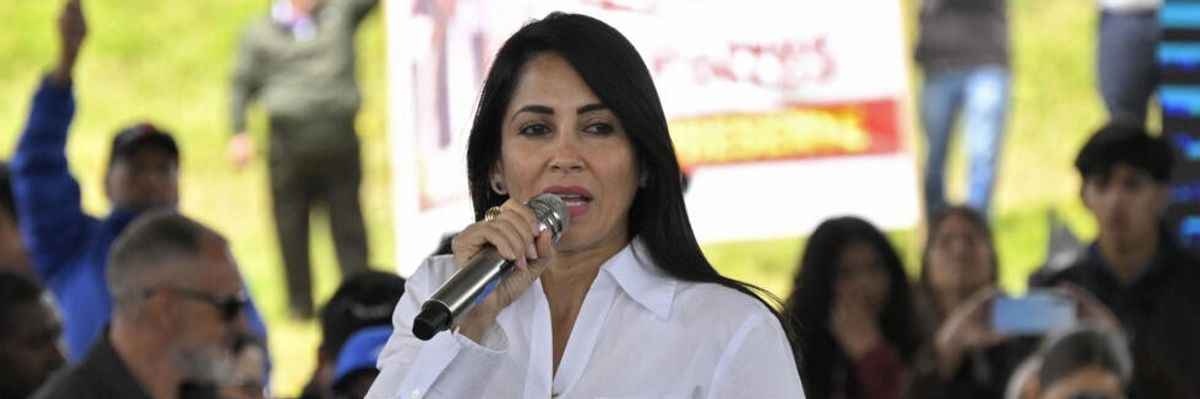
Ecuador's presidential candidate for the Revolucion Ciudadana party, Luisa Gonzalez, delivers a speech during a political gathering with students in southern Quito on August 9, 2023.
The destruction of the rule of law in Ecuador has destroyed much of the foundations of democracy, including in the areas of basic human rights and free elections.
Imagine a developing country where a 43-year-old economist with a PhD from the University of Illinois, who is relatively unknown as a politician, runs for president and wins. Despite the preceding decades of corruption and institutional rot, he puts together a competent government and gets the economic policy right. The numbers tell much of the story: in the 10 years of his presidency, poverty fell by 41 percent; income per person grew at more than twice the rate of the previous 25 years; and public investment and government expenditure on health services doubled as a share of the economy.
These and other gains (e.g., in education) were accompanied by unprecedented levels of political stability, and Ecuador was one of the safest countries in South America.
Welcome to Ecuador in the twenty-first century. That was part one of the story that began when Rafael Correa took office in 2007. But then he left office in 2017, and things went to hell in a hurry, over the past six years. The first president of this period was Lenín Moreno, who came from Correa’s party but within months turned against it. He purged the party of people who were loyal to its original progressive mission, leaving the country’s largest political movement without a political party. He then purged the judiciary, and used it to persecute his opponents. This included Correa himself — who faces an eight-year prison sentence if he comes home. Correa’s charges and trial were a farce, with the court finding that he used “psychic influence” over others to commit crimes. Because it was so obviously a case of political persecution, he was given political asylum in Belgium, and can travel freely to almost anywhere besides Ecuador without fear of extradition.
Guillermo Lasso, the current president and one of Ecuador’s richest people, was elected in 2021. In May, he dissolved the National Assembly and called for new elections. He was facing impeachment and very likely removal from office, over serious allegations of corruption.
The results of this six-year destruction of the rule of law, and policy reversals, were not pretty. Poverty reached its highest level in a decade, just before the pandemic. The most recent data show a poverty rate 17 percent higher than six years ago. Ecuador’s recovery from the pandemic is at the bottom for South America, in terms of real per capita income today. And the country also had one of the worst per capita death rates in the world from the COVID pandemic.
More frightening right now is the spiraling violence. Under Correa, Ecuador’s homicide rate had declined from 18 per 100,000 to just 5.8 (2016) — one of the lowest in Latin America — but has since exploded to a projected 40 for 2023, one of the highest in the hemisphere. And this includes unprecedented political violence, including the August 9 assassination of a presidential candidate, Fernando Villavicencio, who had challenged organized crime.
This recent history is of particular importance right now. Ecuador has a presidential election in less than a week, and the candidates represent opposing sides of the policy choices, goals, values, and interests that brought about the sharply contrasting results of the two preceding episodes.
On one side, from the same wealth strata as Lasso — net worth in the hundreds of millions at least — is Daniel Noboa. He is the son of the banana tycoon Alvaro Noboa, Ecuador’s richest person. Daniel Noboa was elected to the national Assembly in 2021, and is widely seen as representing the status quo. This includes his connections to both Lasso and to organized crime — for example through Lasso’s agriculture minister, Bernardo Manzano, a former senior manager in the Noboa Group, who resigned as minister in a corruption scandal in February.
On the other side is Luisa Gonzalez, previously a minister in the Correa government and a former representative in the National Assembly. She pledges to reverse the damage of the past six years by stepping up the fight against crime and corruption, as well as by increasing public investment in infrastructure, health, and education. Most of her program is based on a continuation of what she sees as the successful policies of the Correa government, with additional efforts, e.g., in public safety, to fix some of the big things that have since been broken.
The choice would seem self-evident. But, as we who live in the United States have learned — especially since 2016 — a lot can depend on the information that large parts of the electorate consume. Most Ecuadorans have probably not heard the most important facts described here. The latest polls show Sunday’s election as too close to call.
The destruction of the rule of law in Ecuador has destroyed much of the foundations of democracy, including in the areas of basic human rights and free elections. Journalists are afraid to write about the richest and most powerful politicians and presidents’ mafia connections; they face death threats if they do. So, too, can key witnesses in major criminal cases, as witnessed last week: seven men arrested in the assassination of Villavicencio were murdered while in jail. They won’t be telling any stories about who recruited or paid them.
The experience of other countries has shown that the kind of governance that has been developing in Ecuador over the past six years — an amalgamation of oligarchs, organized crime and violence, corruption and lack of accountability — can be extremely difficult to reform when it becomes entrenched. Sunday’s election could have a profound and possibly lasting impact on the country’s future.
Dear Common Dreams reader, It’s been nearly 30 years since I co-founded Common Dreams with my late wife, Lina Newhouser. We had the radical notion that journalism should serve the public good, not corporate profits. It was clear to us from the outset what it would take to build such a project. No paid advertisements. No corporate sponsors. No millionaire publisher telling us what to think or do. Many people said we wouldn't last a year, but we proved those doubters wrong. Together with a tremendous team of journalists and dedicated staff, we built an independent media outlet free from the constraints of profits and corporate control. Our mission has always been simple: To inform. To inspire. To ignite change for the common good. Building Common Dreams was not easy. Our survival was never guaranteed. When you take on the most powerful forces—Wall Street greed, fossil fuel industry destruction, Big Tech lobbyists, and uber-rich oligarchs who have spent billions upon billions rigging the economy and democracy in their favor—the only bulwark you have is supporters who believe in your work. But here’s the urgent message from me today. It's never been this bad out there. And it's never been this hard to keep us going. At the very moment Common Dreams is most needed, the threats we face are intensifying. We need your support now more than ever. We don't accept corporate advertising and never will. We don't have a paywall because we don't think people should be blocked from critical news based on their ability to pay. Everything we do is funded by the donations of readers like you. When everyone does the little they can afford, we are strong. But if that support retreats or dries up, so do we. Will you donate now to make sure Common Dreams not only survives but thrives? —Craig Brown, Co-founder |
Imagine a developing country where a 43-year-old economist with a PhD from the University of Illinois, who is relatively unknown as a politician, runs for president and wins. Despite the preceding decades of corruption and institutional rot, he puts together a competent government and gets the economic policy right. The numbers tell much of the story: in the 10 years of his presidency, poverty fell by 41 percent; income per person grew at more than twice the rate of the previous 25 years; and public investment and government expenditure on health services doubled as a share of the economy.
These and other gains (e.g., in education) were accompanied by unprecedented levels of political stability, and Ecuador was one of the safest countries in South America.
Welcome to Ecuador in the twenty-first century. That was part one of the story that began when Rafael Correa took office in 2007. But then he left office in 2017, and things went to hell in a hurry, over the past six years. The first president of this period was Lenín Moreno, who came from Correa’s party but within months turned against it. He purged the party of people who were loyal to its original progressive mission, leaving the country’s largest political movement without a political party. He then purged the judiciary, and used it to persecute his opponents. This included Correa himself — who faces an eight-year prison sentence if he comes home. Correa’s charges and trial were a farce, with the court finding that he used “psychic influence” over others to commit crimes. Because it was so obviously a case of political persecution, he was given political asylum in Belgium, and can travel freely to almost anywhere besides Ecuador without fear of extradition.
Guillermo Lasso, the current president and one of Ecuador’s richest people, was elected in 2021. In May, he dissolved the National Assembly and called for new elections. He was facing impeachment and very likely removal from office, over serious allegations of corruption.
The results of this six-year destruction of the rule of law, and policy reversals, were not pretty. Poverty reached its highest level in a decade, just before the pandemic. The most recent data show a poverty rate 17 percent higher than six years ago. Ecuador’s recovery from the pandemic is at the bottom for South America, in terms of real per capita income today. And the country also had one of the worst per capita death rates in the world from the COVID pandemic.
More frightening right now is the spiraling violence. Under Correa, Ecuador’s homicide rate had declined from 18 per 100,000 to just 5.8 (2016) — one of the lowest in Latin America — but has since exploded to a projected 40 for 2023, one of the highest in the hemisphere. And this includes unprecedented political violence, including the August 9 assassination of a presidential candidate, Fernando Villavicencio, who had challenged organized crime.
This recent history is of particular importance right now. Ecuador has a presidential election in less than a week, and the candidates represent opposing sides of the policy choices, goals, values, and interests that brought about the sharply contrasting results of the two preceding episodes.
On one side, from the same wealth strata as Lasso — net worth in the hundreds of millions at least — is Daniel Noboa. He is the son of the banana tycoon Alvaro Noboa, Ecuador’s richest person. Daniel Noboa was elected to the national Assembly in 2021, and is widely seen as representing the status quo. This includes his connections to both Lasso and to organized crime — for example through Lasso’s agriculture minister, Bernardo Manzano, a former senior manager in the Noboa Group, who resigned as minister in a corruption scandal in February.
On the other side is Luisa Gonzalez, previously a minister in the Correa government and a former representative in the National Assembly. She pledges to reverse the damage of the past six years by stepping up the fight against crime and corruption, as well as by increasing public investment in infrastructure, health, and education. Most of her program is based on a continuation of what she sees as the successful policies of the Correa government, with additional efforts, e.g., in public safety, to fix some of the big things that have since been broken.
The choice would seem self-evident. But, as we who live in the United States have learned — especially since 2016 — a lot can depend on the information that large parts of the electorate consume. Most Ecuadorans have probably not heard the most important facts described here. The latest polls show Sunday’s election as too close to call.
The destruction of the rule of law in Ecuador has destroyed much of the foundations of democracy, including in the areas of basic human rights and free elections. Journalists are afraid to write about the richest and most powerful politicians and presidents’ mafia connections; they face death threats if they do. So, too, can key witnesses in major criminal cases, as witnessed last week: seven men arrested in the assassination of Villavicencio were murdered while in jail. They won’t be telling any stories about who recruited or paid them.
The experience of other countries has shown that the kind of governance that has been developing in Ecuador over the past six years — an amalgamation of oligarchs, organized crime and violence, corruption and lack of accountability — can be extremely difficult to reform when it becomes entrenched. Sunday’s election could have a profound and possibly lasting impact on the country’s future.
Imagine a developing country where a 43-year-old economist with a PhD from the University of Illinois, who is relatively unknown as a politician, runs for president and wins. Despite the preceding decades of corruption and institutional rot, he puts together a competent government and gets the economic policy right. The numbers tell much of the story: in the 10 years of his presidency, poverty fell by 41 percent; income per person grew at more than twice the rate of the previous 25 years; and public investment and government expenditure on health services doubled as a share of the economy.
These and other gains (e.g., in education) were accompanied by unprecedented levels of political stability, and Ecuador was one of the safest countries in South America.
Welcome to Ecuador in the twenty-first century. That was part one of the story that began when Rafael Correa took office in 2007. But then he left office in 2017, and things went to hell in a hurry, over the past six years. The first president of this period was Lenín Moreno, who came from Correa’s party but within months turned against it. He purged the party of people who were loyal to its original progressive mission, leaving the country’s largest political movement without a political party. He then purged the judiciary, and used it to persecute his opponents. This included Correa himself — who faces an eight-year prison sentence if he comes home. Correa’s charges and trial were a farce, with the court finding that he used “psychic influence” over others to commit crimes. Because it was so obviously a case of political persecution, he was given political asylum in Belgium, and can travel freely to almost anywhere besides Ecuador without fear of extradition.
Guillermo Lasso, the current president and one of Ecuador’s richest people, was elected in 2021. In May, he dissolved the National Assembly and called for new elections. He was facing impeachment and very likely removal from office, over serious allegations of corruption.
The results of this six-year destruction of the rule of law, and policy reversals, were not pretty. Poverty reached its highest level in a decade, just before the pandemic. The most recent data show a poverty rate 17 percent higher than six years ago. Ecuador’s recovery from the pandemic is at the bottom for South America, in terms of real per capita income today. And the country also had one of the worst per capita death rates in the world from the COVID pandemic.
More frightening right now is the spiraling violence. Under Correa, Ecuador’s homicide rate had declined from 18 per 100,000 to just 5.8 (2016) — one of the lowest in Latin America — but has since exploded to a projected 40 for 2023, one of the highest in the hemisphere. And this includes unprecedented political violence, including the August 9 assassination of a presidential candidate, Fernando Villavicencio, who had challenged organized crime.
This recent history is of particular importance right now. Ecuador has a presidential election in less than a week, and the candidates represent opposing sides of the policy choices, goals, values, and interests that brought about the sharply contrasting results of the two preceding episodes.
On one side, from the same wealth strata as Lasso — net worth in the hundreds of millions at least — is Daniel Noboa. He is the son of the banana tycoon Alvaro Noboa, Ecuador’s richest person. Daniel Noboa was elected to the national Assembly in 2021, and is widely seen as representing the status quo. This includes his connections to both Lasso and to organized crime — for example through Lasso’s agriculture minister, Bernardo Manzano, a former senior manager in the Noboa Group, who resigned as minister in a corruption scandal in February.
On the other side is Luisa Gonzalez, previously a minister in the Correa government and a former representative in the National Assembly. She pledges to reverse the damage of the past six years by stepping up the fight against crime and corruption, as well as by increasing public investment in infrastructure, health, and education. Most of her program is based on a continuation of what she sees as the successful policies of the Correa government, with additional efforts, e.g., in public safety, to fix some of the big things that have since been broken.
The choice would seem self-evident. But, as we who live in the United States have learned — especially since 2016 — a lot can depend on the information that large parts of the electorate consume. Most Ecuadorans have probably not heard the most important facts described here. The latest polls show Sunday’s election as too close to call.
The destruction of the rule of law in Ecuador has destroyed much of the foundations of democracy, including in the areas of basic human rights and free elections. Journalists are afraid to write about the richest and most powerful politicians and presidents’ mafia connections; they face death threats if they do. So, too, can key witnesses in major criminal cases, as witnessed last week: seven men arrested in the assassination of Villavicencio were murdered while in jail. They won’t be telling any stories about who recruited or paid them.
The experience of other countries has shown that the kind of governance that has been developing in Ecuador over the past six years — an amalgamation of oligarchs, organized crime and violence, corruption and lack of accountability — can be extremely difficult to reform when it becomes entrenched. Sunday’s election could have a profound and possibly lasting impact on the country’s future.