

SUBSCRIBE TO OUR FREE NEWSLETTER
Daily news & progressive opinion—funded by the people, not the corporations—delivered straight to your inbox.
5
#000000
#FFFFFF
To donate by check, phone, or other method, see our More Ways to Give page.
Daily news & progressive opinion—funded by the people, not the corporations—delivered straight to your inbox.

"It is a dark and dangerous moment for this country when our government chooses to target orphaned 10-year-olds and denies them their most basic legal right to present their case before an immigration judge," a lawyer said.
In an effort reminiscent of US President Donald Trump using the Alien Enemies Act to send hundreds of migrants to a Salvadoran prison, his administration just tried to deport more than 600 unaccompanied children to Guatemala over Labor Day weekend—though for now, a federal judge's order appears to have halted the plan, unlike last time.
CNN exclusively reported Friday morning that the Trump administration was "moving to repatriate hundreds of Guatemalan children" who arrived in the United States alone and were placed in the custody of the Office of Refugee Resettlement. Subsequent reporting confirmed plans to deport the kids, who are ages 10-17.
Fearing their imminent removal after the administration reportedly reached an agreement with the Guatemalan government, the National Immigration Law Center (NILC) launched a class action lawsuit around 1:00 am Sunday, seeking an emergency order that was granted just hours later by a federal judge in Washington, D.C.
"Plaintiffs have active proceedings before immigration courts across the country, yet defendants plan to remove them in violation of the Trafficking Victims Protection Reauthorization Act of 2008, the Immigration and Nationality Act, and the Constitution," NILC's complaint explains.
Efrén C. Olivares, vice president of litigation and legal strategy at the NILC, said that "it is a dark and dangerous moment for this country when our government chooses to target orphaned 10-year-olds and denies them their most basic legal right to present their case before an immigration judge."
"The Constitution and federal laws provide robust protections to unaccompanied minors specifically because of the unique risks they face," Olivares noted. "We are determined to use every legal tool at our disposal to force the administration to respect the law and not send any child to danger."
Politico's Kyle Cheney and Josh Gerstein reported on the judge's moves:
U.S. District Judge Sparkle Sooknanan issued the order just after 4:00 am Sunday, finding that the "exigent circumstances" described in the lawsuit warranted immediate action "to maintain the status quo until a hearing can be set."
The judge, a Biden appointee, initially scheduled a virtual hearing on the matter for 3:00 pm Sunday, but later moved up the hearing to 12:30 pm after being notified that some minors covered by the suit were "in the process of being removed from the United States."
Sharing updates from the hearing on social media, Cheney reported that Sooknanan took a five-minute recess so that US Department of Justice attorney Drew Ensign could ensure that the details of her order reached the Trump administration—which is pursuing mass deportations. Ensign confirmed to the judge that while it's possible one plane took off and then returned, all the children are still in the United States.
Following the judge's intervention, NILC's Olivares said in a statement that "in the dead of night on a holiday weekend, the Trump administration ripped vulnerable, frightened children from their beds and attempted to return them to danger in Guatemala."
"We are heartened the court prevented this injustice from occurring before hundreds of children suffered irreparable harm," he added. "We are determined to continue fighting to protect the interest of our plaintiffs and all class members until the effort is enjoined permanently."
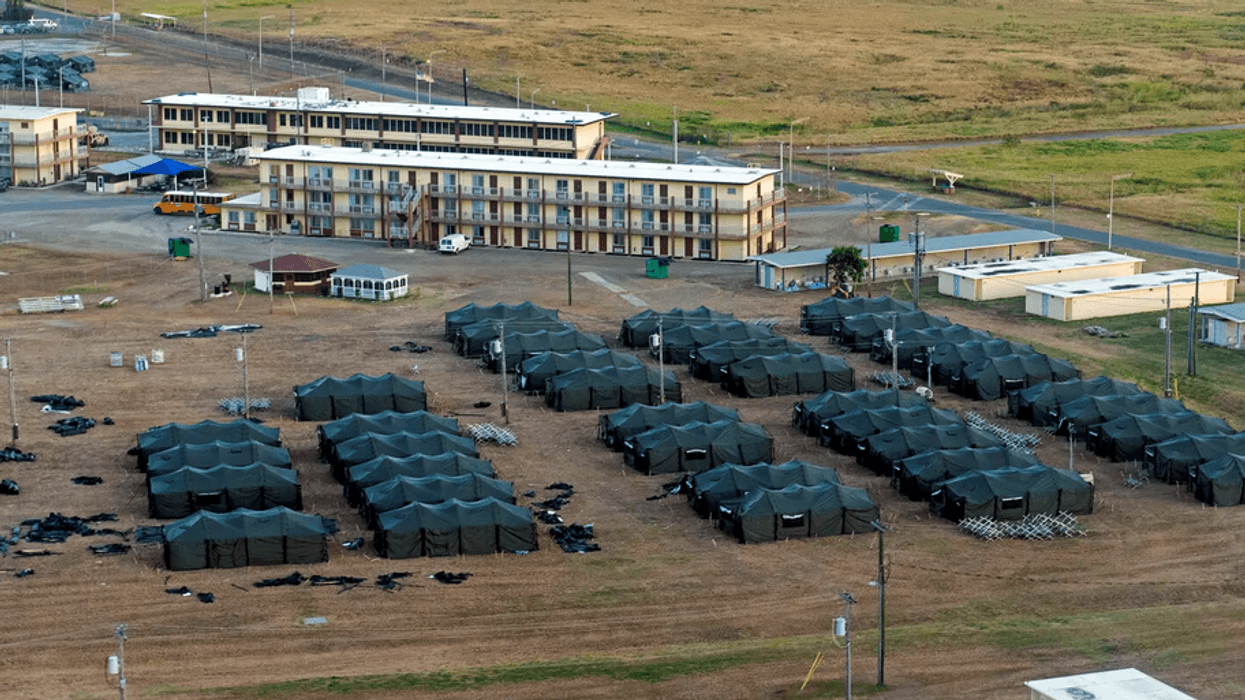
"There's no reason to build this in Guantánamo unless you want to do things you don't think you could get away with on the U.S. mainland. It's easy to put tents in Florida. But they're putting them in Cuba. Ask yourself why."
Fears are growing that the offshore U.S. detention facilities at Guantánamo Bay, Cuba, are an ominous sign of what President Donald Trump has in store as he further disregards the rule of law and normalizes actions that previously would have been unthinkable or faces immediate, bipartisan opposition in Congress.
After the first pictures emerged Saturday of still unidentified persons transferred to the island from the U.S. mainland by immigration officials, progressive journalist Nathan Robinson was among those raising the alarm, accusing Trump of "building a concentration camp and deliberately putting it where it is hardest to monitor or enforce the law."
The New York Times, alongside pictures of newly-erected tents taken by photojournalist Doug Mills, reported Saturday that the administration had already "moved more than 30 people described as Venezuelan gang members to the U.S. Navy base at Guantánamo Bay, as U.S. forces and homeland security staff prepare a tent city for potentially thousands of migrants." Mills was traveling Friday with Kristi Noem, the secretary of homeland security, as she made her first visit to the offshore site.
According to the outlet:
Ms. Noem visited the nascent tent camp, where the administration has suggested that thousands, perhaps tens of thousands, of migrants who pose lesser threats could be housed. She watched Marines rehearse how to move migrants to the future tent city, and she was shown a tent with cots and a display of basic items to be provided each new arrival — T-shirt, shorts, underwear and a towel — and then got an aerial view of the mission from a Chinook helicopter.
"The Trump administration," the Times reported, "has not released any of their identities, though they are believed to all be men, nor has it said how long they might be held at the island outpost."
According to critics like Robinson, "There's no reason to build this in Guantánamo unless you want to do things you don't think you could get away with on the U.S. mainland. It's easy to put tents in Florida. But they're putting them in Cuba. Ask yourself why."
On Friday, a coalition of more than a dozen rights groups—including the ACLU, National Immigration Law Center, and others—sent a letter to the Department of Homeland Security (DHS), Department of Defense (DoD), and the U.S. State Department demanding Trump officials provide immediate access to those who have been transferred out of the country to the offshore facility.
In addition, the groups demanded to know:
"Sending immigrants from the U.S. to Guantánamo and holding them incommunicado without access to counsel or the outside world opens a new shameful chapter in the history of this notorious prison," said ACLU deputy director of immigrant rights Lee Gelernt. "It is unlawful for our government to use Guantánamo as a legal black hole, yet that is exactly what the Trump administration is doing."
Setareh Ghandehari, advocacy director of Detention Watch Network, said Friday that the expansion of operations at Guantánamo "is especially alarming given its remote location and the decades-long documented history of abuse and torture there, which will only be exacerbated by the well-documented abuse inherent to the ICE detention system, including abuse, unsanitary conditions, and medical neglect. In no uncertain terms—lives are in jeopardy."
While previous administrations have exploited the land seized by the U.S. in Cuba to detain and process asylum seekers and migrants in the past, those were individuals interdicted at sea or before having ever set foot on American soil. The facilities have not been used to hold noncitizens deported from the U.S. mainland.
Last week, Slate's Mary Harris interviewed journalist Andrea Pitzer, author of "One Long Night: A Global History of Concentration Camps," who acknowledged that while many immediately think of Nazi Germany's death camps under Adolf Hitler when they hear the term "concentration camp," it is not wrong to describe the U.S. prison facilities at Guantánamo that way and for important reasons.
In her questioning, Harris posed to Pitzer how the existence of Guantánamo "doesn’t mean it’s going to become Auschwitz" necessarily, but that it does make "the road to Auschwitz more possible."
And Pitzer responded:
That's exactly right. And so what it means is even to do the most horrible things that humans have done takes time. It takes sort of a space and imagination and tools and resources. And the more of those kinds of tools and resources we line up in one place, the more room there is for the obscene or the perverted imagination to work. And even Auschwitz—keep in mind that it was 1933 when Hitler came to power and they started with concentration camps right out of the gate. So within the first weeks, Dakau is opened, though not quite in its final form, but it is already a camp and it takes almost a decade to get to even this final solution. And so, yes, absolutely, the Holocaust as we know it, as we remember it, has never been repeated. Nothing has come close to that. But you do not get to the death camps without having several years of Auschwitz, of Buchenwalds, of those beforehand.
"And right now," Pitzer said of Gitmo's legacy and the new purpose that Trump is giving it, "we have a place where there has been torture, we have a place where there has been riots, we have a place where there have been people held without trial for more than 20 years. And those are some of the most dangerous seeds that humanity can plant."
"The Holocaust as we know it, as we remember it, has never been repeated. Nothing has come close to that. But you do not get to the death camps without having several years of Auschwitz, of Buchenwalds, of those beforehand."
In a weekend column, the Philadelphia Inquirer's Will Bunch warned that even as much of the Trump administration's targeting of immigrants and refugees thus far should be seen as a "propaganda" exercise designed to titillate his base and antagonize his liberal opponents, the danger present by the Gitmo policy and others are very real.
"The bigger worry, " writes Bunch, "is that just because the cruelty of mass deportation is largely performative doesn’t mean these performances won’t scale up dramatically in the months ahead. Trump reportedly is already badgering his border czar, Tom Homan, and ICE to meet ambitious arrest targets, which would probably require crueler and more legally dubious measures that would fill those empty tents at Gitmo. If the president needs his phony war against a nonexistent border invasion to distract the American heartland from the coming evisceration of government services, the cruelty will become a bigger and bigger point."
Referencing the great Russian playwright's famous quote about the introduction of a gun onstage, Bunch opined that Trump's performative brand of governance does not mean the threat isn't real.
"You don't need Anton Chekhov," noted Bunch, "to understand that you don't build empty tents at Gitmo in Act One of your presidency unless you plan to fill them in Act Three."
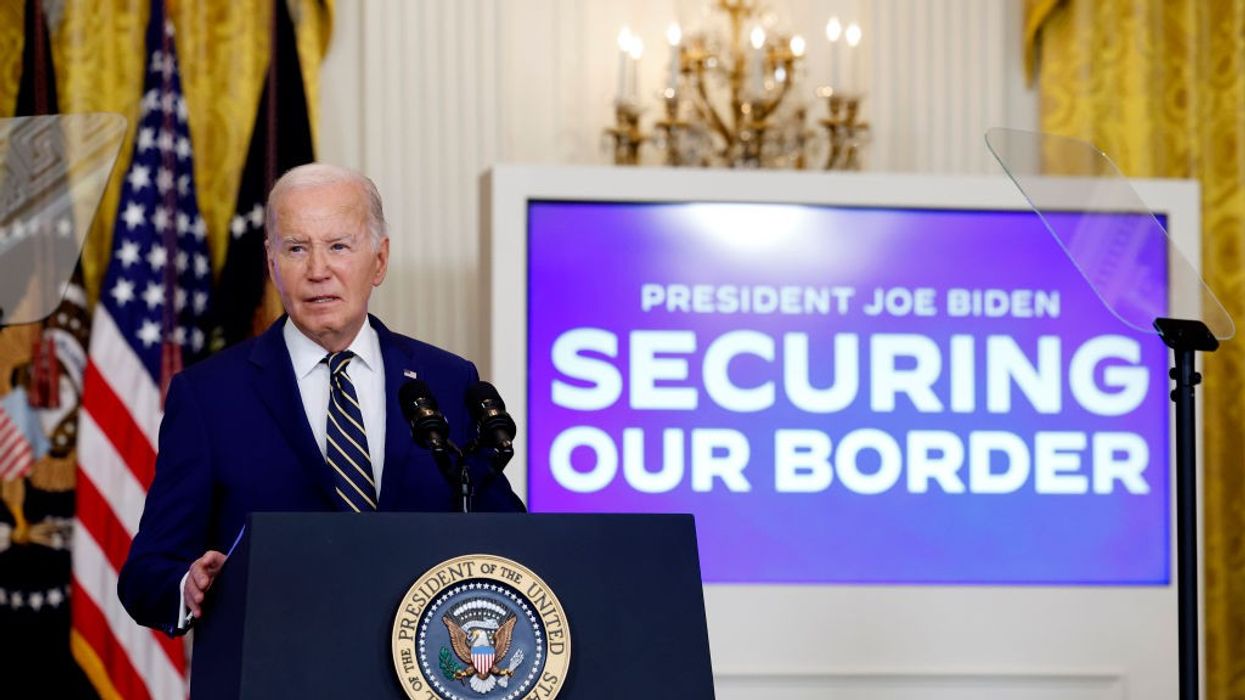
"It was illegal when Trump did it, and it is no less illegal now."
The ACLU on Tuesday vowed to launch a legal challenge to U.S. President Joe Biden's executive order barring migrants who cross the southern border without authorization from receiving asylum.
Biden's executive action invokes Section 212(f) of the Immigration and Nationality Act—previously used by the administration of former Republican President Donald Trump to deny migrants asylum—"when the southern border is overwhelmed."
Under the policy, asylum requests will be shut down when the average number of daily migrant encounters between ports of entry hits 2,500. Border entry points would reopen to asylum-seekers when that number dips below 1,500.
The president said he was acting, in part, because "Republicans in Congress chose to put partisan politics ahead of our national security, twice voting against the toughest and fairest set of reforms in decades."
On Tuesday, the ACLU said Biden's policy will "rush vulnerable people through already fast-tracked deportation proceedings, sending people in need of protection to their deaths."
"We intend to challenge this order in court," Lee Gelernt, deputy director of the ACLU Immigrants' Rights Project, said in a statement. "It was illegal when Trump did it, and it is no less illegal now."
In July 2020 a federal judge in Washington, D.C. struck down the Trump administration's ban on most Central Americans and migrants from other countries.
ACLU chief political and advocacy officer Deirdre Schifeling said that "we need solutions to address the challenges at the border, but the administration's planned executive actions will put thousands of lives at risk."
"They will not meet the needs at the border, nor will they fix our broken immigration system," Schifeling added. "We urge the administration to uphold its campaign promise to restore asylum and mobilize the necessary resources to address the challenges at the border. It's not just the morally sound thing to do—it's good politics."
The ACLU pointed to polling showing that "voters nationwide and in battleground states largely reject enforcement-only policies that put vulnerable people in danger."
The group is advocating "balanced and humane solutions" including "improving processing at ports of entry and addressing the immigration case backlog by investing in immigration court judges and legal representation."
This isn't the first time that Biden's immigration policies have been likened to those of Trump, who is the presumptive 2024 Republican nominee despite having recently been convicted on 34 felony counts and facing 54 other federal and state charges across three cases.
One year ago, critics accused Biden of "finishing Trump's job" by implementing a crackdown on asylum-seekers upon the expiration of Title 42—a provision first invoked during the previous administration at the onset of the Covid-19 pandemic and continued by Biden to expel more than 1 million migrants under the pretext of public health.
The international medical charity Doctors Without Borders—which has deployed aid teams along migration routes—warned Tuesday that Biden's new order will put vulnerable people who endure treacherous, sometimes deadly, risks trying to reach the United States "at even greater risk."
"In signing this executive order, President Biden has betrayed his promise to build a fair, safe, and humane immigration system," Doctors Without Borders USA CEO Avril Benoît said in a statement. "This order is not only counter to U.S. law and international law, it puts people's lives and health at risk."
"Today's decision will trap vulnerable people, including young families, in insecure cities in Mexico and put them in grave danger," Benoît added. "The Biden administration continues to prioritize optics and political expediency at the expense of thousands of people who are attempting to exercise their legal right to seek asylum."
Kica Matos, president of the National Immigration Law Center and the NILC Immigrant Justice Fund, said Tuesday that "President Biden's craven embrace of failed Republican policies is a mistake that will only lead to more harm and dysfunction at the U.S.-Mexico border."
"There is a better way," she stressed. "Rather than playing politics with people's lives, the president should pursue practical solutions that increase our capacity to welcome immigrants humanely. These solutions include timely and fair processing of asylum applications, expanding legal pathways, and supporting cities that are welcoming our new neighbors."

"If this bill passes, it will mark a complete abdication of the United States' legal and moral commitments to refugees," said one advocacy organization.
Immigrant rights groups are urging Congress to reject bipartisan Senate legislation released Sunday that would severely weaken asylum protections, expand migrant detention capacity, and give the president the authority to effectively shut down U.S.-Mexico border crossings under certain conditions—power that President Joe Biden vowed to use immediately if the bill reaches his desk.
Anthony Romero, the ACLU's executive director, said lawmakers must ensure it never does, warning that the bill's enactment "would eviscerate longstanding asylum protections" and institute "variations of Stephen Miller's playbook"—a reference to the xenophobic White House adviser to former president Donald Trump.
"Deportation without due process was the Trump administration's disastrous experiment which should never be repeated, let alone used as a model for permanent border policy," said Romero. "This deal would force the government to summarily expel people from the border without due process, restricting legal pathways for the people who need them most."
"Eliminating longstanding, core due process protections like court review of asylum cases and doubling down on harmful deterrence and detention policies are not going to get cities and states the support they need, nor are they a substitute for policies that would improve border management and address the immigration case backlog," he added. "This deal also fails to deliver on years of promises to enact reforms providing pathways to citizenship for Dreamers and other longtime residents."
As The Washington Post noted, the past several months of border-related talks "have been unusual, given that past efforts at bipartisan immigration reform included discussions of providing pathways to citizenship for undocumented immigrants already living in the country demanded by Democrats, in addition to tightening border restrictions."
A pathway to citizenship was never on the table during negotiations over the new package. Instead, as The Intercept's Ryan Grim pointed out, Senate Democrats granted some of the GOP's anti-immigrant demands in exchange for military aid for Ukraine.
The 370-page bill includes more than $60 billion in military aid for Ukraine and around $14 billion for Israel.
Immigration policy analyst Adam Isacson observed in a brief analysis of the legislation that it includes "a lot of the controversial limits on access to asylum that had already been reported in media."
The bill, he observed, would require asylum seekers placed in the "expedited removal" process to "meet a much higher standard of 'credible fear' in screening interviews with asylum officers," raising the possibility that many people would be sent back into life-threatening circumstances.
Sen. James Lankford (R-Okla.), the bill's lead GOP negotiator, called the measure's asylum changes "dramatic."
The new bill would also "allow the Department of Homeland Security (DHS) to impose a Title 42-like expulsion authority, 'summarily removing' asylum seekers from the United States (except for hard-to-prove Convention Against Torture appeals), when unauthorized migrant encounters reach a daily threshold," Isacson added.
In addition to the new discretionary authority, the bill would require DHS to mostly shut down the asylum process if an average of 5,000 people or more reach the southern border per day over a seven-day period.
"While Donald Trump abhorrently says, 'Immigrants are poisoning the blood of our country,' congressional Republicans continue to openly admit they'd prefer the politics of a broken immigration system to a functional, just process."
Kica Matos, president of the National Immigration Law Center, said in a statement that the legislation "is not worth the incredible price it would exact—more families separated, more children detained, and more people sent back to face persecution, torture, and even death."
"Instead of enacting draconian policies that create more chaos," Matos continued, "we urge the White House and Senate Democrats to change course, reject this framework, and recommit to building an orderly, humane, and functioning immigration system."
The Center for Gender and Refugee Studies (CGRS) similarly implored members of Congress to oppose the agreement, calling it "a shameful attempt at political posturing that treats refugees' lives as expendable."
"If this bill passes, it will mark a complete abdication of the United States' legal and moral commitments to refugees and a stunning betrayal of President Biden's promise to restore our 'historic role as a safe haven' for those escaping persecution," said CGRS legal director Blaine Bookey. "It will amount to a death sentence for many people seeking refuge in the United States. We implore the Biden administration to reverse course, and we urge lawmakers to oppose this deal."
The legislation also faced immediate backlash from progressive lawmakers.
Rep. Pramila Jayapal (D-Wash.), chair of the roughly 100-member Congressional Progressive Caucus, said the bill "includes poison pill provisions such as new Title 42-like expulsion authority that will close the border and turn away asylum seekers without due process, a boon to cartels who prey on migrants."
"While Donald Trump abhorrently says, 'Immigrants are poisoning the blood of our country,' congressional Republicans continue to openly admit they'd prefer the politics of a broken immigration system to a functional, just process," Jayapal continued. "Democrats have given in to these extremist views over and over again for 30 years. By refusing to make the structural changes in the Senate needed to pass true reforms, allowing MAGA Republicans to lie to the American public, and declining to stand up and defend immigrant communities, it appears that President Biden and Senate Democrats have fallen into the same trap again."
While the White House and top Republican and Democratic senators have lined up behind the bill, its prospects remain highly uncertain in both the upper chamber and the GOP-controlled House of Representatives. In a social media post late Sunday, Speaker of the House Mike Johnson (R-La.) said the bill is "dead on arrival" if it reaches the lower chamber.
Even if the bill ultimately doesn't become law, observers warned that the Senate deal could do lasting damage to efforts to create a humane immigration system.
"I think the House Republicans mean what they say on not passing this border bill, but this is the end of comprehensive immigration reform because Democrats just showed that they don't need a path to citizenship to make a deal," wrote The American Prospect's David Dayen.

"Today's ruling is a testament to the incredible power and resiliency of immigrant workers and their communities," said one advocate.
Immigrant rights groups celebrated a historic victory late Monday as a federal judge handed down what is believed to be the first-ever class action settlement over a workplace immigration raid in the United States, awarding $1.17 million to nearly 100 people who were targeted by the Trump administration in 2018.
Most of the plaintiffs will receive more than $5,700 each, while a total of $475,000 will be split between six people who the U.S. District Court for the Eastern District of Tennessee found were eligible to be compensated for "negligent or wrongful acts by agents of the federal government," The New York Times reported Monday.
The plaintiffs, represented by legal advocacy groups including the Southern Poverty Law Center (SPLC) and the National Immigration Law Center (NILC), were rounded up by the Department of Homeland Security in April 2018 after an Internal Revenue Service (IRS) found that their employer at a meat processing plant in Bean Station, Tennessee was evading taxes by paying them in cash.
"They used the pretext of a tax investigation of the plant's owner to plan and carry out a full-blown operation targeting the Latino workers," Michelle Lapointe, deputy legal director for the NILC, told the Times on Monday.
Immigration and Customs Enforcement (ICE) agents descended on the plant and violently arrested dozens of Latino workers, separating them from their white coworkers and physically assaulting some of them. The warrant the agents had to enter the premises did not authorize them to arrest anyone. Only one Latino employee avoided the raid—by hiding in a meat freezer.
A majority of the workers were placed in deportation court proceedings and at least 20 were deported shortly after the raid.
More than 150 children were directly affected by the raid, as their parents were detained. The nearby city of Morristown rallied around the immigrant community, providing legal services, donations, help with locating detained people, and child care.
The NILC called the legal victory handed down on Monday "a testament to the power of community organizing to protect workers' rights."
"Today's ruling is a testament to the incredible power and resiliency of immigrant workers and their communities," said Lisa Sherman Luna, executive director at the Tennessee Immigrant and Refugee Rights Coalition. "Violent enforcement tactics like workplace raids are designed to keep immigrant families living in fear, but these plaintiffs and class members refused to stand by when they knew their rights had been violated. This settlement sends a clear message: No matter who we are or where we are from, we all deserve the freedom to work and live safely in our communities."
Meredith Stewart, senior supervising attorney at the SPLC's Immigrant Justice Project, called the ruling "unprecedented" and said the settlement "demonstrates that we, as a nation, will not tolerate racial profiling."

Migrant rights advocates on Friday accused President Joe Biden of embracing his predecessor's racist policies and endangering families following a court ruling that will allow the administration to continue expelling asylum-seekers under the pretext of protecting public health during the Covid-19 pandemic.
"The president has adopted Trump's racist policy as his own, without regard for the families and children harmed as a result."
--Neela Chakravartula, CGRS
On Thursday, the U.S. Court of Appeals for the District of Columbia Circuit ruled in Huisha-Huisha v. Mayorkas that the U.S. Department of Homeland Security (DHS) can continue removing asylum-seeking migrants under Title 42, a section of the Public Health Safety Act first invoked by the Trump administration as the coronavirus pandemic began in March 2020.
Title 42 was scheduled to be lifted Thursday in compliance with a lower court's order. However, the Biden administration--which has deported hundreds of thousands of migrants under the law--appealed the decision.
Human rights experts including United Nations officials have condemned Title 42 removals, which plaintiffs' attorneys in Huisha-Huisha called "a pretext" to deport migrants legally seeking asylum in the United States.
"Expert scientists at the Centers for Disease Control and Prevention rejected the use of public health powers to expel noncitizens as unnecessary," a court filing in the case asserts, "but the process was nevertheless imposed on the CDC by White House officials seeking to limit immigration, and not as a bona fide measure to protect public health."
ACLU attorney Lee Gelernt, the lead lawyer in the Title 42 challenge, said following the ruling that "if the Biden administration really wants to treat asylum seekers humanely, it should end this lawless policy now and withdraw its appeal."
"We will continue fighting to end this illegal policy," he vowed.
Tami Goodlette, director of litigation at Refugee and Immigrant Center for Education and Legal Services (RAICES) and co-counsel in Huisha-Huisha, said in a statement that "the Biden administration should never have appealed this case."
"The lower court concluded Title 42 was illegal and should not be applied to exclude families from seeking asylum in the U.S.," Goodlette continued. "But rather than allow families to seek refuge in our country--which is legal under U.S. law and international law--the administration chose to further promulgate the Trump administration's racist and xenophobic policies by appealing the case, and then [proceeded] to expel thousands of Haitians from Del Rio, Texas under Title 42."
"The Biden administration has lost its way and needs to remember its promises from the election," Goodlette added. "Migrants deserve better. Our country deserves better."
Neela Chakravartula, managing attorney at the Center for Gender & Refugee Studies (CGRS) and another co-counsel in the case, said that "the Biden administration's embrace of Title 42 has exposed people seeking safety to untold violence and suffering."
"The administration's decision to defend the policy in court is unconscionable, and a complete betrayal of the president's promise to restore access to asylum," asserted Chakravartula. "Recent events have laid bare the tragic consequences of Title 42. In less than two weeks, the administration has expelled over 5,000 Haitians to a country plagued with widespread violence and insecurity--a human rights travesty, and no small operational feat."
"They could have used those resources to safely welcome Haitians seeking refuge," she added. "Instead, the president has adopted Trump's racist policy as his own, without regard for the families and children harmed as a result."
Amy Fischer, Americas Advocacy Director at Amnesty International USA, said that "once again, the Biden administration has shown that it is more committed to defending Title 42 than upholding the human rights of asylum-seekers."
"The continued weaponization of the pandemic to expel people from our border will result in serious harm for the thousands who have been denied protection, including thousands of Haitians who have been brutalized and expelled under the policy in recent weeks," Fischer added. "There is simply no way around it--Title 42 must end, and every day the Biden administration fights to uphold it, they choose xenophobia and racism over protecting human rights."
Karla Marisol Vargas, senior attorney with the Texas Civil Rights Project and Huisha-Huisha co-counsel, said in a statement that "by fighting to keep Title 42 in place, this administration is doubling down on its commitment to continue the racist and violent policies of the Trump administration and to further entrench cruelty and racism into an immigration system in sore need of change--a system that continually violates the basic human rights of migrants, especially Black and brown migrants."
"The violence against Black migrants in Del Rio showed us not only this administration's utter lack of humanity, but it also showed us the absolute lack of will in upholding the promises it claimed when on the campaign trail," she added.
Thursday's ruling came hours after DHS issued new guidance for Immigration and Customs Enforcement (ICE) and other agencies prioritizing the expulsion of people in the country illegally "who are a threat to our national security, public safety, and border security."
While DHS says the guidance is meant to empower authorities to exercise greater discretion and weigh the "totality of the facts and circumstances" when considering deportations, Marielena Hincapie, executive director of the National Immigration Law Center, warned that "the memo places a dangerous amount of discretion in the hands of ICE agents."
"Given the agency's long history of operating--and even rewarding--a culture of cruelty and impunity, it is crucial for the agency to commit to ensuring that these priorities are implemented fairly and justly," said Hincapie, "and that DHS leadership ensures ICE agents are held accountable."

Immigrant rights defenders were encouraged by President-elect Joe Biden's Monday nomination of Alejandro Mayorkas for Secretary of Homeland Security and expressed hope that the first Latino and immigrant to lead the department will implement humane immigration policies to reverse the damage inflicted by President Donald Trump.
"After the cruelty and devastation wrought by the Trump administration, Mayorkas has a mandate to overhaul DHS."
--Rep. Joaquin Castro
Arturo Vargas, CEO of the National Association of Latino Elected and Appointed Officials (NALEO), said that "Mayorkas' keen knowledge of our immigration policies and procedures, as well as his commitment to a fair immigration system, makes him exceptionally qualified."
Citing his work at U.S. Citizenship and Immigration Services (USCIS), Vargas pointed out that "in addition to his tireless work to make naturalization accessible and affordable, Mayorkas oversaw the building and implementation of the Deferred Action for Childhood Arrivals (DACA) program," which Trump has attempted to dismantle.
"His work at USCIS also included promoting the importance of working with stakeholders and community organizations," Vargas added, "where he created the Office of Public Engagement, helping promote and strengthen those relationships."
Adding to the chorus of approval for Mayorkas was Rep. Joaquin Castro (D-Texas), chair of the Congressional Hispanic Caucus. Castro said the CHC is eager to work with the nominee to "treat immigrants with dignity and respect."
"A dedicated public servant and Cuban immigrant, Alejandro Mayorkas is a fantastic choice to lead DHS," Castro said. "After the cruelty and devastation wrought by the Trump administration, Mayorkas has a mandate to overhaul DHS."
"As the former deputy secretary of DHS and lead implementer of DACA," Castro added, "he has the necessary experience to bring about much-needed reforms."
NALEO and CHC's positive assessments of Mayorkas were mirrored by the leaders of numerous immigrant right organizations.
"Welcomed news," tweeted Greisa Martinez Rosas, executive director of United We Dream.
Nicole Melaku, executive director of the National Partnership for New Americans (NPNA), said that her organization finds the nomination of Mayorkas encouraging.
"DHS is in dire need of a course correction," Melaku noted, "and we welcome its transition from an enforcement-focused agency to one that prioritizes eliminating barriers in order to achieve greater immigrant and refugee inclusion in our country."
The NPNA "look[s] forward to working with Secretary Mayorkas and the Biden administration to move our country forward, make immediate and urgently needed changes to federal immigration policy, and bring into focus a new vision for how this country treats immigrant and refugee communities," she added.
Marielena Hincapie, executive director of the National Immigration Law Center (NILC), said that "we are thrilled with... [the] historic selection," which she called "an exemplary choice that will not only serve our next president and the American people well, but also sends a strong signal to immigrant communities that the Biden administration fully intends to follow through on their commitment to undo the harms of the Trump administration."
Hincapie described Mayorkas as "someone who will listen to the voices of immigrant communities and will remain responsive to their concerns."
"Mayorkas has a deep understanding of the complex immigration laws and policies impacting the country," Hincapie added. "He is compassionate, fair, and deeply committed to restoring due process to our system."
RAICES, an immigration legal services nonprofit, expressed hope that Mayorkas will "change the direction of DHS once and for all."
Acknowledging the "crucial role" that he played in creating DACA, the organization "look[s] forward to the immediate expansion of the program and the dismantling of the detention and deportation machine that was created under Obama and expanded by Trump."
DHS "was built in the wake of 9/11 to protect the U.S. from terrorists," RAICES noted, "only for it to now be used to terrorize immigrants."
In order for the Biden administration to "immediately change course," the group called for "eliminating the 'good vs bad immigrant' narrative."
RAICES also advocated for "dismantling rogue agencies like Immigration and Customs Enforcement and Customs and Border Protection in order to prevent further human rights abuses at the border and the interior of the country."

A federal judge said Saturday that Chad Wolf was not legally serving as acting homeland security chief when he issued a July memo limiting protections under the Deferred Action for Childhood Arrivals program, so the memo is invalid.
"This is a victory for our courageous plaintiffs, DACA-eligible youth across the country, and all of our communities," Trudy S. Rebert, staff attorney at the National Immigration Law Center, said in a statement.
The July 28, 2020 memorandum, which included a bar on accepting new applications for DACA--which protects undocumented people in the U.S. who arrived in the country as children--by first-time applicants, "was not an exercise of legal authority," Judge Nicholas Garaufis of the U.S. District Court for the Eastern District of New York wrote.
From the Associated Press:
In Garaufis' ruling Saturday, the judge wrote that DHS didn't follow an order of succession established when then-Secretary Kirstjen Nielsen resigned in April 2019. Kevin McAleenan, who succeeded Nielsen until he resigned in October 2019, also didn't have statutory authority to hold the position, Garaufis wrote.
Karen Tumlin, one of the lawyers in the case and director of the Justice Action Center, broke down the ruling's implications:
"The ruling is another defeat for the Trump administration, which is now unlikely to be able to address DACA and the fate of Dreamers," CNN noted. The outlet added:
The administration tried ending the program in 2017, but the U.S. Supreme Court blocked their attempt in June. The memo invalidated on Saturday had sought to buy time while the administration decided its next steps.
Tumlin, in a statement, pointed to the unwavering determination of the Trump administration--which includes immigration hardliner Stephen Miller--to attack the Obama-era program.
"After the June Supreme Court victory, the Trump administration was bound to reset the DACA program to its original terms from 2012," said Tumlin. "Rather than doing that, the Trump administration gutted the program again--locking out young people who had been waiting years to apply and severely curtailing the program for existing DACA recipients," said Tumlin, adding that Congress must "pass permanent protections for these immigrant youth."
President-elect Joe Biden has pledged to protect so-called Dreamers, but immigrant rights groups still see much work ahead.
"As we look forward to a Biden administration, we know this victory is just the beginning," said Javier. H. Valdes, co-executive director of Make the Road New York, an organizational plaintiff in the case.
"Not only must the new administration immediately protect DACA and [Temporary Protected Status] holders and reverse all of Trump's nativist polices," he said, "but also provide swift relief and a path to citizenship for the millions of undocumented families across this country."

This week, the Trump administration launches a pernicious attack on our democracy as it begins implementing the so-called "public charge" regulation. This regulation is a racially-motivated wealth test that will block low- and moderate-income immigrants from obtaining visas and green cards by declaring that immigrants who are likely to use essential public services, like nutrition assistance and health care, at any time in the future, are ineligible. In short, it is a radical attack on the face of our democracy, which will disproportionately impact communities of color. By fundamentally transforming our legal immigration system to further privilege the wealthy and white, the Trump administration is seeking to prevent people of color from becoming permanent residents--and eventually citizens and voters.
While hundreds of thousands of people across the U.S. have protested this cruel regulation, and immigrants, state and local governments, and other stakeholders have sued the Trump administration to block it, the U.S. Supreme Court has allowed the regulation to go into effect this week while lower courts review its legality. But, as the legal battle continues, we must all fight this cruel regulation and the Trump administration's broader anti-immigrant agenda and see it for what it truly is: a power struggle between those of us who believe we can become an inclusive and equitable society and those who are threatened by our diversity.
"By fundamentally transforming our legal immigration system to further privilege the wealthy and white, the Trump administration is seeking to prevent people of color from becoming permanent residents--and eventually citizens and voters."
While Trump wages this political power grab, the regulation going into effect this week will devastate countless families, deterring immigrants and citizens from seeking critical services--even though their tax dollars support these very programs. The regulation has already had a chilling effect on immigrant communities. With the rampant fear and uncertainty surrounding this policy, many families who are not subject to the regulation have been foregoing access to programs for which they are eligible. Indeed, one in five adults in low-income immigrant families report that they or a family member chose not to seek vital public benefits, and the percentage of children without adequate health insurance increased in 2018 for the first time in a decade. These trends are deeply disturbing. Public benefits programs exist to help all families through hard times, and they are critical for building healthy families and communities.
As an immigrant, I understand firsthand how damaging this regulation will be for working families and our entire country. Each time I hear of another family that is foregoing crucial support for fear of losing the opportunity of remaining with their loved ones, I am reminded of my own family's experience. I moved to the United States at the age of three, and my parents labored tirelessly to give my nine siblings and I the opportunity to thrive in this new country. They worked for decades in factory jobs, and turned to public support programs to help our family make ends meet during difficult times. With the help of these vital resources, my siblings and I have had the opportunity to pursue meaningful careers and give back to our communities and country.
Advocates for immigrants across the country, including my organization, the National Immigration Law Center, are fighting back alongside our communities to ensure that all of us, regardless of who we are and where we come from, will continue to have the opportunity to realize our full potential. But, now, as the regulation goes into effect for the time being, we need all Americans to fight back. As the Trump administration seeks to change the face of America by excluding and demonizing immigrants, we need everyone to stand up to defend our shared values and support immigrant families as they weather Trump's attacks.
First, we can fight fear with facts. We can all educate ourselves and help share the facts about who and what this regulation actually applies to, helping dispel the fear and confusion about public charge in immigrant communities. Many of our trusted community messengers -- doctors, teachers, faith leaders, employers, public officials--live and work among immigrants or are immigrants ourselves. All of these trusted messengers can help mitigate the chilling effect of the public charge regulation by dispelling rumors and providing accurate information about public program eligibility. It's critical to ensure that immigrant families are informed about what programs they can continue to access without fear of punishment.
Second, we can take direct action to support the immigrant-led organizations on the frontlines, as well as those providing legal services. Many are in dire need of contributions to help fund their work at this critical time and many also welcome volunteer support from pro bono attorneys, translators and other professionals with specialized skills.
Finally, we must defeat the Trump administration's broader anti-immigrant and anti-democracy agenda this November. Those who can vote must cast ballots in support of candidates who believe our nation's diversity is a strength and in policies that result in healthy and thriving communities. And those who cannot yet vote can still engage civically to protect our democracy by urging their family members, neighbors, and coworkers who are voters to show up for this most consequential election.
Although Trump seeks to deny the contributions of countless immigrants to the United States with the label "public charge," immigrants pursuing the American dream represent the future of our nation's democracy. We must continue to fight against the public charge regulation until that future is guaranteed for all of us.
Immigration rights groups are slamming the ruling by a federal judge in Texas who has ordered a preliminary injunction against a set of immigration policy changes put forth by the Obama administration in an executive order last year.
In a ruling handed down late Monday, Judge Andrew Hanen of the U.S. District Court in Brownsville, Texas said that the administration's attempt to expand protections against deportation for certain segments of the immigrant population would cause "dramatic and irreparable injuries" to the 26 states who joined together in a lawsuit against the president's action.
The White House vowed to appeal Hansen's decision, likely to the Fifth Circuit Court of Appeals, as both the Justice Department and supporters of the president's measures said the legal arguments against are simply cover for political opposition to any kind of immigration reform.
"The district court's decision wrongly prevents these lawful, commonsense policies from taking effect and the Department of Justice has indicated that it will appeal that decision," a statement from the White House said.
According to the Associated Press:
The first of Obama's orders -- to expand a program that protects young immigrants from deportation if they were brought to the U.S. illegally as children -- was set to start taking effect Wednesday. The other major part of Obama's order, which extends deportation protections to parents of U.S. citizens and permanent residents who have been in the country for some years, was not expected to begin until May 19.
Joaquin Guerra, political director of Texas Organizing Project, called the ruling a "temporary setback."
"We will continue getting immigrants ready to apply for administrative relief," he said in a statement.
The coalition of states, led by Texas and made up of mostly conservative states in the South and Midwest, argues that Obama has violated the "Take Care Clause" of the U.S. Constitution, which they say limits the scope of presidential power. They also say the order will force increased investment in law enforcement, health care and education.
According to the complaint filed by the 26 states, "This lawsuit is not about immigration. It is about the rule of law, presidential power, and the structural limits of the U.S. Constitution."
However, in a statement made to Reuters, Melissa Crow, legal director of the American Immigration Council, said her group believes the decision in Texas is "more about politics than law."
"We firmly believe that these programs will be implemented," Crow added, "and whether it's now or several months from now, we have no question that the president was well within the bounds of his executive authority."
Marielena Hincapie, executive director of the National Immigration Law Center, expressed disappointment, but also described the ruling as a short-term roadblock for the president's plan.
Judge Hansen's ruling, Hincapie said, puts the court "far outside the legal mainstream and away from public opinion, which supports the step President Obama took toward finally beginning to fix our dysfunctional immigration system." Her statement continued:
Questions about the legality of President Obama's actions on immigration have already been addressed in other courts, and state claims like the ones upheld today have already been rejected. Today's decision overlooked sound legal reasoning and precedent, and, if not reversed, threatens to keep millions of aspiring Americans from coming forward to apply for much-needed reprieves from deportation and work authorization.
Fortunately, this decision represents only a temporary setback. We urge the Department of Justice to act swiftly to ask the Fifth Circuit Court of Appeals to reverse this court's decision to block the immigration initiatives. Failure to do so will confuse potentially eligible immigrants and undermine the success of these initiatives.
Opponents' declarations of victory today are premature. We are confident that the courts will ultimately side with the scores of legal experts, state leaders, city officials, and law enforcement leaders who say that these immigration initiatives are both in full compliance with law and deeply beneficial to our communities, society, and country. In the meantime, we will only strengthen our resolve to prepare for the moment when immigrant families can come forward and apply for the opportunity to contribute more fully to the country they have made their home.
This decision will undoubtedly raise concerns for immigrant communities anxiously awaiting the day they can come out of the shadows. They should continue preparing for implementation by gathering documents that serve as proof of their eligibility, saving money for application expenses, and staying informed. It won't be long before eligible immigrants will be able to live without the fear of deportation while working lawfully and contributing to their families and communities. That will be a good day for our country.