SUBSCRIBE TO OUR FREE NEWSLETTER
Daily news & progressive opinion—funded by the people, not the corporations—delivered straight to your inbox.
5
#000000
#FFFFFF
To donate by check, phone, or other method, see our More Ways to Give page.


Daily news & progressive opinion—funded by the people, not the corporations—delivered straight to your inbox.
Republicans will hold an internal vote Thursday on whether to empower Speaker Pro Tempore Patrick McHenry (R-N.C.), but some allies of Jordan indicated they would oppose the move.
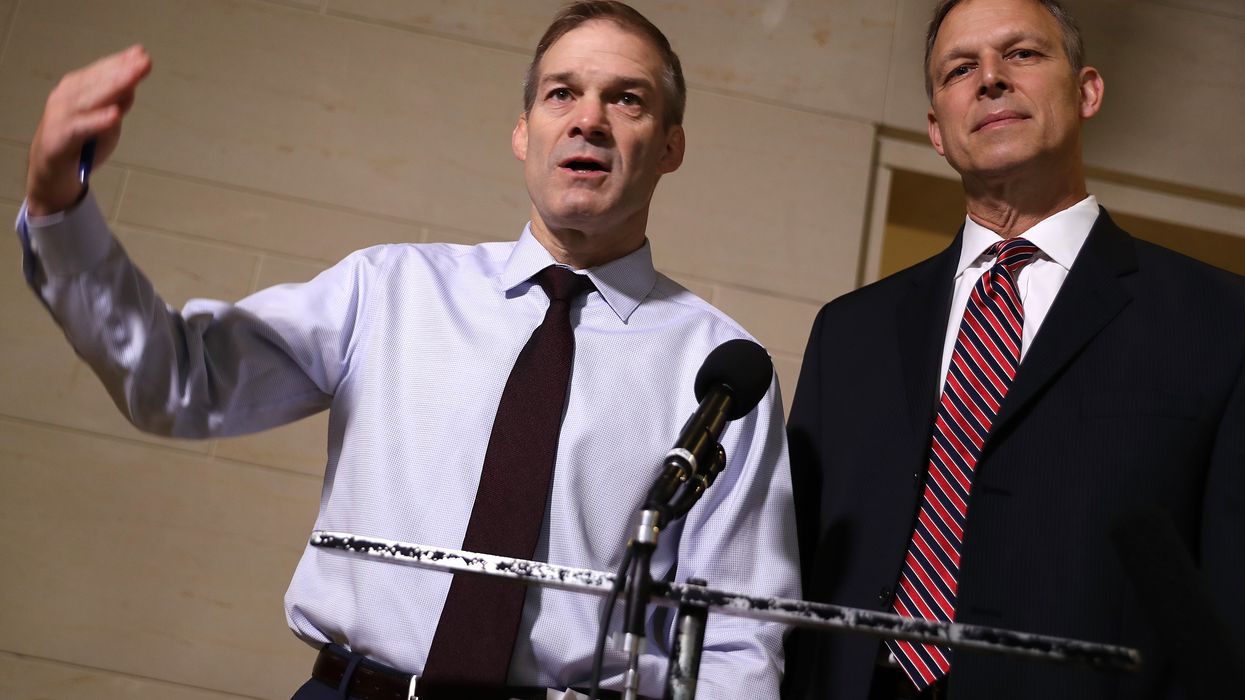
Far-right U.S. Rep. Jim Jordan, confronting two failed attempts to garner the support needed to be elected speaker of the House, intends to back a plan to empower Rep. Patrick McHenry—named speaker pro tempore earlier this month—to act as a temporary speaker until at least January 3, according to new reporting on Thursday.
The House held two votes for House speaker on Tuesday and Wednesday, with House Minority Leader Hakeem Jeffries (D-N.Y.) securing the support of all 212 Democrats—putting him just five votes away from the leadership position—and Jordan losing support from the first vote to the second. Twenty of his Republican colleagues opposed his bid on Tuesday and 22 voted against him the following day.
The Ohio Republican, a close ally of former President Donald Trump and a key player in efforts to challenge the 2020 presidential election, will attempt to build support for the remainder of the year if the party moves forward with the plan to empower McHenry (R-N.C.), who currently has no authority to conduct legislative business.
Jordan and allies who want to see him leading House Republicans have been accused of using "bullying" tactics in his effort to secure votes. The wife of Rep. Don Bacon (R-Neb.) received messages threatening her husband's political career and accusing him of causing "chaos" and failing to be "a team player" after Bacon voted against Jordan.
Fox News interviews with Jordan opponents have had a similar tenor, while Rep. Mariannette Miller-Meeks (R-Iowa) reported receiving "credible death threats and a barrage of threatening calls" and Rep. Drew Ferguson (R-Ga.) said he and his family got similar threats.
Republicans planned to hold an internal vote on whether to empower McHenry, the House Financial Services Committee chair and a close ally of ousted House Speaker Kevin McCarthy (R-Calif.), on Thursday afternoon.
Jeffries told reporters that he and other Democrats are also considering backing McHenry, saying the party wants to "stop Jim Jordan, who is a clear and present danger to our democracy."
The minority leader told members of the party that they should only support elevating a temporary speaker if they voted to certify the 2020 election, have a record of "standing up to extremism" and "governing," and supported the debt ceiling deal reached by the Biden administration and McCarthy in May, which was condemned by progressives as it scaled back food and housing aid, educational funding, and an Internal Revenue Service budget increase meant to stop tax evasion by the wealthiest Americans.
Progressive strategist Sawyer Hackett cautioned against some suggestions that McHenry would lead the party as a so-called "moderate."
"Let's be crystal clear: Patrick McHenry is only moderate in contrast to Jim Jordan," said Lisa Gilbert, executive vice president of consumer advocacy group Public Citizen. "He's tightly interwoven with the biggest banks—from pushing to undercut tougher capital standards to critiquing the [Securities and Exchange Commission]."
"His loyalty lies with corporate America," Gilbert said. "Not with the American people."
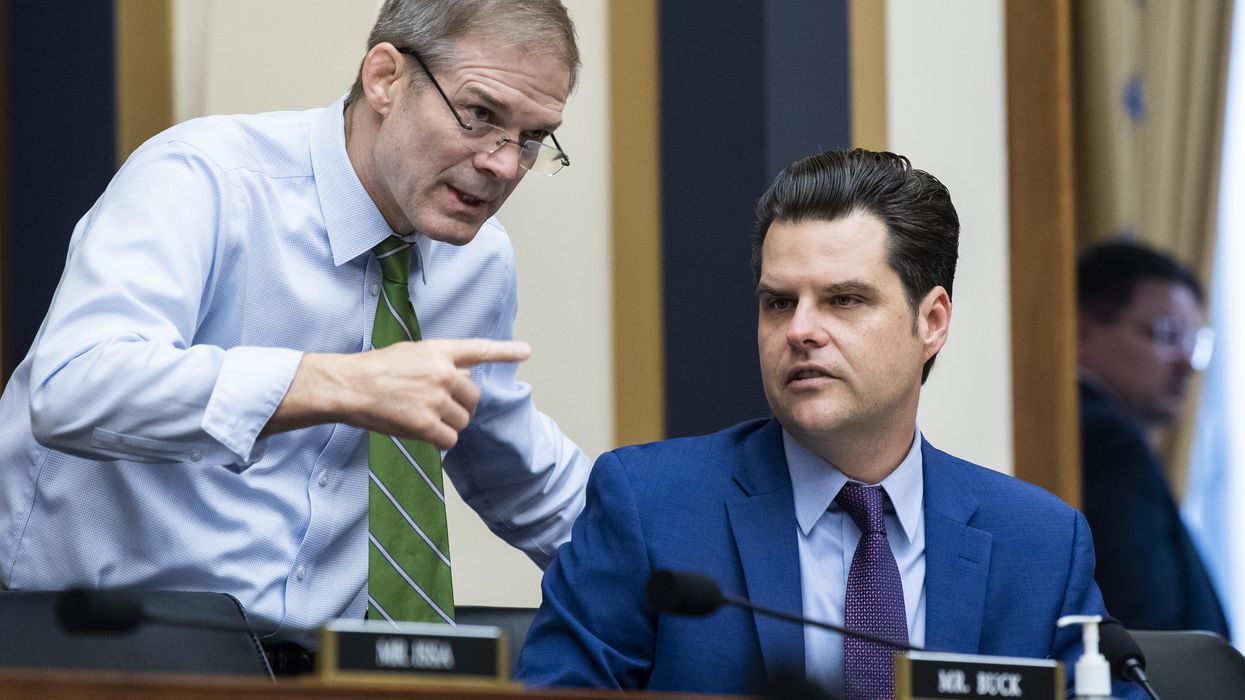
Far-right Rep. Matt Gaetz (R-Fla.), who led the effort to push McCarthy out of the speakership earlier this month and supported Jordan's bid, indicated he would not back the plan to empower McHenry.
Another Jordan ally, Rep. Jim Banks (R-Ind.), said the move would effectively "give the Democrats control of a Republican majority."
"Raise your hand if you DON'T want a speaker of the House who is hellbent on cutting your hard-earned Social Security and Medicare," said one Democratic state lawmaker.
In the midst of the second vote on U.S. Rep. Jim Jordan's nomination to be the next House Speaker on Wednesday, one right-wing lawmaker cut through the Republican infighting to remind his fellow GOP members of the common goal they share: cutting programs that millions of Americans rely on to obtain healthcare and afford their day-to-day expenses.
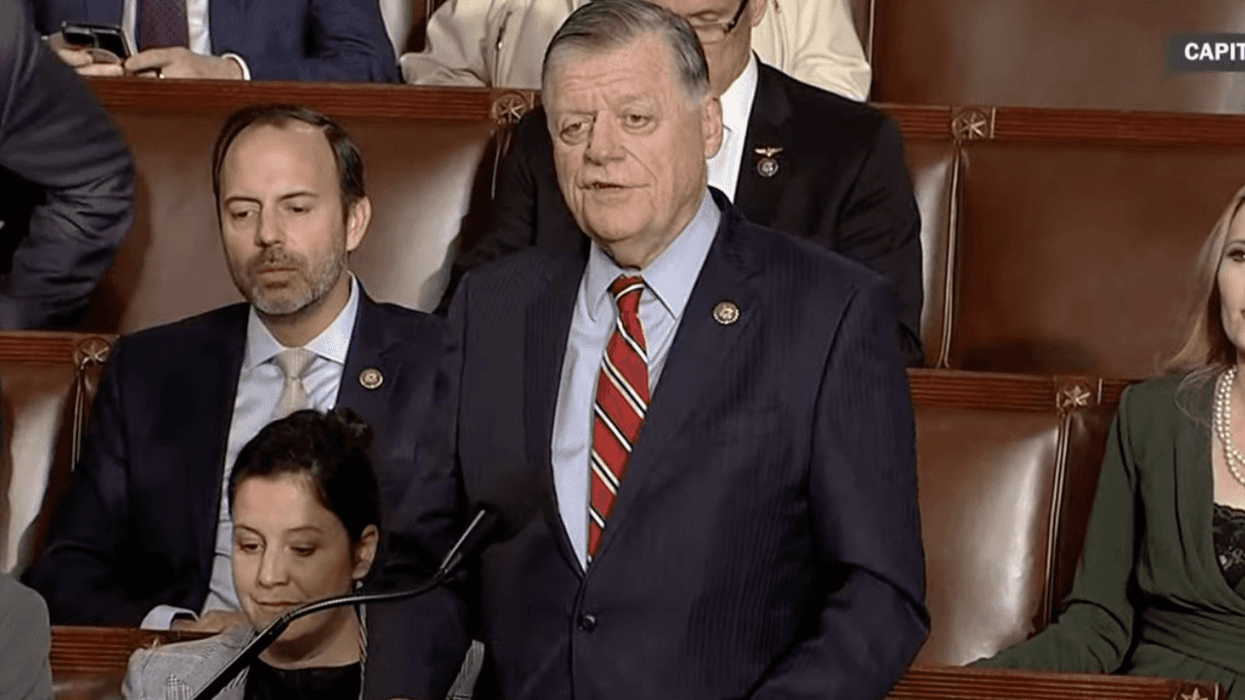
Speaking in favor of the Jordan, Rep. Tom Cole (R-Okla.) called on his colleagues to recognize the Ohio Republican's so-called "courage" in fighting "to get at the real drivers of debt, and we all know what they are. We all know it's Social Security, we all know it's Medicare, we all know it's Medicaid."
Cole recalled how he and former Rep. John Delaney (D-Md.) offered a proposal to make changes to Social Security akin to those made in 1983, when benefits for retirees were effectively cut by 13%.
"We never could get any help," Cole lamented. "[Jordan] is the guy that wants to create a debt commission, a bipartisan debt commission and get at the roots of our spending problem. That takes courage."
Progressives have long warned that as soon as they win the White House and majorities in the House and Senate, Republicans will not hesitate to slash Social Security and Medicare spending, and the party itself regularly claims the two programs are bankrupting the federal government—all while voting in favor of hundreds of billions of dollars in military spending.
Since Social Security is funded almost entirely through contributions of workers and employers, explains the advocacy group Social Security Works, the program does not contribute to the national deficit and "can never go bankrupt... Even if Congress were to take no action, Social Security could pay 100% of promised benefits for the next 12 years, and more than three-quarters of benefits after that."
Jordan, the group said on social media Wednesday as it posted the following image, supports plans to cut benefits by raising the retirement age to 70.

"Raise your hand if you DON'T want a speaker of the House who is hellbent on cutting your hard-earned Social Security and Medicare," tweeted Tennessee state Rep. Gloria Johnson (D-90).
While Republicans are not yet united around a speaker, said Social Security Works, "they are united on destroying our earned Social Security and Medicare benefits."
Nearly two dozen of Jordan's GOP colleagues opposed him for the leadership role.
An aggressive pressure campaign to convince holdouts in the Republican Party to back far-right Rep. Jim Jordan for House speaker on Wednesday was unsuccessful, with 22 GOP lawmakers voting against the Ohio congressman in the second round of voting—two more than the number that opposed him in the first vote Tuesday.
Jordan received 199 votes, while seven Republicans backed Rep. Steve Scalise (R-La.)—who withdrew from consideration last week shortly after being nominated—and five supported Rep. Kevin McCarthy (R-Calif.), who was ousted from the House speaker role earlier this month by a far-right faction in the party.
Others rejected Jordan—a close ally of former President Donald Trump who played a "significant" role in strategizing to challenge the 2020 election, according to the House January 6 Committee—in favor of former lawmakers who haven't held office in years and others who have not run to replace McCarthy, despite what some have called Jordan's "bullying" tactics to garner votes.
In addition to Trump ally Sean Hannity's interviews on Fox News in recent days in which the anchor has pointedly questioned members about their refusal to back Jordan, NBC News reported on Wednesday that the spouse of at least one Republican, Rep. Don Bacon of Nebraska, received anonymous messages threatening her husband's political career if he opposed the Ohio lawmaker.
"If House Republicans want to stand for their families to receive anonymous political threats every time their leadership wants to push a tough vote, they can vote Jordan," said Rep. Alexandria Ocasio-Cortez (D-N.Y.). "But they'd be fools to think this is the last time it happens. Members who vote for him affirm this kind of practice."
The threats didn't deter Bacon from supporting McCarthy in both rounds of voting so far.
Some of the nearly two dozen Republicans who opposed Jordan represent districts carried by Democratic President Joe Biden in 2020, while others sit on the House Appropriations Committee and "are deeply distrustful of Mr. Jordan's approach to spending and the types of cuts he has endorsed," The New York Times reported.
Progressives mocked a speech given by Rep. Tom Cole (R-Okla.) in favor of Jordan, in which he praised the congressman for having "the courage to talk about a long-term plan and to get at the real drivers of debt, and we all know what they are. We all know it's Social Security, we all know it's Medicare, we all know it's Medicaid."
The Congressional Progressive Caucus, whose members have repeatedly warned in recent years that the Republicans are planning to cut the broadly popular programs, called Cole's speech "a campaign ad for Democrats."
"Jim Jordan may never be speaker, but we should never forget the reasons so many Republicans wanted him for the role," said Rep. Jesús "Chuy" García (D-Ill.).
Progressives including Ocasio-Cortez have noted this week that while Republicans struggle to find a House speaker candidate who can convince 217 members of the party to back them, House Minority Leader Hakeem Jeffries (D-N.Y.) has all 212 Democrats in the House supporting him.
"Seems like we know who should be Speaker," said Rep. Pramila Jayapal (D-Wash.).
Jordan indicated after the second round of voting that he will continue vying for the leadership position.
"If elected speaker, Jordan would effectively give the House to Trump," said former Labor Secretary Robert Reich. "No alliance poses a greater threat to our democracy."
As the U.S. House began its latest voting process in an attempt to secure a speaker, progressive lawmakers made clear their view that Rep. Jim Jordan's history of spreading lies about the 2020 election and racist anti-immigration rhetoric disqualifies him from the role that would place him second in line for the presidency.
Not only that, said Rep. Cori Bush (D-Mo.) as the first round of voting got underway, but Jordan (R-Ohio) is "unfit to be in office."
Like other progressives have in recent days, Bush connected Jordan's refusal to accept former Republican President Donald Trump's loss in the 2020 election and his involvement in strategizing to challenge the election with the violent insurrection at the U.S. Capitol on January 6, 2021.
Jordan emerged on Friday as the latest candidate to lead Republicans in the House, where they hold a majority, after winning his party's nomination to replace former House Speaker Kevin McCarthy (R-Calif.) and beginning a pressure campaign to secure the 217 votes he needed to win the speakership.
Last week, Rep.Steve Scalise (R-La.) failed to garner the votes he needed, leading critics including Rep. Alexandria Ocasio-Cortez (D-N.Y.) to reason that House Minority Leader Hakeem Jeffries (D-N.Y.)—with all 212 Democrats supporting him—was far closer to gathering the support needed to win the speaker election.
Rep. Ilhan Omar (D-Minn.) repeated that sentiment on Tuesday, calling Jordan an "insurrectionist" and posting a video made by the Democratic Policy and Communications Committee which noted that in 17 years of public service, the lawmaker has never managed to get a bill signed into law or passed in the House.
"Rep. Jeffries has the votes if four Republicans work for the people," said Omar. "Americans deserve better than these political games."
Jordan, founder of the far-right House Freedom Caucus, quickly began a pressure campaign saying Republicans who wouldn't support him were harming the party and the country, with Fox News anchor Sean Hannity commencing "a thinly veiled pressure campaign by querying GOP House members about their refusal to support Jordan," as The Daily Beast reported.
Still, he failed to convince 20 of his GOP colleagues in the first round of voting on Tuesday afternoon, with several of the holdouts supporting Scalise and McCarthy. The vote placed Jordan further away from victory than McCarthy was in the first round of voting when he was eventually elected speaker in January; 19 Republicans opposed McCarthy in the first round, and lawmakers voted 15 times before McCarthy garnered enough support to win.
Jordan began speaking to the dissenters shortly after the first vote, while former U.S. Labor Secretary Robert Reich accused him of using "[Former President Donald] Trump's playbook to try to bully his way to victory."
"If elected speaker, Jordan would effectively give the House to Trump," said Reich. "No alliance poses a greater threat to our democracy."
Rep. Pete Aguilar (D-Calif.), who serves as chair of the House Democratic Caucus, urged his colleagues to vote against "the architect of a nationwide abortion ban, a vocal election denier, and an insurrection insider," saying elevating Jordan to the top House position would send "a terrible message to the country and our allies."
Ocasio-Cortez urged New York voters in districts represented by House Republicans to call their members and make their opposition to Jordan known.
"We will see if individuals like Mike Lawler or Marc Molinaro who represent New Yorkers in the Hudson Valley, the Catskills, Westchester County, will actually vote to install a man who voted to overturn the election and who supports a national abortion ban to be speaker of the House and second in line for the presidency," said Ocasio-Cortez Tuesday night on CNN. "I have my doubts that people in New York will stand for that."
Is that you, Kevin?
It has always been clear that a Republican takeover of the House of Representatives would signal real danger for American democracy. Last week’s drama surrounding Kevin McCarthy’s ascension to the House Speakership was a sideshow. The demands of the so-called “far-right” Gaetz Gang—“so-called” because the entire House Republican leadership and most of its members are far-right—for House rules changes was never a sincere effort to promote greater transparency and deliberation.
More important, the changes were always motivated by a genuine far-right agenda far beyond legislative “process”: to weaken the Biden administration and the Democratic Party, to harass and intimidate all so-called “deep state” agencies of the federal government, and to wage a culture war against liberalism.
"[ Republicans] cannot govern. But they do not seek to govern. They seek to lay waste to what they despise..."
McCarthy’s nauseating encomiums to “democracy” notwithstanding, it is now even clearer that what House Republicans have in store for us is a version of “democracy” best described by the influential, Carl Schmitt, whose political ideas helped to pave the way for the rise of Nazism in the 1930’s:
“Every actual democracy rests on the principle that not only are equals equals but unequals will not be treated equally. Democracy requires, first, homogeneity and second—if the need arises—elimination or eradication of heterogeneity . . . A democracy demonstrates its political power by knowing how to refuse or keep at bay something foreign and unequal that threatens its homogeneity.”
This is precisely what the new McCarthyism promises: the investigation, punishment, and suppression, if not the more ominous “eradication,” of what is “foreign” and “threatening” to the MAGA vision: the Democratic Party, liberalism and progressivism in all of its variations, and especially “wokeness” as it has supposedly corrupted and debased all educational, scientific, and legal institutions. And while McCarthy himself speaks out of both sides of his mouth—playing to his red base while also pretending to be “moderate”—his entire leadership team, with his blessing, is already laying the foundation for this latest MAGA assault on liberal democracy.
Exhibit 1: News outlets report that plans are underway for the House Armed Services Committee to investigate and purge “wokeness” in the armed forces. Rep. Mike Rogers—the so-called “moderate” that assaulted Matt Gaetz on the House floor after McCarthy’s failed fourteenth ballot last week—is in line to assume the chairmanship of the Committee. And he has already declared: “All this wokeness in the military, we are going to be aggressively trying to root that stuff out.” As Paul Waldman has pointed out, there is absolutely no evidence that the U.S. military is overtaken with “wokeness.” But there is a great fear on the right that traditional gender norms, and especially conceptions of “masculinity,” have been waning in society at large, including the military, and this fear is being stoked daily by Tucker Carlson, Laura Ingraham, and a host of other right-wing media personalities. And so it is now Republican dogma that liberal gender norms, and the protections they offer to many citizens, must be eradicated. This obviously represents a threat to women, LGBTQ individuals, and perhaps even ethnic and racial minorities. But it also represents a threat to all of those inside the military, in the officer corps and in the military academies and educational institutions, who are working to create a culture of greater tolerance and understanding of the world. In short, it represents a threat to the very practice of military professionalism.
We can thus look forward to Benghazi-like hearings in which General Milley and a range of other military leaders who have refused to follow the example of Mike Flynn will be subjected to public inquisition and debasement.
Exhibit 2: Sunday’s Tweet from Rep. Steve Scalise, McCarthy’s loyal lieutenant who will now step into the role of House Majority Leader:
Every one of these promises represents an attack on the federal government. The “SPR oil sales” is a nod to the investigation of Hunter Biden and on Joe Biden himself (the logic of this is laid out in Barton Gellman’s recent Atlanticpiece, “The Impeachment of Joe Biden”). And items two and four are clearly aimed at the Justice Department’s investigations and prosecutions of the January 6, 2021 insurrection, including its cases against Donald Trump, and is possibly also aimed at the House January 6 Committee itself (promised by McCarthy back in November).
Exhibit 3: The “committee on the weaponization of the federal government against citizens” is a very serious, and ominous, initiative that is clearly intended to counter, and undermine, the now-terminated January 6 Committee. The new committee, a subcommittee of the House Judiciary Committee, will be chaired by Judiciary Chair Jim Jordan. As the New York Times reports, the Republican initiative will grant Jordan extensive power:
“authority to subpoena the Justice Department for information about the special counsel inquiry into Mr. Trump’s attempts to overturn the 2020 election and his handling of classified documents, along with other politically charged matters like an open tax investigation into President Biden’s son, Hunter Biden . . . [it] would also grant Mr. Jordan’s panel the power to receive the same highly classified information that intelligence agencies make available to their oversight committee, the House Permanent Select Committee on Intelligence.”
This committee is being promoted by Republicans as “a new Church Committee.” But it is likely to be more similar to the infamous House Un-American Activities Committee which, along with the Senate Permanent Subcommittee on Investigations chaired by the infamous Joseph McCarthy, contributed immeasurably to the evisceration of civil liberties during the 1950’s, and indeed created a new term in the lexicon of American politics: “McCarthyism.” When the records of McCarthy’s closed, executive sessions were finally made public by the Senate in 2004, Senators Carl Levin and Susan Collins issued this statement:
“Senator McCarthy’s zeal to uncover subversion and espionage led to disturbing excesses. His browbeating tactics destroyed careers of people who were not involved in the infiltration of our government. His freewheeling style caused both the Senate and the Subcommittee to revise the rules governing future investigations, and prompted the courts to act to protect the Constitutional rights of witnesses at Congressional hearings. … These hearings are a part of our national past that we can neither afford to forget nor permit to re-occur.”
It is very clear that this past is now prologue.
House Republicans are taking aim at the Biden administration; the Democratic Party, including their own Democratic colleagues; and a wide range of governmental institutions deemed “tyrannical.” They will use their investigative and subpoena power to destroy individuals, disrupt the process of government, attack opponents, and delegitimize the very institutions of liberal democracy. And they will be aided, abetted, and incited by a far-reaching network of media institutions and social media platforms.
They cannot govern. But they do not seek to govern. They seek to lay waste to what they despise, and especially anything that is “foreign” to their perverse idea of “American Greatness.” What they despise is nothing less than political pluralism and liberal democracy itself.
When Marjorie Taylor Greene is the pivot on which "the mainstream" turns, then what exactly has the "mainstream" become?
After a bitter, grueling, melodramatic and days-long contest on the House floor, Kevin McCarthy was finally elected as Speaker of the House just after the clock struck midnight on the early morning of January 7.
His “far-right” Republican opponents, led by Matt Gaetz and Lauren Boebert, relented, after fourteen ballots, by voting “present” rather than for an alternative, as they had thirteen previous times. Gaetz in particular played his opposition for all it was worth. While it remains to be seen exactly what concessions McCarthy made to Gaetz and his gang—who numbered anywhere from 6 to 20 as the process unfolded—it is clear that huge concessions were made, related to House rules, committee assignments, and perhaps even the vigor with which the Republican Inquisition of both Biden and the entire federal government will now proceed (that such an Inquisition would the first order of Republican business has never been in doubt).
Every fracture and every contest within the Republican party matters, for the effectiveness (and vulnerabilities) of that party and for the workings of the government. But much too much is being made of the contest between McCarthy and the opponents–Republicans all–who held up his ascension for fourteen ballots before giving their very visible tacit consent.
The desire to see the Gaetzes of the world as crazy extremists beyond the pale runs so deep among the commentariat that even the very best pundits fall prey to it.
The desire to see the Gaetzes of the world as crazy extremists beyond the pale runs so deep among the commentariat that even the very best pundits fall prey to it. A case in point: Saturday’s Washington Post column by E.J. Dionne, Jr., one of the sharpest liberal writers in the country (full disclosure: he is a friend), entitled “How the right took joy and profit in McCarthy’s misery.” It might be possible to chalk up the piece’s unfortunate headline–which counterposes McCarthy and “the right”—to the work of a creative Post editor, were it not for the fact that the entire piece centers on this very contrast, pitting “members of an extreme minority” against “McCarthy and his lieutenants.”
That these cliques disagreed is obvious. And Dionne is surely correct to note that 90% of the House Republican caucus supported McCarthy and rejected every candidate advanced by his opponents. But he is seriously wrong to regard this contest between these two unevenly divided Republican factions as a contest between extremist ideologues and more mainstream politicians interested in bargaining with others and serious about what he calls “normal governance.”
Dionne, acknowledging that much of the opposition to McCarthy was personal, nonetheless insists:
“But all of the initial holdouts were motivated by a sense of grievance against what most everyone else sees as mainstream politics; a longing for government shrunken to pre-New Deal levels; an insistence that Washington is an alien place; and a view of “the people” shaped by those who nominate, elect and sustain them in office — and pretty much no one else.”
The clear implication is that those who the “holdouts” were opposing—McCarthy and his roughly 200 Republican supporters—were not motivated by this “sense of grievance,” were not interested in turning back the clock on the New Deal (and let’s not forget the sixties especially not hatred of Obama), and were committed instead to “what most everyone else sees as mainstream politics.”
Dionne goes on to note, as he has analyzed in a number of books, that the Republican Party has shifted far to the right in recent decades. But he still insists on regarding McCarthy and his lieutenants as “mainstream” politicians rather than “right-wing extremists.”
The problem is that McCarthy’s “chief lieutenants”—Steve Scalise, Elise Stefaniak, and Jim Jordan—are right-wing extremists, and that the person who did the most to finally convince “the holdouts” to cease their opposition to McCarthy was none other than Marjorie Taylor Greene, who apparently took a phone call from Donald Trump that eventually persuaded Gaetz and his “Never Kevins” to stop opposing “My Kevin.” When Marjorie Taylor Greene is the pivot on which “the mainstream” turns, then said mainstream has been become pretty “extreme.”
When Marjorie Taylor Greene is the pivot on which “the mainstream” turns, then said mainstream has been become pretty “extreme.”
Jim Jordan, after all, is one of the founders and leaders of the so-called “Freedom Caucus” that is responsible for pushing the Republican party far to the right and into the arms of Trump. Jordan did not need pressure from Gaetz to make very clear, many months and perhaps even years ago, that if Republicans retook the House he was determined to use his control of the House Judiciary Committee to launch investigations against the White House, Anthony Fauci, the Justice Department, the FBI, and perhaps even the now-defunct House Select January 6 Committee.
Indeed, McCarthy himself has long threatened the impeachment of Homeland Security Secretary Alejandro N. Mayorkas, declaring only months ago before television cameras that “if Secretary Mayorkas does not resign, House Republicans will investigate every order, every action and every failure, and will determine whether we can begin an impeachment inquiry.”
The morning after his election as Speaker, McCarthy went out of his way to thank “President Trump” for his support, stating forthrightly that “I don’t think anybody should doubt his influence. He was with me from the very beginning—he was all in.”
Is Trump now to be considered “mainstream?”
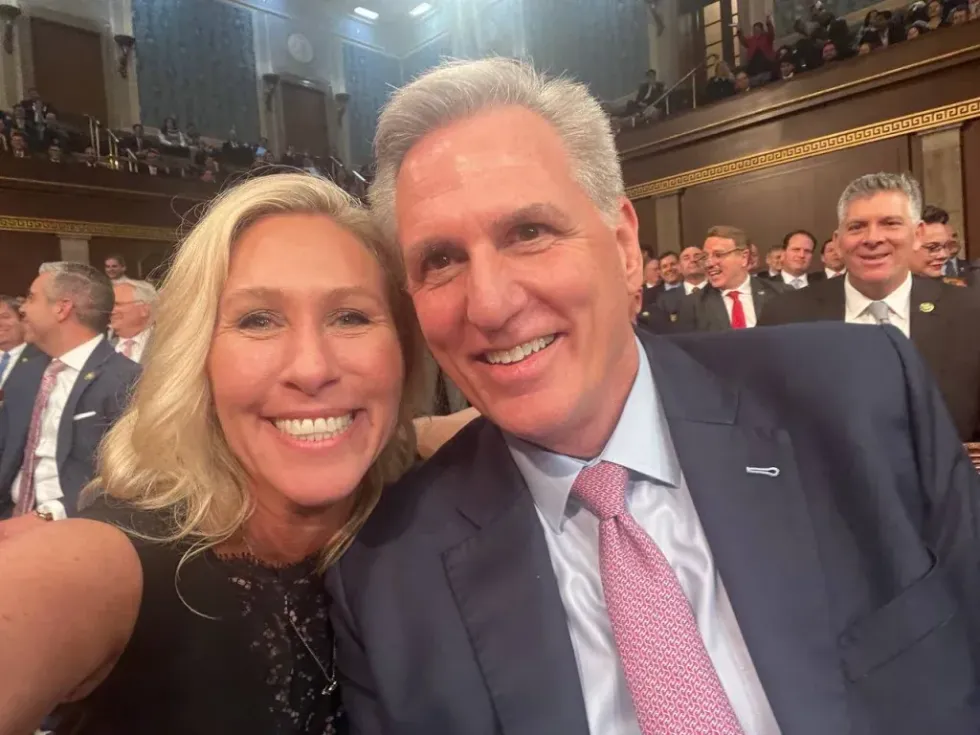
It seems appropriate to leave the last word on this to Marjorie Taylor Greene, who on the afternoon of January 6, in the middle of the Speaker contest, posted a link on her Twitter feed to an interview she had given explaining “the REAL story of January 6, 2021” which centered on the allegation that “federal agents” were “involved in the planning and execution of J6,” and then two hours later posted the following photo under the caption “Congratulations Mr. Speaker!”:

So in the end, Greene and Trump persuaded Gaetz and Boebert to assent to the Speakership of McCarthy.
Who are the extremists?
Who caved to whom?
What we saw this week is a preview of much worse to come, with or without McCarthy as figurehead speaker.
I’d wondered how Republicans would mark the anniversary of the January 6 attack on the U.S. Capitol. Then untarnishable Florida Man Matt Gaetz and his freedom contras reenacted it by other means this week. This insurrection is from within. It’s just starting.
Kevin McCarthy, the wobbliest amoeba to be elected Speaker and stand third in line for the presidency, got his prize by sacrificing it. There is no Speakership anymore except in name.
Any single member of the House can now call for the speaker’s ouster whenever they choose. Previously, only party leaders could. Insurrectionists got their pick of crucial committee assignments. They’ll dictate what bills get to the floor, rig any bill with whatever suicidal amendment they choose, kill any spending bill they don’t like. These 20 insurrectionists with neither congressional seniority nor accomplishments to their names will sabotage committees, Congress and country from weaponized backbenches, with their party’s blessing. Is anybody surprised?
McCarthy surrendered gavel for grovel.
Lost in the din is the very unusual bipartisan success of the two years of the 117th Congress that just ended. Democrats and Republicans combined to give us laws that protect gay marriage. They gave us the largest infrastructure bill and largest government investment in research and development in decades. They gave us tighter background checks on younger people buying guns. And they gave us a law that changed the way electoral votes are counted so people like Donald Trump couldn’t attempt the kind of coup he did two years ago by fabricating constitutional clauses the way he does his tax returns.
Every one of these laws drew a dozen or more Republican senators and quite a few Republican House members, too. It was one of the most productive congresses in not-so recent years. Now the barbarians are back in charge. It only takes a few, if the rest of them allow it. That’s the thing: we keep hearing that the 20 insurrectionists are a tiny minority. But they’re the core of Republican ideology, such as it is. They couldn’t get away with their stunts if they didn’t represent a constituency reflecting the anarchy. It’s Trumpism on steroids. It can only end one way. The Republicans had yet to swear-in their new House majority before they turned the whole thing into Jonestown. You remember Jonestown, don’t you, the town the paranoid California preacher and power-mad Jim Jones established in the jungles of Guyana with about 900 of his more gullible church flock, first taking their savings then taking their lives in a mass murder-suicide in 1979. That’s where the expression drinking the kool aid comes from, because he had everyone drink cyanide mixed in with kool aid as he drilled their souls with conspiracies all around. Jones was a QAnon stem cell.
It’s Trumpism on steroids. It can only end one way.
You know Republicans have gone Jonestown when the likes of Marjorie Taylor Green and action-figure Trump end up sounding like their most reasonable voices. Here those two were this week, begging the monsters they created to calm down at least long enough to elect that other Californian while Gaetz’s horde played what Green herself called “Russian Roulette” with their newly gained power. Republicans know suicide.
Lost in the din, too, is the scum pond that “Freedom Caucus” crawled out of a few years ago. One of its founding members was none other than Ron DeSantis, the Guantanamo graduate who’d have been standing right along Gaetz and other insurrectionists this week had he not become Florida’s doubleplus caudillo-in-chief. Every time DeSantis speaks the word “freedom”–as he did 12 times in his inaugural address Tuesday–another liberty loses its wings.
Like the speakership, the word freedom has lost its meaning, though in fairness to DeSantis he’s only applying the Grand Old Party’s stately definition of the word, coined by Ronald Reagan, that unassailable freedom-loving deity, when he called the rapists, terrorists and mass murderers of Central America “freedom fighters.”
“Freedom lives here,” DeSantis told us Tuesday, the way it does in the Republican House: The 20 nut cases holding it hostage are the party’s purest, and purist, expression.
If their fight was about ideas, policies, even principles, even I’d cheer it on. But it’s none of those things. Right wing Republicans have no ideas. No idea, period. Not that moderates have been doing much better. The GOP hasn’t had a single new idea in 30 years, other than lowering taxes and defeating every social and ecological initiative possible while rolling back the hard-won civil rights and liberties of the Warren Court. It’s reactionary ideology: opposition for its own sake, a black and white, all or nothing approach that sees treachery in compromise and an enemy behind every moderate, when compromise and moderation are the essence of American democracy at its best. It was Mitch McConnell, remember, who explicitly put that in words when, as Senate majority leader, he said his only aim in 2010 was to make Obama a one-term president. Accomplishments be damned. The extremists’ nihilism today is not materially different. They’re not about achieving the country. They’re about destruction, their mentality comparable, again, only to the psyche of the suicide bomber, this one wearing a bright red maga hat.
What we saw this week is a preview of much worse to come, with or without McCarthy as figurehead speaker. There’s nothing to cheer here, not for anyone who cares about this country. Not as long as Maga’s white-collar insurrectionists are calling the shots.
The final vote followed a dramatic 14th ballot vote in which tensions soared on the floor of the House chamber.
After nearly a week of chaotic voting on the floor of the U.S. House of Representatives, Republican Kevin McCarthy of California was elected Speaker of the House of the 118th Congress just after midnight early Saturday morning after finally securing enough votes in the 15th ballot.
The final tally was 216 votes for McCarthy and 212 votes for Democrat Hakeem Jeffries of New York, after 6 far-right holdouts, including Rep. Matt Gaetz (R-Fla.), lowered the threshold to secure the speakership by voting "present" instead of registering a vote for another GOP member.
"McCarthy made dangerous concessions to the most fringe members of the House in exchange for their support in his effort to become Speaker."
Progressive critics responded to the final vote by noting the price paid to win over the hostage-takers in the Republican conference.
"Kevin McCarthy has repeatedly put his personal ambitions ahead of our democracy," said Sean Eldridge, president of Stand Up America, referencing the GOP leader's membership in the "Sedition Caucus" to whom he said the new speaker had "sold his soul."
"He voted against certifying President Biden's victory and obstructed the investigation into the January 6 attack on our country," Eldridge said.
Eldridge noted that over 70% of the current GOP conference in the House "are election deniers, including every single member of GOP leadership." That fact, he said, "should be chilling to every American who cares about protecting our democracy and our freedoms."
"This week," said Eldridge, "McCarthy made dangerous concessions to the most fringe members of the House in exchange for their support in his effort to become Speaker. The punishment for his political cowardice will be presiding over the GOP's conference of chaos for the next two years. Unfortunately, it's the American people who will pay the price."
The 15th ballot followed a dramatic 14th ballot vote in which tensions soared on the floor of the House chamber.
The nearly five-day battle for the speakership is over.
They may be wearing suits and carrying briefcases, but this is a mob just the same—a dangerous one.
It’s the afternoon of January 6. There is chaos on the floor of the House of Representatives, and the business of Congress is stalled. Will the meeting be adjourned so that leaders can figure out whether and how it might be possible to restore normal order, so that the business of the House can be resumed?
Back in 2021 these questions arose in the most dramatic way imaginable, in response to the insurrectionary invasion of the Capitol building by an angry ragtag mob seeking to attack public officials deemed “disloyal” and to undermine the democratic election of Joe Biden as president.
It’s now 2023, and the outcome of another election is unfolding at the Capitol. Again a right-wing mob is attempting to seize control of the House floor in order to hijack the political system. But this time the mob consists of besuited Republican politicians recently elected to the House.
The chaos we are now witnessing centers on the inability of the newly elected Republican majority to agree on a new Speaker of the House. The mainstream media has focused obsessively on the dramatic confrontation between Republican leader Kevin McCarthy and a small group of self-styled “change agents,” led by Matt Gaetz and Lauren Boebert, willing to delay indefinitely the normal business of the House in order to obstruct McCarthy’s ascension to the Speakership. This obstruction is figured as “extremist,” and the effort to codify Republican control of the House and “get back to business” is regarded as “normal.” The obstructionists are figured as “radicals” and the supporters of McCarthy as “moderates.”
Pundits on CNN and MSNBC breathlessly wonder whether McCarthy can “get control of the extremist wing of his party.” And every time they wonder, they lend a patina of respectability to McCarthy and his supporters, and obscure the fact that every House Republican, on either side of this dispute, is an extremist, the differences between them miniscule and largely personalist.
Through thirteen rounds of House voting, each one followed by more McCarthy concessions, this has been made increasingly clear, and indeed it has been stated, explicitly, by every Republican who has risen to speak in support of McCarthy: the real “enemy” of them all is Biden and his supposedly critical race theorizing, open border loving, and freedom hating liberal supporters. And so they should “reach across the aisle,” and join together as America-loving Republicans, to vanquish their “Democrat” foes, “enemies of the people” all.
Let us not forget that on the evening of January 6, 2021, when the House finally reconvened hours after members had fled the chamber and the building in fear for their lives, 139 House Republicans—two thirds of the caucus– voted to overturn the election results in order to nullify Joe Biden’s election. Among them were the four top leaders of the current Republican caucus who are now being touted as “institutionalists”—Steve Scalise, Elise Stefaniak, Jim Jordan, and Kevin McCarthy himself.
Since last November’s washout of the so-called Republican “red wave,” it has become fashionable to say that the electorate had decisively repudiated “election denialism.” And it is true that almost all of the most extreme election deniers endorsed by Trump, especially at the state level, were defeated. But, as the Washington Post’s Philip Bump has shown, “House Republicans who opposed 2020 electoral vote paid no price,” and indeed almost every single one of them who ran for reelection—over a hundred– was successful. Indeed, according to the Huffpost, when newly-elected Republicans are added in, the number of election deniers in the 2023 House rises to as many as 170—more than the number who voted to overturn Biden’s election in 2020.
On January 3, the Post’s Amy Gardner reported that “all but two of the 20 Republican House members who voted against Kevin McCarthy . . . are election deniers who embraced former President Donald Trump’s false claims that the 2020 election was rigged.” This may be true. But it is also true that all but a handful or two of the House Republicans who voted for McCarthy were also election deniers and in effect still are election deniers.
To put this more bluntly: the idea that the Biden presidency, and indeed Democratic political power more generally, is illegitimate, and must be reversed by a combination of culture war and dramatic changes to election law—this idea is the common sense, and indeed the catechism, of the entire current Republican party.
Kevin McCarthy and Jim Jordan and their crowd are not eager to become the official leaders of the House so that they can promote a coherent policy agenda. They are eager to assume the reins of power so that they can do what they have long said they wanted to do: relentlessly stymie, investigate, and hound the Biden administration, the Justice Department, the FBI, and the Centers for Disease Control, and more generally to undermine what they call “the deep state.” If there is any distance between McCarthy supporters and “Never Kevins,” it is only that the latter are eager to proceed in an even more fanatical way (one MSNBC journalist just reported that one of McCarthy’s “concessions” to his opponents was an agreement to support the impeachment of Secretary of Homeland Security Alejandro Mayorkas–something that McCarthy himself threatened last November).
The distance between the “original” January 6—2021—and today is not very great at all.
As the House Selection January 6 Committee Report now makes clear, the violent assault of the mob on the Capitol that day was the culmination of a very extensive effort by Trump and his supporters to use a range of legal and extra-legal means to stay in power. The violence was rather quickly seen as excessive by almost all Republican members of Congress—no doubt because it threatened their very lives—if only for a while (within days they were walking back their criticisms of Trump, then opposing his impeachment, and then eventually kissing his ring at Mar-a-Lago). But it has long been clear that the primary means by which the Republican party seeks to weaken political opposition, cement its own power, and thereby limit democracy, are legal or quasi-legal means—through federal and state law, court rulings, and executive power when they control it. And the key to this agenda is the weakening and the delegitimation of the Biden administration, the Democratic party, and liberal democracy itself. Control of the House of Representatives is now central to this. On this all the House Republicans now squabbling about titles and rules and committee assignments agree.
There may be differences among them. But when it comes to their hostility to liberal democracy, they are united. They may be wearing suits and carrying briefcases. But they are a mob, and they are dangerous.
The far-right Opposed-to-Big-Government cultists are dead set on destroying the working class.
While Kevin McCarthy’s struggle to become Speaker of the House of Representatives appears to be about personality and struggles within the House Republican caucus, it’s really about something much larger: the fate and future of American “big government” and the middle class it created.
Ever since the Reagan Revolution, the phrase “big government” has been on the lips of Republican politicians. They utter it like a curse at every opportunity.
It seems paradoxical: Republicans complain about “big government,” but then go on to support more and more government money for expanding prisons and a bloated Pentagon budget. Once you understand their worldview, however, it all makes perfect sense.
First, some background.
From the founding of our republic through the early 1930s the American middle class was relatively small. It was almost entirely made up of the professional and mercantile class: doctors, lawyers, shop-owners and the like. Only a tiny percentage of Americans were what we would today call middle class.
Factory workers, farmers, carpenters, plumbers, and pretty much all manner of “unskilled laborers” were the working poor rather than the middle class. Most neighborhoods across America had a quality of life even lower than what today we would call “ghettos.”
As recently as 1900, for example, women couldn’t vote, senators were appointed by the wealthiest power brokers in the states, and poverty stalked America.
There was no minimum wage; when workers tried to organize unions, police would help employers beat or even murder their ringleaders; and social safety net programs like unemployment insurance, Social Security, public schools, Medicare, food and housing supports, and Medicaid didn’t exist.
There was no income tax to pay for such programs, and federal receipts were a mere 3 percent of GDP (today its around 20 percent). As the President’s Council of Economic Advisors noted in their 2000 Annual Report:
“To appreciate how far we have come, it is instructive to look back on what American life was like in 1900. At the turn of the century, fewer than 10 percent of homes had electricity, and fewer than 2 percent of people had telephones. An automobile was a luxury that only the very wealthy could afford.
“Many women still sewed their own clothes and gave birth at home. Because chlorination had not yet been introduced and water filtration was rare, typhoid fever, spread by contaminated water, was a common affliction. One in 10 children died in infancy. Average life expectancy in the United States was a mere 47 years.
“Fewer than 14 percent of Americans graduated from high school. ... Widowhood was far more common than divorce. The average household had close to five members, and a fifth of all households had seven or more. …
“Average income per capita, in 1999 dollars, was about $4,200. … The typical workweek in manufacturing was about 50 hours, 20 percent longer than the average today.”
The Republican Great Depression of the 1930s, though, was a huge wake-up call for American voters, answered by President Franklin D. Roosevelt.
His New Deal programs brought us, for the first time, “big government” and the people loved it. They elected him President of the United States four times!
FDR created Social Security, unemployment insurance, guaranteed the right to unionize, outlawed child labor, regulated big business by creating the Securities and Exchange Commission (SEC) and other agencies, and funded infrastructure across the country from roads to bridges to dams and power stations.
He raised taxes on the morbidly rich all the way up to 90% and used that money to build schools and hospitals across the nation. He brought electricity to rural parts of the country, and put literally millions to work in various “big government” programs.
“Big government,” in other words, created the modern American middle-class.
By the 1950s a strong middle class representing almost half of Americans had emerged for the first time in American history.
By the late 1970s it was around 65 percent of us.
And that’s when the billionaires (then merely multimillionaires) decided enough was enough and got to work.
In 1980, David Koch ran for vice president with the Libertarian Party, an organization created by the real estate lobby to give an air of legitimacy to their efforts to outlaw rent control and end government regulation of their industry.
His platform included a whole series of positions that were specifically designed to roll back and gut FDR’s “big government” programs (along with those added on by both Nixon and LBJ’s Great Society) that had created and then sustained America’s 20th century middle class:
— “We urge the repeal of federal campaign finance laws, and the immediate abolition of the despotic Federal Election Commission.
— “We favor the abolition of Medicare and Medicaid programs.
— “We oppose any compulsory insurance or tax-supported plan to provide health services, including those which finance abortion services.
— “We also favor the deregulation of the medical insurance industry.
— “We favor the repeal of the fraudulent, virtually bankrupt, and increasingly oppressive Social Security system. Pending that repeal, participation in Social Security should be made voluntary.
— “We propose the abolition of the governmental Postal Service.
— “We oppose all personal and corporate income taxation, including capital gains taxes.
— “We support the eventual repeal of all taxation.
— “As an interim measure, all criminal and civil sanctions against tax evasion should be terminated immediately.
— “We support repeal of all law which impede the ability of any person to find employment, such as minimum wage laws.
— “We advocate the complete separation of education and State. Government schools lead to the indoctrination of children and interfere with the free choice of individuals. Government ownership, operation, regulation, and subsidy of schools and colleges should be ended.
— “We condemn compulsory education laws … and we call for the immediate repeal of such laws.
— “We support the repeal of all taxes on the income or property of private schools, whether profit or non-profit.
— “We support the abolition of the Environmental Protection Agency.”
— “We support abolition of the Department of Energy.
— “We call for the dissolution of all government agencies concerned with transportation, including the Department of Transportation.
— “We demand the return of America’s railroad system to private ownership. We call for the privatization of the public roads and national highway system.
— “We specifically oppose laws requiring an individual to buy or use so-called ‘self-protection’ equipment such as safety belts, air bags, or crash helmets.
— “We advocate the abolition of the Federal Aviation Administration.
— “We advocate the abolition of the Food and Drug Administration.
— “We support an end to all subsidies for child-bearing built into our present laws, including all welfare plans and the provision of tax-supported services for children.
— “We oppose all government welfare, relief projects, and ‘aid to the poor’ programs. All these government programs are privacy-invading, paternalistic, demeaning, and inefficient. The proper source of help for such persons is the voluntary efforts of private groups and individuals.
— “We call for the privatization of the inland waterways, and of the distribution system that brings water to industry, agriculture and households.
— “We call for the repeal of the Occupational Safety and Health Act.
— “We call for the abolition of the Consumer Product Safety Commission.
— “We support the repeal of all state usury laws.”
Today’s challenges to Kevin McCarthy are mostly coming from members of the Republican House Freedom Caucus, pretty much a reinvention of the Tea Party Caucus, funded in substantial part by rightwing billionaires and CEOs who share the late David Koch’s worldview.
The world is made up of “makers” and “takers,” they’ll tell you. The billionaire “job creators” shouldn’t be taxed to support the “moochers” who demand everything from union rights to a living wage to free college.
Why, these Freedom Caucus members ask, should their billionaire patrons be forced — at the barrel of an IRS agent’s gun! — to pay taxes to support the ungrateful masses through “big government” programs? Isn’t it up to each of us to make our own fortunes? Wasn’t Darwin right?
These Republicans believe our government should really only have a few simple mandates: maintain a strong military, tough cops, and a court system to protect their economic empires.
That’s why they’ll support massive prison expansions and nosebleed levels of pentagon spending but (metaphorically) fight to the death to prevent an expansion of Social Security or food stamps.
And that’s why they hate Kevin McCarthy.
In the past, McCarthy has shown a willingness to compromise and negotiate with Democrats. Most recently, as Congressman Chip Roy pointed out on the House floor yesterday when nominating Byron Donalds to replace McCarthy, he failed to block the $1.7 trillion omnibus bill through Congress that was loaded with what rightwing billionaires consider “freebies” for “taker” and “moocher” Americans.
It appears all or nearly all of the Freedom Caucus members, dancing to the tune first played by David Koch, don’t believe in our current form of American government. They want us to go back to the pre-1930s America, before FDR’s New Deal.
Those were the halcyon days when workers cowered before their employers, women and minorities knew their places, and government didn’t interfere with the business of dynasty-building even when it meant poisoning entire communities and crushing small businesses.
They appear to agree with the majority of the Supreme Court Republicans who recently began dismantling the “big government” administrative state by ending the EPA’s power to regulate greenhouse gasses.
They’ve already succeeded, over the past 40 years of the Reagan Revolution, at whittling the middle class down from 65 percent of us to around 45 percent of us: NPR commemorated it in 2015 with the headline: “The Tipping Point: Most Americans No Longer Are Middle Class.”
Now they want even more poverty for workers and more riches for their morbidly rich funders, and don’t believe that “moderate” Republicans will get them there. As Ginni Thomas and a pantheon of “conservative” luminaries wrote yesterday in an open letter opposing McCarthy’s speakership:
“[H]e has failed to answer for, or commit to halting, his coordinated efforts in the 2022 elections to promote moderate Republican candidates over conservatives.”
The “conservative” Republicans have already announced that once they get their act together in Congress with a new speaker, their first order of business is going to be to cut more taxes on billionaires.
While the battle for House Speaker appears to be about personality, it’s really about ideology and policy. It’s about the future of “big government” and whether or not we will continue to have an American middle class.
And as long as Libertarian-leaning billionaires continue pouring cash into the campaigns and lifestyles of Republican members of Congress, this battle that’s been going on for over 40 years to tear apart the American middle-class is not going to end or go away any day soon.