

SUBSCRIBE TO OUR FREE NEWSLETTER
Daily news & progressive opinion—funded by the people, not the corporations—delivered straight to your inbox.
5
#000000
#FFFFFF
To donate by check, phone, or other method, see our More Ways to Give page.
Daily news & progressive opinion—funded by the people, not the corporations—delivered straight to your inbox.

The clock is ticking. Young borrowers must not lose out on urgently-needed debt relief should November bring a new administration.
Exactly one year ago, President Joe Biden stood before the American people after the politicized U.S. Supreme Court ripped away critical student debt relief from 40 million borrowers. The President reaffirmed his commitment to cancel student debt and pledged to use different authority under the Higher Education Act. Since then, President Biden has worked arduously to deliver debt relief to nearly 5 million student loan borrowers by making critical fixes to loan relief programs. But now, in nearly identically timed releases, federal judges in Kansas and Missouri issued a pair of injunctions blocking portions of the new Saving on a Valuable Education repayment plan (the SAVE plan)—making President Biden’s promise of relief more critical than ever.
Biden’s fixes to Public Service Loan Forgiveness and the Income-Driven Repayment Account Adjustment gave millions of borrowers the relief they should have received all along. And this cancellation has been life-changing for the borrowers who have been trapped in the broken student loan system for decades. But one fix that still remains elusive is the crushing burden that student loan debt is putting on our nation's youngest borrowers.
If this rule is pushed to the next Administration, young borrowers may be cut out of relief entirely.
Young people have not had decades to experience runaway interest or pay into the wrong payment plan, but they are being devastated by the student loan crisis nonetheless. For borrowers who are just starting out in their careers, their student debt is inhibiting their ability to start a family, buy a home, save for retirement, or start a business. Student debt is exacerbating racial and economic inequities and widening the racial wealth gap, worsening economic insecurity for people with disabilities, and increasing health disparities and the mental health crisis. And after this week’s rulings, these young borrowers may not even have the benefit of affordable payments and the guarantee of a light at the end of the tunnel.
A recent poll found that at least two-thirds of the youngest voters consider cancelling student loan debt to be an important issue in the upcoming election. It is no wonder why. In fact, younger voters are also far more likely to connect student debt relief with a stronger U.S. economy no matter their political affiliation—even Gen Z and Millennial Republican voters believe action to cancel student debt will help the economy by a 2:1 margin.
And yet, these are the last borrowers to see relief. Earlier this year, a U.S. Department of Education committee held a series of meetings to create a hardship rule for student debt relief. The committee came to consensus on a proposal to provide the Secretary with broad authority and flexibility to cancel debt for borrowers most likely to face difficulties repaying their student loans. It would allow the Secretary to consider a wide-ranging list of factors when considering whether a borrower is experiencing hardship. If enacted, this rule has the potential to unlock economic mobility for millions of young borrowers, workers, and families.
Despite the fact that the committee reached consensus in February, the Administration has yet to publish the proposed rule on hardship. It is no secret that time is running out for the Administration to finish its regulatory agenda. If this rule is pushed to the next Administration, young borrowers may be cut out of relief entirely.
It has been a year since the Supreme Court callously ripped vital relief from tens of millions. Providing relief to young borrowers must be a priority—the Administration cannot allow young student loan borrowers to be a victim of the clock.
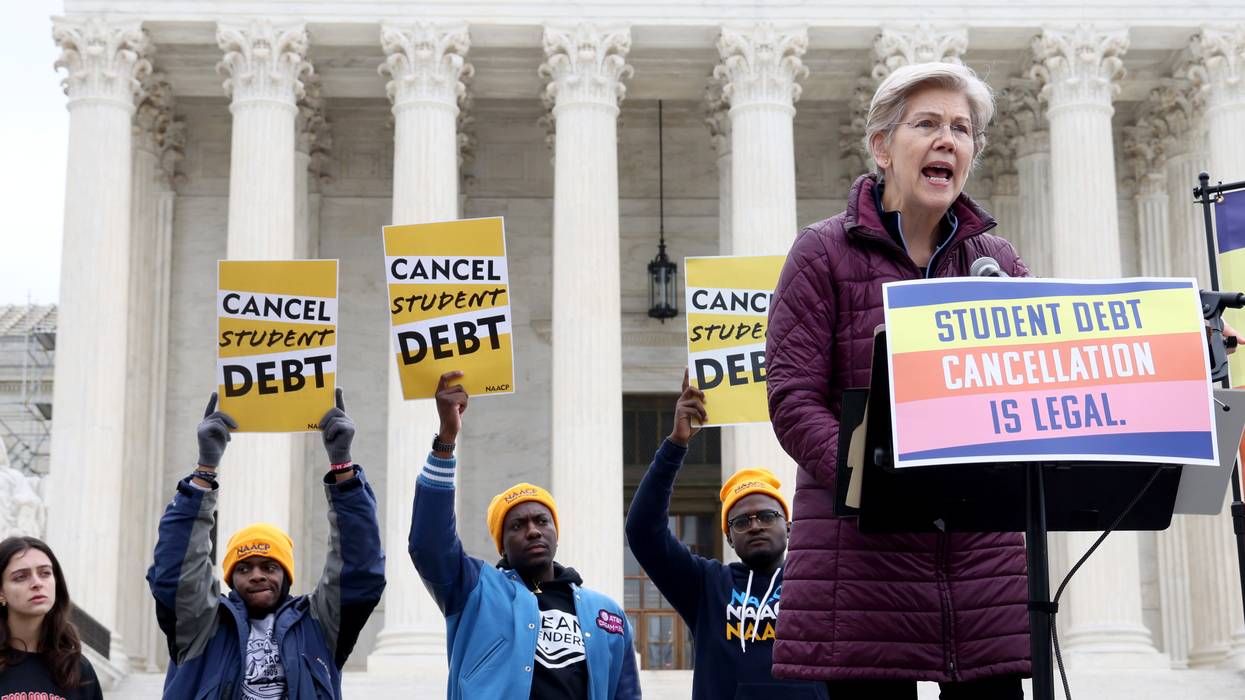
"We are concerned that the latest draft of the rule would fall far short of providing the full scale of debt relief that low- and middle-income Americans urgently need."
Seven members of Congress on Monday sounded the alarm about the Biden administration's evolving student debt cancellation plan and called on U.S. Secretary of Education Miguel Cardona to use his authority to provide broad relief.
After the right-wing U.S. Supreme Court in June struck down President Joe Biden's initial debt relief plan—designed to cancel up to $20,000 per federal borrower—the administration launched a negotiated rulemaking process to establish an alternative plan under the Higher Education Act (HEA) of 1965.
The committee responsible for crafting the rule "has met several times already, but its final round of talks began on Monday and will continue through Tuesday," reported USA Today. "Frustrations arose almost immediately. Committee members expressed disappointment in the department's latest forgiveness proposal, released last week, which many said doesn't go far enough in its current form to address the issues they've spent months debating."
U.S. Senate Majority Leader Chuck Schumer (D-N.Y.), Sens. Alex Padilla (D-Calif.), Bernie Sanders (I-Vt.), and Elizabeth Warren (D-Mass.), and Reps. Ilhan Omar (D-Minn.), Ayanna Pressley (D-Mass.), and Frederica Wilson (D-Fla.) are also unsatisfied with the draft, as they made clear Monday in a letter to Cardona.
"This regulation has the potential to improve the financial security of tens of millions of hard-working Americans who are currently trapped by crushing student debt," the lawmakers noted. "However, we are concerned that the latest draft of the rule would fall far short of providing the full scale of debt relief that low- and middle-income Americans urgently need."
The letter explains that under the draft, only four groups would be eligible for relief: "(1) borrowers with outstanding federal student loan balances that exceed their original principal balance, due to interest; (2) borrowers with loans that have been in repayment for over 20 or 25 years; (3) borrowers who are eligible for forgiveness under an enumerated repayment plan or loan program but have not enrolled; and (4) certain borrowers who took on loans to attend programs that provide insufficient financial value, lost Title IV eligibility, or were found to have committed misconduct."
The U.S. Education Department (ED) "has also released an issue paper indicating the potential need for the rule to address a fifth category: 'those experiencing hardship that is not otherwise addressed by the existing student loan system,'" the letter notes.
The HEA empowers Cardona to "enforce, pay, compromise, waive, or release" federal student loans. The lawmakers pressured him "to leverage this authority to its fullest extent, maximizing relief for the greatest number of borrowers facing financial hardship," highlighting that 43.6 million borrowers "collectively owe an astronomical $1.65 trillion."
"As we lend our support to your diligent efforts to provide debt relief through regulatory procedures, we urge you to consider several recommendations to strengthen the department's debt relief rule," the lawmakers wrote, detailing six proposals:
"We are encouraged by the department's critical efforts to provide student debt relief through negotiated rulemaking. However, we believe more must be done to improve the draft regulatory text," the letter concludes. "The Biden administration should take every
opportunity to use the authority Congress has already given it to deliver on the promises made to student loan borrowers."
Acknowledging the letter on the Senate floor Monday, Schumer declared that "following the Supreme Court's cruel, abrupt blocking of student debt relief, too many borrowers—too many—remain saddled with massive—in many cases, unbearable—amounts of debt. We can and we must do more to help these borrowers."
After being paused throughout the Covid-19 pandemic and the legal battle over Biden's first debt relief proposal, student loan repayments resumed in October. Since the high court's ruling, federal borrowers across the country have pushed the president to continue pursuing sweeping debt cancellation.
"An Education Department spokesperson said the agency had received the letter, is reviewing it, and welcomes the input from lawmakers," according to Politico.
"The Biden-Harris administration is proud of our record of providing relief to borrowers as we work to fix the broken student loan system," the spokesperson said in a statement. "This rulemaking process is about standing up for borrowers who've been failed by the country's broken student loan system and creating new regulations that will reduce the burden of student debt in this country."
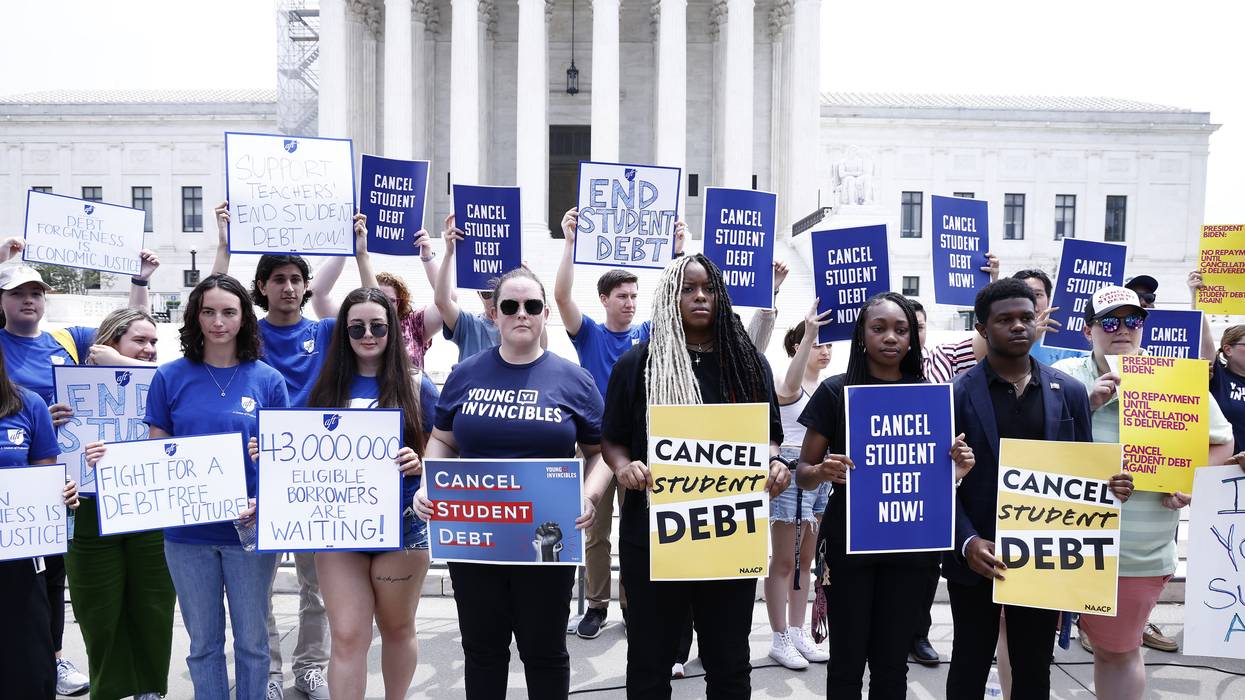
The letter highlights "the crushing weight of the student debt crisis on borrowers and their communities, and the extended economic limbo millions of borrowers have been forced to endure."
Leaders of 20 U.S. cities and counties, representing more than 1.2 million borrowers with nearly $50 billion in student debt, wrote to President Joe Biden on Thursday demanding swift action on long-promised and long-delayed relief.
Biden's first plan to cancel up to $20,000 per borrower was struck down by the U.S. Supreme Court in June. The administration is now working on a new relief plan involving the Higher Education Act (HEA) of 1965 but has chosen to initiate a drawn-out rulemaking process that campaigners say is unnecessary.
While welcoming the HEA effort, the letter stresses the urgent need among borrowers whose loan payments are set to resume October 1 after being paused for over three years in response to the Covid-19 pandemic.
"Given the crushing weight of the student debt crisis on borrowers and their communities, and the extended economic limbo millions of borrowers have been forced to endure as partisan lawsuits blocked transformative debt relief in the courts, we urge you to continue the necessary work to deliver on your promise of up to $20,000 in student debt relief and enact your new debt relief plan as swiftly as possible," local leaders from more than a dozen states wrote to the president.
"The Supreme Court's decision to ignore the clear letter of the law and strike down your life-changing debt relief plan is further evidence of its willingness to put politics and special interests before the American people," they argued.
The letter is signed by mayors, city attorneys, and other officials from Little Rock, Arkansas; Berkeley, Oakland, and San Francisco, California; Evanston, Illinois; Gary, Indiana; Mount Rainier, Maryland; Boston, Massachusetts; Ann Arbor, Lansing, and Washtenaw County, Michigan; Kansas City, Missouri; Carrboro and Hillsborough, North Carolina; Hoboken and Newark, New Jersey; Cleveland, Ohio; Philadelphia, Pennsylvania; Travis County, Texas; and Madison, Wisconsin.
As they detailed:
America's cities are on the frontlines of the $1.7 trillion student debt crisis. This crisis has spiraled out of control, reinforcing deeply embedded inequities in our country and creating financial despair in our communities—and the pandemic has exacerbated these challenges. Relief is urgently needed to help alleviate the financial burden on residents, helping families cover rising costs and invest in our local economies and their own future. As officials in your administration have consistently stated, resuming loan payments this fall without first providing broad-based student debt relief would result in a catastrophic wave of borrower distress, dealing a punishing blow to millions of families in our communities while destabilizing our local economies and increasing demand for public benefits and services.
As the letter notes, the Consumer Financial Protection Bureau said in June that around 2.5 million student loan borrowers already have a delinquency on another loan. The federal agency also found that about 1-in-5 student loan borrowers "have risk factors that suggest they could struggle when scheduled payments resume."
Recent polling suggests that number could be even higher. As Common Dreams reported last month, 49% of borrowers surveyed by Intelligent.com said they aren't sure they can afford the looming loan bills, and 62% said they are likely to boycott repayments.
"Your administration is now only days away from restarting a fundamentally broken and underfunded student loan servicing system, throwing 45 million Americans into chaos," the new to Biden letter warns. "While we appreciate your administration's announcement to shield borrowers from the most severe economic consequences of default, millions of borrowers will be forced to navigate the complex system for the first time in more than three and a half years."
Potentially compounding the stress for borrowers, the resumption of payments could coincide with a looming government shutdown—and as Insider reported Monday, the U.S. Department of Education "does not yet have a contingency plan for managing Federal Student Aid's operations without funding in two weeks."
Whether or not the government will be shut down when payments resume, borrowers are bracing for the impacts of another monthly bill, as are restaurants, retailers, and overcrowded animal shelters—and economists are warning of the consequences for the U.S. economy.
Pausing payments "helped ensure that people did not face financial ruin as a part of a pandemic they did not cause, and borrowers found themselves on more solid financial footing, for many, for the first time in years," Angela Hanks, chief of programs at Demos and a former Biden administration official, told Newsweek on Thursday.
"This meant that people were able to pay other bills on time, including basics like rent and groceries," Hanks said. "For the millions of borrowers who will be forced into repayment in just a few weeks, this transition will undermine whatever stability they've been able to create for their families over the last few years."
"The end of the student loan forbearance risks disrupting an otherwise growing economy," she added. "Wages are outpacing inflation, and unemployment is down, but saddling families with another expensive bill risks undermining our collective economic progress."
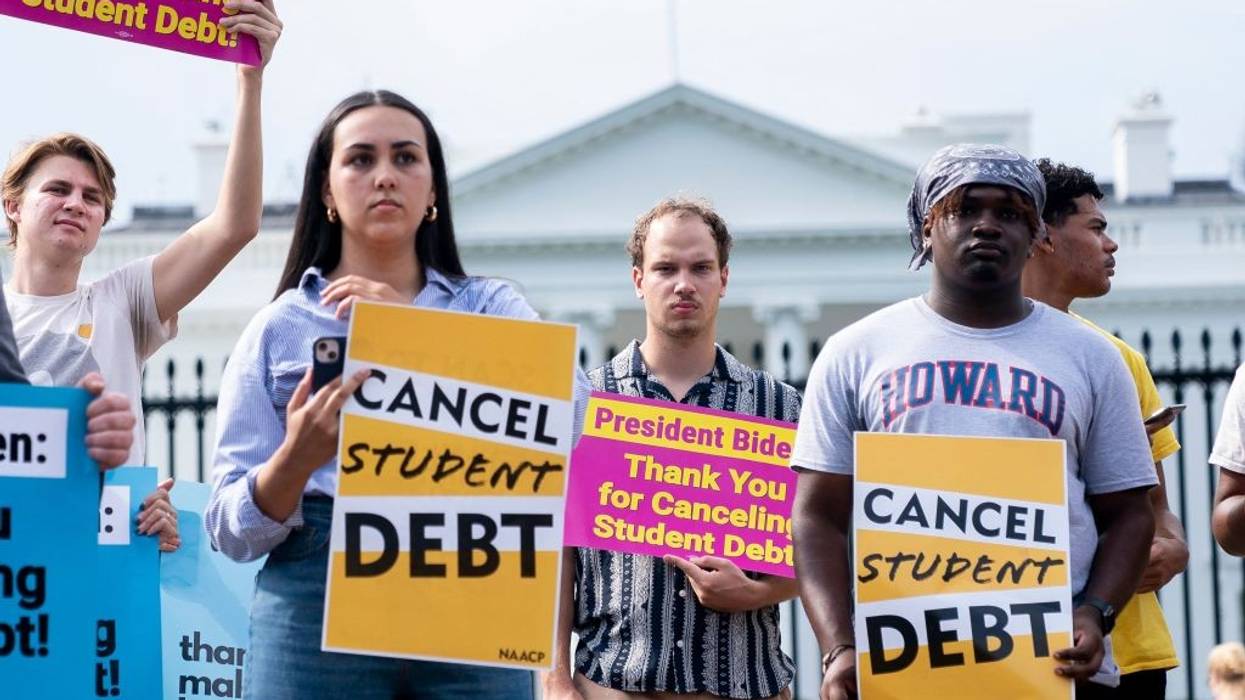
"President Biden says he is going to use every tool he can to cancel student debt, but there is still much more he can do," said a co-founder of the Debt Collective. "With this new tool, we are calling his bluff."
"Filling out this form creates an individual demand letter, tailored to your own student debt story, calling on the Department of Education to use its powers to cancel not just your debt, but everyone's."
That's how the Debt Collective describes a tool it launched Monday to increase pressure on the Biden administration to deliver on long-promised relief from federal student loan repayments.
As the group's website explains, for those who want to use the tool:
"Using this new tool can in no way harm you," said Debt Collective spokesperson Braxton Brewington. "The reality is, the Education Department has the authority to eliminate a person's federal student debts if they want to. We know because they've done it before. Whether they choose to cancel people's debts or not is completely up to their political rationale."
An FAQ section for the tool explains that filling out the form does not ensure debt cancellation, and "the Department of Education is not required to respond to these letters. However, our goal is to submit so many of them, they will HAVE to make a statement."
President Joe Biden—who is seeking reelection next year—announced his initial plan to use a 2003 law to cancel up to $20,000 per borrower last August, but the U.S. Supreme Court's right-wing supermajority struck down the program in June.
Now, with loan payments that have been paused throughout the Covid-19 pandemic set to resume in October, borrowers and some Democrats in Congress have renewed demands for urgent relief action by the Biden administration.
"President Biden says he is going to use every tool he can to cancel student debt, but there is still much more he can do," noted Debt Collective co-founder Thomas Gokey. "With this new tool, we are calling his bluff and demanding he cancel the debt for everyone today."
After the Supreme Court ruling, the Biden administration initiated a rulemaking process involving the Higher Education Act of 1965, but borrowers and campaigners are concerned about how long it is taking and warn that right-wing opponents of debt cancellation will use the time to come up with ways to keep blocking relief.
Hoping for swift and sweeping presidential action, the Debt Collective previously published a draft executive order that says in part, "The secretary of education shall immediately use the full extent of his power under the Higher Education Act and any other applicable law to cancel all obligations to repay federal student loans."
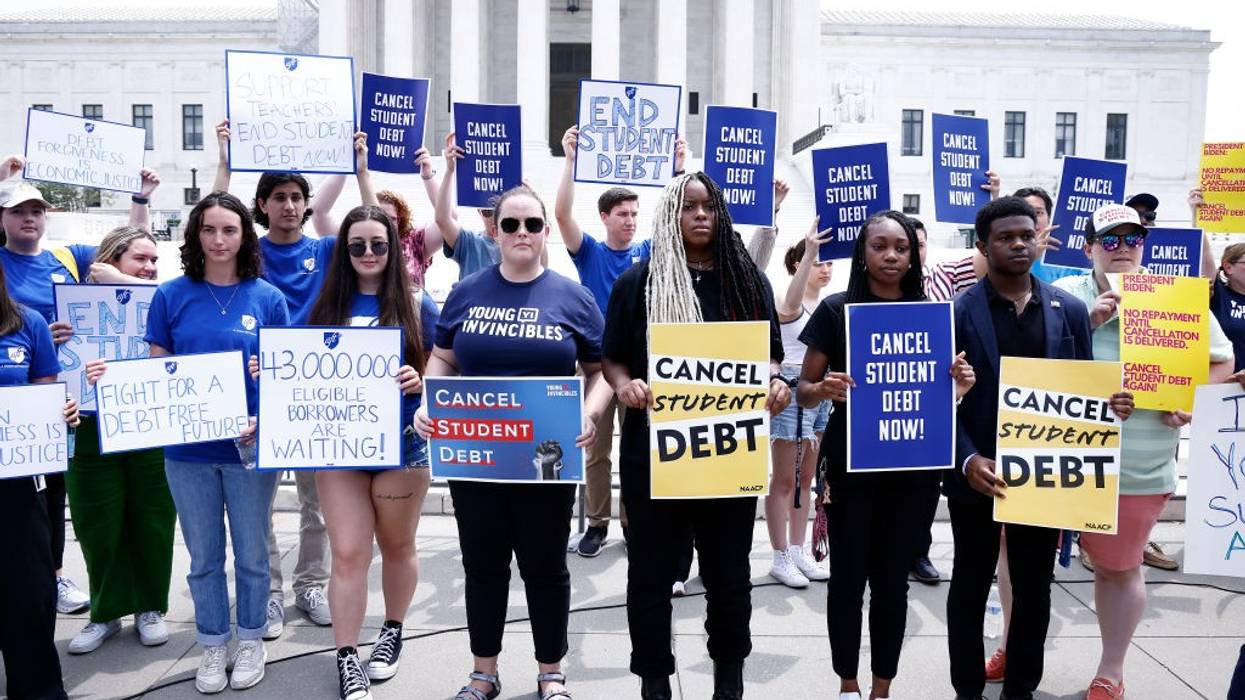
As resumption of educational debt repayment looms, more than 7 in 10 borrowers say they are taking on extra work, while half say they don't know whether they'll be able to make payments come October.
With U.S. federal student loan payments set to resume in a matter of weeks, more than 6 in 10 borrowers say they're likely to boycott repayments, an intelligent.com survey published Wednesday revealed.
Nearly half of the 1,000 borrowers surveyed believe boycotting could lead to all student debt being forgiven, while 3 in 4 respondents also said they think a boycott would be "somewhat" or "highly" likely to help elect politicians who support loan forgiveness.
Some of the write-in responses from borrowers inclined to boycott loan repayments include:
After years of activist organizing, President Joe Biden last August announced a plan to cancel $10,000 to $20,000 in federal student loan debt per borrower, a move that drew both praise and admonition from progressives—many of whom wanted to erase $50,000 or even all educational debt.
After right-wing Senate Democrats joined with Republicans to pass a joint resolution to block Biden's plan, the president vetoed the measure. House Republicans subsequently failed to override Biden's veto. In June, the U.S. Supreme Court's right-wing majority struck down the president's plan.
More than 7 in 10 borrowers polled by intelligent.com said they will have to take on extra work in order to prepare for the resumption of repayments. Half said they've started a "side hustle," while 34% are working longer hours and 20% have gotten an additional job.
Interest on student loans restarts on September 1, with repayments resuming the following month. Just under half—49%—of borrowers told intelligent.com they aren't sure they can afford the looming payments. In June, the U.S. Consumer Financial Protection Bureau warned that 1 in 5 of the 32 million federal student loan borrowers it tracked "have risk factors that suggest they could struggle when scheduled payments resume."
According to the Education Data Initiative, there are 43.6 million federal student borrowers owing a total of nearly $1.8 trillion. The average federal student loan debt balance is $37,717, with public university students borrowing an average of nearly $26,000 to earn their bachelor's degree.
The new survey also found that 81% of respondents likely to vote in the 2024 presidential election are "somewhat" or "strongly" influenced by candidates' views on student debt forgiveness.
The Biden administration has now initiated a lengthy rulemaking process that involves Higher Education Act of 1965, which legal experts argue empowers the secretary of education to eliminate loan balances. Some campaigners have expressed concern that the backup plan for debt forgiveness could also be struck down by right-wing lawsuits.

"Restarting the fundamentally broken student loan system without first delivering on the relief promised to borrowers remains a grave mistake, and will only exacerbate already dire economic situations for millions."
As millions of Americans prepare to start making student loan payments again in October, nearly 180 organizations on Wednesday pressured U.S. President Joe Biden to immediately enact a new plan to deliver on long-promised relief for federal borrowers.
After the U.S. Supreme Court's right-wing majority ruled last month that the Higher Education Relief Opportunities for Students Act "does not authorize" the president's plan to cancel up to $20,000 in debt for millions of borrowers, the administration initiated what is expected to be a drawn-out process that instead relies on the Higher Education Act.
"Due to the crushing nature of the student debt crisis and the fact that millions of workers and families have already had to wait in economic limbo for nearly a year as partisan lawsuits blocked transformative relief in court, we urge you to continue the necessary work to deliver on your promise of up to $20,000 in student debt relief and enact your new debt relief plan as swiftly as possible," 179 groups, led by Student Borrower Protection Center, wrote to Biden on Wednesday.
"The Supreme Court's decision to ignore the clear letter of the law and strike down your life-changing debt relief plan is further evidence of its willingness to put politics and special interests before the American people," the groups argued. "The recently signed Fiscal Responsibility Act which suspends the debt ceiling until 2025 while codifying the end of the student loan payment pause—a crucial economic lifeline for millions—has made it all the more urgent to act now to cancel student debt before payments resume."
The coalition warned that "while the administration has announced notable steps to mitigate the harshest economic consequences for borrowers—including shielding borrowers from negative credit reporting, delinquencies, and defaults should they fall behind—restarting the fundamentally broken student loan system without first delivering on the relief promised to borrowers remains a grave mistake, and will only exacerbate already dire economic situations for millions of American households."
The organizations stressed both the popularity and necessity of student debt relief, pointing to polling and the fact that after Biden unveiled his long-awaited initial plan last year, "26 million borrowers applied for debt relief and 16 million were approved during the short window of time that the application was open to the public."
The new letter comes after Biden's U.S. Department of Education announced last week that it will soon begin wiping out the federal student loan debt of about 804,000 borrowers after implementing fixes to income-driven repayment plans—which also provoked calls for more sweeping relief.
Student loan payments for federal borrowers were initially halted under former President Donald Trump, in response to the start of the Covid-19 pandemic. The Trump and Biden administrations repeatedly extended the pause over the past few years. Following the recent court ruling, interest is set to resume on September 1 and payments will be due starting in October.
Policies on student debt are widely expected to influence next year's presidential and congressional elections. Biden—who continues to refuse to support expanding the Supreme Court—is seeking reelection, and Trump is leading in the polls for the GOP's 2024 nomination, despite his legal trouble and arguments that his incitement of the January 6, 2021 insurrection disqualifies him from holding public office again.
Meanwhile, Protect Borrowers Action has launched a campaign targeting 13 U.S. House Republicans in battleground districts who signed an amicus brief urging the Supreme Court to strike down the president's first student debt relief plan and backed an unsuccessful congressional resolution that would have killed the policy.
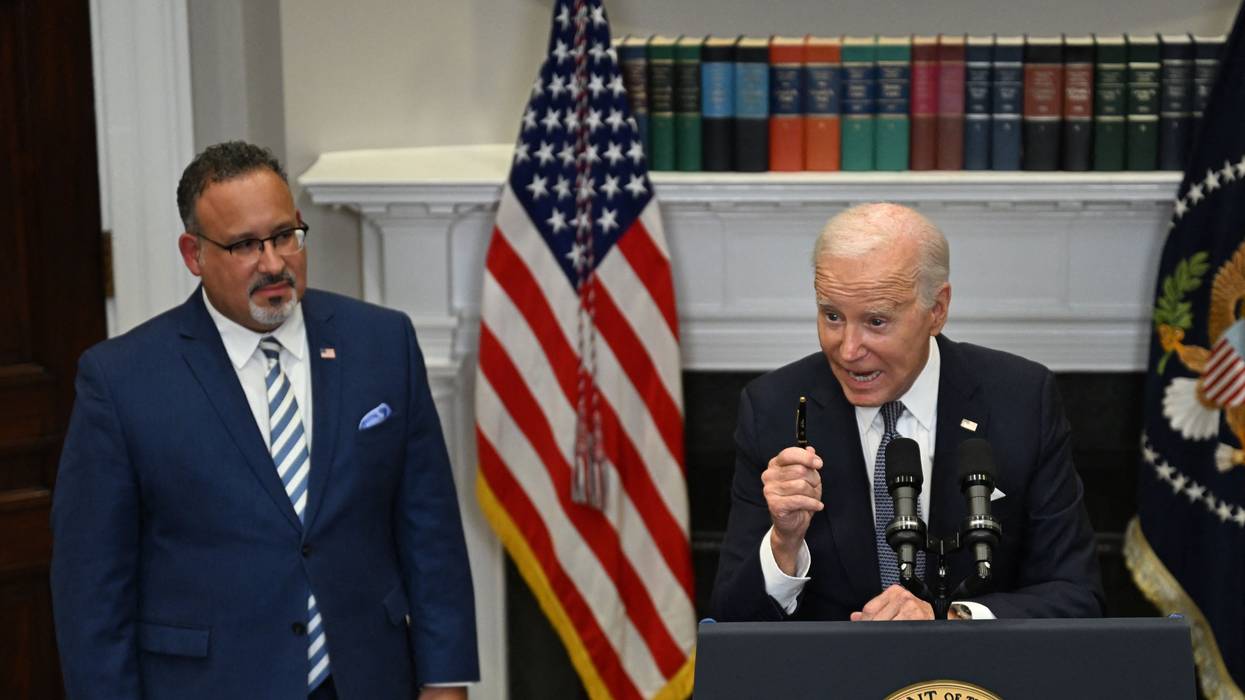
Biden's so-called Plan B "buys time for more baseless, bad faith, billionaire-backed lawsuits to get lined up with rogue judges eager to block anything that helps working people," fumed the Debt Collective.
Proponents of student debt cancellation reacted angrily Friday to what the leading activist group Debt Collective called President Joe Biden's "horseshit" response to the U.S. Supreme Court's invalidation of his proposal to forgive $400 billion worth of educational loan debt for tens of millions of borrowers.
In a Friday afternoon White House address, Biden vowed he was "not going to stop fighting to deliver borrowers what they need, particularly those at the bottom end of the economic scale," and that his administration would create a "ramp repayment program" to help struggling debtors make their monthly loan payments when they resume in the autumn.
"I believe that the court's decision to strike down our student debt relief plan is wrong," Biden said. "But I will stop at nothing to find other ways to deliver relief to hard-working middle-class families."
That, the president said, includes invoking the Higher Education Act (HEA) in order to empower the Department of Education to deliver loan relief.
Biden urged patience, saying action is "gonna take more time" and tweeting that "we're moving as fast as we can."
"Not fast enough," Debt Collective co-founder Astra Taylor shot back.
"The problem is speed," Taylor wrote on Twitter. "This plan buys time for more baseless, bad faith, billionaire-backed lawsuits to get lined up with rogue judges eager to block anything that helps working people. Under HEA you can cancel debt immediately. That's what fighting looks like."
"Time is of the essence," Taylor stressed.
Debt Collective called Biden's so-called Plan B "worse than this morning's Supreme Court ruling."
"He is stabbing student debtors in the back. This is a deeply cynical approach they know will fail," the group said. "It is designed to make sure future administrations cannot cancel debt under the HEA."
"Today Biden joined the six conservatives on SCOTUS to make sure no student debt is coming," Debt Collective added.
Even before Biden's Friday speech, activists warned what inaction or inadequate action by Biden could mean.
“Democrats desperately need young people to turn out in 2024 and future elections," the youth-led progressive groups Debt Collective, Sunrise Movement, Gen Z for Change, Path to Progress, March for Our Lives, and United We Dream Action said in a joint statement published just before Biden's speech.
"Young people believed President Biden would deliver student debt abolition—not a costly return to repayment without a penny of the promised relief. Meanwhile, our skies are choked orange with wildfire smoke, and the average monthly student debt payment is north of $400 a month," the groups continued. "And from approving the Willow Project and the Mountain Valley Pipeline, to their cruel asylum policies, President Biden cannot afford another disappointment with young people—a vital voting bloc for Democrats."