SUBSCRIBE TO OUR FREE NEWSLETTER
Daily news & progressive opinion—funded by the people, not the corporations—delivered straight to your inbox.
5
#000000
#FFFFFF
To donate by check, phone, or other method, see our More Ways to Give page.
Daily news & progressive opinion—funded by the people, not the corporations—delivered straight to your inbox.
“We believed that she was being authentic and honest with us," said one Virginia labor leader. "She just flat-out flipped."
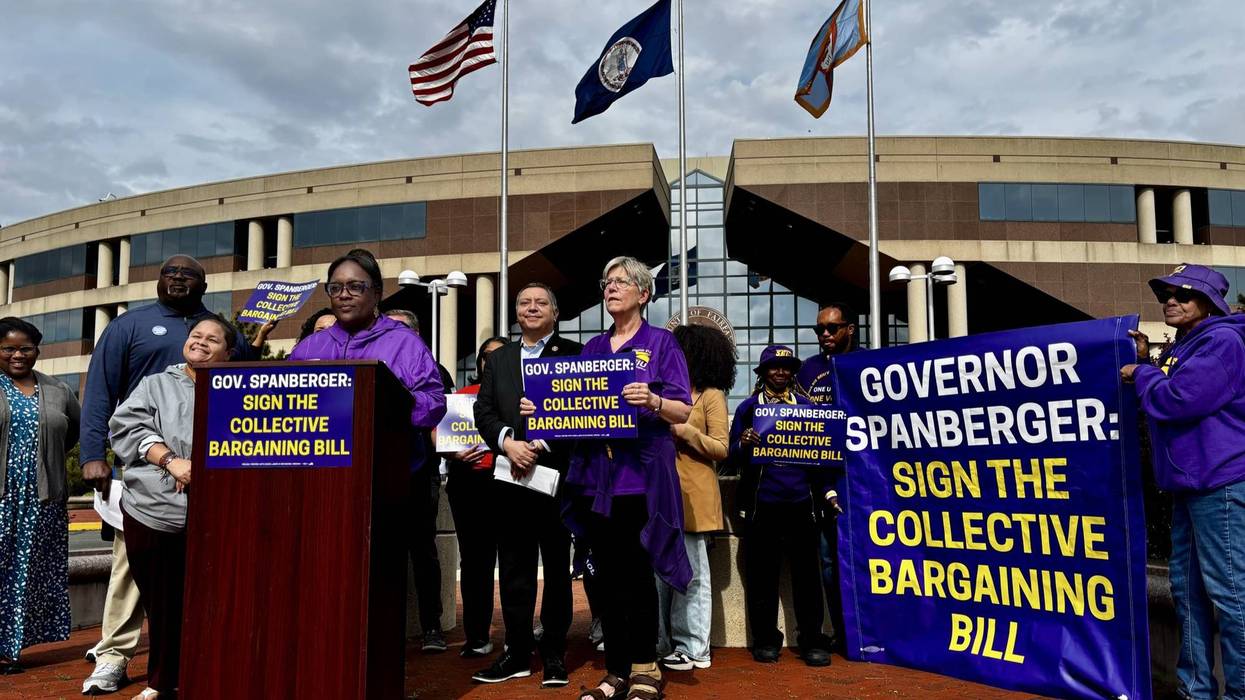
Labor unions are feeling betrayed after Virginia's Democratic Gov. Abigail Spanberger vetoed a bill on Thursday that would have restored collective bargaining rights for half a million public sector workers.
Virginia is one of the most restrictive states in the country for public sector bargaining, a holdover from the Jim Crow era when the General Assembly and other state legislatures across the South sought to crush the power of a public workforce with many Black employees.
According to the Economic Policy Institute, Virginia has one of the largest public sector pay gaps in the country, with state and local government employees making about 27% less on average than their private-sector peers, and it is similarly stratified in other states with weak collective bargaining rights.
Spanberger, a former US representative who was elected governor this past November, made pro-union messaging central to her affordability-focused platform. She decried President Donald Trump's executive order stripping federal workers of collective bargaining rights last year and said that as governor, she'd "look forward to working with members of our General Assembly to make sure more Virginians can negotiate for the benefits and fair treatment that they earn.”
But since taking office, Spanberger's support for restoring public sector union rights has been more tepid as she's gotten an earful from fiscally conservative Right-to-Work and taxpayer advocacy groups who claimed higher salaries for public employees would drain state funds and raise the cost of services.
When a bill to immediately mandate collective bargaining rights to 500,000 workers was proposed in the Democratic-controlled General Assembly, she introduced amendments aimed at watering down the bill—making it optional for employers to recognize unions, delaying the full implementation until 2030, and introducing what unions called a "kill-switch" that would have allowed future governors to revoke collective bargaining power.
The legislature shot Spanberger's amendments down and passed the bill in its original form. On Thursday, the governor vetoed it altogether.
In her veto message, Spanberger said she wanted the bill's other collective bargaining provisions for state employees, home care workers, and higher education employees to go into effect first "in order to demonstrate the efficacy of this new system" before it was opened up to all public employees.
But the unions that advocated for the bill say Spanberger led workers on with false promises.
"This veto is a devastating betrayal to the hundreds of thousands of public employees who have spent years, and in many cases decades, fighting for a seat at the table," said Doris Crouse-Mays, the president of the Virginia AFL-CIO. "Spanberger campaigned publicly and privately on promises [of] affordability, to support working families and respect workers' rights... Instead, when presented with the opportunity to make history and deliver on those promises, she chose to side with fear, political calculation, business, and the same anti-worker arguments that have been used for generations to deny workers power in Virginia."
LaNoral Thomas, the president of the Service Employees International Union (SEIU) Virginia 512—a union which helped lead the charge to pass the bill—told the Virginia news site Dogwood that her union had "high hopes" for Spanberger when she was elected.
“We believed that she was being authentic and honest with us," Thomas said. "She just flat-out flipped. It is shocking.”
"Public employees are not a special interest. They are our neighbors. They are the educators, bus drivers, social workers, librarians, custodians, and first responders who hold our communities together," said a joint statement from Carol Bauer, president of the Virginia Education Association, and Becky Pringle, president of the National Education Association.
They emphasized that the veto also carried "a deep racial and gender impact," noting that "Virginia’s public sector bargaining ban is rooted in a Jim Crow era effort to silence Black workers at the University of Virginia Hospital who organized for fair pay and dignity." They said, "Preserving that legacy today disproportionately harms women and workers of color, who make up so much of the public-service workforce and who have the most to gain from fair wages, safer workplaces, and a real voice on the job."
Lee Saunders, the president of the American Federation of State, County and Municipal Employees (AFSCME)—the largest national union of public sector workers in the US, with more than 1.4 million members—said that Spanberger had caved to "anti-worker extremists [who] have sidelined working people while starving the public services Virginia families rely on, earning the state a reputation as one of the most anti-worker in the country."
"While the governor has broken her word," Saunders said, "AFSCME members are deeply grateful to the bill’s sponsors and the leadership of both chambers, who kept theirs. Their commitment to working people stands in stark contrast to the governor and will not be forgotten."
"Gov. Spanberger made a choice today," he added. "Working people will remember it."
This Public Service Recognition Week, we can show our appreciation for their grit and dedication by taking a page out of their book and joining the fight to protect public services and workers’ voices on the job.
There is no sector of the workforce more resilient than those who work in public service. As billionaires raise costs for working families and funding for essential services is slashed, these workers are being asked to do more with less.
Every day they go above and beyond to respond to the needs of their community: stepping up during extreme weather events, responding to emergencies, educating the next generation, keeping our streets clean, caring for patients and the elderly, ensuring public safety, and so much more.
This Public Service Recognition Week, we can show our appreciation for their grit and dedication by taking a page out of their book and joining the fight to protect public services and workers’ voices on the job.
Despite the importance of all they do, public service workers are often met with attacks by anti-union politicians, rather than the support they deserve. These attacks include budget cuts that endanger their jobs, staffing crises that jeopardize safety for everyone, and threats to pay and benefits.
The best way to channel our love for this country and commitment to our communities is by getting organized and standing together to make working people’s lives better.
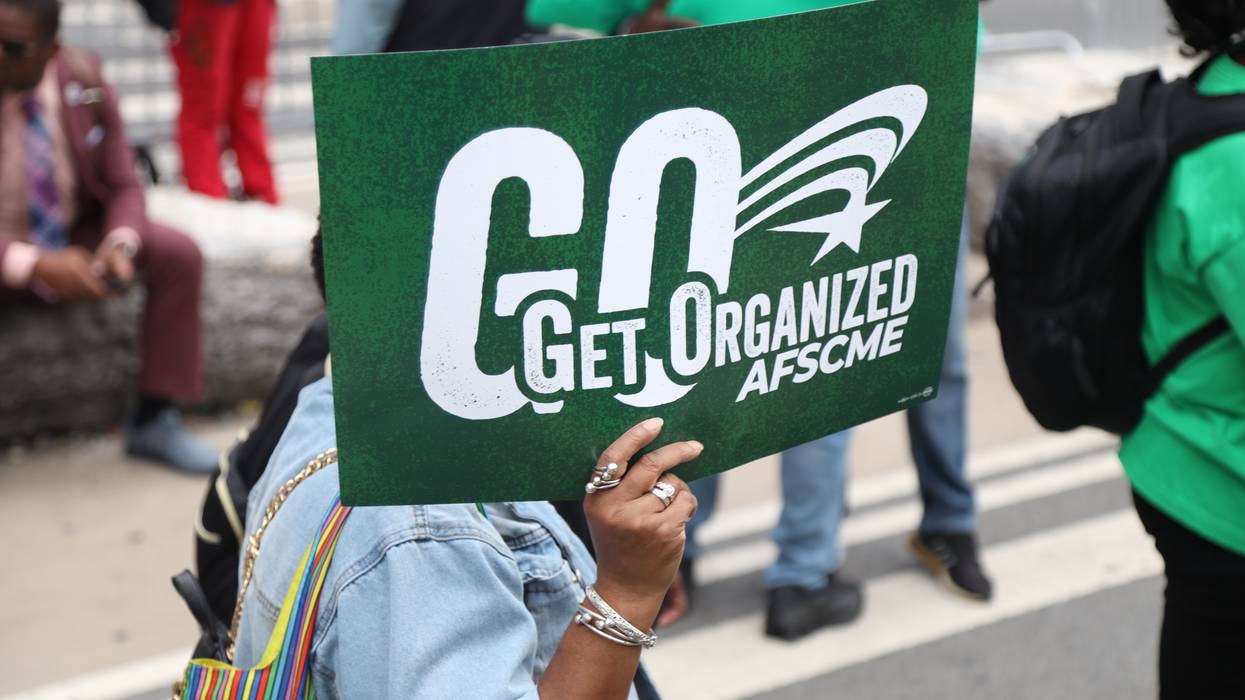
Never giving in, public service workers answer this assault by getting organized.
Nationwide, the American Federation of State, County and Municipal Employees (AFSCME) members are using their union voice to demand more for their communities. Since the extremists in Congress and the Trump administration recklessly slashed funding for Medicaid, food assistance, and other programs to give tax breaks to billionaires, AFSCME members have been fighting at the state and local level to protect schools, hospitals, public works projects, and more.
In the courts, AFSCME members have successfully protected funding for museums, libraries, and childcare. And at the bargaining table, they continue to negotiate for fair wages, safe staffing, and respect, all of which ensure public services remain strong for the community.
They don’t do it to get rich or get famous. They keep going—behind the scenes and outside the limelight—because working in public service is their life’s calling.
Their resilience and perseverance teaches all of us an important lesson: The best way to channel our love for this country and commitment to our communities is by getting organized and standing together to make working people’s lives better.
So, this week, remember to stop and show your appreciation for the public service workers who show up every single day by joining them in the fight.
The dismantling of our rights relies on complacency—we must begin to organize protests, strikes, and direct aid to affected communities starting immediately.
The U.S. Supreme Court just handed President Donald Trump a blank check to dismantle the federal government—and with it, the last safeguards for civil rights in America.
In an unsigned order last Tuesday, the justices allowed the Trump administration to proceed with mass federal layoffs and agency closures, overriding lower courts that had ruled these moves unconstitutional.
The consequences will be immediate and devastating. For example, the Department of Education’s (DOE) workforce will be cut by half and Trump’s executive order to commence the closure of the federal agency is now enforceable. Among the first departments to face reductions? Nearly half the staff at the Office for Civil Rights. Seven of its regional offices—including busy ones in major hubs like New York, Chicago, and Dallas—have been shuttered. Thousands of pending civil rights cases will now hang in limbo.
This attack on the DOE—and the nearly 60,000 other workers purged from federal agencies this year under the Trump administration—aren’t just another round of bureaucratic belt-tightening; they’re a deliberate attack on our civil rights and on the only watchdogs in the federal government left that can stop Donald Trump’s authoritarian overreach.
Rolling back the gains of the civil rights era is precisely the point.
As a former civil rights attorney at the DOE’s Office for Civil Rights, I’ve seen firsthand how the oversight from civil servants at federal agencies has safeguarded marginalized communities. In my eight years as a civil rights attorney, I worked with other civil servants to ensure that every child in America—regardless of their background or circumstance—saw equal treatment and opportunity in their education. We were the last line of defense to ensure that students of color, women, LGBTQ+ youth, and disabled students’ rights were protected and anti-discrimination laws were enforced.
But now, with these attacks from the Trump administration, that enforcement will be severely weakened, if not done away with completely. What’s more, civil rights oversight isn’t just a casualty of cuts at the DOE; it’s every federal agency.
The Department of Homeland Security recently implemented a “reduction in force” for three key offices that oversee civil rights protections, including the Office for Civil Rights and Civil Liberties. The Social Security Administration recently announced it was closing its Office of Civil Rights and Equal Opportunity, where about 150 people worked investigating civil rights complaints. And, the Department of Justice’s Civil Rights Division has been frozen.
These attacks are not only morally reprehensible—they are outright unconstitutional. By dismantling agencies established by acts of Congress and diverting funds from congressionally mandated programs, Trump is violating the separation of powers and usurping authority that the Constitution explicitly grants to the legislative branch.
And make no mistake: Rolling back the gains of the civil rights era is precisely the point—Trump’s white nationalist supporters want to return America to a mythical white, Christian past. These interests just so happen to align with the Trump-backing billionaires for whom cutting public services frees up funds for lucrative tax cuts.
The issue is compounded by the fact that these cuts simultaneously do away with the last watchdogs left in the federal government who would be able to push back against this type of unconstitutional overreach attacking our civil rights.
When I worked in the DOE, I witnessed firsthand in President Trump’s first term how civil servants worked as a last line of defense against Trump’s authoritarian assault on our democracy. Although often maligned by the right as “deep-state” actors, these nonpartisan civil servants who acted on their oath to the Constitution—rather than any president—leaked damaging information and resisted unlawful orders, significantly stymieing the first Trump administration’s agenda. Their effectiveness was illustrated clearly by how this time around Project 2025 made their removal a high priority via Schedule F, which reclassifies nonpartisan roles as political appointees.
As these workforce reductions go into effect, the administration has simultaneously instituted loyalty screenings—ensuring anyone hired is loyal MAGA to the core and that only ideologues will remain. The result? There is no one left to investigate when our civil rights are being violated—and there is no one left to push back to prevent them from doing so in the first place.
The courts will not save us—that much is clear. And we all know what returning these functions to the state looks like: the Jim Crow era, where states, particularly red states, turned their back on civil rights and instead entered into a new reign of terror. But the dismantling of our rights relies on complacency—we must begin to organize protests, strikes, and direct aid to affected communities starting immediately.
If we wish to defend the civil rights of Black people and other communities of color, the LGBTQ+ community, women and children, and the millions of us who aren’t part of the top 1% and defend our democracy from Trump’s authoritarian attacks, we must become ungovernable now and resist every chance we get.