SUBSCRIBE TO OUR FREE NEWSLETTER
Daily news & progressive opinion—funded by the people, not the corporations—delivered straight to your inbox.
5
#000000
#FFFFFF
To donate by check, phone, or other method, see our More Ways to Give page.
Daily news & progressive opinion—funded by the people, not the corporations—delivered straight to your inbox.
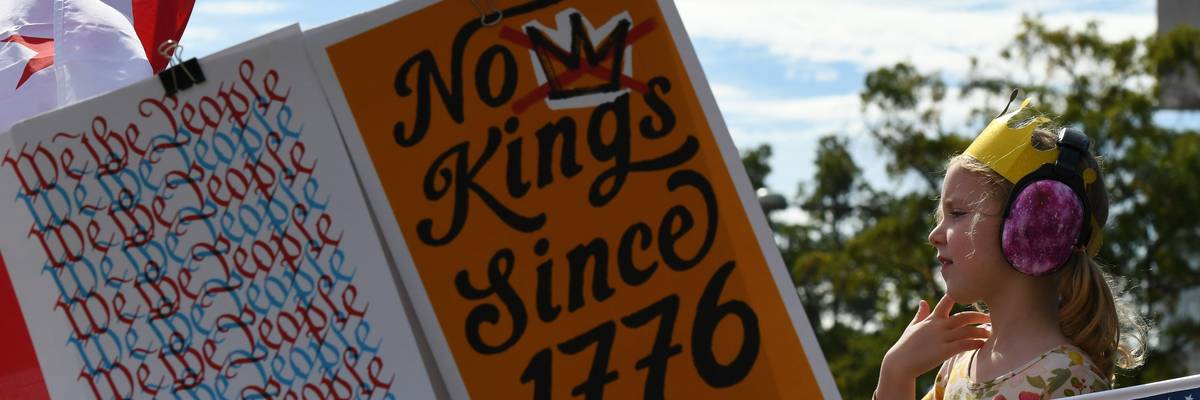
People take part in a "No Kings" protest in Washington, DC, the United States, on Oct. 18, 2025.
"I am disappointed in those who think keeping quiet will save them," said said one Trump critic. "It will not."
Even as they acknowledged that only the public opposition of people in power would rein in President Donald Trump's attacks on democracy and the rule of law, a number of political, military, business, and academic elites made clear Friday that they "are scared of crossing" the president.
In a column published on Friday in the Financial Times, Edmundv Luce revealed that he has been talking with "dozens of figures, including lawmakers, private sector executives, retired senior military figures and intelligence chiefs, current and former Trump officials, Washington lawyers, and foreign government officials," and he found that the vast majority asked to remain anonymous for fear of attacks from the president and his administration.
"Such is the fear of jail, bankruptcy, or professional reprisal, that most of these people insisted on anonymity," Luce explained. "This was in spite of the fact that many of the same people also wanted to emphasize that Trump would only be restrained by powerful voices opposing him publicly."
Trump's revenge campaign against his foes has taken many forms, Luce found. The most high-profile examples have been instances in which the president has personally pushed for officials at the US Department of Justice to criminally indict many longtime adversaries, including New York Attorney General Letitia James, former FBI Director James Comey, and John Bolton, Trump's own former national security adviser.
Luce also learned that the administration has been waging pressure campaigns on private employers to blacklist former Biden administration officials and other opponents from being offered jobs.
"Every employer says something along the lines of 'We’d love to hire you but it’s not worth the risk,'" one former Biden White House staffer told Luce. "All they offer me is apologies."
Former Biden national security adviser Jake Sullivan, who is now a professor at Harvard University, told Luce that he spends much of his time "trying to help former colleagues find jobs" because so few employers are willing to chance angering the president.
Military officials who spoke with Luce expressed fears that the US armed forces will not resist Trump, as they did in his first term, were he to give them illegal orders. One retired four-star general said he worried that Dan Caine, the current chairman of the Joint Chiefs of Staff, would not refuse to carry out requests to have the military interfere with elections, as many officials did in 2020 when Trump tried to get the US Army to seize voting machines in swing states that he had lost to former President Joe Biden.
"Caine has the thinnest background to run the military at its most difficult stress test in modern history," the general said.
Many Trump critics who read Luce's reporting found it appalling that so many wealthy and powerful Americans were afraid to publicly criticize the president.
"When all this is over, we need to have a pretty serious conversation about the utter moral failure of the elite of this country," remarked Leah Greenberg, co-founder and co-executive director of Indivisible, on Bluesky.
Brendan Nyhan, a political scientist at Dartmouth, said that Luce's reporting shows "how much opposition we never see or hear because people fear reprisal" from the president.
Bradley Moss, a national security attorney who was one of Luce's few sources willing to speak on the record, wrote on Bluesky that more elites needed to start speaking out against the president and his authoritarian ambitions.
"I am disappointed in those who think keeping quiet will save them," he said. "It will not."
Ryan Enos, a political scientist at Harvard University, acknowledged the dangers outlined in Luce's column but also pointed out reasons for hope.
"This wannabe dictator is also extremely unpopular and those of us with the courage to stand up have the American people on our side," he argued. "It'll take courage and focus, but democracy can win."
The elites interviewed by Luce expressed their reticence to publicly speak out against Trump days after more than 7 million people gathered at thousands of "No Kings" protests condemning the president's authoritarian agenda—despite the administration's threats against protest movements. Residents in cities including Portland, Oregon and Chicago have also resisted federal agents carrying out Trump's mass detention and deportation campaign.
Dear Common Dreams reader, It’s been nearly 30 years since I co-founded Common Dreams with my late wife, Lina Newhouser. We had the radical notion that journalism should serve the public good, not corporate profits. It was clear to us from the outset what it would take to build such a project. No paid advertisements. No corporate sponsors. No millionaire publisher telling us what to think or do. Many people said we wouldn't last a year, but we proved those doubters wrong. Together with a tremendous team of journalists and dedicated staff, we built an independent media outlet free from the constraints of profits and corporate control. Our mission has always been simple: To inform. To inspire. To ignite change for the common good. Building Common Dreams was not easy. Our survival was never guaranteed. When you take on the most powerful forces—Wall Street greed, fossil fuel industry destruction, Big Tech lobbyists, and uber-rich oligarchs who have spent billions upon billions rigging the economy and democracy in their favor—the only bulwark you have is supporters who believe in your work. But here’s the urgent message from me today. It's never been this bad out there. And it's never been this hard to keep us going. At the very moment Common Dreams is most needed, the threats we face are intensifying. We need your support now more than ever. We don't accept corporate advertising and never will. We don't have a paywall because we don't think people should be blocked from critical news based on their ability to pay. Everything we do is funded by the donations of readers like you. When everyone does the little they can afford, we are strong. But if that support retreats or dries up, so do we. Will you donate now to make sure Common Dreams not only survives but thrives? —Craig Brown, Co-founder |
Even as they acknowledged that only the public opposition of people in power would rein in President Donald Trump's attacks on democracy and the rule of law, a number of political, military, business, and academic elites made clear Friday that they "are scared of crossing" the president.
In a column published on Friday in the Financial Times, Edmundv Luce revealed that he has been talking with "dozens of figures, including lawmakers, private sector executives, retired senior military figures and intelligence chiefs, current and former Trump officials, Washington lawyers, and foreign government officials," and he found that the vast majority asked to remain anonymous for fear of attacks from the president and his administration.
"Such is the fear of jail, bankruptcy, or professional reprisal, that most of these people insisted on anonymity," Luce explained. "This was in spite of the fact that many of the same people also wanted to emphasize that Trump would only be restrained by powerful voices opposing him publicly."
Trump's revenge campaign against his foes has taken many forms, Luce found. The most high-profile examples have been instances in which the president has personally pushed for officials at the US Department of Justice to criminally indict many longtime adversaries, including New York Attorney General Letitia James, former FBI Director James Comey, and John Bolton, Trump's own former national security adviser.
Luce also learned that the administration has been waging pressure campaigns on private employers to blacklist former Biden administration officials and other opponents from being offered jobs.
"Every employer says something along the lines of 'We’d love to hire you but it’s not worth the risk,'" one former Biden White House staffer told Luce. "All they offer me is apologies."
Former Biden national security adviser Jake Sullivan, who is now a professor at Harvard University, told Luce that he spends much of his time "trying to help former colleagues find jobs" because so few employers are willing to chance angering the president.
Military officials who spoke with Luce expressed fears that the US armed forces will not resist Trump, as they did in his first term, were he to give them illegal orders. One retired four-star general said he worried that Dan Caine, the current chairman of the Joint Chiefs of Staff, would not refuse to carry out requests to have the military interfere with elections, as many officials did in 2020 when Trump tried to get the US Army to seize voting machines in swing states that he had lost to former President Joe Biden.
"Caine has the thinnest background to run the military at its most difficult stress test in modern history," the general said.
Many Trump critics who read Luce's reporting found it appalling that so many wealthy and powerful Americans were afraid to publicly criticize the president.
"When all this is over, we need to have a pretty serious conversation about the utter moral failure of the elite of this country," remarked Leah Greenberg, co-founder and co-executive director of Indivisible, on Bluesky.
Brendan Nyhan, a political scientist at Dartmouth, said that Luce's reporting shows "how much opposition we never see or hear because people fear reprisal" from the president.
Bradley Moss, a national security attorney who was one of Luce's few sources willing to speak on the record, wrote on Bluesky that more elites needed to start speaking out against the president and his authoritarian ambitions.
"I am disappointed in those who think keeping quiet will save them," he said. "It will not."
Ryan Enos, a political scientist at Harvard University, acknowledged the dangers outlined in Luce's column but also pointed out reasons for hope.
"This wannabe dictator is also extremely unpopular and those of us with the courage to stand up have the American people on our side," he argued. "It'll take courage and focus, but democracy can win."
The elites interviewed by Luce expressed their reticence to publicly speak out against Trump days after more than 7 million people gathered at thousands of "No Kings" protests condemning the president's authoritarian agenda—despite the administration's threats against protest movements. Residents in cities including Portland, Oregon and Chicago have also resisted federal agents carrying out Trump's mass detention and deportation campaign.
Even as they acknowledged that only the public opposition of people in power would rein in President Donald Trump's attacks on democracy and the rule of law, a number of political, military, business, and academic elites made clear Friday that they "are scared of crossing" the president.
In a column published on Friday in the Financial Times, Edmundv Luce revealed that he has been talking with "dozens of figures, including lawmakers, private sector executives, retired senior military figures and intelligence chiefs, current and former Trump officials, Washington lawyers, and foreign government officials," and he found that the vast majority asked to remain anonymous for fear of attacks from the president and his administration.
"Such is the fear of jail, bankruptcy, or professional reprisal, that most of these people insisted on anonymity," Luce explained. "This was in spite of the fact that many of the same people also wanted to emphasize that Trump would only be restrained by powerful voices opposing him publicly."
Trump's revenge campaign against his foes has taken many forms, Luce found. The most high-profile examples have been instances in which the president has personally pushed for officials at the US Department of Justice to criminally indict many longtime adversaries, including New York Attorney General Letitia James, former FBI Director James Comey, and John Bolton, Trump's own former national security adviser.
Luce also learned that the administration has been waging pressure campaigns on private employers to blacklist former Biden administration officials and other opponents from being offered jobs.
"Every employer says something along the lines of 'We’d love to hire you but it’s not worth the risk,'" one former Biden White House staffer told Luce. "All they offer me is apologies."
Former Biden national security adviser Jake Sullivan, who is now a professor at Harvard University, told Luce that he spends much of his time "trying to help former colleagues find jobs" because so few employers are willing to chance angering the president.
Military officials who spoke with Luce expressed fears that the US armed forces will not resist Trump, as they did in his first term, were he to give them illegal orders. One retired four-star general said he worried that Dan Caine, the current chairman of the Joint Chiefs of Staff, would not refuse to carry out requests to have the military interfere with elections, as many officials did in 2020 when Trump tried to get the US Army to seize voting machines in swing states that he had lost to former President Joe Biden.
"Caine has the thinnest background to run the military at its most difficult stress test in modern history," the general said.
Many Trump critics who read Luce's reporting found it appalling that so many wealthy and powerful Americans were afraid to publicly criticize the president.
"When all this is over, we need to have a pretty serious conversation about the utter moral failure of the elite of this country," remarked Leah Greenberg, co-founder and co-executive director of Indivisible, on Bluesky.
Brendan Nyhan, a political scientist at Dartmouth, said that Luce's reporting shows "how much opposition we never see or hear because people fear reprisal" from the president.
Bradley Moss, a national security attorney who was one of Luce's few sources willing to speak on the record, wrote on Bluesky that more elites needed to start speaking out against the president and his authoritarian ambitions.
"I am disappointed in those who think keeping quiet will save them," he said. "It will not."
Ryan Enos, a political scientist at Harvard University, acknowledged the dangers outlined in Luce's column but also pointed out reasons for hope.
"This wannabe dictator is also extremely unpopular and those of us with the courage to stand up have the American people on our side," he argued. "It'll take courage and focus, but democracy can win."
The elites interviewed by Luce expressed their reticence to publicly speak out against Trump days after more than 7 million people gathered at thousands of "No Kings" protests condemning the president's authoritarian agenda—despite the administration's threats against protest movements. Residents in cities including Portland, Oregon and Chicago have also resisted federal agents carrying out Trump's mass detention and deportation campaign.