

SUBSCRIBE TO OUR FREE NEWSLETTER
Daily news & progressive opinion—funded by the people, not the corporations—delivered straight to your inbox.
5
#000000
#FFFFFF
To donate by check, phone, or other method, see our More Ways to Give page.
Daily news & progressive opinion—funded by the people, not the corporations—delivered straight to your inbox.
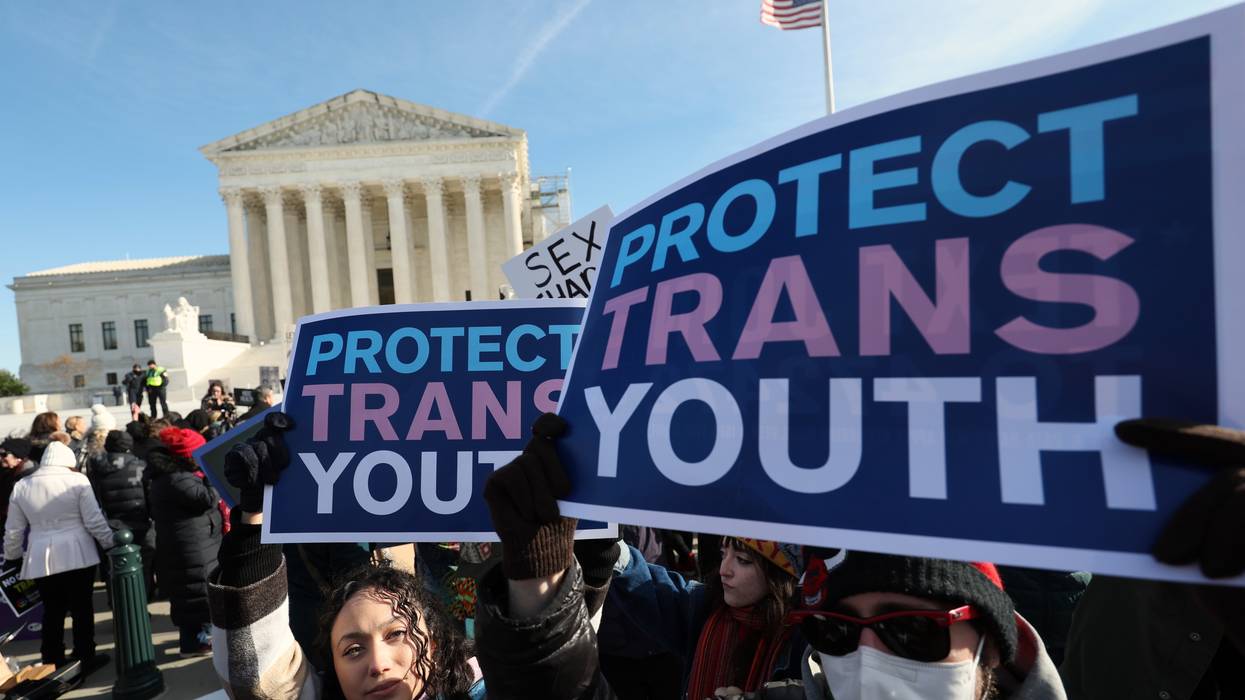
The Republican judge cited the Supreme Court's recent decision that stripped federal agencies of their regulatory power.
In a decision that was partially underpinned by the U.S. Supreme Court's overturning of a 40-year-old legal precedent last year, a federal judge in Kentucky on Thursday struck down President Joe Biden's expanded protections for transgender youths and other vulnerable students, saying the administration overstepped in introducing the rules.
Chief Judge Danny C. Reeves of the Eastern District of Kentucky ruled that the Education Department did not have the authority to expand the protections provided by Title IX of the Civil Rights Act, which since 1972 has prohibited sex discrimination at schools that receive federal funding.
The ruling applies to the new definition in Title IX that was proposed by the department last April, which prohibited "discrimination on the basis of sex stereotypes, sex-related characteristics (including intersex traits), pregnancy or related conditions, sexual orientation, and gender identity."
Right-wing activists and politicians objected in particular to the protections for gender identity.
The rules stopped short of requiring schools to allow transgender students to play on sports teams that correspond with their gender identity—a key fixation of the far right—but required schools and staffers to accept students' identities on a daily basis, for example by calling them by their preferred pronouns rather than according to their sex assigned at birth.
The rules have been blocked in 26 states as Republican leaders in Tennessee, Kentucky, Ohio, Indiana, and other states have filed legal challenges.
In his ruling, Reeves, who was appointed by former President George W. Bush, wrote that "the entire point of Title IX is to prevent discrimination based on sex."
"Throwing gender identity into the mix eviscerates the statute and renders it largely meaningless," he said.
Reeves wrote that "the final rule and its corresponding regulations exceed the department's authority," citing Loper Bright Enterprises v. Raimondo, the Supreme Court case in which the court's right-wing majority overturned the so-called Chevron doctrine. The legal precedent held that judges should defer to federal agencies' reasonable interpretation of a law if Congress has not specifically addressed the issue at hand.
The judge also rejected the Education Department's position that protections for transgender people against workplace discrimination—which were established in 2020 in the Supreme Court case Bostock v. Clayton County, Georgia—should also apply in schools that receive federal funding.
At Law Dork, journalist Chris Geidner wrote that Reeves rejected "Bostock's application to Title IX and [cited] his newfound authority in the wake of the U.S. Supreme Court's decision in Loper Bright Enterprises v. Raimondo to determine 'the statute's single, best meaning' himself."
"As such, he took that authority to decide what Title IX means, the department's view notwithstanding, and set aside the rule," wrote Geidner.
Reeves also wrote that requiring teachers and schools to use students' preferred pronouns and names "offends the First Amendment" and violates the free speech rights of teachers.
That assertion, said Jennifer Berkshire, author of The Education Wars, "really shows you how fake the rhetoric of 'parents rights' is."
"The idea that using a student's preferred pronouns is in any way an imposition on teachers is patently absurd," added Jonathan Cohn of Progressive Massachusetts. "If you can handle using nicknames, you can handle correct pronouns."
Fatima Goss Graves, president and CEO of the National Women's Law Center, said the judge turned "longstanding legal precedent on its head in a direct, disproportionate attack on trans students," and noted that the harm caused by the ruling will extend beyond transgender students.
"Today's decision displays extraordinary disregard for students who are most vulnerable to discrimination and are in the most need for federal protections under the Title IX rule," said Goss Graves. "The Biden administration's Title IX rule is essential to ensure that all students—including survivors of sexual assault and harassment, pregnant and parenting students, and LGBTQI+ students—are able to learn in a safe and welcoming environment. With these protections already removed in some states, students who experience sexual assault have had their complaints dismissed, or worse, been punished by their schools after reporting; pregnant students have been unfairly penalized for taking time off to give birth to a child; and LGBTQI+ students have faced vicious bullying and harassment just for being who they are."
Melanie Willingham-Jaggers, executive director of the LGBTQ rights group GLSEN, told The New York Times that the ruling "shows a stunning indifference to marginalized youth facing harassment and discrimination, as well as hardworking school administrators and principals who are working to build safer learning environments for their increasingly diverse student populations."
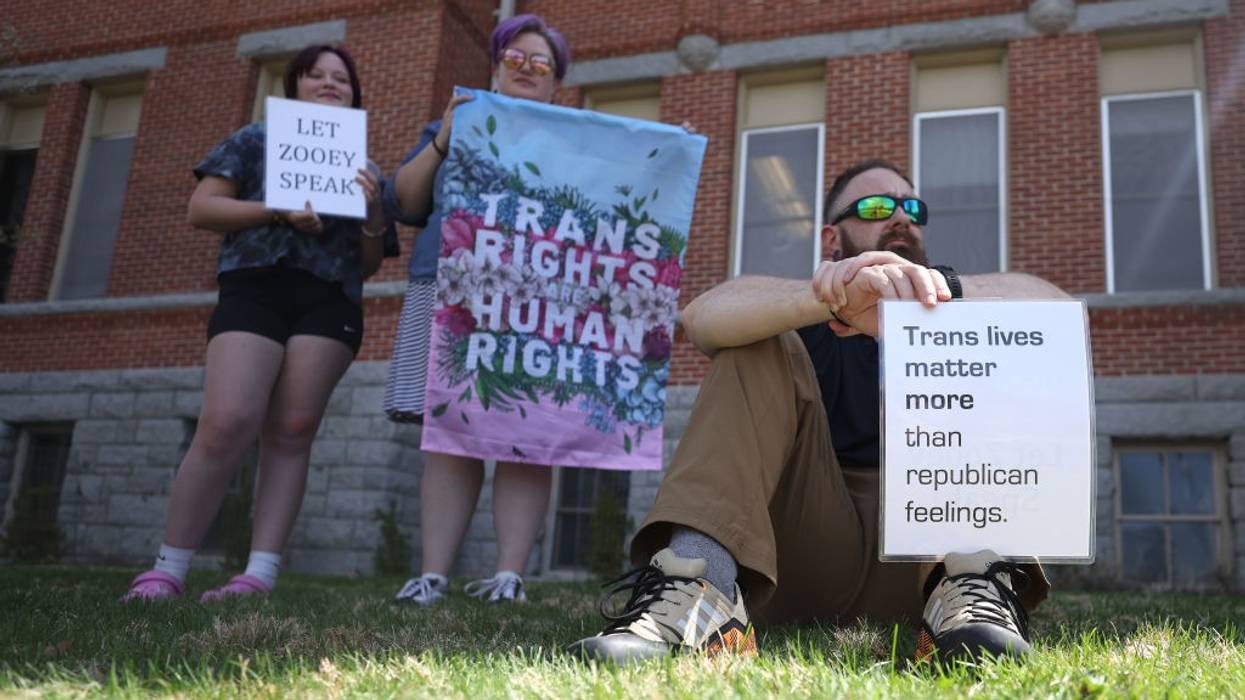
"Rest assured that the passage of this discriminatory bill would have a detrimental and real-life impact on the trans community," said one Florida ACLU leader.
The ACLU of Florida on Friday led condemnation of a bill passed by the Republican-controlled lower chamber of the state Legislature that "seeks to deny the legal existence of transgender individuals by requiring individuals to identify as their sex assigned at birth instead of their gender on their driver's licenses and ID cards."
Dubbed the Trans Erasure Bill by opponents, H.B. 1639 passed by a vote of 75-33. The ACLU notes that the legislation "also requires health plans to cover the widely discredited practice of conversion therapy and creates additional obstacles for health plans to cover gender-affirming care."
"H.B. 1639 is harmful, vague, and does nothing to improve the lives of Floridians," ACLU of Florida policy strategist NR Hines said in a statement. "It is eerily silent on the consequences for transgender individuals who identify their gender on their driver's license or other government-issued identification instead of their sex assigned at birth."
"It weaponizes state agencies and private insurance companies to threaten the safety and inclusion of transgender people," they asserted. "It is a cruel bill aimed at erasing transgender Floridians out of public life entirely. We have deep concerns about the life-altering impacts on the trans community."
Hines continued:
Last month, we learned of the death of a transgender student after they experienced violence on school grounds in Oklahoma. Nex Benedict should still be alive today. While this violence didn't occur in Florida, the fear and hate towards trans people that some elected officials are spreading directly leads to these unsafe situations.
Rest assured that the passage of this discriminatory bill would have a detrimental and real-life impact on the trans community. Thankfully, there is currently no Senate companion bill, and Senate leadership has stated the bill will not be heard.
"We hope this remains true," Hines added. "Trans people belong and deserve the freedom to be who they are."
LGBTQ+ rights—and especially trans rights—are under attack across the country. The ACLU is currently tracking 471 anti-LGBTQ+ bills in a majority of states, including 11 pieces of proposed legislation in Florida.
Last year, Republican Florida Gov. Ron DeSantis, a failed GOP presidential candidate, signed a bundle of bills that activists condemned as the most extreme slate of anti-trans laws in modern history. Among these were S.B. 254, which bans gender-affirming care for minors, while prohibiting nurse practitioners from providing such healthcare to adults.
Last June, federal Judge Robert Hinkle temporarily blocked the enforcement of certain provisions of S.B. 254, saying they constituted "purposeful discrimination" against transgender people.
DeSantis also signed H.B. 1069, which expands the so-called "Don't Say Gay or Trans" law to prohibit educators from discussing sexual orientation or gender identity in grades K-12.
H.B. 1521 empowers cisgender people to order transgender people to leave publicly available restrooms—in places including airports, sports arenas, convention centers, beaches, parks, and public and even private healthcare and educational institutions—or face criminal trespass charges that could result in up to a year behind bars for those who refuse to comply.
The Human Rights Campaign—the largest LGBTQ+ political advocacy group in the United States—issued a first-ever national emergency declaration for LGBTQ+ people last June, citing the torrent of discriminatory and dangerous legislation emerging from Republican-controlled legislatures across the country.

A "right-wing culture war and transphobic propaganda is never just about discourse, debate, or the 'potential for violence,'" said one gender studies professor in response to the attack. "It's about actual violence."
Police in Ontario, Canada on Thursday said the stabbing of multiple people in a University of Waterloo gender studies class was a "hate-motivated incident related to gender expression and gender identity" as they charged the suspect with several crimes.
Geovanny Villalba-Aleman, a 24-year-old former student at the school, was identified by the Waterloo Regional Police Service as the suspect and has been charged with three counts of aggravated assault, four counts of assault with a weapon, and two counts of possession of a weapon for a dangerous purpose.
Villalba-Aleman is accused of stabbing a 38-year-old professor and two students, aged 19 and 20, after entering the classroom of a Philosophy 202: Gender Issues class on Wednesday afternoon and asking the professor "what the class was about," according to The Imprint, the school's student newspaper.
After the professor answered and said she was the instructor of the class, Villalba-Aleman allegedly "closed the door, took out two knives, and began attacking the professor."
A student told The Imprint that the attacker "missed the professor and 'ended up attacking one or two other people.'"
The three victims were hospitalized with non-life-threatening injuries.
The stabbing is the latest attack in Canada that was allegedly motivated by gender-related hate.
In 2018, a man killed 10 people in Toronto when he drove a van into a crowd of pedestrians, later saying he had been motivated by his anger over being rejected by women.
Wednesday's attack comes amid a surge in anti-transgender rights legislation in the United States, with right-wing lawmakers passing more than 80 bans this year on gender-affirming healthcare, discussions about LGBTQ+ issues in schools, and students playing sports and using restrooms in accordance with their gender identity.
In the Canadian province of New Brunswick this month, conservatives changed rules for public schools to "recognize the role of parents" regarding the names and pronouns children use. A previous policy, adopted in 2020, stated that teachers should respect all children's chosen names and pronouns.
"It's the first well-documented instance of Canada copying U.S. anti-trans policies, which usually focus on solving a problem that doesn't exist through blatantly discriminatory practices," wrote Nate DiCamillo at Quartz.
The attack at University of Waterloo demonstrates that a "right-wing culture war and transphobic propaganda is never just about discourse, debate, or the 'potential for violence,'" said Jeremy Johnston, a gender studies professor at Western University in Ontario. "It's about actual violence."
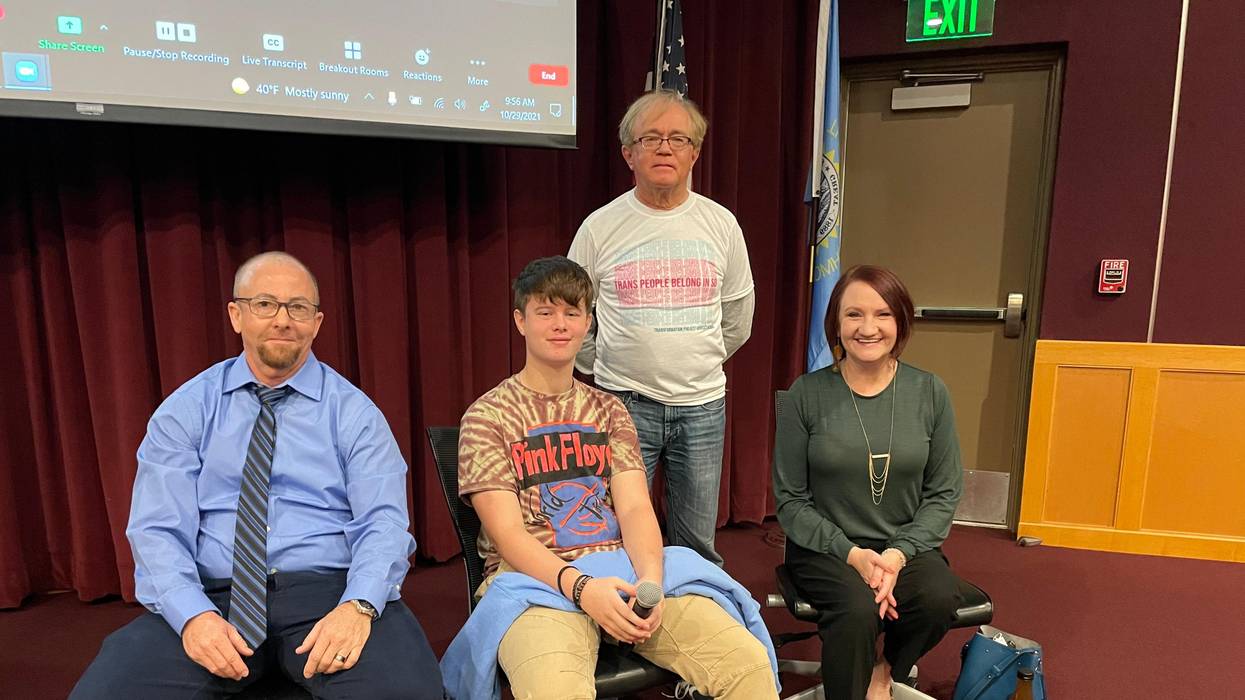
LGBTQ+ rights advocates on Thursday condemned a new South Dakota law banning transgender students from playing on sports teams matching their gender identity.
"This legislation isn't solving an actual problem that South Dakota was facing: It is discrimination, plain and simple. Shame on Gov. Noem."
The Sioux Falls Argus Leader reports Gov. Kristi Noem, a Republican with 2024 presidential aspirations, cited "fairness" as she signed S.B. 46, which mandates that scholastic sports teams from the kindergarten through collegiate levels be segregated by sex assigned at birth.
Mark Miller, Noem's chief of staff and lead counsel, last month likened transgender athletes' participation on school sports teams that match their gender identity to "terrorism."
"You see it elsewhere and don't want it to get to South Dakota," he said.
The ACLU tweeted Thursday that "this cruel and dangerous bill is part of a coordinated attack on trans youth moving nationwide."
S.B. 46, which is the first bill of its kind to be signed into law this year, is set to take effect on July 1, although implementation could be delayed by legal challenges.
A second anti-trans measure, H.B. 1005, which would bar transgender students from using restrooms that correspond with their gender identity, was passed Tuesday by the South Dakota House and was sent to the state Senate for consideration.
Kris Wilka, a 14-year-old transgender boy who plays football for Harrisburg North Middle School in Sioux Falls, will be banned from his team if the new law takes effect.
"Sports is my life," Wilka told NBC News. "My world revolves around football, and I don't know if I would be able to function without it."
Human Rights Campaign state legislative director and senior counsel Cathryn Oakley said in a statement that "instead of focusing on the real issues affecting the people of South Dakota, Gov. Noem and anti-LGBTQ+ state legislators continue their relentless, baseless, and patently discriminatory attacks against transgender kids."
"They show no shame," she continued. "The governor's eagerness to pass a bill attacking transgender kids reveals that her national political aspirations override any sense of responsibility she has to fulfill her oath to protect South Dakotans."
"Gov. Noem and South Dakota legislators need to stop playing games with vulnerable children," Oakley added. "Transgender children are children. They deserve the ability to play with their friends. This legislation isn't solving an actual problem that South Dakota was facing: It is discrimination, plain and simple. Shame on Gov. Noem."
According to the Human Rights Campaign, more than 250 pieces of anti-LGBTQ+ legislation were introduced in 31 U.S. states last year, with 17 new laws enacted in 10 states.
Hoera Kingi is an Oglala Lakota and Ngati Kahungunu transgender two-spirit woman. The non-binary two-spirit identity has been acknowledged and revered by Indigenous peoples for centuries before white invaders conquered what is now South Dakota.
Testifying against S.B. 46 last month, the former high school cheerleader said that not being able to compete on sports teams "would've been devastating to me."
"It would've stopped me from meeting my favorite people and [making] my most cherished memories," she added.
Update:
South Dakota Governor Dennis Daugaard (R) on Tuesday vetoed a bill that would have forced transgender students to use the bathrooms and locker rooms that correspond with their biological sex, rather than their gender identity.
"Today, Governor Daugaard made a symbolic statement that South Dakota's transgender students are a valued part of the community and that our state leaders won't be swayed by out-of-state groups that don't have the interests of South Dakotans at heart," said Heather Smith, executive director of ACLU South Dakota.
"People from across the state and country took time to reach out to the governor to urge this veto--that's the true testament of democracy," Smith said. "There was no place for discrimination in South Dakota when this bill was initially proposed by a handful of legislators, and today the governor confirmed unequivocally that discrimination has no place in our future. Thank you, governor, for listening to the collective voices of South Dakotans and voting for your values."
The veto blocked the nation's first anti-transgender bathroom bill to pass state legislature. However, as ACLU-SD pointed out, 16 other states are still considering enacting similar laws.
Chase Strangio, a staff attorney with the ACLU's Lesbian, Gay, Bisexual, and Transgender Project, said the governor's decision "will place him unequivocally on the right side of history. Federal law is clear that transgender students are protected under Title IX, and the governor's veto prevents costly investigations into school districts across South Dakota."
"Hopefully this important action by Governor Daugaard will allow the state and other states across the country to continue to invest in the safety of all students instead of singling out a vulnerable few for isolation and discrimination," Strangio said.
Earlier:
South Dakota Governor Dennis Daugaard (R) is expected on Tuesday to make a decision, one way or another, on a controversial bill that critics say targets and stigmatizes transgender students.
Daugaard had until Tuesday to either approve or veto legislation, known as HB 1008, that would force transgender students to use the bathrooms and locker rooms that correspond to their biological sex, rather than their gender identity, or else request that the school provide them with a third "reasonable accommodation."
The governor met with Rep. Fred Deutsch, the bill's sponsor, at 4:00 p.m. CST and is expected to make an announcement shortly after that.
Deutsch previously said he introduced legislation "to protect the innocence of children." However, LGBTQI rights advocates say it does nothing but single out transgender students and creates a culture that separates them from their peers.
"We know transgender students face staggering rates of depression and anxiety, and an alarming 41% of transgender people have attempted suicide," said Heather Smith, executive director of ACLU South Dakota, in a statement in February. "H.B. 1008 would do nothing to protect students privacy, but it will do real and lasting harm to vulnerable transgender students."
The organization would consider filing a lawsuit if the legislation is approved.
Ashley Joubert-Gaddis, director of operations at the Sioux Falls-based Center for Equality, told USA Today last week, "What this amounts to is legislators saying we didn't win the gay marriage fight, so let's go after someone else."
Daugaard met with transgender rights activists last week, who said they hoped to influence him to veto the bill. The governor said the sit-down "helped me see things through their eyes a little bit and understand their perspective."
Still, he added, "I have my own set of values and in the end I'll make my own decisions."
Despite having won federal recognition of the right to marry a partner of their choosing, lesbian, gay, bisexual, and transgender (LGBT) people continue to face the possibility of being fired or harassed at work because of their identity or sexual preference.
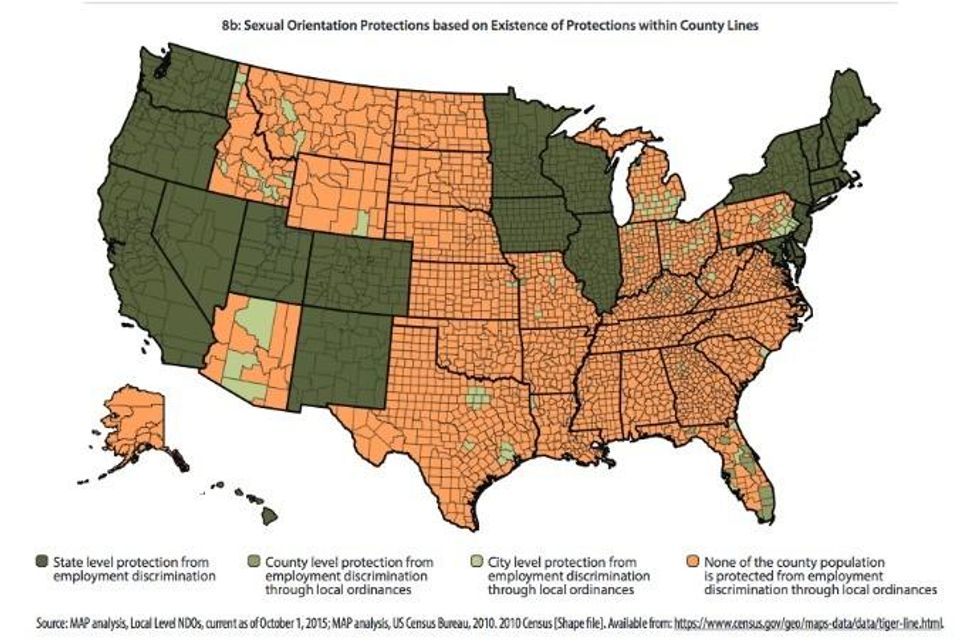
As much as 70 percent of the United States, geographically speaking, lacks any employment protections for LGBT workers, according to a study (pdf) released Tuesday by the equal rights think tank Movement Advancement Project (MAP).
Instead of nationally recognized protections, local governments seeking to prevent discrimination within their borders have enacted a patchwork of laws known as local non-discrimination ordinances (NDO).
Nineteen states have enacted workplace protections and, combining the coverage provided by those and other local NDOs, currently, "more than 170 million Americans are living in areas with laws that explicitly protect them from being fired based on their sexual orientation, and more than 157 million are explicitly protected from discrimination based on their gender identity," according to the MAP study.
However, huge gaps remain.
"There is a deep rural-urban divide when it comes to non-discrimination protections for LGBT people," said Ineke Mushovic, executive director of MAP. "Vast geographic stretches in this country--mostly in rural areas--lack LGBT-inclusive nondiscrimination laws." Mushovic said that an LGBT person is "50 times more likely to be covered by local laws if he or she lives in an urban rather than a rural area" in a state that lacks protections.
For the most part, MAP found statewide protections "exist in clusters of generally more progressive states in the west, Midwest, and Northeast," while LGBT people in the Plains states and South are still largely left vulnerable.
This summer, the Workplace Equality Act was introduced to Congress. While the bill—which amends the Civil Rights Act of 1964 to include sex, sexual orientation, and gender identity—enjoys widespread support, it faces a steep hurdle in the Republican-dominated legislature.
According to a recent poll by the advocacy group the Human Rights Campaign, two-thirds of LGBT respondents said they had experienced discrimination in their lives. And in June, 59 percent said they would be less likely to support a candidate for President who opposed a federal LGBT non-discrimination bill.
"Our country's most basic promise of equal treatment under the law will never be real if you fear losing your job, being kicked out of your home, denied access to healthcare or turned away from a business because of who you are," said James Esseks, director of the ACLU's LGBT Project, upon introduction of the Equality Act. He added that the "lack of clear and explicit federal protections... in core areas of American life [is] unacceptable."