

SUBSCRIBE TO OUR FREE NEWSLETTER
Daily news & progressive opinion—funded by the people, not the corporations—delivered straight to your inbox.
5
#000000
#FFFFFF
To donate by check, phone, or other method, see our More Ways to Give page.
Daily news & progressive opinion—funded by the people, not the corporations—delivered straight to your inbox.
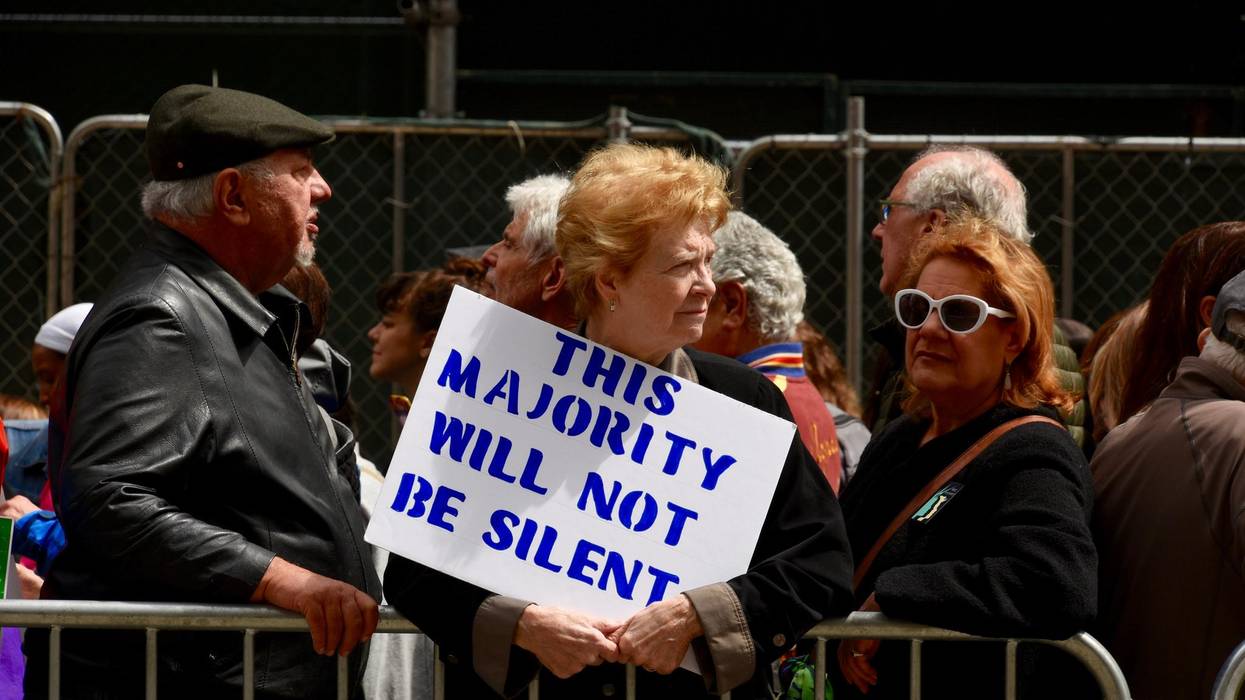
With state and local elections across the United States on Tuesday, the Democratic Party and progressive grassroots organizers were able to claim victories in key battles--including gubernatorial races, state legislatures, ballot initiatives, and local government--a repudiation of both President Donald Trump and the agenda being driven by Republicans.
What follows is just a snapshot of the assorted headlines and significance of those various victories.
"Unelectable" Progressive Civil Rights Attorney Larry Krasner Wins Philadelphia DA Race in Landslide
The Democrat joked during a debate that he "spent a career becoming completely unelectable," having sued his city's police department dozens of times for civil rights violations--only to beat his Republican opponent by 40 percentage points. Krasner has represented activists with the Occupy movement and Black Lives Matter pro bono, and pledged during his campaign to work to end Philadelphia's epidemic of mass incarceration.
Our Revolution Candidates Win Big in Boston Suburb
Based on the city's unofficial election results, all seven Somerville, Mass. aldermen candidates who were endorsed by Our Revolution--the group spun out of Sen. Bernie Sanders' (I-Vt.) 2016 bid for president--won: Ben Ewen-Campen, Jesse Clingan, Will Mbah, Matthew McLaughlin, Mary Jo Rossetti, J.T. Scott, and Bill White. McLaughlin, who last year chaired the Sanders campaign in Somerville, told the Boston Globe that he thought the results reflected residents' desire for "progressive change," adding: "Locally this is mandate for change in Somerville and the affordable housing crisis specifically."
Justin Fairfax Trounces GOP Opponent in Virginia's Race for Lieutenant Governor
In the state where white supremacists marched chanting, "You will not replace us" three months ago, a black Democrat won by a comfortable margin against a Republican who embraced President Donald Trump's agenda and declared at a rally, "We are going to take back Virginia the way this president is going to take back this country!" Fairfax's new role often serves as a stepping stone to a gubernatorial race.
Maine Becomes First State to Expand Medicaid by Ballot Measure
Rebuffing Congressional Republican's attacks on healthcare, and Maine Gov. Paul LePage's vetoes of at least five legislative efforts to expand Medicaid in the state, a ballot initiative to provide healthcare to an estimated 70,000 low-income residents of the state passed by nearly 20 percentage points. "Maine has shown the way for the rest of the country," Jennie Pirkl, the campaign manager for measure told the Bangor Daily News. "Voters have sent a clear message to Augusta, Washington, and the rest of the country that we want more health care, not less."
Democrat Danica Roem Becomes Virginia's First Openly Transgender House Member By Defeating Anti-Trans Republican Incumbent
Defeating the GOP incumbent who wanted to ban transgender people like her from using public bathrooms of their choice, Roem won her place in the state legislature by unseating Republican Bob Marshall, described as "one of the state's longest serving and most socially conservative lawmakers." Roem focused her campaign on jobs, schools, and northern Virginia's traffic congestion.
Democrat Socialist Lee Carter Headed to Virginia House of Delegates
Carter unseated Republican delegate Jackson Miller in an upset after a contentious race; Miller attacked Carter for being an open socialist, comparing him in a mailer to Josef Stalin and Mao Zedong. Carter is a proponent of single-payer healthcare and promised during his campaign to expand access to Medicaid in Virginia.
First Transgender Woman of Color Wins in Minneapolis City Council Race
While long-time Minneapolis City Council members struggled to hold their seats, Andrea Jenkins secured more than 70 percent of the vote in the city's Eighth Ward and became the first transgender black woman elected to public office nationwide. "Transgender people have been here forever, and black transgender people have been here forever," Jenkins told the Washington Post after her win. "I'm really proud to have achieved that status, and I look forward to more trans people joining me in elected office, and all other kinds of leadership roles in our society."
After Race-Baiting Tactics Used by Opponent, Ravi Bhalla Becomes Nation's First Sikh Mayor
Days after his opponents distributed a racist flyer portraying him as a terrorist, Ravinder Bhalla was elected as the nation's first Sikh mayor. During the campaign, the new mayor of Hoboken, New Jersey responded to attacks on his ethnicity and religion with a simple tweet stating, "We won't let hate win."
In a pair of special elections on Tuesday, Democratic candidates flipped statehouse seats in Oklahoma and New Hampshire, winning by double digits in districts that voted for President Donald Trump in November, and adding to a growing list of party victories that could offer insight into coming elections.
In the New Hampshire race for a state House seat, Democrat and small-business owner Charles St. Clair secured 55 percent of the vote in a district that Trump won by 19 points. In Oklahoma, meanwhile, schoolteacher Jacob Rosecrants won 60 percent of the vote in his district, according to unofficial election results, becoming the third Democrat from the state to defeat a Republican challenger for a GOP-held seat this year.
Discussing Rosecrants' win, Carolyn Fiddler at Daily Kos notes:
Trump won this district 52-41 percent last fall, making this win a 31-point swing toward the Democrat. What's more, Rosecrants himself ran for this same seat and lost in 2016...by the same 60-40 margin he won by on Tuesday.
This dramatic shift tracks with the massive improvement in Democratic performance in the majority of special elections at both the congressional and state legislative level since Trump's election last November.
Although Democratic candidates in 2017 special elections for seats in the U.S. Congress have lost close contests in Georgia, Kansas, and Montana, Democrats have flipped six state-level seats in special elections this year. In addition to picking up the other two state legislative seats in Oklahoma this summer, Democrats also flipped a seat in both New Hampshire and New York earlier this year.
"Open seats are far more likely to flip party control than when an incumbent runs," CNN's Chris Cillizza acknowledges, but the combination of "Trump's unpopularity, historic midterm patterns for the president's party, and the early-warning signs" from state legislative districts that helped elect Trump suggest that this shift in key districts for Republicans could foreshadow future Democratic Party wins in coming state-level elections as well as the 2018 midterms.
Recent victories in red districts "bolster the party's attempt to regain nearly 1,000 legislative seats that Democrats have lost across the country since 2009," notes Daniel Marans for the Huffington Post, "and suggest they could make more significant gains in normal state-level elections in Virginia and New Jersey this November."
These state-level wins also come as three Republicans in Congress have announced they will not seek re-election for their competitive U.S. House seats next year, which multiple political analysts have indicated are positive developments for Democrats.
On Tuesday, the New York Times' Nate Cohn shared on Twitter a "telling chart" that shows a higher number of open seats among congressional Republicans for 2018.
And as David Wasserman of the Cook Political Report points out, in the 2008 election, seats vacated by Republicans led to Democratic gains in Congress.
Nathaniel Rakish, writing for FiveThirtyEight, observes that this recent "pattern of retirements appears to be generational as well as about representatives responding to the political environment," based on his analysis of U.S. representatives' retirements since the mid-1970s.
Although "a rash of retirements doesn't necessarily signal" guaranteed victories for the other party in the next election, Ravish concludes "the most fundamental takeaway is still this: Retirements from a competitive state or district hurt the party the member belongs to" because of incumbency advantage, so "the more Republicans in competitive districts who retire heading into 2018, the more seats Democrats can realistically go after."
In an era of increasing dissatisfaction with and disengagement from governments, political parties, and much of the rest of the democratic establishment, it's more important than ever that you show up and vote.
Suffrage is not a right afforded to everyone. Rather, voting is a privilege in the United States - and a hard-earned privilege at that.
At the beginning of the republic, only those white men with land were allowed a hand in electing our leaders and lawmakers. Later, under President Andrew Jackson, that decision-making power was extended to most white men. After a lengthy civil war - shedding a staggering amount of blood and treasure - successive amendments to the US constitution granting broader voting rights followed. Women, at this time, were entirely disregarded - until the 19th amendment passed in 1920.
Although some people of color were allowed to vote, many still faced disenfranchisement prior to the Voting Rights Act of 1965. With the recent gutting of that act by the supreme court, the systematic disenfranchisement of people of color is alive and well today.
Progress on suffrage has always tended to be incremental. And, far from being a closed chapter in our history, the fight to keep things moving forward continues to this day.
For every thousand people living in the US, seven are incarcerated. That population consists disproportionately of black and brown people, whether accused and convicted of crimes or held by immigration authorities.
Even when the incarcerated leave prison, they often return to our communities without the ability to vote. That means the people most affected by our political institutions and processes today often have absolutely have no say in how they are run. This group includes me. In Maryland, my state of residence, for instance, I will not be able vote until the year 2045.
Disenfranchisement and legal exclusion - whether by race, gender, class, immigration status, or otherwise - from our democratic institutions is one of the most significant failures of American society today.
One of the most contentious general elections in modern US history is in front of us. Next Tuesday, if, instead of making your way to the booth, you decide to go shopping, out for lunch or dinner, stay at home, play a video game, or whatever, just remember that many of us cannot vote but would dearly like to. While universal suffrage remains an ideal yet to be attained, if you're lucky enough to be able to vote, don't let that privilege go to waste.