

SUBSCRIBE TO OUR FREE NEWSLETTER
Daily news & progressive opinion—funded by the people, not the corporations—delivered straight to your inbox.
5
#000000
#FFFFFF
To donate by check, phone, or other method, see our More Ways to Give page.
Daily news & progressive opinion—funded by the people, not the corporations—delivered straight to your inbox.
We are witnessing the reemergence of a dangerous repetition: one where the pattern of assertion becomes the prelude to action, and where action can lead to irreversible consequences.
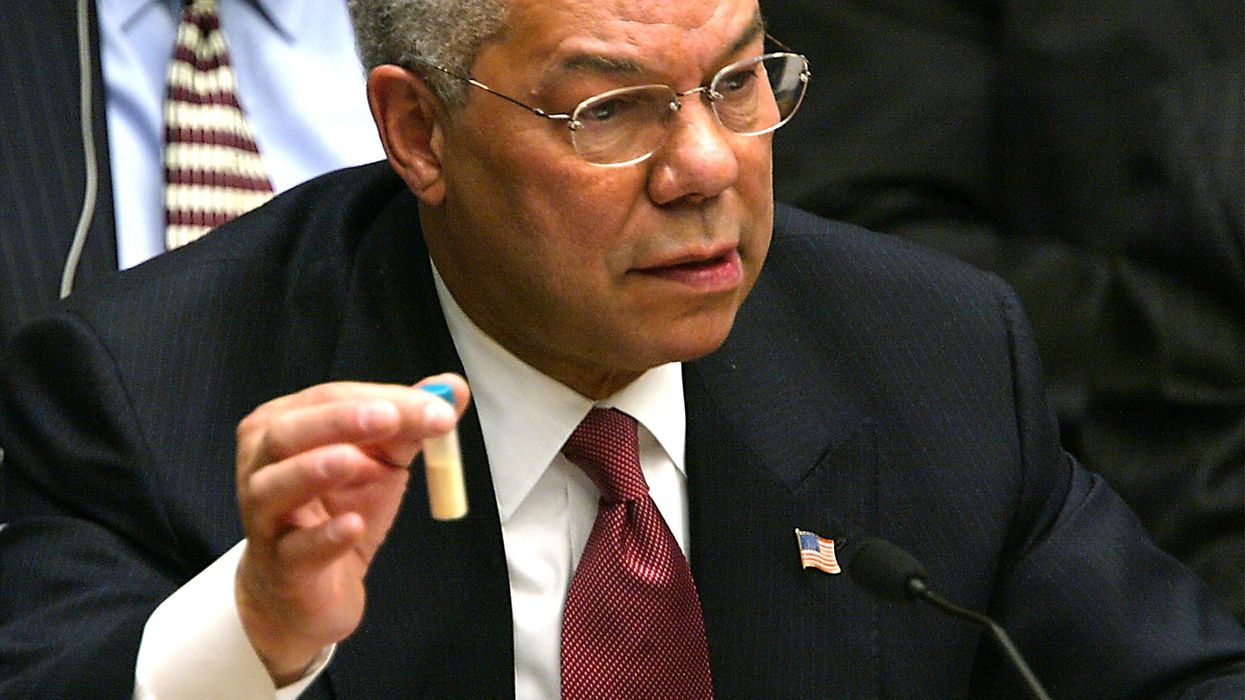
In the annals of modern international relations, few moments carry as heavy a legacy as the speech given by US Secretary of State Colin Powell to the United Nations Security Council on February 5, 2003. With solemn authority, Powell presented what he called “facts and conclusions based on solid intelligence” regarding Iraq’s weapons of mass destruction. The world watched. The Security Council listened. The invasion of Iraq soon followed.
Yet nearly every core assertion Powell made that day collapsed under post-war scrutiny. Iraq, it turned out, had no active WMD program. The biological labs, the chemical weapons, the nuclear revival—none existed. The damage, however, had been done: hundreds of thousands of lives lost, regional instability that persists two decades later, and a critical blow to the credibility of the international system.
The latest fact-checking report on statements made by the US ambassador to the United Nations at the Security Council emergency meeting on December 23, 2025 evokes Powell’s fateful moment with uncomfortable clarity. Assertions regarding Venezuela—about narco-terrorism networks, stolen oil, and naval interdictions—were advanced with the same kind of urgency and confidence that once shaped the Iraq invasion narrative. But just like 2003, these claims are not being matched by publicly verifiable evidence.
At the center of the current controversy is the claim that Venezuelan oil revenues finance a powerful criminal entity known as the “Cartel de los Soles.” Yet no evidentiary chain has been produced to establish this link: no verifiable financial tracing, no adjudicated findings, and no independent corroboration by multilateral investigative bodies. Even UN human-rights experts have questioned the coherence and existence of the cartel as a unified organization.
What the 2003 Iraq experience makes painfully clear is that institutional credibility depends on the ability to separate fact from political fiction.
Equally troubling is the claim that this alleged cartel poses a major narcotics or terrorist threat to the United States. The US Drug Enforcement Administration’s own 2025 National Drug Threat Assessment identifies Mexican transnational criminal organizations—not Venezuelan entities—as the principal threat. The Venezuelan organization does not even appear in the assessment.
Assertions have also been used to justify naval interdictions—military actions that, in legal terms, dangerously approach the definition of a blockade. But UN experts have been clear: Unilateral sanctions do not confer a right to enforce them through armed action. Under Article 2(4) of the UN Charter, the use of force is prohibited unless specifically authorized by the Security Council or justified in self-defense under Article 51. Neither condition has been met.
Finally, the idea that Venezuelan oil is “stolen” US property collapses under legal scrutiny. Venezuela nationalized its oil industry in 1976. While disputes over contractual terms and compensation have existed, these have historically been handled through arbitration and diplomacy—not force. No international court has ruled these oil shipments to be stolen under law.
What the 2003 Iraq experience makes painfully clear is that institutional credibility depends on the ability to separate fact from political fiction. Colin Powell’s posthumous regret—that his speech was a “blot” on his record—remains a chilling reminder that when unverified intelligence is used as justification for coercive action, the cost is not borne by the speaker, but by the people affected on the ground.
The December 2025 Security Council meeting reminds us how dangerous it is when urgency displaces evidence, as happened in Iraq in 2003. Unverified assertions create policy momentum. That momentum can foreclose diplomacy, manufacture inevitability, and normalize coercive actions like blockades or seizures—justified not through law, but through narrative inertia.
For policy analysts and scholars of international relations, this moment demands clarity. We are not debating ideology or even the internal legitimacy of a foreign government. The question is one of process: Do the claims being made meet minimum evidentiary thresholds before they are used to rationalize actions with international consequences?
Especially when coercive measures—economic or military—are on the table, the evidentiary bar must be high, not symbolic.
The UN Security Council’s authority rests not just on its legal charter, but on its credibility as a deliberative body. When that credibility is weakened by unsourced or politically convenient assertions, the council itself becomes a platform for escalation—not prevention.
The lesson from Iraq is not rhetorical—it is institutional. Intelligence must not be permitted to morph into justification before it becomes verification. Assertions, no matter how confidently delivered, are not evidence. When the international system forgets that distinction, the consequences are paid in blood and legitimacy.
It is not enough to feel certain. Policy must be grounded in demonstrable truth. Especially when coercive measures—economic or military—are on the table, the evidentiary bar must be high, not symbolic.
We are witnessing the reemergence of a dangerous repetition: one where the pattern of assertion becomes the prelude to action, and where action can lead to irreversible consequences. Whether in Baghdad or Caracas, this is a pattern we cannot afford to repeat.
Former British foreign secretary Jack Straw, a key player in the invasion of Iraq, expressed relief in July that the political brouhaha over Brexit would distract from the damning contents of the Chilcot Inquiry into the United Kingdom's role in the war.
"The only silver lining of the Brexit vote is that it will reduce medium term attention on Chilcot--though it will not stop the day of publication being uncomfortable," Straw wrote in an email to former U.S. Secretary of State Colin Powell, obtained by the hacking group DC Leaks and provided to The Intercept and other news organizations on Tuesday.
The email, dated July 4, came two days before the release of the 2.6 million-word Chilcot Inquiry, which showed that the invasion of Iraq was decided well before all peaceful resolutions were exhausted, proving--as critics have long-contended--that the disastrous intervention was a war of choice.
The Brexit vote, in which the majority voted to leave the European Union, took place June 23.
As The Intercept reports, "In anticipation of coming [Chilcot] press coverage, Straw asked Powell to review a statement in a Word document he drafted."
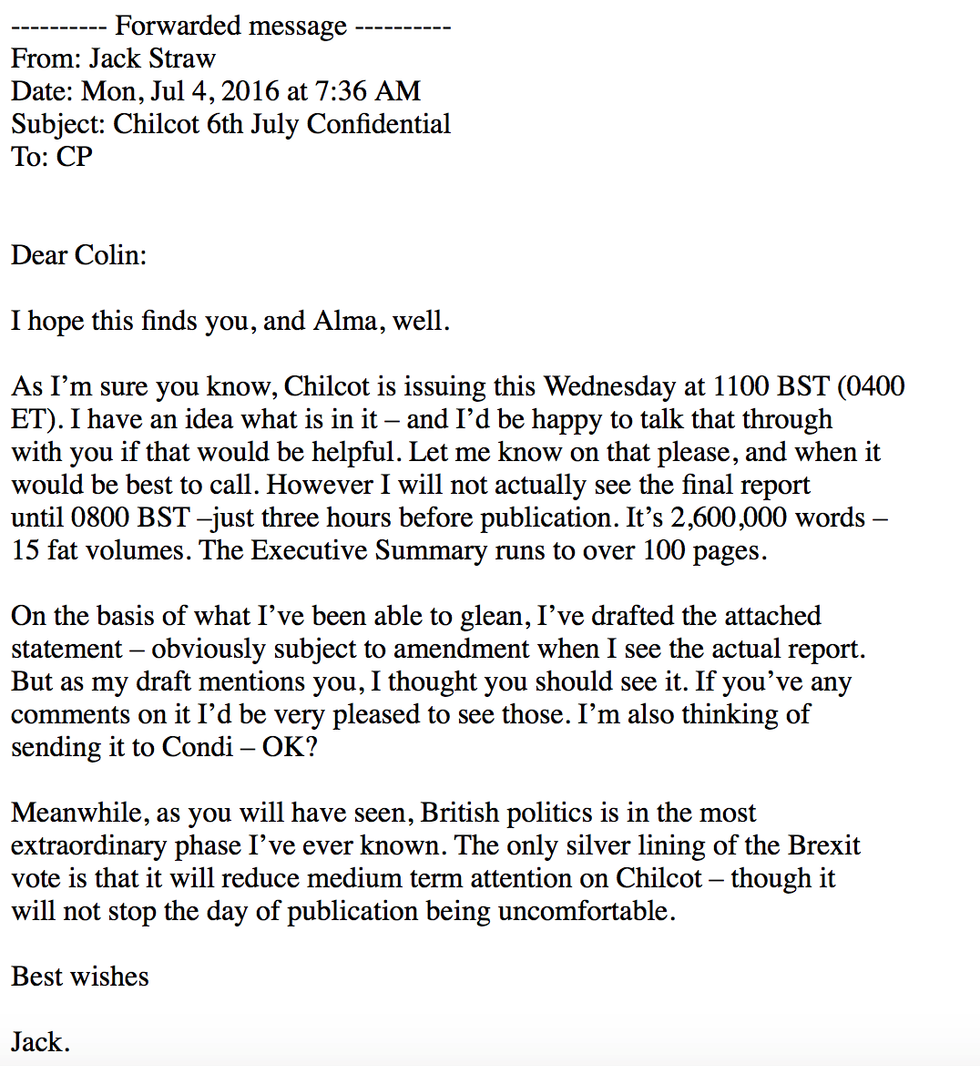
Powell responded, advising Straw to share the statement with Powell's successor as secretary of state, Condoleezza Rice, and saying he would also show former Deputy Secretary of State Richard Armitage.
And, The Intercept adds:
He showed skepticism towards a part of Straw's statement which claimed that an additional United Nations resolution prior to the conflict would have avoided the invasion. He wrote back to Straw, "I can't agree or disagree with your judgement that a second resolution would have prevented conflict. I doubt it, but I don't know." (In Straw's final statement released to the press, the claim remained.)
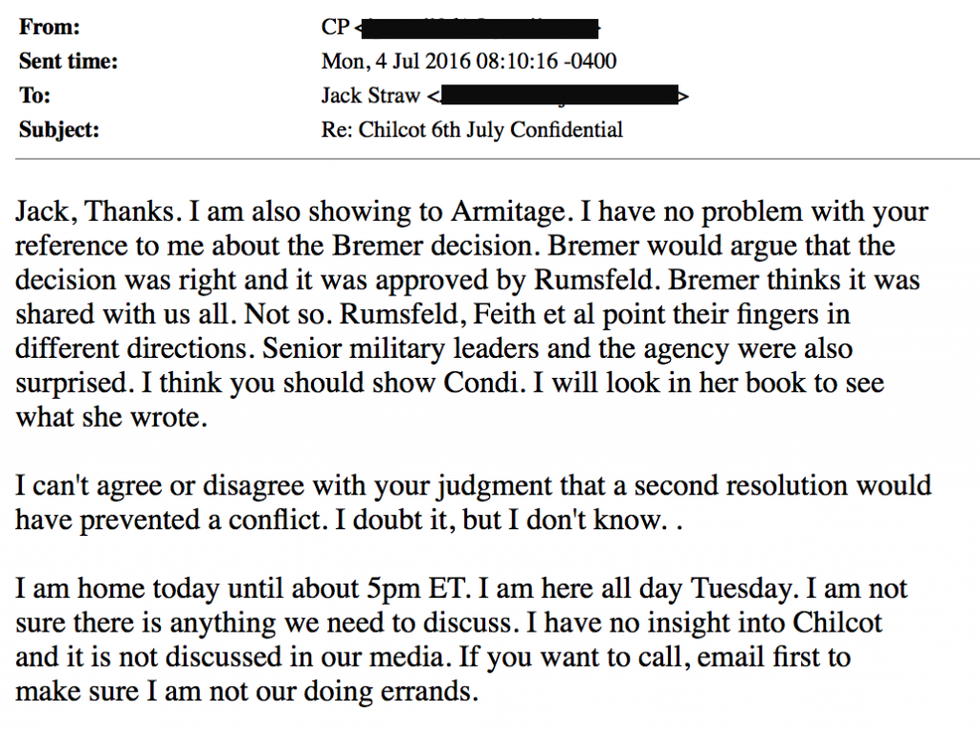
The two men didn't correspond again for almost a month, at which point Powell emailed Straw with birthday wishes.
He noted Straw had been "quiet since Brexit" and appeared to confirm Straw's prediction, writing: "I assume the report has faded away in the avalanche of other news."
"Didn't amount to anything over here [in the United States]," Powell added.
Other emails contained in the Powell leak show the former secretary of state calling Republican presidential nominee Donald Trump a "national disgrace;" criticizing Democratic nominee Hillary Clinton and her campaign for using him to justify her use of a private email server at the State Department; and discussing former Secretary of Defense Donald Rumsfeld and his handling of the Iraq War.
A Memo to: Dr. Ben Carson, Hillary Clinton, Ted Cruz, John Kasich, Marco Rubio, Bernie Sanders, Dr. Jill Stein, and Donald Trump
The media brouhaha over naming your campaign advisers on foreign policy prompts this reminder of a unique resource available, gratis, to all of you. That resource is our nonpartisan group - Veteran Intelligence Professionals for Sanity (VIPS). If we were into self-promotion, we would add to our (virtual) letterhead: "Serving satisfied customers since 2003."
We are about apolitical analysis; we are into spreading unvarnished truth around; we do not shape our analysis toward this or that debating point.
We are about apolitical analysis; we are into spreading unvarnished truth around; we do not shape our analysis toward this or that debating point. Thus, we eschew the moniker "campaign adviser." But that doesn't mean we wouldn't provide apolitical and unvarnished advice to anyone who seeks it.
Unique? We are on the outer edge of atypical in the sense that we are a fiercely nonpartisan, tell-it-like-it-is group of professionals with long experience in intelligence and related fields and with no policy or personal axes to grind. We are Republicans, Democrats and Independents. Abundant proof that party preference plays no role in our analysis can be seen in our enviable record - in the substantive work we have produced over the past 13 years - both before and after the ill-advised attack on Iraq in March 2003.
Also distinguishing us from "campaign advisers," none of us in VIPS lust for a high position in a new administration; none are heavily invested in arms industries; none of us ask for a retainer. In other words, there are no strings attached to the substantive analysis we provide to all our readers and listeners. If objective, disinterested analysis is your cup of tea, we suggest that you check out VIPS's record, to include the multiple warnings we gave President George W. Bush in the months before the attack on Iraq.
In fact, VIPS was founded by a handful of former CIA analysts, including me, for the express purpose of warning President Bush that his small coterie of advisers, led by Vice President Dick Cheney, was adducing fraudulent - not mistaken - "intelligence" in promoting the concept the war on Iraq.
Indeed, in recent years VIPS has been accused of naivete in failing to understand that Bush, to whom we addressed most of our pre-war memos, was fully aware of how Cheney and his cunning co-conspirators and conmen were fabricating the false pretenses for war. We plead guilty to believing that U.S. presidents deserve unspun analysis and to trusting that honest assessments will help presidents act responsibly on behalf of the nation.
Call us old-fashioned, but we just found it hard to believe that any U.S. president would justify war on "evidence" made out of whole cloth. Equally difficult to believe was that our former colleagues would acquiesce in the deception.
So, despite the doubts that Bush really wanted the real story, we rose to the occasion, nonetheless, and issued three corporate VIPS memoranda before the attack on Iraq: (1) "Today's Speech By Secretary Powell At the UN," February 5, 2003; (2) "Cooking Intelligence for War in Iraq," March 12, 2003; and (3) "Forgery, Hyperbole, Half-Truth: A Problem," March 18, 2003.
Our commentary on Secretary of State Colin Powell's UN speech went out on the AFP wire and was widely read - abroad. Foreign media followed up with us; U.S. media - not so much. (This is the primary reason you may be learning all this for the first time).
During that critical pre-war period we took pains to use whatever entree we had to influential people. For example, I personally sought to reach then-Sen. Hillary Clinton via a key person on her staff, who assured me that the senator was being given our op-eds and our analyses to read.
In our memorandum of Feb. 5, 2003, we told President Bush we could give Powell "only a C-minus in providing context and perspective." As for input from Defense Secretary Donald Rumsfeld's Pentagon, we told the President: "Your Pentagon advisers draw a connection between war and terrorism, but for the wrong reasons. The connection takes on much more reality in a post-U.S. invasion scenario. [Emphasis in the original]
"Indeed, it is our view that an invasion of Iraq would ensure overflowing recruitment centers for terrorists into the indefinite future. Far from eliminating the threat it would enhance it exponentially."
Though it went unheeded 13 years ago, the final paragraph of VIPS's first Memorandum for the President seems quite relevant to the current discussion regarding "campaign advisers" on foreign policy. In our same-day memo to the President on Powell's UN speech we noted that he had described what he said as "irrefutable and undeniable." Our final paragraph started with an allusion to those words:
"No one has a corner on the truth; nor do we harbor illusions that our analysis is irrefutable or undeniable. But after watching Secretary Powell today, we are convinced that you would be well served if you widened the discussion beyond ... those advisers clearly bent on a war for which we see no compelling reason and from which we believe the unintended consequences are likely to be catastrophic."
Our work reflects the ethos that earlier guided the work of intelligence community analysts at CIA and elsewhere, a commitment to both objectivity and scholarship.
Our VIPS memorandum of Feb. 5, 2003, was sent to the President more than two years before the London Times published the minutes of a July 23, 2002 briefing at 10 Downing Street, during which Richard Dearlove, the head of British intelligence, reported to British Prime Minister Tony Blair on Dearlove's talks three days earlier with his U.S. counterpart, CIA Director George Tenet, at CIA headquarters. According to those undisputed minutes, Dearlove said the following:
"Military action was now seen as inevitable. Bush wanted to remove Saddam through military action, justified by the conjunction of terrorism and WMD. But the intelligence and facts were being fixed around the policy." [Emphasis added]
Our warnings to President Bush also came more than five years before the completion of a five-year investigation by the Senate Intelligence Committee on pre-war intelligence, the results of which were approved by a bipartisan majority. On June 5, 2008, the date of its release, committee chair Jay Rockefeller commented on its findings:
"In making the case for war, the administration repeatedly presented intelligence as fact when in reality it was unsubstantiated, contradicted, or even non-existent. As a result, the American people were led to believe that the threat from Iraq was much greater than actually existed."
Just So You Know
One presidential candidate is said to have "an army of several hundred, perhaps even more than a thousand, foreign policy advisers;" another has been criticized for having no "talent pool" of "trusted experts." Little is known about those advising other candidates or, for example, in which campaign headquarters erstwhile advisers to dropout candidates like Jeb Bush are now hanging their hats.
The purpose of this open letter is merely to ensure that you know that you are welcome to dip into a different and unique "talent pool" - Veteran Intelligence Professionals for Sanity (VIPS). This pool is now several hundred years deep in collective experience and brimming with the kind of knowledge that flows from senior-level work in intelligence and related fields. Our record of memoranda, averaging three per year, speaks for itself.
If nonpartisan, fact-based analysis is your cup of tea, have a look at those memoranda, which we believe are second to none in terms of candor and tell-it-like-it-is analysis. Our work reflects the ethos that earlier guided the work of intelligence community analysts at CIA and elsewhere, a commitment to both objectivity and scholarship.
That was before Director Tenet decided to welcome frequent visits by Vice President Dick Cheney to make sure CIA analysts were finding or fabricating enough "intelligence" to "justify" the launch of an unnecessary war. We take no pleasure in having been correct at the outset, in predicting "the unintended consequences are likely to be catastrophic."
One year before the United States-led coalition invaded Iraq, then-UK Prime Minister Tony Blair told the administration of President George W. Bush that he would support military action in that country, according to a memo publicized Sunday by the Daily Mail.
The revelation "flies in the face of the Prime Minister's public claims at the time that he was seeking a diplomatic solution to the crisis," the Mail points out. "He told voters: 'We're not proposing military action'--in direct contrast to what the secret email now reveals."
The document, written in March 2002 by former Secretary of State Colin Powell to Bush, was among a batch of secret emails held on the private server of Democratic presidential candidate Hillary Clinton.
"On Iraq, Blair will be with us should military operations be necessary," Powell wrote in a memo penned one week before Blair met Bush at the former president's ranch in Crawford, Texas.
"Aside from his foreign and defense secretaries, Blair's Cabinet shows signs of division, and the Labour Party and the British public are unconvinced that military action is warranted now," Powell continued, noting that Blair was likely to suggest ideas on how to "make a credible public case on current Iraqi threats to international peace" and "demonstrate that we have thought through 'the day after'."
In public comments during his time at Crawford, Blair denied that Britain was on an unstoppable path to war, saying: "This is a matter for considering all the options. We're not proposing military action at this point."
A year later, British Members of Parliament (MPs) gave Parliamentary approval for the invasion of Iraq.
According to the Mail, "A second explosive memo from the same cache also reveals how Bush used 'spies' in the Labour Party to help him to manipulate British public opinion in favor of the war."
The revelations outraged current and former MPs, at least one of whom said he felt "duped."
Former Labour MP Andrew MacKinlay, who sat on the foreign affairs select committee in the run-up to the war, told LBC Radio that he is "ashamed" to have trusted Blair about the Iraq War. "Looking at these documents this morning and everything else that has gone before, we know that this was a complete and utter deceit to me and to others," he said.
"Obviously I feel both deeply ashamed and very stupid having trusted a British prime minister, but it was a British prime minister," MacKinlay added. "One assumed that even allowing for exaggeration or inaccuracies in intelligence, I never thought it would be one hundred percent untrue, but it was--and myself and the British people, all of us, were duped."
Another unnamed senior diplomat, who according to the Mail had "close knowledge of Blair-Bush relations," said on Monday: "This memo shows beyond doubt for the first time Blair was committed to the Iraq War before he even set foot in Crawford."
Former Tory Shadow Home Secretary David Davis told the Mail that "[t]he memos prove in explicit terms what many of us have believed all along: Tony Blair effectively agreed to act as a frontman for American foreign policy in advance of any decision by the House of Commons or the British Cabinet."
Davis went on: "He was happy to launder George Bush's policy on Iraq and sub-contract British foreign policy to another country without having the remotest ability to have any real influence over it. And in return for what?"
"For George Bush pretending Blair was a player on the world stage to impress voters in the UK when the Americans didn't even believe it themselves," he concluded.
Meanwhile, a timetable for publication of an official inquiry into the UK's invasion of Iraq by Sir John Chilcot still has not been set. The Guardian reports that "there are already calls for further delays if he has not been given access to this secret memo between Powell and Bush setting out the U.S. view of Britain's position."
Secretary of State Colin Powell is one of the most recognizable, and maybe the most well-liked figure across party lines, in the Bush administration. He has served his country long and well. Yet evidence mounts that he was (and remains) on the sidelines to advise and implement President Bush's major foreign activities, especially the Iraq war.
Powell's reluctance to invade Iraq has been no secret. Bob Woodward's new book, "Plan of Attack," has added new, attributable quotes. If, as Woodward suggested, Powell is "out of the loop," and peripheral to the president's major decisions, then he should resign. He owes that course to himself, his reputation and to the nation.
Principled resignations have not been prominent in American history. Resignations have become elaborately ritualized, designed largely to spare both sides public embarrassment. The famous Watergate resignations of April 30, 1973, offer a case in point. President Richard Nixon's top aides, H.R. Haldeman and John Ehrlichman "regretfully" resigned, and with apparent equal "regret," the president accepted them. Atty. Gen. Richard Kleindienst similarly "resigned" that day. All three fought tenaciously to preserve their jobs; they had no choice, however, and they left at Nixon's insistence. That same day, Nixon simply fired John Dean, the counsel to the president. Nixon was unconcerned about his feelings or reputation; for good reason, as we were to learn in less than two months.
Powell might want to be remembered for the manner of his leaving. Resigning on principle, in the firm belief you behaved correctly, is a rare act. U.S. Atty. Gen. Elliot Richardson resigned in 1973 with dignity and grace when he refused to carry out Nixon's order to dismiss Watergate Special Prosecutor Archibald Cox. William Jennings Bryan resigned as secretary of state because he believed President Woodrow Wilson's actions would lead the nation to war. And Cyrus Vance, President Jimmy Carter's secretary of state, resigned because he disagreed with military operations to rescue Iranian hostages in 1979. All had the satisfaction of eventual vindication.
Richard Clarke's resignation as Bush's chief adviser on counter-terrorism apparently resulted from his growing sense of frustration. He also regarded the looming war with Iraq as misdirected. At first, he requested transfer to a cyber-security position, and apparently cared deeply about that issue. Yet in January 2003, he quit during the run-up to the Iraq war.
Powell has acknowledged that he talked to Bob Woodward about his role in the decision to go to war. He has denied that he was "out of the loop." But he has not specifically confirmed or rejected any of the remarks Woodward attributed to him. Did Powell tell the president that he would be "the proud owner of 25 million people; [y]ou will own all their hopes, aspirations, and problems. You'll own it all."? Did he tell the president, "If you break it, you own it."? We don't know. But the useful Latin maxim here is that "silence connotes consent."
A principled resignation by Powell might offer the nation clarity and focus as it prepares to debate and judge the actions of the administration. Powell's speech to the United Nations, "documenting" the administration's case for war, has proven both exaggerated and deceitful. Powell himself found the usual Washington language to acknowledge his errors without, of course, explicitly saying so.
Profound principles are at stake: Does the administration have a right to use foreign policy for its own political and personal agendas? May the government make a blatantly dishonest case, based on hyped claims that Iraq held vast quantities of weapons of mass destruction, and had strong links to Al Qaeda, to lead the nation to war? As evidence mounts that the Iraq war was unnecessary or, at best, unjustified, contrary to what the administration contended, Colin Powell should weigh his own beliefs and his responsibility.
Powell is a highly decorated military officer, rising to chairman of the Joint Chefs of Staff, and he served well as President George H.W. Bush's national security adviser. Powell certainly has been a good soldier for this president. Recently, he bristled at a congressman who had questioned Bush's military record. Yet in his autobiography, Powell angrily denounced "the sons of the powerful and well placed ... [who] managed to wangle slots in Reserve and National Guard units. Of the many tragedies of Vietnam, this raw class discrimination strikes me as the most damaging to the ideal that all Americans are created equal and owe equal allegiance to their country."
Powell has indicated, and it has been widely reported, that he will not be part of a second Bush administration. His choice then is simple: serve until January 2005, fight some skirmishes against Vice President Dick Cheney and Secretary of Defense Donald Rumsfeld, yet remain marginalized except when there is a need to parade the "Good Soldier"; or resign now because he has been badly used, even ignored, by the administration.
Resignation would ensure a historic and successful memoir.