

SUBSCRIBE TO OUR FREE NEWSLETTER
Daily news & progressive opinion—funded by the people, not the corporations—delivered straight to your inbox.
5
#000000
#FFFFFF
To donate by check, phone, or other method, see our More Ways to Give page.
Daily news & progressive opinion—funded by the people, not the corporations—delivered straight to your inbox.

"I chose to take on the biggest companies in the world, to hold them accountable, to speak truth to power. There is a cost attached to that," said Imran Ahmed, one of five Europeans targeted by the Trump administration.
After a US judge on Thursday blocked President Donald Trump's administration from detaining one of the European anti-disinformation advocates hit with a travel ban earlier this week, Imran Ahmed suggested that he is being targeted because artificial intelligence and social media companies "are increasingly under pressure as a result of organizations like mine."
Ahmed is the CEO of the Center for Countering Digital Hate (CCDH). The 47-year-old Brit lives in Washington, DC with his wife and infant daughter, who are both US citizens. While the Trump administration on Tuesday also singled out Clare Melford of the Global Disinformation Index, Josephine Ballon and Anna-Lena von Hodenberg of HateAid, and Thierry Breton, a former European commissioner who helped craft the Digital Services Act, Ahmed is reportedly the only one currently in the United States.
On Wednesday, Ahmed, who is a legal permanent resident, sued top Trump officials including US Attorney General Pam Bondi, Immigration and Customs Enforcement acting Director Todd Lyons, Secretary of Homeland Security Kristi Noem, and Secretary of State Marco Rubio in the District Court for the Southern District of New York.
"Rather than disguise its retaliatory motive, the federal government was clear that Mr. Ahmed is being 'SANCTIONED' as punishment for the research and public reporting carried out by the nonprofit organization that Mr. Ahmed founded and runs," the complaint states. "In other words, Mr. Ahmed faces the imminent prospect of unconstitutional arrest, punitive detention, and expulsion for exercising his basic First Amendment rights."
"The government's actions are the latest in a string of escalating and unjustifiable assaults on the First Amendment and other rights, one that cannot stand basic legal scrutiny," the filing continues. "Simply put, immigration enforcement—here, immigration detention and threatened deportation—may not be used as a tool to punish noncitizen speakers who express views disfavored by the current administration."
Just a day later, Judge Vernon Broderick, an appointee of former President Barack Obama, issued a temporary restraining order, blocking the administration from arresting or detaining Ahmed. The judge also scheduled a conference for Monday afternoon.
The US Department of State said Thursday that "the Supreme Court and Congress have repeatedly made clear: The United States is under no obligation to allow foreign aliens to come to our country or reside here."
Ahmed's lawyer, Roberta Kaplan, said that "the federal government can't deport a green-card holder like Imran Ahmed, with a wife and young child who are American, simply because it doesn't like what he has to say."
In the complaint and interviews published Friday, Ahmed pointed to his group's interactions with Elon Musk, a former member of the Trump and administration and the richest person on Earth. He also controls the social media platform X, which sued CCDH in 2023.
"We were sued by Elon Musk a couple of years ago, unsuccessfully; a court found that he was trying to impinge on our First Amendment rights to free speech by using law to try and silence our accountability work," Ahmed told the BBC.
Months after a federal judge in California threw out that case last year, Musk publicly declared "war" on the watchdog.
CCDH's work is being targeted by the U.S. State Department trying to sanction and deport our CEO, Imran Ahmed. This is an unconstitutional attempt to silence anyone who dares to criticize social media giants. But a federal judge has temporarily blocked his detention.More in BBC ⤵️
[image or embed]
— Center for Countering Digital Hate (@counterhate.com) December 26, 2025 at 4:05 PM
"What it has been about is companies that simply do not want to be held accountable and, because of the influence of big money in Washington, are corrupting the system and trying to bend it to their will, and their will is to be unable to be held accountable," Ahmed told the Guardian. "There is no other industry, that acts with such arrogance, indifference, and a lack of humility and sociopathic greed at the expense of people."
Ahmed explained that he spent Christmas away from his wife and daughter because of the Trump administration's track record of quickly sending targeted green-card holders far away from their families. He said: "I chose to take on the biggest companies in the world, to hold them accountable, to speak truth to power. There is a cost attached to that. My family understands that."
The British newspaper noted that when asked whether he thought UK politicians should use X, the former Labour Party adviser told the Press Association, "Politicians have to make decisions for themselves, but every time they post on X, they are putting a buck in Mr. Musk's pocket and I think they need to question their own consciences and ask themselves whether or not they think they can carry on doing that."
Ahmed also said that it was "telling that Mr. Musk was one of the first and most vociferous in celebrating the press release" about the sanctions against him and the others.
"He said it was great, and it is great, but not for the reasons that he thinks," the campaigner said. "Because what it has actually done is give a chance for the system to show that the advocacy that we do is both important and protected by the First Amendment."
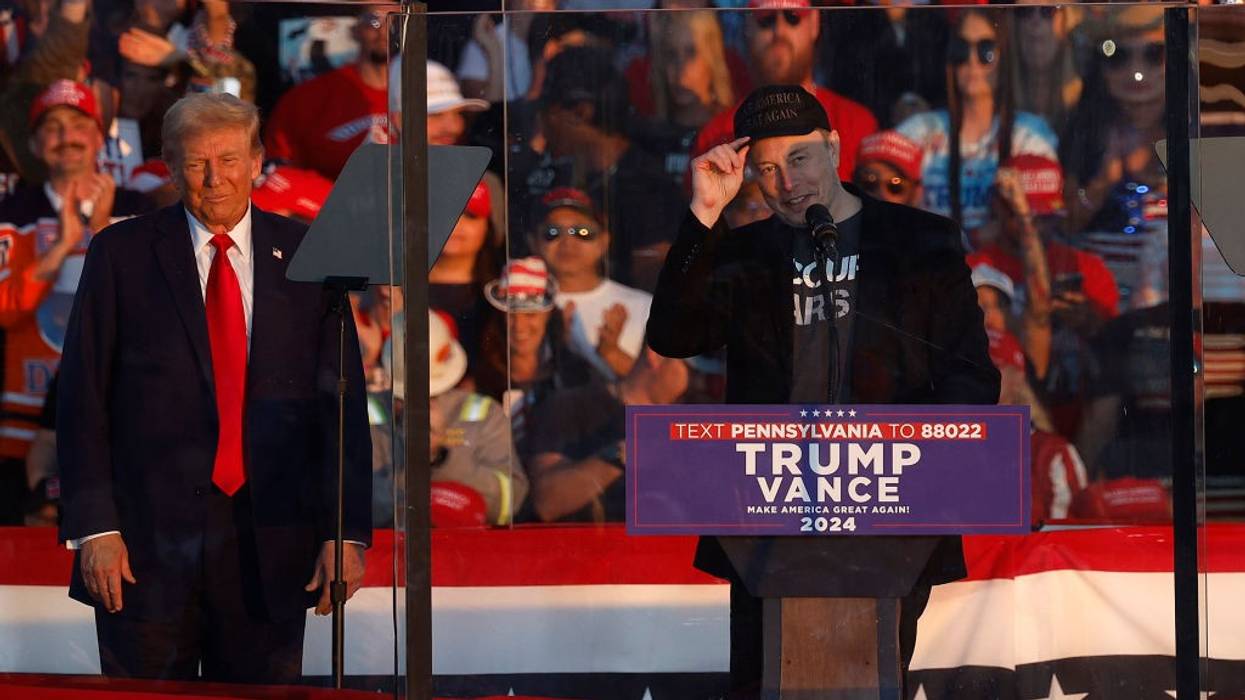
"Given the sheer frequency of Elon Musk's posting of disinformation and partisan rhetoric, it is almost inevitable that he will be one of the top spreaders of election-related disinformation in this cycle," one expert said.
Since richest-man-alive and X-owner Elon Musk endorsed former Donald Trump for president in July, he has emerged as the No. 1. financial backer of Republican candidate's campaign. But his support hasn't only come in outright donations. His tweets in support of the former president, according to a new analysis, are worth a total of $24 million.
In a report published Monday, the Center for Countering Digital Hate (CCDH) found that Musk's political posts between July 13 and October 25 received over twice as many views as U.S. "political campaigning ads" run on X during that time. If any of those advertisers had wanted to reach the same number of people as Musk, they would have had to pay $24 million.
"X has long dropped its pretense to be anything but a loudspeaker for its owner's opinions, personal vendettas, and conspiracies," CCDH wrote on the platform as it shared the report.
Since he endorsed Trump, Musk made a total of 746 posts that mentioned key terms such as "Donald Trump," "Kamala Harris," "voting," or "ballots." These posts were viewed a total of 17.1 billion times compared with 7.7 billion times for all paid political ads.
What's more, at least 87 of Musk's election-themed posts between January 1 and October 23 contained "false or misleading about the presidential election."
These were seen 2 billion times, and none of them was appended by a "community note," a mechanism by which X users can fact-check or provide context to inaccurate posts.
CCDH pointed to two main genres of misleading tweet shared by Musk: those claiming that the Democratic Party was importing immigrant voters and those claiming that U.S. voting systems are not reliable.
For example, on September 18, Musk wrote: "The Dem administrative state is flying millions of future voters directly into swing states. They are being sent to cities and towns throughout Ohio, Pennsylvania, Wisconsin, and Arizona. Given that this is a sure path to permanent one-party rule, it is a very smart strategy."
Musk made more than 66 posts along these lines that were seen nearly 1.3 billion times.
Fact-checkers say these claims are false because it takes years for an immigrant to become a U.S. citizen and to be able to vote, and there would be no guarantee that such a person would vote for the Democrats. Existing laws already penalize noncitizens who vote with either deportation or incarceration.
In an example of the second category of lie, Musk wrote on September 4 that "not requiring ID, combined with mail in voting, makes it completely impossible to prove fraud (obviously)."
Musk has made 19 of these types of posts targeting either mail-in or electronic voting, which were viewed almost 532 million times. However, research has shown that voter fraud related to either mail-in voting or drop boxes is exceedingly rare. A full 36 states mandate that voters show an ID before voting, while 14 others have other ways of confirming identity, such as checking a signature against one on file. In all states, voter fraud is against the law.
"Given the sheer frequency of Elon Musk's posting of disinformation and partisan rhetoric, it is almost inevitable that he will be one of the top spreaders of election-related disinformation in this cycle," CCDH founder Imran Ahmed told CNN.
"He is using the platform to persuade people that elections are rigged," Ahmed continued, adding "it is such a tragic waste of a phenomenally powerful tool."
"The time of big online platforms behaving like they are 'too big to care' has come to an end," one official said.
The European Commission on Monday announced that it was opening an investigation into X, the social media platform formerly known as Twitter that was purchased by billionaire Elon Musk a little more than one year ago.
The investigation marks the first under the European Union's Digital Services Act (DSA), which requires large platforms to limit illegal posts and protect public security, as Reuters reported. It is also possibly the biggest regulatory action against X so far, according to The New York Times.
"Today's opening of formal proceedings against X makes it clear that, with the DSA, the time of big online platforms behaving like they are 'too big to care' has come to an end," E.U. Commissioner for Internal Market Thierry Breton said in a statement. "We now have clear rules, ex ante obligations, strong oversight, speedy enforcement, and deterrent sanctions and we will make full use of our toolbox to protect our citizens and democracies."
"We are delighted that new regulators are flexing their powers to hold social media companies to account."
Since acquiring Twitter in 2022, Musk has been widely criticized for his management of the site, in particular for weakening policies aimed at moderating content and limiting the spread of false information. The site's advertising revenue fell by 60% from August 2022 to August 2023, as Reuters reported. And the platform hemorrhaged even more ad revenue last month after Musk expressed support for an antisemitic conspiracy theory, according to The New York Times.
In a post on Monday, Breton said he was investigating X for "suspected breach of obligations to counter illegal content and disinformation, suspected breach of transparency obligations, and suspected deceptive design of user interface."
In particular, the investigation will consider the process by which X takes down illegal content flagged by E.U. authorities, the effectiveness of its community notes system for countering disinformation, whether the switch in meaning of the blue checkmark—from verified to paid user—is a "deceptive design," and whether it has complied with E.U. language requirements, The Guardian reported. For example, there are reports X only employs one content moderator to cover the Netherlands.
The announcement comes after Breton sent a letter to X, Meta, TikTok, and Alphabet reminding them that they were required under the DSA to limit harmful and illegal content in the wake of Hamas' October 7 attack on Israel, according to Reuters.
Musk responded to Breton on X, challenging him to publicize any violations in the name of transparency.
"You are well aware of your users'—and authorities'—reports on fake content and glorification of violence," Breton replied. "Up to you to demonstrate that you walk the talk."
Responding to the news of the investigation, X said it "remains committed to complying with the Digital Services Act and is cooperating with the regulatory process. It is important that this process remains free of political influence and follows the law."
"X is focused on creating a safe and inclusive environment for all users on our platform, while protecting freedom of expression, and we will continue to work tirelessly towards this goal," the company statement continued.
Imran Ahmed, the founder and CEO of the Center for Countering Digital Hate (CCDH), said on X that his organization had provided the E.U. with information and called the investigation "a good first step."
"CCDH has campaigned for many years for meaningful regulation of social media companies, with transparency as a central pillar, and we are delighted that new regulators are flexing their powers to hold social media companies to account," Ahmed continued in a statement.
The E.U. said the investigation would take as long as necessary, according to The Guardian. If found in violation of the DSA, X could be fined 6% of its global income or barred from the E.U.

"Musk is trying to 'shoot the messenger' who highlights the toxic content on his platform rather than deal with the toxic environment he's created."
The internet watchdog Center for Countering Digital Hate hit back at billionaire Elon Musk Tuesday after X—his company formerly known as Twitter—sued the organization over its research into the dissemination of hate speech on the social media platform.
In a complaint filed Monday in the U.S. District Court for Northern California in San Francisco, X accused the Center for Countering Digital Hate (CCDH)—a nonprofit with offices in the U.S. and United Kingdom—of "using flawed methodologies to advance incorrect, misleading narratives" and engaging in a series of unlawful acts designed to improperly gain access to protected X Corp. data" after the group published research critical of the social platform's failure to tackle hate speech.
One CCDH analysis found that X failed to remove 99% of hate speech posted by Twitter Blue users, who pay an $8 monthly subscription fee.
"Elon Musk's latest legal move is straight out of the authoritarian playbook—he is now showing he will stop at nothing to silence anyone who criticizes him for his own decisions and actions," CCDH founder and CEO Imran Ahmed said in response to X's lawsuit.
"The Center for Countering Digital Hate's research shows that hate and disinformation is spreading like wildfire on the platform under Musk's ownership and this lawsuit is a direct attempt to silence those efforts," Ahmed continued. "People don't want to see or be associated with hate, antisemitism, and the dangerous content that we all see proliferating on X."
"Musk is trying to 'shoot the messenger' who highlights the toxic content on his platform rather than deal with the toxic environment he's created," he added. "CCDH has no intention of stopping our independent research—Musk will not bully us into silence."
Since purchasing Twitter for $44 billion last year, Musk has laid off around 80% of the company's workforce, including many content moderators. Last December, the company dissolved its Trust and Safety Council, an independent advisory board of around 100 human and civil rights experts.
Meanwhile, Musk—who describes himself as a "free speech absolutist" even as he allegedly purges left-wing users—has welcomed or reinstated the accounts of white supremacists, anti-LGBTQ+ bigots, election conspiracy theorists, antisemites, and others.
"This is an unprecedented escalation by a social media company against independent researchers. Musk has just declared open war," Ahmed told The Associated Press on Sunday. "If Musk succeeds in silencing us other researchers will be next in line."
The magnate positions himself as a champion of free and open debate while taking extraordinary efforts to silence any honest criticism and independent research that might negatively impact him or his businesses.
In Elon Musk’s mind he’s absolutely a free-speech absolutist. He’ll absolutely defend your right to speak out, as long as you don’t criticize him. If you do... well... then you’re out of luck.
To no one is this more evident right now than the good people at the Center for Countering Digital Hate (CCDH). The nonprofit organization investigates the spread of hate speech across social media, and has devoted much of its recent research to Musk’s many failures since taking over Twitter last fall.
In return for its work, CCDH is now on the receiving end of a lawsuit filed by X Corp., the company that until recently was known as Twitter, claiming that the organization “engaged in a series of unlawful acts” when researching the platform.
“Twitter has made a series of escalating and ever-more-bizarre moves to try to silence or intimidate CCDH. Starting [with] Musk calling the organization ‘evil’ and its CEO a ‘rat,’ then by his office cold-calling the chair of the CCDH Board.”
The lawsuit is just the latest Musk assault on free expression. “Twitter has made a series of escalating and ever-more-bizarre moves to try to silence or intimidate CCDH. Starting [with] Musk calling the organization ‘evil’ and its CEO a ‘rat,’ then by his office cold-calling the chair of the CCDH Board,” a CCDH spokesperson wrote several allies in an email. “Musk’s billionaire bully-boy tactics to try to shut down his critics couldn’t be more at odds with his purported commitment to open and transparent debate.”
These attempts to silence his critics are not surprising to anyone who’s followed Musk’s erratic behavior. The magnate positions himself as a champion of free and open debate while taking extraordinary efforts to silence any honest criticism and independent research that might negatively impact Musk and his many businesses.
Musk has targeted CCDH for exposing how hate and disinformation have mushroomed on Twitter since he took over in late October. That he still considers himself a free-speech absolutist is stunning given his past efforts to silence anyone who questions his motives or criticizes his businesses.
Musk’s taste for shutting down dissenting voices predates CCDH and even his takeover of Twitter. Here’s the history:
As Musk began rolling out sales of Tesla in China in 2021, he and company colleagues became unnerved by a number of consumers who had taken to Chinese social media to complain about issues with the company’s malfunctioning electric cars. Rather than fix the problems, Tesla called on the Chinese government to use its censorship powers to block its critics online.
By the end of the year, the company filed defamation claims against at least two Chinese citizens who raised concerns about the safety and quality of its vehicles, according to Bloomberg.
A Tesla employee was fired in 2022 after he posted critical video reviews of Tesla’s autopilot system, including an instance where he had to disengage the function and take control of the car to avoid a possible crash.
Other employees claimed they were fired for reporting racist harassment at several Tesla plants. When one brought his complaints to management at the company, he was fired for “not having a positive attitude,” according to The Guardian.
More than his predecessors at Twitter, Elon Musk has gone out of his way to appease repressive regimes seeking to shut down the social-media accounts of their critics. X Corp. has helped India’s Modi government take offline a BBC documentary that criticizes the leadership for inciting religious-based violence against the country’s Muslim population.
Beneath the surface of Musk's free-speech jingoism is a man who is far too willing to defer to repressive regimes. “My preference is to hew close to the laws of countries in which Twitter operates,” he tweeted in 2022 in response to those who called on him to defend dissident voices worldwide. He claimed that his Twitter predecessors took the same approach. Except they didn't: Prior to Musk, Twitter frequently took a stand against governments that attempted to silence dissent, calling on these regimes to respect freedom of expression.
In late 2022, Musk suspended the accounts of several high-profile journalists who covered his businesses. To justify this action, he suddenly changed the company’s policies so that he could also bar the account of a person who had been tracking the whereabouts of Musk’s private jet using publicly available information. Most of the journalists who were suspended, including reporters from CNN, The New York Times, and The Washington Post, were merely writing about this suspension and questioning Musk’s supposed allegiance to free speech.
“Musk already has a long track record of trying to silence people he dislikes or speech that is critical of him,” Free Press’ Nora Benavidez told NPR at the time, noting that the suspension of journalists “endangers the broader public’s ability to know what is happening inside Twitter.”
Just this spring, Musk began suppressing Substack links on Twitter. The newsletter company had earlier announced plans to launch a Twitter-like service called Notes, which allowed people to share short updates to a reverse-timeline feed. The move angered several journalists who were using Substack and Twitter to build large followings for their newsletters and other commentary. (Musk had previously—but temporarily—blocked Twitter users’ ability to link to Mastodon, another competitor.)
“Musk’s attack on Substack is part of [a] pattern, since he bought Twitter in October, to suppress content on an essentially ad hoc basis—from enabling the Indian government to silence dissent to reinstating white nationalists and haphazardly banning journalists,” wrote The New Republic's Prem Thakker at the time.
***
Right now CCDH is Musk’s target. Next week he’ll pick another, someone else who is brave enough to call the billionaire’s bluff, criticize his alt-right politics, or highlight X Corp.’s many failures.
Musk’s habit of bullying those he disagrees with emboldens his many followers to pile on and harass his critics until they go quiet. The danger is not just that anyone speaking truth to power must put up with the increased abuse, including Musk’s own attacks. Groups like CCDH are forced to play defense to a set of hollow accusations, which distracts from the necessary work of holding people like Musk and companies like X accountable to their users.
The headlines are focused on CCDH; they should instead center on Musk and his attempts to turn a popular social-media platform into a weapon he can wield against his foes and anyone who doesn’t follow his reactionary agenda.
The only thing absolute about Elon is his refusal to give a fair hearing to any of his critics. And that’s absolutely not free-speech absolutism.

"Google is a willing participant and supporter of the fake clinic industry, profiting from—and even subsidizing—the anti-choice lobby's campaigns," says a new report.
In its latest report on crisis pregnancy centers' (CPCs) use of internet search engines to promote their anti-abortion services, the Center for Countering Digital Hate (CCDH) found that the anti-choice movement has spent $10.2 million on Google search ads in the last two years.
Over that time period, anti-abortion groups have spent four times as much on boosting deceptive clinics as they've spent on ads related to "their constitutionally-protected right to campaign to restrict abortion care," said CCDH, suggesting that these groups are relying heavily on misinformation to promote their cause.
CPCs are facilities that are often affiliated with national ideological groups that aim to ban abortion care. They purport to offer unbiased mental and reproductive healthcare to pregnant people but, unlike genuine healthcare facilities, are unregulated and have no legal obligation to provide accurate information.
"Staff at fake clinics have been found to impede access to comprehensive, ethical care by using deception, emotional manipulation, delay tactics, and disinformation," in order to stop clients from obtaining abortion care, the CCDH report says.
Hundreds of thousands of people per month seek information about abortion care using Google's search engine, but CCDH found that even after Google said nearly two years ago that it would ban ads from fake clinics that advertise an unproven and dangerous method of "reversing" the effects of abortion pills—as many CPCs do—it is still selling ad space to such facilities.
Since Google pledged to crack down on false advertising by CPCs, "fake clinics have targeted more than 15,000 different queries related to abortion, including 'abortion pill,' 'abortion clinic,' 'abortion clinic near me,' and 'planned parenthood,'" reads the report, titled Profiting From Deceit
"Google is betraying the trust of hundreds of thousands of Americans seeking reproductive healthcare and services," said Imran Ahmed, CEO of CCDH. "Instead of providing accurate results to people who search for 'abortion clinics near me,' Google is directing them straight towards those who wish only to delay and prevent their care using deceptive practices."
More than 70% of the fake clinics that have advertised on Google's search results pages in the last two years use deceptive tactics, including claiming to clients that abortion care is linked to diseases including cancer. Thirty-eight percent do not carry disclaimers on their homepage making it clear that they do not provide abortion care.
Forty percent of the clinics advertising on Google continue to promote abortion pill "reversal" despite Google's pledge two years ago. Proponents of the method claim that a pregnant person can reverse the effects of medication abortion—a two-pill regimen—by ingesting high doses of progesterone after taking the first pill and then forgoing the second pill.
The American College of Obstetricians and Gynecologists says abortion pill "reversal" is "not based on science," and a 2019 study on the method was halted after several participants were hospitalized for "dangerous hemorrhaging," CCDH found.
"Despite pledging to ban advertisements of this unproven and unsafe 'treatment,'" said the group, "Google has since taken $2.6 million in search ad revenue from such fake clinic websites that promote it."
The Women's Equality Party in the United Kingdom said CCDH's new findings show that Google is permitting "deceptive and cruel" groups to target vulnerable people.
In addition to allowing CPCs advertise their services on their search results pages, Google has given an anti-choice marketing firm access to its Ad Grant program, which offers nonprofit groups up to $10,000 per month in free ad credits.
"Google is a willing participant and supporter of the fake clinic industry, profiting from—and even subsidizing—the anti-choice lobby's campaigns," said CCDH. "It is the linchpin of a multi-million dollar fake clinic industry that works around the clock to deprive Americans of medical assistance by deceptive means."
CCDH called on Google to enforce transparency rules for fake clinic by demanding that they make clear on their homepages that they do not provide abortion care and ending Ad Grants for deceptive CPCs.
The group also said the company should "highlight and prioritize genuine abortion clinics in search results" and that lawmakers must empower the Federal Trade Commission (FTC) to prosecute those who use false advertising to promote anti-abortion facilities. While the FTC has established "truth in advertising" rules, "anti-abortion organizations are often unregulated facilities which don't need to adhere to key principles of patient care," said CCDH.
"Google and the anti-choice movement must not be allowed to continue to betray Americans seeking reproductive healthcare advice and services," said Ahmed. "The first step is to dismantle the vast, powerful digital advertising architecture that has been so effectively weaponized to deprive them of their rights."

Unless Linda Yaccarino has the authority to reverse Musk’s many harmful policy decisions and reinvest in content moderation and enforcement, the social-media platform is headed for insolvency.
Twitter’s new boss has inherited a company in a tailspin—and unless Linda Yaccarino takes up advice Elon Musk has ignored, the social-media platform is destined to crash and burn.
According to reporting Monday by The New York Times, Twitter’s U.S. advertising revenue is down 59% from a year ago.
These are just the latest sinking business numbers for Twitter since Musk assumed control of the company in October 2022. And they came on the day Yaccarino is reportedly due to start work as the new CEO of the besieged social-media company.
Musk has decided to ignore an elemental truth: To grow healthy and profitable online communities, you need effective content moderation.
Twitter’s latest round of bad news recalls a meeting that Free Press and other racial-justice and digital-rights groups held during the first week of Elon Musk’s disastrous run as CEO.
We sat down with the new-media boss to gauge his commitment to community standards, election integrity, and content moderation. We urged Musk to retain and actually enforce existing content-moderation rules if he wanted advertisers to continue to spend money on Twitter.
He initially seemed to agree with us, but quickly reversed course, laying off many of those on the company’s trust and safety team in charge of this important work.
Musk then granted a “general amnesty” to legions of neo-Nazis, conspiracy theorists, and anti-vaccine trolls, reinstating thousands of previously banned accounts. He also gutted long-standing content-moderation rules and stopped enforcing Twitter’s ban on Covid-19 disinformation.
By then advertisers were leaving the platform in droves. Musk’s Twitter purchase saddled the company with $13 billion in loans, and his refusal to seriously consider content moderation and brand safety ensured that Musk wouldn’t have the revenue needed to pay off these debts.
Those who loaned him the money were banking on a “small chance that Elon is some sort of genius and can turn around an operational and financial situation that looks increasingly doomed,” William Cohan of Puck wrote at the time. But Musk’s erratic behavior has dashed those hopes.
A mistake-riddled attempt to recoup this lost revenue by selling Twitter Blue subscriptions hasn’t won over even 1% of the platform’s users, according to Bloomberg. The company is now worth only a fraction of the $44-billion sum Musk paid for it.
Recent research by the Center for Countering Digital Hate (CCDH) underscores the point we were making to Musk during our early November meeting: Allowing Twitter to become a hate-trolling hellscape has imperiled the company’s remaining business prospects.
According to a CCDH sampling, Twitter has failed to remove 99% of hate speech posted by Twitter Blue users. Instead Musk has enabled algorithms that amplify these and other paid accounts over those that don’t pay.
Twitter feels increasingly “unpredictable and chaotic,” Jason Kint of Digital Content Next told the Times. “Advertisers want to run in an environment where they are comfortable and can send a signal about their brand,” he said.
To make matters worse, Musk’s own politics have become increasingly reactionary and strident, so much so that he has started to sound like many of the most vitriolic hate trolls featured in CCDH's latest research.
“A stroll through Musk’s replies on the site reveals the extent to which one of the richest men in the world spends his time replying to far-right influencers and nodding in approval to their racist memes,” Charlie Warzel wrote in The Atlantic.
Musk rushed online to defend racist comic-strip author Scott Adams after he characterized Black people in the United States as a “hate group.” And Musk routinely boosts “anti-woke” influencers, adopting much of their anti-trans and homophobic rhetoric. He’s been binging on right-wing memes to fuel MAGA fears about alleged censorship of conservative voices and to bolster antisemitic claims about a global cabal that controls the media.
A new CEO, regardless of her marketing savvy, will likely do little to save Twitter from the extremist bent of her boss. As my colleague Jessica J. González told CNN: “Musk is setting Yaccarino up to fail—as long as he continues to make the platform toxic, it will be impossible to lure back advertisers and users.”
A CEO reshuffle won’t be enough—unless Yaccarino has the authority to reverse Musk’s many harmful policy decisions and reinvest in content moderation and enforcement. So far, Musk hasn’t given any indication that he’ll allow someone else to fix his long string of business screw-ups.
Musk has decided to ignore an elemental truth: To grow healthy and profitable online communities, you need effective content moderation. If Twitter becomes insolvent—which seems more likely by the day—it’ll be because he lacks this basic business sense about social media.
His decision to dismiss this advice offered by a small group of advocates during his first week on the job set Twitter on a path to ruin that today seems inevitable.

"Should Meta throw open the doors of these worlds to minors rather than pause to protect them, you would, yet again, demonstrate your company to be untrustworthy when it comes to safeguarding young people's best interests," a coalition told CEO Mark Zuckerberg.
On the heels of a study showing that minors who use Facebook's virtual reality platform known as the "Metaverse" have routinely been exposed to harassment and abuse, a coalition of more than 70 children's health experts and advocacy groups on Friday called on its parent company Meta to scrap plans to officially open up the digital world to children as young as 13.
A letter signed by groups including Fairplay and the Center for Countering Digital Hate (CCDH) warns that insufficient research has been done on the effects of spending time on platforms like Facebook's "Horizon Worlds"—but notes the research that has been done shows clear risks.
The platform is currently open to users aged 18 and up, but CCDH published a study in March after showing that out of 100 recorded visits to Horizon Worlds, minors were present in 66 of them. Facebook plans to permit 13-17 year olds to use the platform,
Since introducing the Metaverse last year, the company's stock price has dropped more than 70%, and Facebook has conducted two rounds of mass layoffs in the past six months, with more expected.
Josh Golin, executive director of Fairplay, accused Facebook CEO Mark Zuckerberg of expanding the platform to children in order to boost the company.
"It's beyond appalling that Mark Zuckerberg wants to save his failing Horizons World platform by targeting teens," said Golin. "Already, children are being exposed to homophobia, racism, sexism, and other reprehensible content on Horizon Worlds."
CCDH's study identified 19 recordings in which minors were harassed by adult users, including "sexually explicit harassment, racist abuse, and misogyny."
A minor using a Black avatar was told, "You're Black, you're sentenced to death, get out of here" in a virtual courtroom in Horizon Worlds, and "minors were on the receiving end of sexually explicit insults" in at least four of the documented instances.
"Meta must wait for more peer-reviewed research on the potential risks of the Metaverse to be certain that children and teens would be safe," wrote the signatories, including former U.S. House Majority Leader Richard Gephardt, now at the Council for Responsible Social Media, and social psychologist Jonathan Haidt.
In addition to being exposed to harassment and explicit content, the advocates warned in the letter, children's access to Horizons World "magnifie[s] risks to privacy through the collection of biomarkers."
"Before it considers opening its Horizon Worlds metaverse operation to teens, it should first commit to fully exploring the potential consequences," Center for Digital Democracy deputy director Katharina Kopp said of Facebook. "That includes engaging in an independent and research-based effort addressing the impact of virtual experiences on young people's mental and physical well-being, privacy, safety, and potential exposure to hate and other harmful content. It should also ensure that minors don't face forms of discrimination in the virtual world, which tends to perpetuate and exacerbate 'real life' inequities."
The company is planning to welcome minors into Horizons World a year-and-a-half after former Facebook data scientist Frances Haugen testified that the company's products "harm children."
In addition to raising other concerns about the social media platform, Haugen pointed to studies showing that 13.5% of teen girls in the United Kingdom felt that Instagram—which Meta owns—contributed to suicidal thoughts, and that 17% of teen girls said their eating disorders got worse after they began using Instagram.
"Should Meta throw open the doors of these worlds to minors rather than pause to protect them, you would, yet again, demonstrate your company to be untrustworthy when it comes to safeguarding young people's best interests," the coalition told Zuckerberg in their letter Friday.